Debt collection software for banks is sold as one category and bought as four different decisions: whether to keep running a dialer alongside a spreadsheet of counts, to buy a collections system that holds the account and the workflow, to place accounts with outside agencies, or to put a planning layer over the systems already in place. Each buys a genuinely different thing, and the honest comparison is not a feature grid — it is a list of what each one leaves undone and who ends up doing it. Botminds' Collections Contact Strategy is the fourth kind: it counts every contact per debt from the dialer, branch call logs, the text and email platforms, the letters vendor, the outside agencies and the account and payment records, applies the limits that bind you, and builds each collector's day inside them. This guide sets the four approaches against the same requirements, then prices them on hours, commission and the cost of proof. No product other than our own is named, because a comparison of approaches survives a market that changes every year and a comparison of products does not.
Figures drawn from the solution are fictional sample data from it as it runs; cost arithmetic is ours and its inputs are named; research figures are the regulators' and are linked where they appear.
What debt collection software for banks has to do
Start from the work rather than the category. A past-due book generates one question per account per day: should this account be contacted today, on which channel, at which hour, and by whom. Answering it correctly requires four things a bank cannot opt out of. A complete count of contacts per debt, from every team and every agency, because the limits are counted per debt and not per system. A current rulebook: the federal presumption, the state and city limits that apply to your borrowers, each borrower's opt-outs and stated inconvenient times, and your own policy. An ordering: which accounts, in which hour, within a collector's capacity. And a record of all three that survives the people who made it.
The context is a book that does not shrink. The New York Fed's household debt report for the second quarter of 2026 puts 4.7% of outstanding household debt in some stage of delinquency and the share of consumers with a third-party collection account on their credit report at 4.9%, both roughly steady (NY Fed, Household Debt and Credit, 2026 Q2). Delinquency is not a spike to be staffed for and then forgotten; it is a standing population, which is what makes the cost of the way you work it compound.
The scale the decision is made at
4.7%
of outstanding household debt in some stage of delinquency at the end of June 2026
NY Fed, Household Debt and Credit
4.9%
of consumers with a third-party collection account on their credit report, largely steady
NY Fed, Household Debt and Credit
1,904
contacts in the last seven days on one sample team’s book, read from six different sources
demo · sample data
Four ways to run a contact plan, and what each one buys
The table below sets the four approaches against ten requirements. The scoring is ours and describes the typical shape of each approach rather than any particular product; a specific system may do better or worse on any line, which is exactly the thing to test in a trial.
Ten requirements, four ways of meeting them
| Requirement | Dialer + spreadsheet | Collections system | Agency placement | Planning layer |
|---|---|---|---|---|
| Count contacts per debt across every team | By hand, and wrong by mid-morning | Within the system; blind to contacts made outside it | Only the agency’s own | Yes, from every feed it is given |
| See branch and agency contacts | Only if someone types them in | Usually by file import, on a lag | Not applicable | Yes, as feeds, counted on arrival |
| Apply state and city limits | In a collector’s head | Configurable rules, maintained by the vendor or by you | The agency’s obligation, your exposure | Yes, as rules a compliance team edits |
| Judge the borrower’s local hours | Area code, usually | Area code, sometimes address | The agency’s practice | Both, with the stricter reading applied |
| Honour opt-outs across channels | Per channel, per system | Within the system | Separately held | One view per account, across channels |
| Re-plan when a count changes | The lead rebuilds the list | On the next batch | Not applicable | Immediately, filling the freed slot |
| Evidence a single contact a year later | Three systems and a memory | Workflow history, if retained | Request it from the agency | One entry with its rule and source record |
| Approve a strategy change on evidence | A meeting | Reporting, rarely a control group | The agency’s own strategy | A held-back control group and four numbers |
| Price | Cheapest licence, dearest hours | Large licence and a project | Commission on what is recovered | A layer price over systems you keep |
| Who owns the conduct risk | You | You | You, jointly, whoever dialled | You |
The dialer and the spreadsheet: what the log cannot see
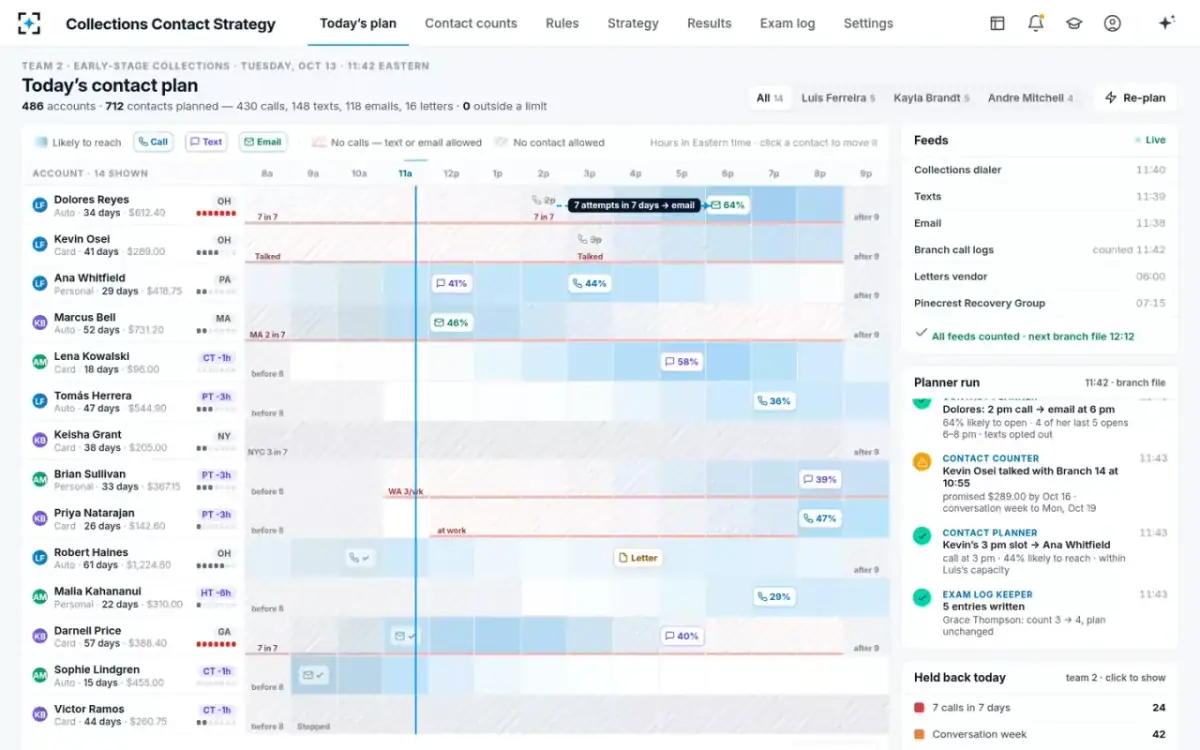
The default arrangement on many floors is a predictive or preview dialer plus a spreadsheet of counts maintained by a team lead. It is cheap in licence terms and it works until the count has to include somebody else's calls. The dialer's own log is a complete record of what the dialer did and nothing else, which means a branch loan officer's call about a past-due payment, a call from the payment-reminder line and an outside agency's attempts are all invisible to it. By mid-morning the spreadsheet is wrong in a direction that matters: it shows room for a call that the rules no longer allow.
The second weakness is that a spreadsheet count cannot be re-planned. When a new contact lands, the arithmetic changes for a handful of accounts, and the correct response is to withdraw the contacts that are no longer allowed and give the freed capacity to the next best account. Doing that by hand, several times a day, is the work that eats a team lead's morning — and the work nobody does on a busy day, which is when the eighth call happens.
A contact file from outside the dialer, counted on arrival
A collections system: one record, and the limits of a rules engine
A collections system holds the past-due account, its workflow and its history in one place, and for a bank that has grown a book across several origination systems that is worth a great deal on its own. What it does not automatically solve is the count, for the same reason the dialer does not: a system knows what happened inside it. Contacts made by branch staff, by a reminder line run elsewhere, or by an agency arrive as imports if they arrive at all, usually overnight, which is a lag measured against a rule counted in days.
The rules engine inside such a system is usually capable, and the practical questions are about ownership and speed. Who writes a new rule when a city adopts a stricter limit — your compliance team, or a vendor change request with a release date? How is the stricter of two overlapping rules chosen? And what does the system do with a borrower's statement, captured in a collector's note, that calling at work is not convenient? The last one separates a rules engine from a rulebook: a limit that exists only as prose in a note field is not applied to tomorrow's plan.
The replacement decision is also a programme decision. Changing the system that holds the account is a long project with a conversion in the middle, and the contact-plan problem is usually urgent on a different timescale. That is the structural reason the fourth approach exists.
Agency placement: the commission, and the risk that does not transfer
Placing accounts with outside agencies converts a fixed cost into a variable one: you pay a share of what is recovered and nothing on what is not. The share is substantial. The Philadelphia Fed working paper on third-party debt collection cites the industry association's benchmarking survey for the rate.
According to the ACA International's 2012 Benchmarking Survey, the median commission rate charged by third-party debt collectors was 26 percent.
Federal Reserve Bank of Philadelphia, Working Paper 18-04 (revised 2018)
That figure is dated and comes from a working paper rather than a peer-reviewed study, so treat it as an order of magnitude rather than a price. At a quarter of recoveries, placement is a serious line in a collections budget, and the arithmetic is simple enough to do on your own numbers before any conversation with a vendor.
Commission at a 26% rate, on one assumed recovery rate
The part that does not convert is the risk. The same working paper argues that creditors use third-party collectors partly to avoid competing on their collection practices, and reports evidence that third-party collectors use harsher practices than original creditors — a finding that should make a bank read its oversight materials rather than relax. Supervisory expectations point the same way: interagency third-party risk guidance asks a banking organisation to determine how it will select, assess and oversee a third party, including monitoring compliance with applicable laws and requiring remediation of compliance issues (Interagency Guidance on Third-Party Relationships, June 2023). The Bureau's own examination procedures ask for the agency contracts and the evidence of overseeing them, monitoring reports and findings included — the second half is the half that is usually missing from a bank's file.
In practical terms, placement moves the dialling and leaves you the count. An agency's calls about a debt you also work still belong to that debt, and a daily contact file from each agency is the only way to keep your own count honest. A bank that places accounts and does not ingest the agency's contacts has not simplified its contact problem; it has made part of it invisible.
A planning layer over what you already run
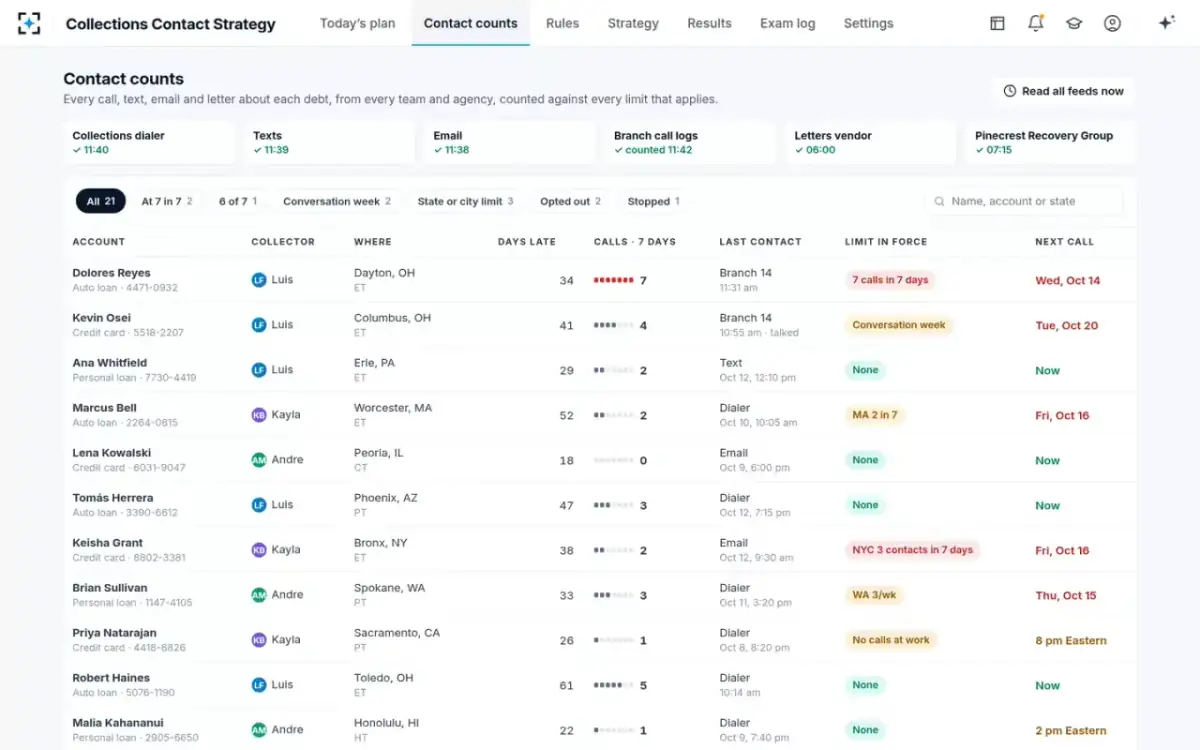
The fourth approach keeps the dialer, the collections system and the agencies and puts one thing above them: the count, the rulebook and the plan. It reads from each source, writes to none of them, and hands each collector an ordered day with the forbidden hours already removed and the reason attached to each one. It is the cheapest of the four to install, because nothing is replaced, and the most dependent on feeds, because a source nobody sends is a source it cannot count.
What it buys is the thing the other three leave undone: one count per debt across every team and agency, one rulebook that a compliance analyst edits directly, and one entry per contact that names the rule and the source record behind it. What it does not buy is an account system, a workflow, a payment engine or a recovery strategy for charged-off paper. A bank that needs those needs a collections system, and can still put a planning layer over it.
One count per debt, from every source that contacted the borrower
How much does collections software cost a bank? Four numbers to price
Licence price is the number buyers compare and the smallest of the four that matter. Price these instead, on your own floor, before you talk to anybody: collector time, the hours spent reconciling counts by hand, agency commission, and the cost of proving what you did. The first three can be arithmetic within an afternoon; the fourth is zero until it is very large.
The cost of running a contact plan, written out
Collector time
collectors × productive hours × hourly wage
For 40 collectors at 1,800 productive hours a year, at the occupation’s 2025 median hourly wage of $22.61, that is about $1.63 million a year before benefits and overheads.
Priced by operations
Reconciling counts by hand
team leads × hours a day × working days × hourly wage
Our estimate for one team is about 4.5 hours a day across rebuilding the order, chasing contacts the dialer cannot see, checking limits, re-planning and answering compliance — falling to well under an hour when the count is kept for them.
Priced by operations
Agency commission
balances placed × recovery rate × commission rate
At $18 million placed, a 12% recovery and the 26% median commission rate, about $562,000 a year. Your own placement data replaces every input.
Priced by the recovery team
The cost of proof
analyst days per examination + remediation
Unpriced here because it is lumpy: a handful of analyst days a year while nothing goes wrong, and a very different number when a call-frequency finding has to be answered across a year of accounts.
Priced by compliance
Two things usually surprise people who do this arithmetic for the first time. The reconciliation line is small per person and large per year: a few hours a day across a handful of team leads is a full post's worth of salary spent producing a number that is wrong by eleven o'clock. And the collector line dominates everything, which means the test of a contact plan is not whether it reduces headcount but whether the same hours produce more promises — the measure worked through in right party contact rate.
The cost of one call over a limit, and who pays it
There is no published price for a single call over a limit, and anyone who quotes one is selling something. What can be said is where the cost actually falls, and it is almost never on the call itself. It falls on the examination: a finding on call frequency is a finding about a system, so the question is never about one account but about how many others look like it, which turns into a look-back across a period, by hand, on records held in several systems. It falls on remediation, which is scoped by the same look-back. And it falls on the complaint, which arrives with your name on it whoever dialled.
That is why the useful internal number is not a fine but a look-back: how many analyst days would it take, today, to answer the question "show me every account contacted more than seven times in seven days in the last year, with the source of each contact". A floor that can answer in an afternoon has bought something real. A floor that estimates three weeks has just priced its own exposure, and should compare that number with the licence it was arguing about.
What to ask for in a trial on your own contact history
A demonstration on a vendor's data proves that the demonstration works. The only trial worth running uses a week of your own contact history, including the sources that usually go missing, and asks four questions whose answers you can check independently.
A one-week trial on your own contact history
- Bring all six kinds of source, not the clean two
Dialer, branch call logs, the reminder line, texts and email, the letters vendor and every agency file. The value of the exercise is entirely in the awkward ones.
- Ask for the count per debt, and check it by hand on twenty accounts
Pick the twenty with the most contacts. A difference is the answer, whichever direction it goes.
- Ask what happened to the records it could not match
There will be some. A queue with the record attached is the right answer; a quiet fuzzy match on a phone number is not.
- Ask it to find the contacts that would have been over a limit
Run it retrospectively over the week and compare with what your floor believed at the time.
- Add one rule in the room
A city limit, or your own stricter policy. Time how long it takes and note who had to be involved.
- Ask for one contact explained end to end
The rule, the source record, the hour chosen, who placed it, and what the log says — for an account you choose, not one they choose.
- Test a borrower statement
Take an account where a collector noted a bad time to call, and see whether tomorrow’s plan respects it.
- Ask what it does when a feed fails
Make one of your files arrive empty. The plan should become more conservative, not carry on as though the week were quiet.
The requirements list, in plain words
If the list above has to become procurement language, keep each line in the form of the question it is really asking, so that a compliant-sounding answer cannot pass. The core is eight lines: count contacts per debt across every team and every agency, with the source of each; apply federal, state, city and lender rules with the stricter reading winning; determine the borrower's local calling window from more than the area code; hold opt-outs and stated inconvenient times as limits across channels; re-plan the day when a count changes; write one entry per contact and per block, naming the rule and the source record, that cannot be edited afterwards; let a named compliance owner add or change a rule without a vendor release; and prove a strategy change against a randomly held-back control group before it reaches the book.
Two lines that are usually added are worth challenging. "Must integrate with our dialer" is weaker than "must count contacts from our dialer, branches, reminder line, letters vendor and agencies, naming the source of each" — integration is a mechanism, counting is the requirement. And "must be configurable" is weaker than "a named owner in our compliance team must be able to add a limit and see every block it causes the next day", which is the thing configurability is supposed to deliver.
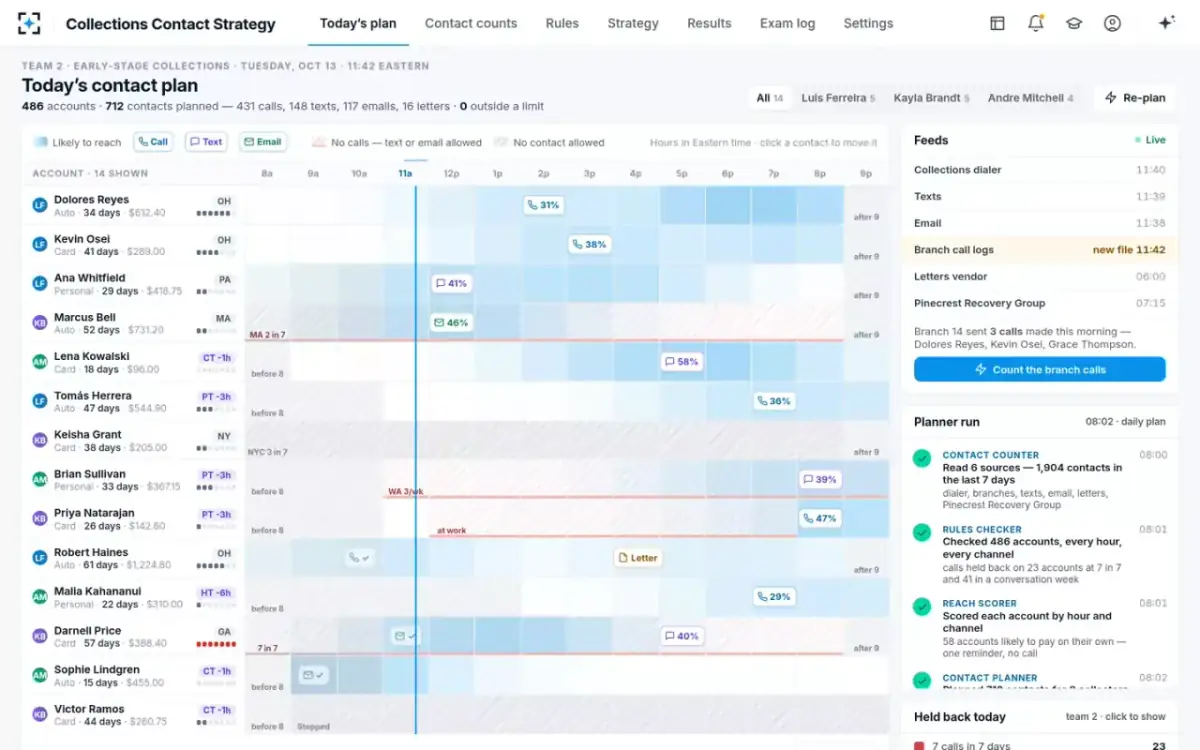
The day the four approaches are really being compared on
One closing caution about the market. Collections technology is sold into a function whose staffing is expected to shrink — the Bureau of Labor Statistics projects employment of bill and account collectors to decline about 10 percent between 2025 and 2035 — and that expectation produces a lot of claims about replacing people. The claim to be sceptical of is not that software helps; it is that software can hold the decisions that carry consequences for a borrower. Which decisions those are is set out in what the agents may and may not do. To see the count, the rulebook and the plan on one book, start from Collections Contact Strategy.
Questions people ask
What does a collections dialer not do?
It does not count contacts it did not make. A dialer's log is complete for the dialer and blind to branch calls, a payment-reminder line, texts and emails sent from another platform, letters and any agency working the same debt — all of which count toward a per-debt limit. It also does not re-plan: when a new contact changes an account's count, the list the dialer is working does not change by itself.
Is it cheaper to place accounts with an agency?
Per dollar recovered it is often cheaper, because commission is paid only on recoveries while a floor is paid whatever happens. At a median commission rate around a quarter of recoveries, the comparison turns on your own recovery rate and on what the accounts would have done in-house. What does not change with the arrangement is who answers for conduct: the contacts are still about your debts, and oversight of the agency is a supervisory expectation in its own right.
Do we need a collections system or a contact strategy layer?
They answer different questions. A collections system holds the account, its workflow and its payments; a contact strategy layer decides who is contacted today, on which channel and at which hour, within the limits. If your account data is scattered across origination systems, the first problem is the system. If your accounts are fine and your count is a spreadsheet, the first problem is the plan, and replacing the system will not fix it soon.
How do you compare collections software without a trial?
You mostly cannot, but you can narrow the field with three documents: the list of sources each product counts contacts from today, named; one worked example of a block showing the rule, the triggering record and the release date; and the procedure for adding a new city limit, with who does it and how long it takes. Products that cannot produce all three on paper will not produce them in a trial either.
What should we keep in-house and what should we outsource?
A common split is to keep early-stage accounts, where the relationship is still worth something and a cure is likely, and to place later-stage accounts where recovery economics dominate. Whatever the split, keep two things in-house: the count, because it has to span both, and the rulebook, because the limits that bind you do not stop at the placement boundary. An agency that cannot send you a daily contact file makes the first of those impossible.
How do we price the cost of one call over a limit?
Not as a fine. Price it as a look-back: how many analyst days it would take to answer, from your records as they stand today, which accounts were contacted more than the limit allows over the last year and from which source each contact came. That number is concrete, is produced by your own staff, and is the thing a finding on one account actually triggers.