A collections strategy is usually described as one manager's list of verbs — segment the book, design the contact strategy, test it, report on it — and that is the wrong shape, because the strategy seat is defined by what it does not decide. A collections floor runs on four distinct decisions: what the strategy is, what today's call order is, what is said on the call, and what the rules allow. The strategy manager owns the first and can be overruled on the fourth. Botminds' Collections Contact Strategy is built around that division: agents count the contacts, apply every limit and rank each day's accounts, and each of the four seats keeps the decision that is actually theirs.
The four people in the examples are fictional sample staff on one early-stage collections team of 486 past-due accounts, with the hours estimated for that team. The headcount and outlook figures are the occupation's, published by the Bureau of Labor Statistics, and they describe a national occupation rather than this team; the two sets of numbers are kept apart throughout.
Four seats on one floor, and what each keeps
Today
Wants more promises to pay rather than more dials, and wants the evidence in hand before changing anything. Spends the week reconciling results she did not produce.
With agents
Decides on tested results — promises per hundred contacts, contacts per promise, complaints and opt-outs — with a control group behind each proposal.
Still theirs: Whether a change becomes the standard, and what the book is segmented into.
Today
Starts the day rebuilding the call order from a spreadsheet of counts that is wrong by ten o’clock, because a branch or an agency called someone it never saw.
With agents
Opens a plan already built, with every closed hour explained and every new contact counted and re-planned as it lands.
Still theirs: Moving a contact, coaching the floor, and the judgement about who is worth a second attempt.
Today
Dials in list order and cannot tell whether the next call is the eighth about that debt.
With agents
Calls who the plan says, when it says; a call over a limit never reaches the list, and each email waits for approval.
Still theirs: The conversation — what is offered, what is agreed, and whether to let it go today.
Today
When an examiner asks why someone was called on day eight, the answer is split between a spreadsheet, the dialer’s own log, and branch and agency files.
With agents
Has every contact and every block with its rule in one place, and signs a monthly pack built from it.
Still theirs: The rulebook, every exception, and the signature at the end of the month.
What does a collections strategy manager do?
The job is to decide how a book of delinquent accounts is worked, and to prove the decision. In practice that is four recurring pieces of work. Segmentation: cutting the book by product, days past due, balance, payment behaviour and likelihood of curing without contact. Strategy design: for each segment, the channel mix, the intensity and the order of the week. Testing: running a challenger against the current approach on a random control group, for long enough that the result means something. And the case for change: taking a tested result to whoever signs for it, with the bad numbers in it as well as the good.
What the role does not own is the day. The call order for Tuesday morning belongs to the team lead, the conversation belongs to the collector, and the rulebook belongs to compliance. A strategy manager who finds herself rebuilding tomorrow's list is doing someone else's job, usually because the list cannot be trusted — which is a tooling problem wearing a staffing problem's clothes.
The four seats, and the one decision each of them owns
Write the four seats as decisions rather than as duties and the overlaps disappear. The strategy manager decides what the plan should optimise. The team lead decides how today's plan survives contact with the day. The collector decides what happens inside the conversation. The compliance analyst decides what the rules permit, and can stop any of the other three. Each has a line it may not cross, and the lines are what make the floor auditable.
One change, travelling across four seats in Collections Contact Strategy
Agent
CountEvery call, text, email and letter is read from the dialer, branches, the reminder line, the letters vendor and outside agencies, and held as a live count per debt.
Never: places, changes or deletes a contact; an unmatched record goes to a person rather than being guessed.
Agent
CheckEvery hour and channel on every account is tested against the federal, state, city and bank rules, and anything forbidden is closed with its rule named.
Never: switches a rule off, or overrides a block.
Agent
Rank and planAccounts are scored for the chance of reaching the borrower by hour and channel, and the day is laid out collector by collector within capacity.
Never: plans a forbidden cell, and never contacts anyone.
A person decides
The team lead adjustsMoves a contact, reorders a collector’s morning, and decides who is worth another attempt today.
Never: moves a contact into an hour a rule has closed — the move is refused, with the rule.
A person decides
The collector callsPlaces every call, holds the conversation, offers what the script allows, and approves each email before it goes.
Never: has to work out whether the call is inside the limit.
A person decides
The compliance analyst rulesOwns the rulebook and its citations, checks any proposed contact against every rule, and signs the monthly pack.
Never: is asked to reconstruct a count after the fact.
A person decides
The strategy manager decidesTakes a four-week challenger result against a random control group and approves it, declines it, or runs it longer.
Never: changes the standard on a result that has not held.
Who decides which accounts get called?
In a well-ordered floor, nobody decides it one account at a time. The strategy manager decides the policy — which segments are worked, with what intensity and on which channels. The plan then applies that policy to today's counts, limits and hours, and produces an order. The team lead decides which parts of that order to change, and lives with the consequence.
The accurate version of the answer is that on many floors the decision is made by whoever last touched the spreadsheet. A list built from a stale count is not a strategy; it is the strategy the data permitted. Giving the decision back to the strategy manager means making the count true at the moment the list is built, and true again when a branch file lands at twenty to twelve.
Decision rights on a collections floor: who decides, who proposes, who is told
Which segments get worked, and in what order
Strategy managerDecides
Team leadIs told
CollectorIs told
Compliance analystIs told
Which channel an account gets today
Strategy managerSets the policy
Team leadMay move one
CollectorProposes on the call
Compliance analystCan forbid
Which hour an account is worked in
Strategy managerSets the policy
Team leadMay move one
CollectorIs told
Compliance analystCan forbid
What is said on the call, and what is offered
Strategy managerApproves the script
Team leadCoaches
CollectorDecides inside it
Compliance analystCan forbid
Which contact rules apply, and how they read
Strategy managerIs told
Team leadIs told
CollectorIs told
Compliance analystDecides
An exception to a rule, for one account
Strategy managerProposes
Team leadProposes
CollectorProposes
Compliance analystDecides
Whether a tested change becomes the standard
Strategy managerDecides
Team leadProposes
CollectorIs told
Compliance analystCan forbid
The strategy manager's week: segments, tests and the case for a change
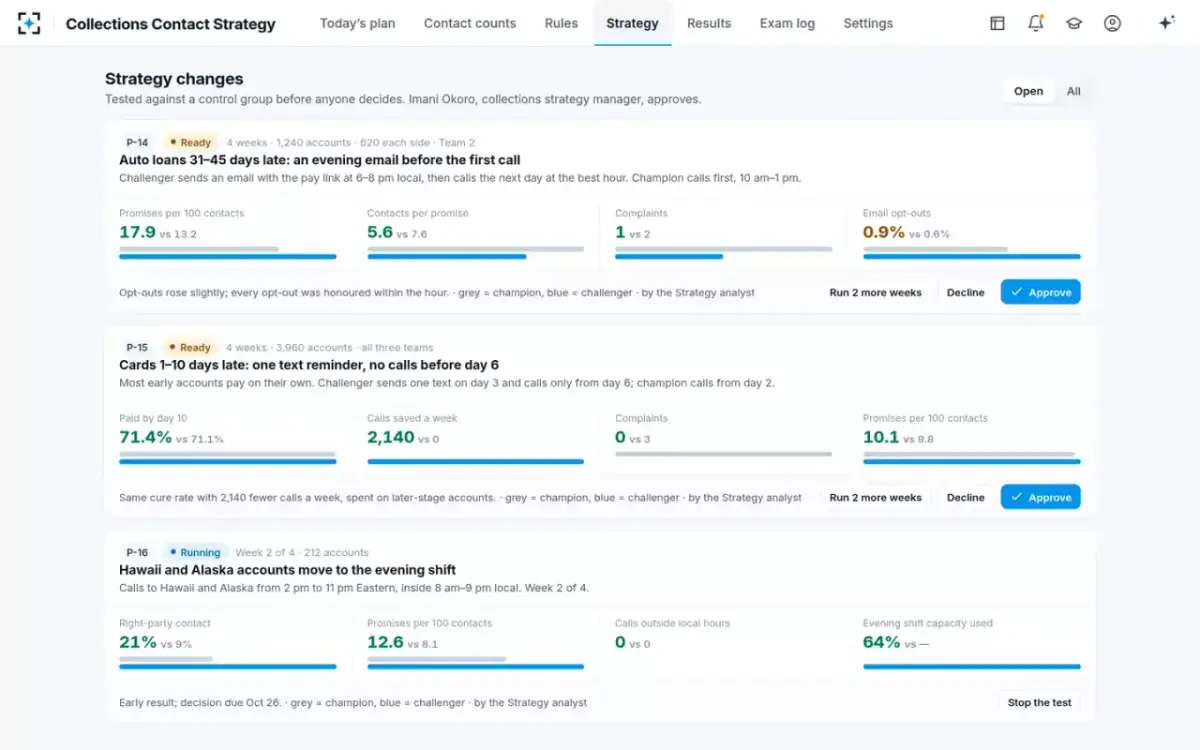
A useful week has one test finishing and one starting. In the sample bank a challenger ran for four weeks on 1,240 auto accounts between 31 and 45 days late: an evening email carrying the pay link before the first call, rather than after it. It returned 17.9 promises per hundred contacts against the champion's 13.2, with one complaint against two — and email opt-outs up from 0.6% to 0.9%, reported rather than buried. The manager's decision is then genuinely three-way: approve, decline, or run it two more weeks because the sample is thin.
The craft of the seat is in the last clause. A result that moves the headline number and quietly raises opt-outs is a worse strategy wearing a better score, and the only defence is to fix the measures before the test runs: promises per hundred contacts, contacts per promise, complaints and opt-outs, all four, every time. How those measures behave, and which of them flatters a floor, is the subject of right party contact rate and what it hides.
A challenger result, laid out for the strategy manager's decision
What a collections team lead does each morning
Traditionally, arithmetic. The lead opens a spreadsheet of contact counts, reconciles it against yesterday's dialer log, works out which accounts are at a limit, rebuilds the call order for each collector, and hands it out. By mid-morning a branch file or an agency file arrives and some of that work is wrong, so part of it is done again. None of this is the job anyone describes in an interview, and all of it is the job.
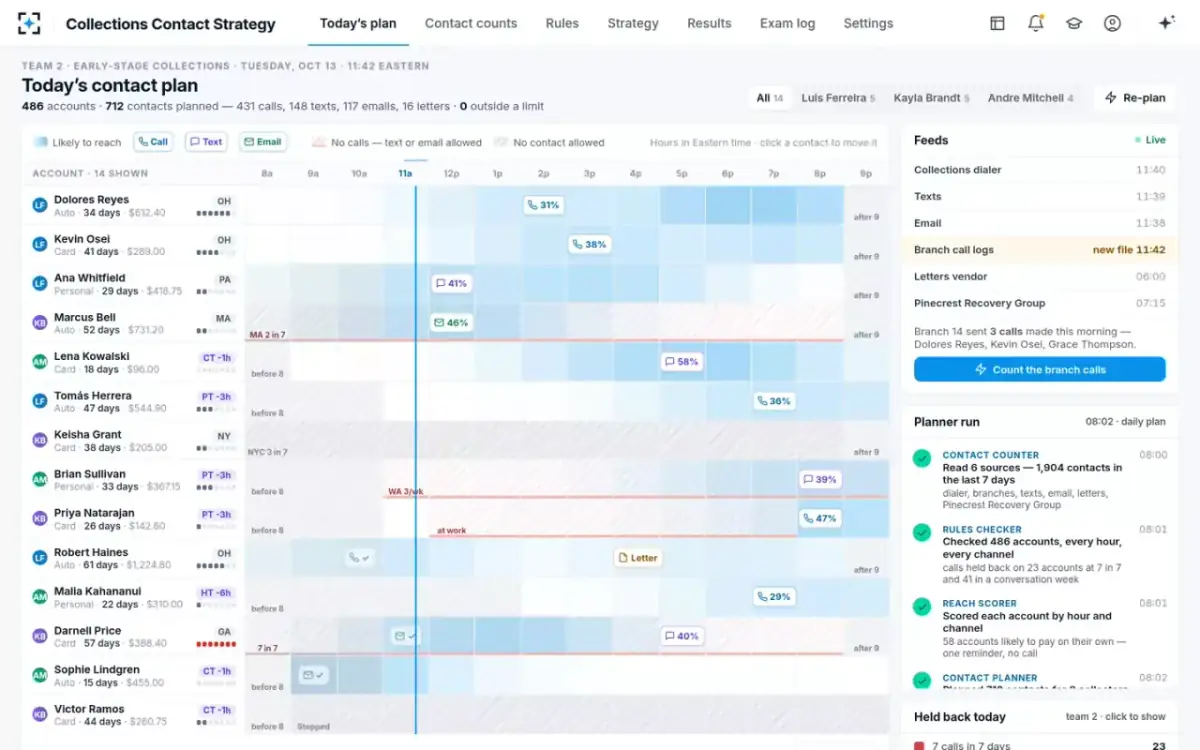
What is left when the count is kept for you is the part that needs a person: deciding who is worth another attempt, moving a contact because a collector knows something the file does not, coaching the conversation that went badly yesterday, and answering the compliance analyst about one specific call. In the sample bank the lead opens a plan that was built before the floor logged in — 712 contacts across 486 accounts for eight collectors, none of them outside a limit — and spends the morning on judgement rather than reconciliation.
The plan a team lead opens in Collections Contact Strategy, built before the floor logs in
The collector's day, task by task
The occupation has a published task list, and it is worth reading because it is both accurate and older than most collections technology. The Department of Labor's occupational profile for bill and account collectors begins: "Locate and notify customers of delinquent accounts by mail, telephone, or personal visits to solicit payment", and lists among the core tasks "Locate and monitor overdue accounts, using computers and a variety of automated systems", "Confer with customers by telephone or in person to determine reasons for overdue payments and to review the terms of sales, service, or credit contracts", and "Record information about financial status of customers and status of collection efforts" (O*NET OnLine, 43-3011.00, updated 2026).
Three of those four are conversation and judgement; one is data entry. A collector's day is bounded by how many of the first three they get to have, and in many operations the binding constraint is not stamina but reachability — the share of dials that find the right person at a moment they can talk. That is why the hour an account is worked in matters more than the number of dials, and why the calling window, by clock and by state is an operational question as much as a legal one.
What does a collections compliance analyst do?
Owns the rulebook, and the evidence. On a contact-strategy floor that means four things: deciding which limits apply to which accounts — federal, state, city and the bank's own; checking a proposed contact before anyone dials and getting a trace rather than a verdict; investigating the single call an examiner or a complaint asks about; and signing the monthly pack that says what the floor did. It is the only one of the four seats that can stop the other three.
The examination manual adds a duty most descriptions of the seat miss: watching incentives. Examiners are told, where "the entity's compensation program creates incentives for behaviors or practices that result in heightened risk to consumers", to determine whether the policy "also includes disciplinary procedures such as reductions in compensation or termination" (CFPB, Debt Collection Examination Procedures, March 2022). A bonus plan paid on dials is a contact-strategy decision made by the compensation committee, and the compliance analyst is the person expected to notice.
Where the hours actually go, seat by seat
The hours a collections desk loses are not spent on borrowers. They are spent reconciling counts that nobody is paid to reconcile — and because the work is invisible, it rarely appears in the business case for fixing it.
A team lead's day by kind of work, before and after a plan that keeps the count
Before: 4 hours 30 minutes a day on the count and the order
- Rebuilding the call order · 33%
- Chasing calls the dialer cannot see · 22%
- Checking local hours and state limits · 17%
- Re-planning after a new contact · 17%
- Answering compliance about one call · 11%
After: about 40 minutes a day on the same five things
- Rebuilding the call order · 40%
- Chasing calls the dialer cannot see · 15%
- Checking local hours and state limits · 15%
- Re-planning after a new contact · 15%
- Answering compliance about one call · 15%
Where the collections occupation is going, and what it means for the desk
The occupation underneath the desk is published, and its trend is the backdrop to every seat on this page.
Bill and account collectors, the occupation under the desk
160,200
people employed in the occupation
2025
−10%
projected change in employment, 2025 to 2035 — a decline of 16,700
11,200
openings projected each year on average over the decade
A declining occupation with 11,200 openings a year is a specific kind of labour market: fewer seats, filled often, with experience concentrating in the people who stay. For a lender designing the desk it argues for the same thing the decision-rights grid does — define each seat by the judgement it exercises, because the mechanical half of the work is the half that is leaving, and the seats that hold the judgement are the ones least exposed to it.
What changes when the count is kept for you
Three things, and none of them is a headcount. The strategy manager gets a result she did not have to assemble, so the argument at the decision meeting is about the strategy rather than about the data. The team lead gets back most of four and a half hours, and spends them on the accounts that need a human read. The compliance analyst stops reconstructing and starts signing.
There is a structural reason this lands on a lender's own floor before it lands on an agency's. A working paper from the Federal Reserve Bank of Philadelphia suggests it is possible that "many original creditors enjoy an absolute technological advantage over most collections firms", because "large lenders enjoy the scale necessary to invest in sophisticated computers and models, which may be prohibitively expensive for most collections firms" (Fedaseyeu and Hunt, FRB Philadelphia Working Paper 18-04, revised October 2018 — a working paper, not peer reviewed). The seat that benefits first from a better count is the in-house one, which is also the seat whose legal position is least settled: which call limits bind your own team is worth reading before the policy is written.
How to write each seat's mandate so the decision rights are clear
Four rules. State the decision the seat owns in the first line, before the duties — "owns the contact strategy for the consumer book, and the decision whether a tested change becomes the standard" beats a paragraph of verbs. Name what the seat may not do, because that is where the friction with the next seat lives. Say which measures the seat is judged on, all of them, including the ones that get worse when the others improve. And say what the seat is given: a maintained count, or a spreadsheet and a Monday morning.
The fourth rule decides whether the seat works at all. A strategy seat whose data has to be assembled by hand is a reporting job with a strategy title. To see the plan, the blocks and the test results on your own accounts, start from Collections Contact Strategy.
Questions people ask
What skills does a collections strategy manager need?
Segmentation and basic experimental design — control groups, sample size, how long a result has to hold — plus enough regulatory literacy to know which limits bind which accounts, and enough operational credibility to be believed by a floor. The skill that separates good from adequate is reporting the measure that got worse.
What is the difference between a strategy manager and a team lead in collections?
Time horizon and decision. The strategy manager decides what should be optimised over weeks and proves it with a test; the team lead decides how today survives, moves contacts and coaches the floor. One owns the policy, the other owns the day, and confusing them leaves both jobs half done.
How many collectors does a team lead run?
It varies with product and delinquency stage; the sample team on this page is eight collectors working 486 accounts in early-stage delinquency. The binding constraint is usually not span of control but how much of the lead's day is spent on arithmetic — a lead who starts the morning with a working plan can carry a larger team than one who starts with a spreadsheet.
Which collections seats are most exposed to automation?
The entry-level floor. The occupation itself is projected to decline 10 percent between 2025 and 2035, with about 11,200 openings a year as people leave. The analytical and compliance seats above it are less exposed to that trend: deciding what the strategy is, and proving the rules were kept, is work that more rulebooks add to rather than remove.
Does a collections strategy manager need to know the regulations?
Enough to know which decisions are not theirs. A strategy that assumes seven calls a week is available on every account is wrong in Massachusetts, wrong in New York City and wrong on any account where the borrower has spoken this week. The analyst owns the rulebook; the manager has to design inside it.
What should a collections strategy manager be measured on?
Promises to pay per hundred contacts and contacts per promise, read together with complaints and opt-outs — four measures, published together, so that a gain bought by annoying borrowers is visible as the trade it is. Dials and raw contact rate are activity measures; they belong on the floor's dashboard, not in the strategy seat's objectives.