CMC Module 3 is the quality module of a drug or biologic application: the chemistry, manufacturing and controls data, laid out in the numbered sections 3.2.S for the drug substance and 3.2.P for the drug product that ICH M4Q(R1) defines. It is hard for a reason that has nothing to do with the science. Counting M4Q(R1)’s own contents page, one substance and one product come to about fifty numbered leaves, each with its own prescribed contents, each written by a different development function from a different set of reports — and a limit written into one leaf has to be met by data in four others and repeated word for word in Module 2.3. Botminds’ CMC Module 3 Authoring drafts each section from the company’s own development reports with every number linked to its page, then puts every limit on one grid and tests it against the batch, stability and process data behind it, so the regulatory CMC lead sees a disagreement before content lock rather than in an information request.
The worked examples below come from the solution’s sample filing: a fictional company, Northwind Bio, filing a BLA for an invented biologic, Veltrimab. The people, batches and documents are invented too. The rules, and every sentence quoted from them, are real and linked where they appear.
One sample filing, three weeks from content lock
45
sections in the sample BLA, each with an author and a named technical reviewer
33
specification limits and critical process parameters on one grid
13 substance, 14 product, 6 process
136
checks run across those 33 rows against the data behind them
2
disagreements found before content lock, each with both sources
What is CMC Module 3?
Module 3 is the quality half of the Common Technical Document, and the only module whose structure is prescribed heading by heading. M4Q(R1) gives it two main parts: 3.2.S, repeated in full for every drug substance in the product, and 3.2.P for the drug product, followed by appendices (3.2.A) and regional information (3.2.R). Module 2.3, the Quality Overall Summary, summarises it; Module 1 carries the regional forms. Nothing in Module 3 is narrative for its own sake: each leaf answers one question the rule asks it.
What makes it a filing obligation rather than a documentation exercise is the standard the data have to meet. For a US new drug application, 21 CFR 314.50(d) states that “each technical section is required to contain data and information in sufficient detail to permit the agency to make a knowledgeable judgment about whether to approve the NDA or whether grounds exist under section 505(d) of the Federal Food, Drug, and Cosmetic Act to refuse to approve the NDA.” For a biologics licence application the regulation is shorter and blunter: 21 CFR 601.2(a) requires “a full description of manufacturing methods; data establishing stability of the product through the dating period” among the things the applicant must submit. Sufficient detail, and stability through the dating period, are both judged on what the sections say together.
The two halves: 3.2.S for the substance, 3.2.P for the product
3.2.S and 3.2.P mirror each other, which is why people confuse them. Both run general information, then manufacture, then characterisation or development, then control, then reference standards, container and stability. The difference is the object. 3.2.S describes the active substance as a material: its nomenclature and structure, the route or the cell line that makes it, the controls on its critical steps, its specification, its stability as a stored substance with a retest date or shelf life. 3.2.P describes the thing a patient receives: the formulation with its excipients, the process that fills and finishes it, the specification applied at release and on stability, the container that holds it, and the shelf life claimed on the label.
M4Q(R1) names twenty-one headings under 3.2.S and twenty-nine under 3.2.P for a single substance and a single product — fifty leaves, our count from the guideline’s contents page, before the appendices and 3.2.R, and before the five further sub-headings beneath 3.2.P.2.1 and 3.2.P.2.2. A product with two actives has 3.2.S written out twice. A product supplied with a reconstitution diluent carries a separate part P for the diluent.
One sentence in 3.2.S.2.2 is worth reading before any of it is drafted, because it changes what the section is.
The description of the drug substance manufacturing process represents the applicant’s commitment for the manufacture of the drug substance.
ICH M4Q(R1), section 3.2.S.2.2
A commitment, not a description. Whatever range the narrative in 3.2.S.2.2 states is the range the company has undertaken to work within, and a batch outside it is a batch outside its registered process. That single sentence is why the clash between a stated range and a characterised one matters so much, and it is worked through in proven acceptable range against normal operating range.
Every leaf of 3.2.P, and what the rule asks it to hold
The table below is the whole of 3.2.P as M4Q(R1) numbers it, with the job each leaf is given and the ICH quality guidelines the rule points its author towards. It is the fastest way to find out whether the thing in your hand belongs in this section or the next one.
The twenty-nine leaves of 3.2.P, and the job the rule gives each one
| Section | Heading | What it has to hold | ICH references |
|---|---|---|---|
| 3.2.P.1 | Description and composition | The dosage form, every component with its amount per unit and its function, the diluent and the container. | Q6A, Q6B |
| 3.2.P.2.1 | Components of the drug product | Compatibility of the substance with the excipients, and the excipients chosen against their functions. | — |
| 3.2.P.2.2 | Drug product development | Formulation development, any overage justified, and the properties relevant to performance. | — |
| 3.2.P.2.3 | Manufacturing process development | Why this process, and what differs from the process that made the pivotal clinical batches. | — |
| 3.2.P.2.4 | Container closure system | Why this container suits storage, transport and use. | — |
| 3.2.P.2.5 | Microbiological attributes | Preservative effectiveness, container integrity for a sterile product, or why microbial limits are not tested. | — |
| 3.2.P.2.6 | Compatibility | Behaviour with the reconstitution diluent or the delivery device, to support the labelling. | — |
| 3.2.P.3.1 | Manufacturers | Name, address and responsibility of every site and contractor that makes or tests it. | — |
| 3.2.P.3.2 | Batch formula | Every component per batch, with overages and quality standards. | — |
| 3.2.P.3.3 | Manufacturing process and controls | A flow diagram, a narrative at the production scale, the critical steps, and each step’s parameters. | Q6B |
| 3.2.P.3.4 | Controls of critical steps and intermediates | Tests and acceptance criteria at the critical steps named in 3.2.P.3.3, with experimental data. | Q2A, Q2B, Q6A, Q6B |
| 3.2.P.3.5 | Process validation or evaluation | The validation studies for critical steps and critical assays, with their results. | Q6B |
| 3.2.P.4.1 | Excipient specifications | The specifications for the excipients. | Q6A, Q6B |
| 3.2.P.4.2 | Excipient analytical procedures | The procedures used to test them. | Q2A, Q6B |
| 3.2.P.4.3 | Validation of those procedures | Validation data for the excipient methods. | Q2A, Q2B, Q6B |
| 3.2.P.4.4 | Justification of excipient specifications | Why those excipient limits. | Q3C, Q6B |
| 3.2.P.4.5 | Excipients of human or animal origin | Sources, specifications, testing and viral safety for each one. | Q5A, Q5D, Q6B |
| 3.2.P.4.6 | Novel excipients | A full substance-format dossier for an excipient used for the first time. | — |
| 3.2.P.5.1 | Specification | The drug product specification itself — the tests, the procedures and the acceptance criteria. | Q3B, Q6A, Q6B |
| 3.2.P.5.2 | Analytical procedures | The procedures used to test the drug product. | Q2A, Q6B |
| 3.2.P.5.3 | Validation of analytical procedures | Validation data for each of those procedures. | Q2A, Q2B, Q6B |
| 3.2.P.5.4 | Batch analyses | A description of the batches, and the results of their analyses. | Q3B, Q3C, Q6A, Q6B |
| 3.2.P.5.5 | Characterisation of impurities | The impurities, unless already characterised in 3.2.S.3.2. | Q3B, Q5C, Q6A, Q6B |
| 3.2.P.5.6 | Justification of specification | Why each procedure and each acceptance criterion in 3.2.P.5.1. | Q3B, Q6A, Q6B |
| 3.2.P.6 | Reference standards or materials | The standards used in testing, unless already given in 3.2.S.5. | Q6A, Q6B |
| 3.2.P.7 | Container closure system | Materials of construction and the specification of every primary component. | — |
| 3.2.P.8.1 | Stability summary and conclusion | The studies, the protocols, the results — and the storage conditions and shelf life concluded from them. | Q1A, Q1B, Q3B, Q5C, Q6A |
| 3.2.P.8.2 | Post-approval stability protocol | What will be tested after approval, and the commitment to do it. | Q1A, Q5C |
| 3.2.P.8.3 | Stability data | The results themselves, with the procedures that generated them. | Q1A, Q1B, Q2A, Q2B, Q5C |
Three of those rows carry most of the rework. 3.2.P.5.1 states the specification. 3.2.P.5.4 reports what the batches actually measured. 3.2.P.8.1 concludes a shelf life, and 3.2.P.8.3 holds the stability results the conclusion rests on. The rule for each is one sentence — for batch analyses, “a description of batches and results of batch analyses should be provided” — and the sentence says nothing at all about agreement between them. That is left entirely to the applicant.
The sections of Module 3 that have to agree with one another
A specification limit is the single most connected fact in the dossier. Write a lower limit of 95.0% of label claim for protein content into 3.2.P.5.1, and you have asserted five other things at once: that every batch reported in 3.2.P.5.4 met it, that every stability result in 3.2.P.8.3 meets it up to the shelf life, that the shelf life concluded in 3.2.P.8.1 is a period over which it holds, that 3.2.P.5.6 can justify it, and that Module 2.3 quotes the same number.
One limit in 3.2.P.5.1, and the five places that have to match it
3.2.P.5.1
Specification
Protein content 95.0 – 105.0% of label claim
- 3.2.P.5.4Batch analysesEvery batch reported here met it, and the text’s ranges match the table
- 3.2.P.8.3Stability dataEvery time point to the proposed shelf life is inside it
- 3.2.P.8.1Stability summaryThe shelf life concluded is a period over which the limit holds
- 3.2.P.5.6JustificationThe evidence cited reaches the limit, not a wider or older one
- Module 2.3Quality Overall SummaryQuotes the same number, to the same decimal
The same shape applies to a critical process parameter, across 3.2.S.2.2, 3.2.S.2.4 and the validation report in 3.2.S.2.5, and again to a retest date in 3.2.S.7.1 against the substance stability data in 3.2.S.7.3. In the sample filing, thirty-three limits and parameters generate a hundred and thirty-six such checks.
Who writes CMC Module 3, section by section, and who reviews it
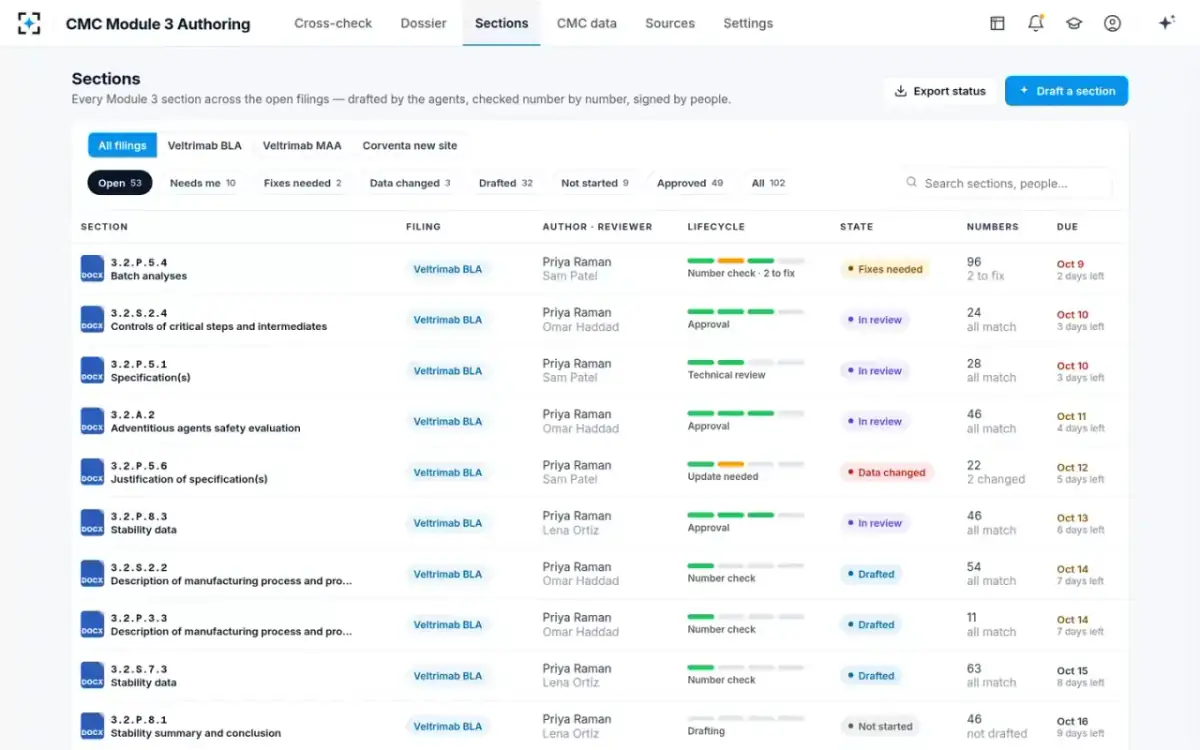
Nobody writes Module 3. A regulatory CMC writer drafts it, from text supplied by the function that owns the data, and a named technical reviewer from that function signs the science before regulatory signs the section. The pattern below is the common one, and it is the sample filing’s: five people, each owning a band of sections, with one lead who signs everything and therefore carries the agreement between them.
Who owns which band of sections, and who reviews it
| Sections | Who supplies and drafts the science | Who reviews it technically | What they are actually signing |
|---|---|---|---|
| 3.2.S.1, 3.2.S.3 | Analytical sciences and characterisation | Characterisation lead | That the structure and the attribute profile are as described |
| 3.2.S.2, 3.2.P.3 | Process development and manufacturing science | Process development lead | That the described process is the one that will be run |
| 3.2.S.4, 3.2.P.5 | Analytical development and quality control | Specification owner | That every limit is justified and every method validated for it |
| 3.2.P.1, 3.2.P.2 | Formulation development | Formulation lead | That the composition matches the process being filed |
| 3.2.S.7, 3.2.P.8 | Stability programme | Stability lead | That the data support the storage conditions and the shelf life claimed |
| 3.2.P.7, 3.2.P.4 | Packaging and materials | Device and materials lead | That the container and the excipient controls are the ones in use |
| Module 2.3, every section | Regulatory CMC writer, then the regulatory CMC lead | Quality assurance, for any change under change control | That the dossier agrees with itself |
The gap in that table is the last row. Every technical reviewer reads one band. The regulatory CMC lead is the only person whose signature spans all of them, and in a dossier assembled in a document system there is no view that shows a limit in 3.2.P.5.1 beside the stability result in 3.2.P.8.3 that has to meet it. That is the view the Quality Overall Summary quietly demands, and the one nobody owns.
Every section of the sample filing in CMC Module 3 Authoring, with its author and its reviewer
What is eCTD Module 3 granularity, and how granular should yours be?
Granularity is the choice of how far down the numbering you split the dossier into separate documents. The same content can be one document per 3.2.P.5 or one per 3.2.P.5.1 through 3.2.P.5.6, and the choice is the applicant’s. It is also the choice that decides, years later, how much you have to replace to change one sentence. The annex to M4(R4) says so directly: “in choosing the level of granularity for this Module, the applicant should consider that, when relevant information is changed at any point in the product’s lifecycle, replacements of complete documents/files should be provided in the CTD and eCTD” (ICH M4(R4), Granularity Document, Table 2).
Two consequences follow, and both are easy to underrate at first filing. Coarse granularity means a one-number correction in the justification re-submits the whole of 3.2.P.5. Fine granularity means more documents, more cross-references and more places the same limit is written, which is why the sample filing’s forty-five sections are forty-five change-control targets rather than six. The annex adds the constraint that settles it: “once a granularity option is chosen, continue with that option during the application’s lifecycle.” The decision is made once, at the first filing, by the people least likely to be maintaining it in 2034.
What the drafting of M4Q(R2) would change for Module 3
M4Q(R1) has stood unchanged since 2002. A revision, M4Q(R2), was released as a Step 2b draft for public consultation in June 2025; the European Medicines Agency’s comment period closed on 24 October 2025. Its restructuring is the one worth knowing about, because it changes which document carries the argument. In the draft, Module 2.3 becomes the overview and evaluation of the product and its components, built on science- and risk-based principles, while Module 3 is recast as the store of detailed methods, data and other quality information that backs Module 2.3 up (ICH M4Q(R2) Step 2b draft).
Read against M4Q(R1), that is close to an inversion. Today 2.3 may contain nothing that is not already in Module 3; in the draft, 2.3 is the assessed document and Module 3 supports it. The draft also reorganises the quality information for each material — drug substance, excipients, impurities, drug product, packaged product, medical device and the rest — under a common structure of description, manufacture, control and storage. None of this is adopted: a Step 2b draft is a consultation text and the Step 4 outcome may differ. What it tells a team planning a filing for 2028 is that the agreement between 2.3 and the sections beneath it is becoming more load-bearing, not less.
Where Module 3 goes wrong: five disagreements, and how each is found
Module 3 rarely fails on a missing section. It fails on sections that each say something defensible and together say something impossible. Five patterns recur, and each is found by comparing two documents nobody reads side by side.
Five ways a Module 3 contradicts itself, and the comparison that catches each
- A limit narrowed late, and the stability sections never re-read
A change control tightens an acceptance criterion from release capability. 3.2.P.5.1 and the justification are updated; 3.2.P.8.3 still holds a time point outside the new limit. Found by testing every limit against every stability result up to the shelf life claimed in 3.2.P.8.1.
- A range stated without saying which range it is
The process description gives one range and the controls section another, one being where the process is run and the other where it has been shown to work. Found by comparing 3.2.S.2.2, 3.2.S.2.4 and the validation report batch by batch.
- A number pasted from an approved prior filing
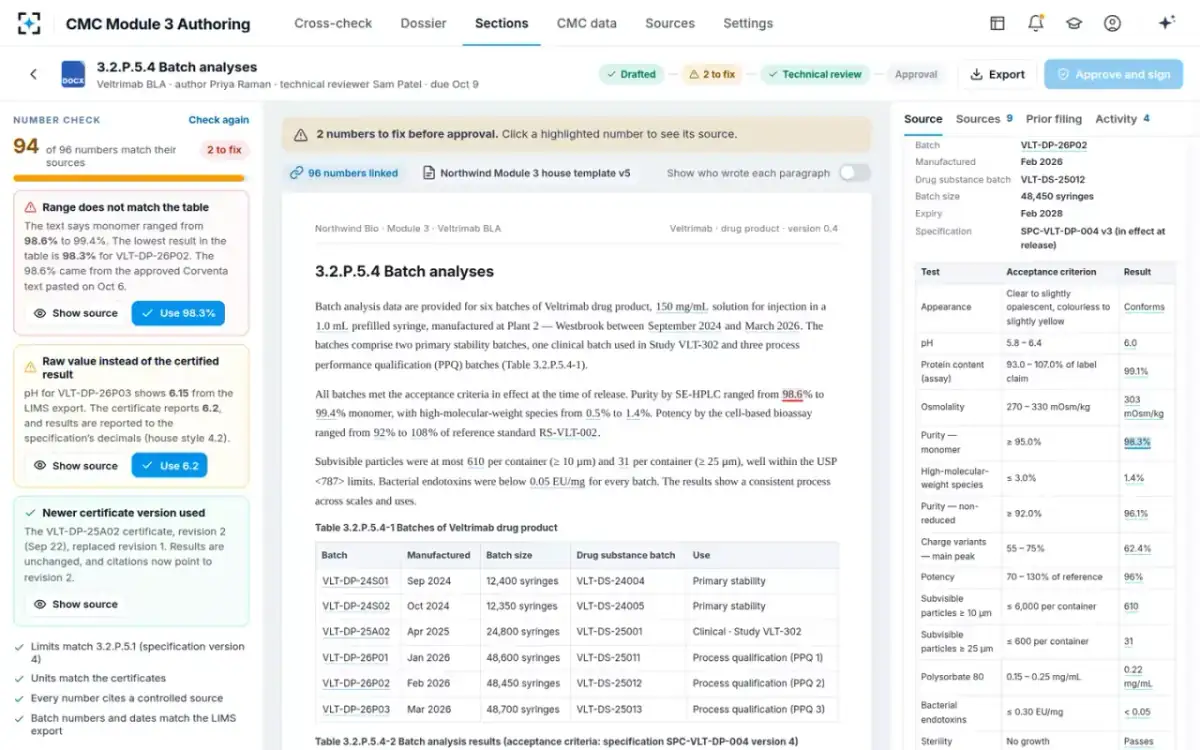
Reused wording is the fastest way to draft and the quietest way to carry a stale value. Found by checking every number in a draft against the certificate or report it should have come from, including its version.
- A raw instrument value where the certificate reports another
A pH of 6.15 from a laboratory export against 6.2 on the certified result. Both are true; only one is the reported result. Found by checking value, unit and decimals against the certified source, not the export.
- Module 2.3 left behind
A limit changes in 3.2.P.5.1 and the summary keeps the old one, because 2.3 is written last and read first. Found by treating 2.3 as a sixth place every limit has to appear.
What all five have in common is that the evidence was already in the company. Nothing was unknown; the two documents were simply never opened on the same screen. That is the work a justification of specification is supposed to do once, and that a late change undoes.
Reading one section: 3.2.P.5.4, annotated
Batch analyses is the shortest rule in 3.2.P and one of the most error-prone sections to draft, because it is almost entirely numbers transcribed from certificates. M4Q(R1) asks only for “a description of batches and results of batch analyses”. In practice a reviewer expects the batch number, scale, site and date of manufacture; the use each batch was put to; a table of results against the current specification; and prose that does not disagree with the table.
The prose is where it breaks. In the sample filing’s 3.2.P.5.4, ninety-six numbers were checked against their sources and ninety-four matched. One was a monomer range opening at 98.6%, carried over from the approved text of an earlier product, where the lowest result in this filing’s own table is 98.3%. The other was a pH of 6.15 taken from a laboratory export where the certificate reports 6.2. Neither is a scientific error. Both are the kind of sentence an agency reviewer quotes back.
A drafted section beside its sources, with every number traced
Six checks before a Module 3 section is signed
The list below is the one a lead can apply to any section, from any author, in any template. Each item is a comparison, not a judgement, which is why each can be made to fail.
Six checks before a section goes for technical review
- Every number in the prose matches the table, and the table matches the certified source
Value, unit and decimals, against the certified result rather than the instrument export. A reported 6.2 is the fact; the 6.15 behind it is not.
- Every limit quoted is the current specification version, by effective date
A superseded specification is kept and never cited. Check the version the section quotes against the one in force on the content-lock date.
- Every stability time point up to the claimed shelf life is inside the limit
3.2.P.8.1 concludes a shelf life; 3.2.P.8.3 has to support it at every point, not only at the ends.
- Every range in the process description says which range it is
M4Q(R1) lets process parameters be presented as an expected range, and requires the ranges for critical steps to be justified in the controls section. Say which is which.
- Nothing reused from a prior filing still describes the prior product
Reuse the wording, replace every product fact. The numbers that survive a copy are the ones nobody re-derived.
- Module 2.3 quotes what this section now says
M4Q(R1) tells the summary not to add anything that is not already in Module 3, which makes every late edit here an edit there.
How long does writing Module 3 take, and where the hours go
There is no published figure for this, and anyone who quotes one is quoting their own programme. What can be said is where the hours go: finding the right version of the right report, retyping values out of certificates and stability tables, writing the prose from prior approved wording, checking each number against its source, and re-reading neighbouring sections for agreement. Only the third of those is writing.
The solution’s design target is about 5.8 hours a section against roughly 13.5 by hand — a target, not a measured customer result, and one whose saving sits mostly in the first, second and fourth of those activities rather than in the prose. The prose is the part a person should still be doing. Agency attention to the quality module of fast programmes is not new either: announcing the fifth year of its CMC Development and Readiness Pilot in September 2026, FDA noted that “marketing applications for products in expedited development programs still need to meet FDA’s approval standards, including manufacturing facility compliance with current good manufacturing practice (CGMP)” (91 FR 59783). Clinical timelines compress; the quality module does not.
The dossier map in CMC Module 3 Authoring, leaf by leaf, against content lock
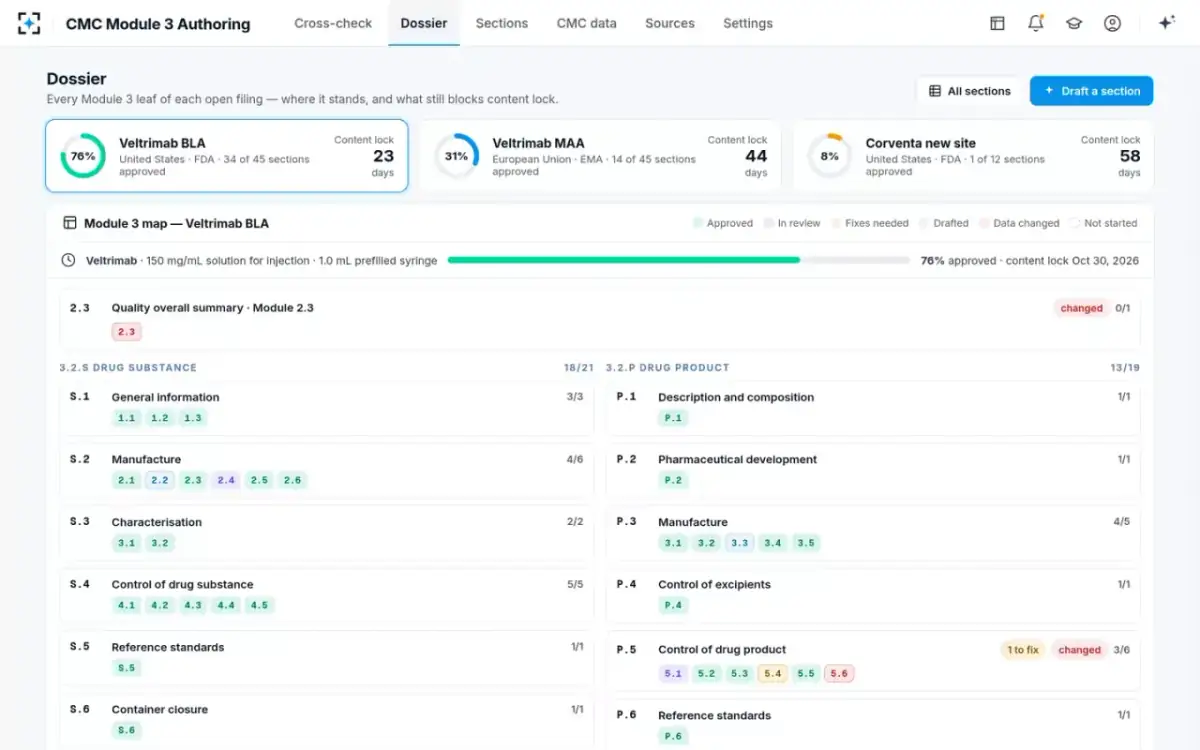
To see the grid, the section drafts and the number checks on a filing of your own, start from CMC Module 3 Authoring.
Questions people ask
Is Module 2.3 part of Module 3?
No. Module 2.3, the Quality Overall Summary, sits in Module 2 with the other CTD summaries; Module 3 holds the data and the detailed descriptions that 2.3 summarises for the assessor. Under M4Q(R1) the summary may add nothing: no information, data or justification that Module 3 or another part of the CTD does not already contain. That is what makes 2.3 a pure agreement problem — every number in it exists somewhere else, and has to match.
Where does the justification of specification go in Module 3?
In 3.2.P.5.6 for the drug product, and 3.2.S.4.5 for the drug substance. M4Q(R1) gives it a single sentence asking for the proposed drug product specification to be justified, and points the author to Q3B, Q6A and Q6B, where the real requirement lives: each procedure and each acceptance criterion argued from development data, clinical and toxicology batches, consistency batches, stability results and the expected analytical and manufacturing variability.
Does every drug substance need its own 3.2.S?
Yes. M4Q(R1) asks for the part S information in its entirety for each drug substance, so a fixed-dose combination with two actives carries 3.2.S twice. A drug product supplied with a reconstitution diluent carries the diluent’s information in a separate part P, as appropriate.
Where do process validation and PPQ data belong?
In 3.2.S.2.5 for the substance and 3.2.P.3.5 for the product, which M4Q(R1) asks to hold the description, documentation and results of the validation or evaluation studies for critical steps and critical assays. The acceptance criteria applied at those critical steps live one leaf earlier, in 3.2.S.2.4 and 3.2.P.3.4, with their justification and experimental data.
Can Module 3 sections be written in any order?
They can be drafted in any order, but they cannot be finished in any order. The specification sections fix the limits that the batch analyses, stability and justification sections then have to meet, and Module 2.3 can only be finished once all of them are stable. In practice that is why content lock, not first draft, is the date that matters — and why a change control landing inside the last month is the most expensive event in the schedule.
Is Module 3 the same for an NDA, a BLA and an EU marketing authorisation?
The structure is, because M4Q is an ICH guideline adopted in all three regions; the regional requirements around it are not. A US filing is judged against 21 CFR 314.50 or 601.2, an EU application against the regional annex and 3.2.R, and expectations about what counts as sufficient detail differ in places — the release and shelf-life acceptance criteria being the clearest example, which release against shelf-life specifications works through.