The Quality Overall Summary is Module 2.3 of the Common Technical Document: a summary of the chemistry, manufacturing and controls information that follows the scope and the outline of Module 3, written for the assessor who will not read every section first. Its defining rule is what it may not do. Under ICH M4Q(R1) the Quality Overall Summary should not introduce anything new, which means every number in it exists somewhere else and has to match — and a limit that changes late has to be swept back through six places, of which 2.3 is the last and the easiest to miss. Botminds’ CMC Module 3 Authoring puts each limit on one grid across the sections that state it, 2.3 included, and re-runs the comparison whenever a source document changes.
The worked example is the solution’s sample filing: a fictional company, an invented biologic, invented batches. ICH M4Q(R1), the M4(R4) granularity annex and the M4Q(R2) draft are quoted from their published texts.
What the rule fixes, and what one sample filing counts
40
pages of text is the normal maximum M4Q(R1) sets for a Quality Overall Summary
80
pages for a biotech product or a more complex process, still excluding tables and figures
33
limits and critical process parameters on the sample filing’s grid
136
comparisons across them, 2.3 among the sections compared
What is the Quality Overall Summary?
Module 2.3 is one of the CTD’s summary documents, sitting between the regional Module 1 and the quality data in Module 3. M4Q(R1) describes it as following the scope and the outline of the body of data in Module 3, and asks it to emphasise critical parameters of the product and to provide, for instance, justification in cases where guidelines were not followed. It is written by regulatory CMC, usually last, and it is often the first quality document an assessor reads in full.
Its sections mirror Module 3’s: 2.3.S for the drug substance, 2.3.P for the drug product, 2.3.A for appendices and 2.3.R for regional information. Where Module 3 holds the batch analysis tables, 2.3 holds a tabulated summary of them; where Module 3 holds the stability data, 2.3 holds a tabulated summary of the results with a graphical presentation where appropriate. The pattern is consistent throughout: summarise, point to the section, add nothing.
Can the QOS include information that is not in Module 3?
No. This is one of the clearest sentences in M4Q(R1), and it shapes everything else about the document.
The QOS should not include information, data or justification that was not already included in Module 3 or in other parts of the CTD.
ICH M4Q(R1), section 2.3, Quality Overall Summary
Three consequences follow, and they explain most of the trouble teams have with 2.3. First, 2.3 cannot be finished before the sections it summarises are stable, which puts it at the end of a schedule that is already compressed. Second, every figure in it is a copy, and a copy is the kind of fact that silently goes stale. Third, 2.3 cannot be used to fix a weakness in Module 3 — if a justification is thin in 3.2.P.5.6, writing a better argument in 2.3 is not permitted and, if noticed, is itself a finding.
The rule has one deliberate counterweight. M4Q(R1) asks that the summary “should also emphasise critical key parameters of the product and provide, for instance, justification in cases where guidelines were not followed”. Emphasis and pointing are allowed; new material is not. In practice the line is that 2.3 may say which of Module 3’s facts matter most, and may not introduce a fact that is not there.
Forty pages, eighty for a biologic: writing to the limit
M4Q(R1) sets an explicit length: “this QOS normally should not exceed 40 pages of text, excluding tables and figures. For biotech products and products manufactured using more complex processes, the document could be longer but normally should not exceed 80 pages of text (excluding tables and figures).” The exclusion of tables and figures is the part that changes how the document is written.
A summary of forty-five Module 3 sections in forty pages of prose is about a page per section — too little for narrative and exactly right for structured summary. A team that writes 2.3 as continuous prose tends to run long and then cut, which is where errors enter, because cutting a summary means re-deriving which numbers survive. A team that writes it as tables with short connecting text can stay inside the limit without editing under pressure, and every number in a table is a number that can be checked against its source mechanically.
The same arithmetic explains why the limit doubles for a biologic. A biological product carries more attributes, more process parameters, a cell bank history and a viral safety argument, and the summary of each is irreducible. A complex small-molecule process with several design spaces has the same problem for a different reason.
One limit, six places: the agreement nobody owns
Take a single drug product acceptance criterion and follow it through the dossier. It is stated once and relied on six times, and M4Q(R1) gives each of those sections a different job in relation to it. That is what makes the agreement hard: no two of the six say the same thing about the limit, so no two of them can be checked by comparing text.
The six places one drug product acceptance criterion appears, and what disagreement looks like in each
| Section | What it states about the limit | What disagreement looks like here |
|---|---|---|
| 3.2.P.5.1 Specification | The limit itself. M4Q asks this section for the specification for the drug product. | A different number from the approved specification version, or an older version quoted by effective date. |
| 3.2.P.5.4 Batch analyses | That the batches described met it. M4Q asks this section to describe the batches and report their results. | A result in the table outside the limit, or a range in the prose that is not the range in the table. |
| 3.2.P.8.3 Stability data | That every time point meets it. M4Q asks for the results of the stability studies in an appropriate format. | A time point outside the limit at or before the claimed shelf life — the failure a narrowed limit creates retrospectively. |
| 3.2.P.8.1 Stability summary | That the shelf life concluded is a period over which it holds. M4Q asks for conclusions "with respect to storage conditions and shelf-life". | A shelf life longer than the data support against this limit, or a conclusion drawn against a superseded limit. |
| 3.2.P.5.6 Justification | Why this limit and not another. M4Q asks this section to justify the proposed drug product specification. | An argument for a number that has since moved, or evidence that reaches a wider limit than the one now proposed. |
| Module 2.3 Quality Overall Summary | The same limit, quoted. The summary may add nothing of its own, so it can only repeat. | Any difference at all, down to a decimal — and the only kind of difference that is always an error rather than a question. |
The last row is the one worth dwelling on. In the other five sections a difference is a question — a reviewer asks what it means, and there may be a good answer. In 2.3 there cannot be. The summary may contain nothing that is not in Module 3, so a number in 2.3 that differs from the section it summarises is, by the rule’s own logic, wrong. It is the cheapest category of finding to produce and the cheapest to prevent.
Does the QOS have to be updated when a specification version changes?
Whenever it quotes the changed value, and that is the whole of the maintenance problem. A specification version moves for ordinary reasons — a capability-based narrowing, a method change, a decision taken on new stability data — and each time, every section that quotes the changed value has to be found and redrafted. The specification, the batch analyses where the results are read against it, the stability summary where a shelf life was concluded against it, the justification that argued for it, and 2.3.
In the sample filing this ran twice. A capability-based narrowing of a pH criterion, from 5.8 – 6.4 to 5.9 – 6.3, left three sections across two filings still quoting the old limit — one of them the overall summary. Later, the decision to separate release and shelf-life criteria for protein content produced updates in the specification section, the justification, the stability summary and 2.3, each drafted as a tracked change that a person confirms and each still subject to its number check before the section can be signed.
The grid after the decision, with Module 2.3 among the columns
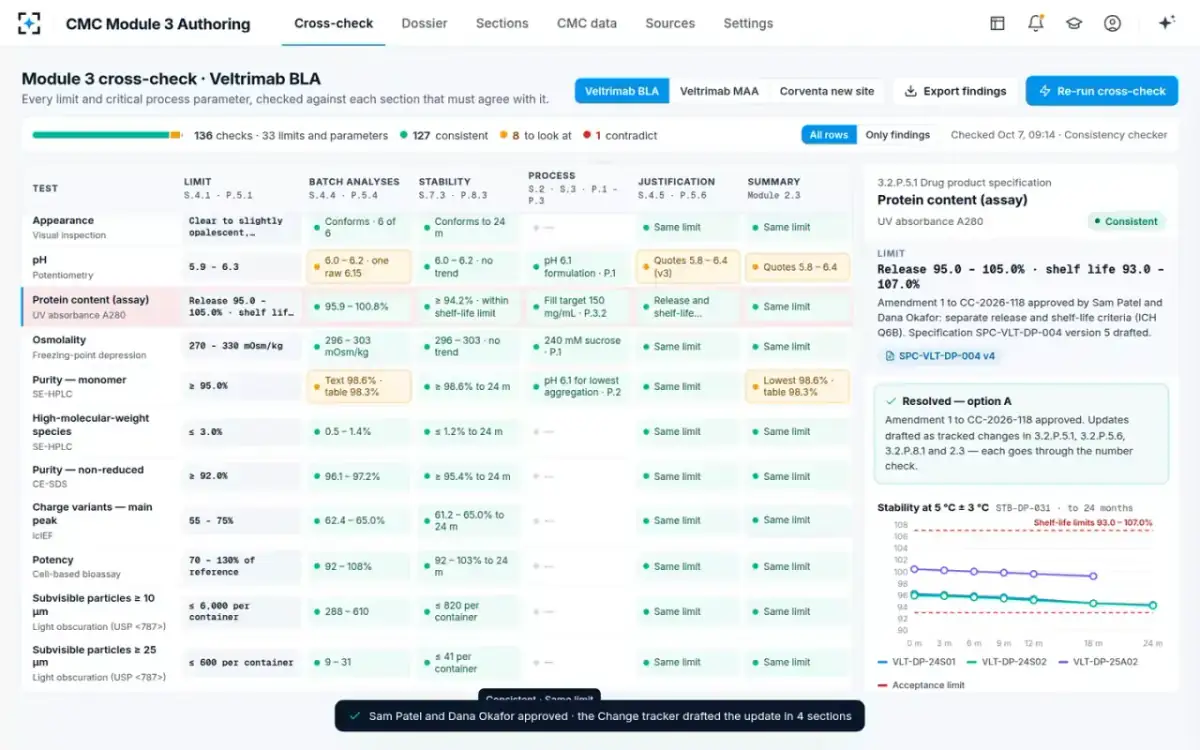
The sections the sweep has to reach, and the decision that triggered this one, are worked through in release against shelf-life specifications.
What granularity should the QOS be managed at?
Granularity — how far down the numbering a dossier is split into separate documents — is usually discussed for Module 3, but it applies to the summary too, and the M4(R4) annex explicitly leaves the choice open for 2.3.
Optionality of granularity for the Quality Overall Summary is provided in order to accommodate different levels of complexity of products. The applicant can choose the level at which the QOS is managed.
ICH M4(R4), Granularity Document, Table 1, Note 1
The choice matters because of what replacement means. The annex’s advice for Module 3 applies with equal force here: when information changes at any point in the product’s lifecycle, complete documents are replaced, so the size of the document decides the size of the replacement. A 2.3 managed as one document means a single corrected limit re-submits the whole summary. A 2.3 managed at 2.3.S and 2.3.P, or finer, confines the replacement — at the cost of more documents and more cross-references between them.
And the choice is effectively permanent: the annex asks the applicant to keep whichever granularity option it chooses for the rest of the application’s lifecycle. A team filing its first application is choosing, for the next decade, how expensive a small correction will be.
How do you check that 2.3 still agrees with Module 3?
Not by reading it. A forty-page summary read against forty-five sections is a comparison nobody completes twice, and reading is the wrong instrument anyway: the differences that matter are single values, not passages. The method that works is to invert it — start from each limit rather than from the document, and ask what each section says about that limit.
Five checks on Module 2.3 before content lock
- Every limit in 2.3 against the current specification version, by effective date
The commonest finding, and the easiest. Check the value, the unit and the number of decimals, against the version in force at content lock rather than the one quoted when 2.3 was drafted.
- Every tabulated summary against the table it summarises
The batch analyses summary against 3.2.P.5.4, the stability summary against 3.2.P.8.3. A summary table that lists a different batch set, or a different range, is a finding.
- Every shelf life and storage condition against 3.2.P.8.1 and 3.2.S.7.1
The conclusions, including in-use shelf life where there is one. These travel to the labelling, so a difference here is wider than a quality finding.
- Every process range quoted in 2.3 against the process description
A range corrected in 3.2.S.2.2 and not in 2.3 reproduces the original clash one module up, where it is more visible.
- Nothing in 2.3 that is not in Module 3
A read-through for new material: an argument, a figure, a justification that appears only here. M4Q(R1) says the summary should not include it, and it is the one check that cannot be done by comparing values.
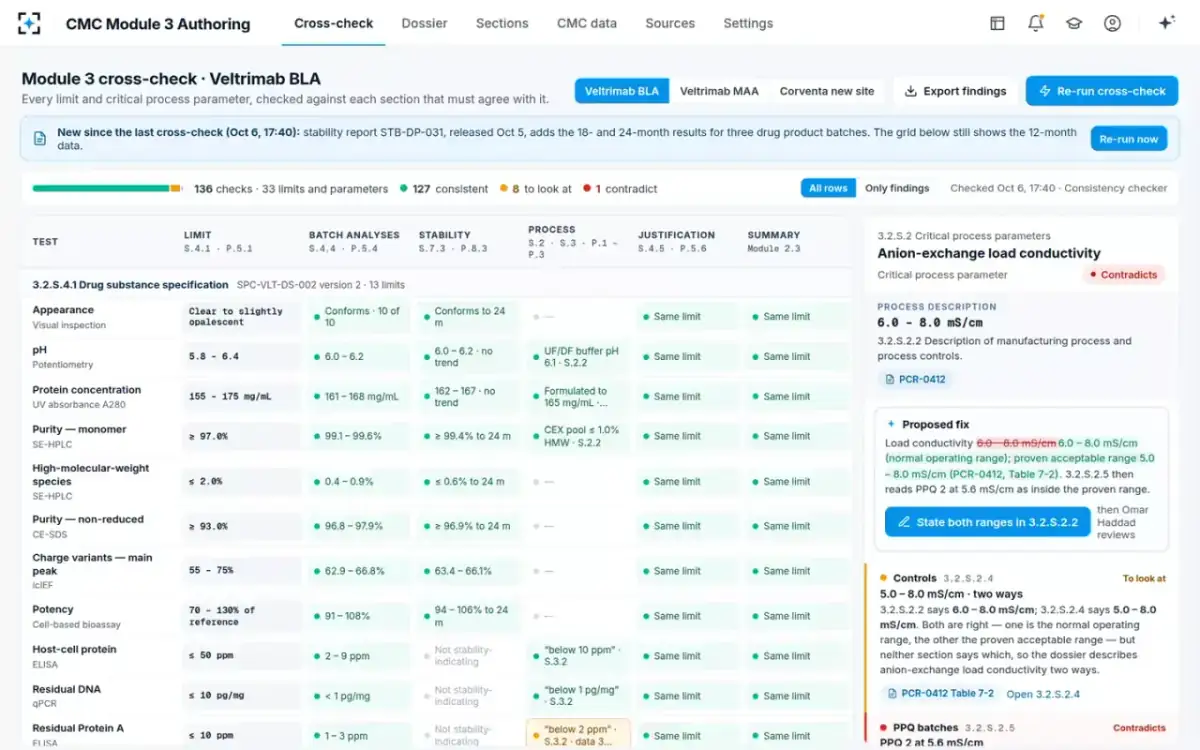
Running the first four on every limit at once is what a cross-check is for. In the sample filing that is thirty-three limits and critical process parameters, each compared with whichever of five sections state it — a hundred and thirty-six comparisons, re-run whenever a source document changes — and the summary is one of the five columns, not an afterthought.
One run of the sample filing’s cross-check, before and after a new stability report
The shape of that pair is the argument for doing it this way. A single new source document moved one limit from consistent to contradicting without anybody editing a section. No read-through of 2.3 would have found it, because 2.3 had not changed.
The cross-check grid, one row per limit, with the summary as a column
The QOS under the M4Q(R2) drafting
The revision of M4Q would change what Module 2.3 is for, not merely how it is written. The Step 2b draft, released for a consultation that closed in the EU on 24 October 2025, describes 2.3 and Module 3 as organised “in a complementary manner” and gives each a role that reads as close to the reverse of today’s.
Module 2.3 today, and in the M4Q(R2) Step 2b draft
M4Q(R1), in force: A summary following the scope and outline of Module 3, which may contain no information, data or justification that is not already in Module 3 or elsewhere in the CTD.
M4Q(R2), Step 2b draft: The basis for regulatory assessment: 2.3 "provides for a sufficiently comprehensive overview and evaluation of the medicinal product and its components applying science- and risk-based principles."
M4Q(R1), in force: The body of data the summary summarises, prescribed heading by heading.
M4Q(R2), Step 2b draft: A repository: Module 3 "serves as a repository for detailed descriptions of methods, data, and other relevant quality information that supports Module 2.3."
M4Q(R1), in force: 2.3.S, 2.3.P, 2.3.A and 2.3.R, mirroring Module 3.
M4Q(R2), Step 2b draft: Sections for general information, overall development and control strategy, core quality information, and development summaries and justifications, with optional lifecycle and benefit-risk sections.
M4Q(R1), in force: Every number in 2.3 exists in Module 3 and must match it.
M4Q(R2), Step 2b draft: The evaluation sits in 2.3 and the evidence sits in Module 3, so the link between a statement and its support becomes more load-bearing, not less.
M4Q(R1), in force: Step 4, adopted, in force since 2002.
M4Q(R2), Step 2b draft: A Step 2b consultation draft. Nothing in it is adopted, and the Step 4 text may differ.
For a team planning a filing several years out, the practical reading is narrow and useful: whatever the final text says, the discipline that keeps 2.3 in agreement with the sections beneath it is the discipline the draft asks for more of, not less. Nothing invested in that is wasted by the revision.
A worked check on one acceptance criterion
Here is the whole of the method on a single criterion, as it ran in the sample filing. It takes five comparisons, and each produces either silence or a question.
One criterion, five sections, one new source document
| The comparison | What was found | What followed |
|---|---|---|
| The limit in 3.2.P.5.1 against the approved specification version | The current version, correctly quoted, effective in late September. | Nothing. This is what a consistent cell looks like. |
| Every batch result in 3.2.P.5.4 against the limit | All inside it. Two numbers elsewhere in that section disagreed with their own sources, which is a different finding. | Two number corrections proposed, each applied by a person before the section could be signed. |
| Every stability time point in 3.2.P.8.3, to the shelf life claimed in 3.2.P.8.1 | Two registration batches at 94.6% at the 18-month point, against a 95.0% lower limit and a 24-month claim. | A contradiction, with both documents named at their pages and two options proposed — and no limit changed by the check. |
| The argument in 3.2.P.5.6 against the evidence | The justification argued the limit from release data alone, so it had nothing to say about the 18-month result. | A second finding on the same criterion: the justification had to be rewritten whichever option was chosen. |
| The limit as quoted in Module 2.3 | In agreement before the decision; in need of an update after it, along with three other sections. | An update drafted as a tracked change, still subject to the number check, and confirmed by the author. |
Nothing in that sequence is clever. It is five comparisons that anyone could make by hand, on one criterion, if they knew to make them on the morning the stability report arrived. The difficulty is that there are thirty-three criteria, forty-five sections and three weeks — and that the person who would notice is the only one who reads all of it.
The dossier map, with the summary flagged as changed
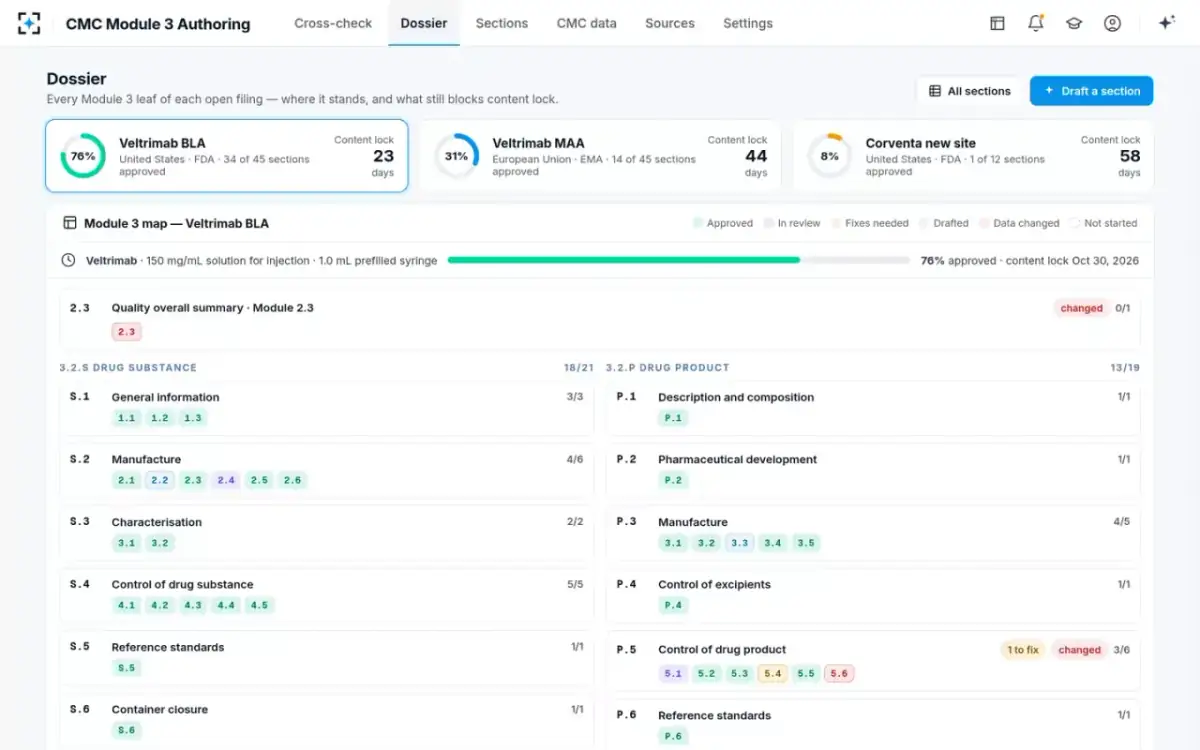
The map of which Module 3 section carries what, and which have to agree, is in what goes in each Module 3 section; the argument that a changed limit most often invalidates is covered in how to write a justification of specification. To see the grid with the summary as one of its columns, start from CMC Module 3 Authoring.
Questions people ask
How long should a Quality Overall Summary be?
M4Q(R1) sets the expectation at 40 pages of text, excluding tables and figures, and allows up to 80 for a biotech product or one made by a more complex process. Those are normal maxima rather than hard limits, and the exclusion of tables and figures is deliberate: a summary written as structured tables with short connecting text stays inside the limit far more easily than one written as continuous prose.
Who writes the Quality Overall Summary?
Regulatory CMC, usually the lead or a senior writer, and usually last. It cannot be finished before the sections it summarises are stable, which is why it sits at the end of the schedule — and why it is among the sections most exposed to a late change control.
What is the difference between Module 2.3 and Module 3?
Module 3 holds the data and the detailed descriptions, section by prescribed section. Module 2.3 summarises them for the assessor and may add nothing: under M4Q(R1) it may not include information, data or justification that is not already in Module 3 or elsewhere in the CTD. The M4Q(R2) consultation draft would change that relationship, making 2.3 the basis for assessment and Module 3 the repository that supports it, but that text is not adopted.
Can the QOS include a justification not in Module 3?
No. M4Q(R1) names justification explicitly among the things 2.3 may not add. What it may do is emphasise: the guideline asks the summary to highlight critical key parameters of the product and to provide, for instance, justification in cases where guidelines were not followed — meaning it points at an argument that already exists in Module 3 rather than making a new one.
How often should 2.3 be re-checked against Module 3?
Whenever a source changes, not on a calendar. A new specification version, a new stability report, an approved change control or an amended development report can each move a value that 2.3 quotes, and none of them touches 2.3 itself. Re-checking at content lock only is too late: it leaves every finding to be resolved in the days when the schedule has no slack.
Does an update to 2.3 need its own approval?
It needs whatever approval the section needs in your own chain — typically the author confirming each change, a technical review, and a regulatory signature for submission. What it should not need is a separate decision about the content, because 2.3 has no content of its own: once the change in Module 3 is approved, the corresponding change in 2.3 follows from it.