A regulatory information management system is the registry a company keeps of its regulatory world: which applications exist, in which countries, at which stage, with which approved variations, which commitments are outstanding and when the next renewal falls due. Around it sit a document management system holding the controlled files, a publishing chain that assembles a submission into the electronic common technical document format and validates it, and a transport link to each agency. None of those systems reads the numbers inside a Module 3 section, and none of them can tell you that the limit in your specification section disagrees with a stability result in another. That work sits between the development records and the registry, and it is what CMC Module 3 Authoring does.
This guide is for the person who already owns the registry and the publishing chain and has been asked where an authoring and cross-checking capability fits without buying a second source of truth. The short answer: it reads from the systems you already have and writes back a signed section. The long answer is the rest of the page, with the screens drawn from a demonstration filing on a fictional company and product.
The three layers, and the gap between them
Where the evidence is made
- Laboratory systems and batch exports
- Specifications and change control
- Stability programme
- Development, validation and process qualification reports
- Manufacturing records
Systems of production. They know results, versions and approvals — and nothing about a dossier.
results, limits and versions, each with its page
Where a section is written and checked
- Drafting in the house template
- Every number checked against its source
- Every limit checked across the sections that quote it
- Technical review, then the approval signature
The gap this guide is about. Values are read from the layer above, compared across sections, and turned into a signed section.
a signed section, and the trail behind it
Where the filing is recorded and sent
- The registry of applications, products and commitments
- Document management and controlled copies
- Publishing and eCTD validation
- The electronic gateway to each agency
Systems of record and transport. They know what was filed, where and when — and nothing about whether the numbers inside agree.
What the middle layer handles, and one date the bottom layer now has
6kinds
of record one Module 3 section is written from, before the house template
8
new high-severity eCTD validations — two for version 3.2.2 and six for version 4.0
16 Jan 2027
the date the FDA begins rejecting submissions that fail them
0
second registries a cross-check needs: it reads the systems you already own
What is a regulatory information management system?
It is a registry, and the word is worth insisting on. Its subject is the application, not the science: a record per product per country, carrying the application type and number, its status, the dates of submission and approval, the approved variations, the commitments made to each agency and their due dates, the manufacturing sites listed on it, and the documents that went with each submission. From that registry come the questions it exists to answer — what is approved where, what is due next, which sites are on which licence, what did we commit to.
Those are good questions and they are hard to answer without a registry. A company filing in thirty countries cannot hold the answer in a spreadsheet, and getting it wrong has consequences of its own: a biologics licence application has to list "the address of each location involved in the manufacture of the biological product" (21 CFR 601.2(a)), and keeping that true across a product's life is registry work.
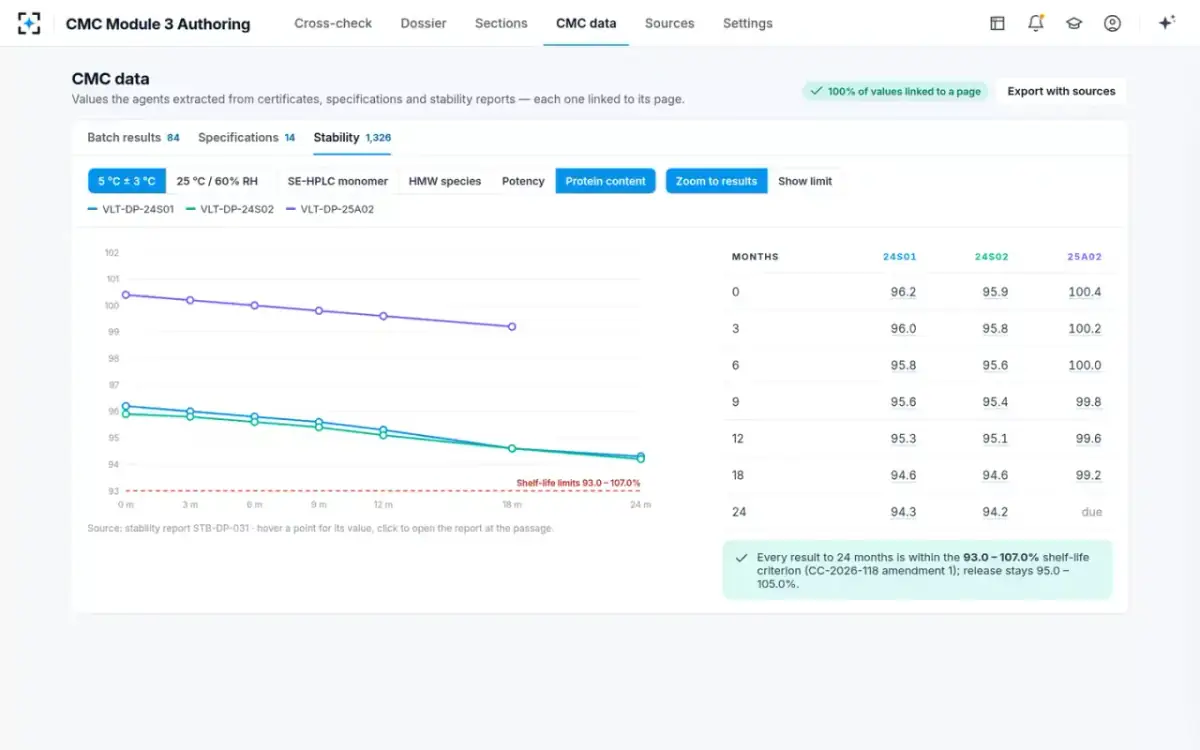
What the registry does not hold is the inside of the documents. It knows that section 3.2.P.5.1 was filed; it does not know that the limit in it is 95.0 to 105.0% of label claim, still less that a stability result at eighteen months reads 94.6%. That is not a defect. It is the boundary of what a system of record is for.
What a RIM system is good at, and what it never held
Four systems, what each owns, and the question each cannot answer
| System | Owns | Answers | Cannot answer |
|---|---|---|---|
| Regulatory information management | Applications, products, countries, statuses, variations, commitments and their dates | “What is approved where, and what is due next?” | “Is the limit in this section supported by our own stability data?” |
| Document management | Controlled files, versions, approvals and retention | “Which version of this document is current, and who approved it?” | “Which other sections quote a number from this document?” |
| Publishing and validation | The assembled submission, its structure, its links and its format validations | “Is this package well formed and will the agency accept it?” | “Do the contents of two leaves of this package contradict each other?” |
| Authoring and cross-checking | Drafts, extracted values with their pages, findings, decisions and signatures | “Where did this number come from, and does every section agree about it?” | “What is our registration status in Japan?” — which is the registry's question, not this one |
The distinction matters because the four are often bought from the same conversation and assumed to overlap more than they do. A publishing chain validating a package is checking structure: that the files are where the specification says, that the links resolve, that the metadata is well formed. It passes a dossier whose sections contradict each other, because contradiction is not a format error.
Researchers describing a machine-readable future for regulatory exchange are blunt about the present: current processes are "slow, fragmented, and resource-intensive, constrained by unstructured file formats, inconsistent submission standards (eCTD and non-eCTD), and inefficient exchange mechanisms ranging from AS2 gateways to email and physical media" (Abernathy and colleagues, International Journal of Pharmaceutics, 2026). Fragmentation is the condition the middle layer lives in, and it is why that layer is still mostly people.
Where the registry, the publishing chain and the authoring each begin
Draw the boundaries by asking what each system is the authority for. The registry is the authority for the fact of a filing. Document management is the authority for which version of a file is current. Publishing is the authority for the shape of the package. Authoring is the authority for nothing at all — and that is the point.
An authoring and cross-checking layer should own no master data. The specification is the authority for the limit; the certificate is the authority for the batch result; the stability report is the authority for the time point; the registry is the authority for what was filed. What the middle layer holds is the relationships: this number in this paragraph came from that document at that page, in that version, and these five sections quote the same limit. Hold those relationships and you can answer the agreement question; claim ownership of the numbers themselves and you have built the second source of truth everyone was trying to avoid.
eCTD validation: the reader that comes before the reviewer
Before a human reviewer sees a submission, an automated one does, and its standards are tightening. In October 2026 the FDA announced new high-severity validations in both current formats and the date they begin to bite: "Rejection for failing to pass the new high-severity eCTD v3.22 and v4.0 validations will begin January 16, 2027" (91 FR 65749). The notice names them: "The new eCTD v3.2.2 validations are 2024 and 2025, which are high-severity validation errors as described in the Specifications for eCTD Validation Criteria," with six more on the version 4.0 side.
Two implications for a buyer. First, this is publishing's problem, not authoring's — if your publishing chain and its validation profiles are current, these validations are handled where they should be. Second, and less obvious, a rejection at this stage is the cheapest kind of failure, because it happens before the clock starts and it tells you exactly what is wrong. The expensive failures are the ones no validator can detect: a limit that disagrees with a stability result is a perfectly well-formed submission. What a second review cycle costs puts a price on that difference.
The format is also about to describe content more tightly. The draft revision of the quality module guideline proposes that "section headers may include mandatory keywords in parentheses ( ) or optional keywords in square brackets [ ] to uniquely identify a section's content and distinguish between multiple instances" (ICH M4Q(R2), Step 2b draft) — which is a format change with a content consequence, since it makes "which section is this value in" a machine-readable question for the first time.
The systems one Module 3 section is written from
Count them for a single drug product control section, and the number can surprise people who have not written one: six kinds of record, before the house template. Certificates of analysis for every batch cited, with their revisions. Laboratory batch exports, which hold the raw values the certificates report in rounded form. Specifications and the change controls that moved them, by version and effective date. Stability reports by batch, storage condition and time point, including interim reports. Development, validation and process qualification reports, which carry the ranges and the characterisation. And at least one prior approved filing, because that is what the new text starts from.
CMC Module 3 Authoring: every source, with version, status and the sections it supports
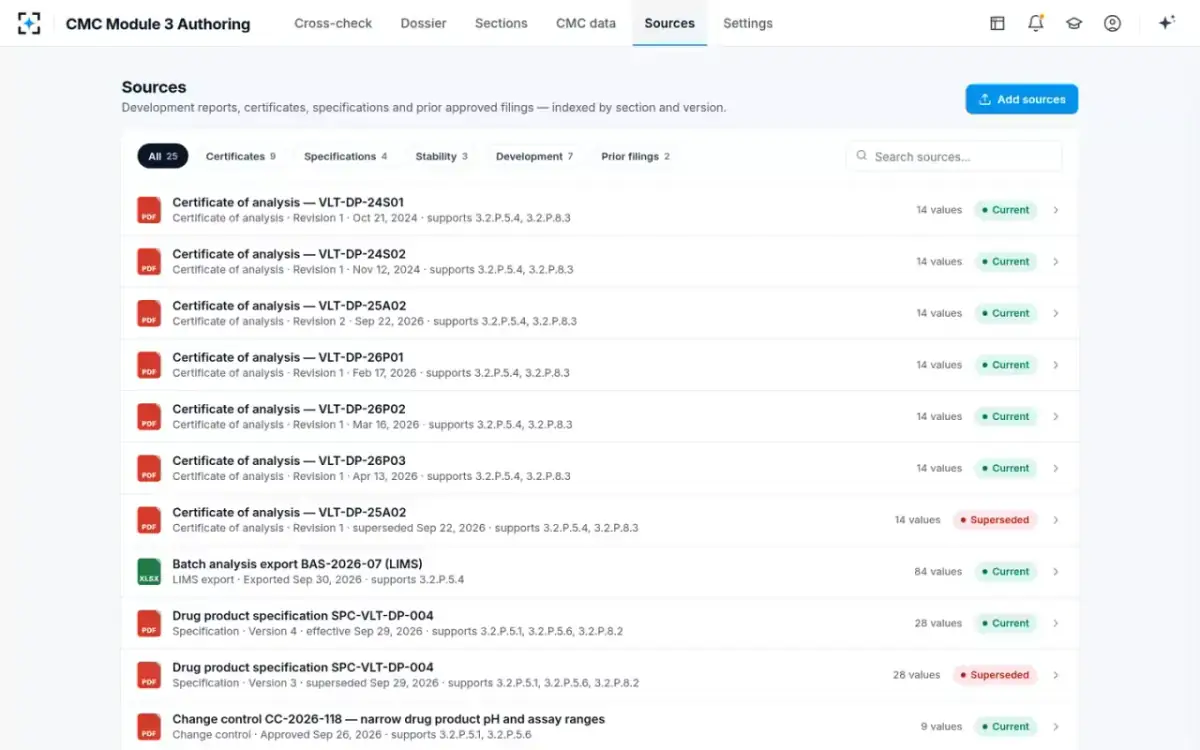
That last column is the whole argument for a layer between the production systems and the registry. A document management system can tell you that a stability report has a version 3. Only something holding the dependency can tell you that version 3 affects four sections across two filings, one of which is signed.
The values themselves, each linked back to the page it came from
What has to flow between them, and in which direction
One value from a certificate to a validated submission, naming the system at each hop
Agent
Read from the production systemsThe result is read from the certificate of analysis, with the laboratory export beside it; the current specification version and its effective date come from change control.
Never: writes back to any of them — the flow into this layer is one-way
Agent
Extract and keep the pageThe reported result is stored with its document, version, page and a confidence, so the sentence that uses it can be opened at its source.
Never: keeps only the raw instrument value where the certificate reports another
Agent
Draft and check the sectionThe section is drafted in the house template, then every number in it is tested against its source and against the same value elsewhere.
Never: applies its own fix, or writes a number it cannot cite
A person decides
The writer and the technical reviewerThe writer applies each fix; the named technical reviewer — the owner of the limits or the ranges in question — signs for scientific accuracy.
A person decides
The regulatory CMC lead signsReads the section against the rest of the dossier, decides any contradiction, and applies the approval signature with its stated meaning.
Agent
Hand the signed section onwardThe signed section goes into document management as a controlled file, and the registry records the filing it belongs to.
Never: duplicates the registry: what was filed, where and when stays the registry's record
The one-way rule is worth stating as a requirement in a selection document, because it is what keeps the master data intact. The authoring layer may read anything and may write exactly one artefact: a section, signed, with its findings and decisions attached. Everything else it holds is a copy with a source attached — and under Part 11 those copies are still records, which must be producible as accurate, complete copies the agency can inspect, review and copy, on paper or on screen as well as electronically (21 CFR 11.10(b)).
Do you need a new system to cross-check your limits?
You need the capability. Whether it arrives as a new system depends on an honest answer to one question: who, today, holds the list of every section that quotes a given acceptance criterion? If the answer is a person, you have a single point of failure whose holidays are a risk. If the answer is a spreadsheet, you have an artefact that is right on the day it is made. If the answer is nobody, that is the reason late changes propagate badly.
Three things make the capability look like an addition rather than a replacement. It stores no master data, so it displaces nothing. It reads what you already have, so its value appears on your existing documents rather than after a migration. And its output — a signed section — is exactly what your document management and publishing chain already expect to receive. The test to apply is therefore narrow: does the thing you are being sold read from your systems and write back a signed section, or does it ask to become the place where limits live? The comparison with templates and structured content runs the same test on the authoring side.
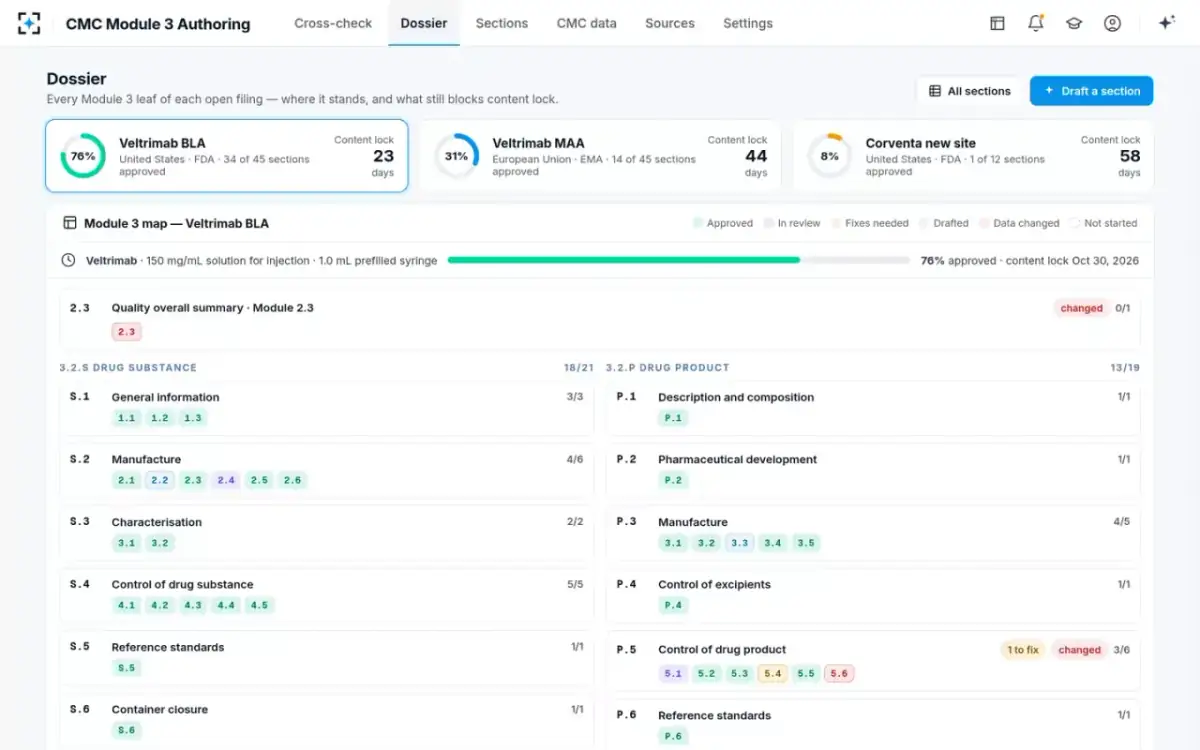
What CMC Module 3 Authoring produces: sections, their state, and what blocks content lock
How long does it take to connect, and what does it need?
Honest answer: it depends almost entirely on the state of your inputs, not on the connection. The solution is built and deployed from your own requirements and documents — your house template, your specifications, a sample of development reports and a prior approved filing — and it goes live once every quality check has passed. We do not publish a number of weeks, because the number is set by how long it takes your team to assemble those five things, and that varies by more than any implementation ever does.
What usually decides it is the second item. Specifications held by version, with effective dates and the change controls that moved them, make everything downstream possible; specifications held as the current file only make the most valuable check — is this section quoting a superseded limit? — impossible to run at all. If you do one piece of preparation before any vendor conversation, do that one.
Two further conditions are worth settling early because they are contractual rather than technical. Source documents should stay in your own environment and should not be used to train models; and the trail of who did what, when, must be exportable, not merely viewable. Both belong in the agreement rather than in the demonstration — and both are among the ten questions worth putting to any vendor.
Five questions to ask before you add a system
Five questions, and the failure each one prevents
- Which system will be the authority for each number after this?
Prevents the second source of truth. The specification, the certificate and the stability report must stay the authority; the new layer holds copies with sources attached.
- What does it read, and does it ever write back?
Prevents a limit changed in an authoring tool and pushed into a production system. Read many, write one signed section — anything else should be refused.
- Can it tell me which sections depend on a given document?
Prevents the late-change failure. If it cannot answer that, it cannot tell you what to re-read when a new stability report lands, which is most of the value.
- What happens to the record when a person or an agent acts?
Prevents an unreconstructable decision. Time, actor, action and previous state, exportable in a form an inspector can read.
- What does it hand to publishing, and in what state?
Prevents a gap at the handover. A signed section as a controlled file, with its findings resolved, is what the rest of your chain already expects.
Answer those five and the shape of the decision is usually clear within a meeting. The registry keeps doing what it is good at. Publishing keeps proving the package is well formed, and will keep doing so against validations that get stricter in January 2027. And the gap between them — the one where a limit is agreed, written, checked against its own data and signed — stops being staffed by memory. To see that middle layer working on a real section, start from CMC Module 3 Authoring, or read who sits at each desk inside it.
Questions people ask
What is the difference between a RIM system and a document management system?
A regulatory information management system is a registry of regulatory facts — applications, countries, statuses, variations, commitments and their dates. A document management system is a controlled library of files with versions, approvals and retention. They are usually bought together and often share a platform, but they answer different questions: one knows what is approved where, the other knows which version of a file is current. Neither reads the numbers inside the files.
Does a RIM system write Module 3?
No. It records that a quality module was filed, with which documents and when, and it tracks the commitments that came out of the review. The writing is done elsewhere — historically in a word processor over a house template, increasingly in a structured or agent-assisted authoring layer — and the finished sections are then placed under document control and published.
What is eCTD publishing, and what are validation errors?
Publishing assembles the finished documents into the electronic common technical document structure with its metadata and links, and validates the result against the agency's published criteria. Validation errors are format and structure faults, graded by severity. From 16 January 2027 the FDA will reject submissions failing two new high-severity validations for version 3.2.2 and six for version 4.0, so a current validation profile is worth confirming before your next filing.
Which systems is a Module 3 section written from?
Six kinds of record, plus the template: certificates of analysis with their revisions, laboratory batch exports, specifications with their change controls by version, stability reports by batch and time point, development and validation reports, and at least one prior approved filing. The last of those is both the starting point for the wording and the place inherited errors come from, which is why a drafted section must be checked against the sources rather than against the text it reused.
Do you need a new system to cross-check specification limits?
You need the capability; whether it is a new system depends on whether anything you own today can tell you which sections quote a given limit. Registries, document management and publishing all answer other questions. The addition is small if it stores no master data, reads what you already have and hands back a signed section — and large if it asks to become the place where limits live.
What documents does a Module 3 cross-check need before it starts?
The house template, specifications by version with effective dates, certificates for the batches you will cite, stability reports by batch and time point, development and validation reports, and a prior approved filing. The specifications-by-version requirement is the one most likely to hold a project up, because the most valuable check — whether a section quotes a superseded limit — cannot be run without it.