Structured content authoring is the practice of writing a regulatory document as reusable pieces of content with meaning attached — a specification table, a process step, a storage statement — rather than as a file of formatted prose, so a piece written once can appear in many documents and be changed in one place. For the quality module of a drug application it is the most-discussed alternative to a house template, and it is now being weighed against a third option, agents that draft each section from the development records. This guide puts the three side by side on the test that separates them, and shows where CMC Module 3 Authoring sits among them: it is the third kind, and it is built on the view that drafting and number-checking are different jobs that must not be done by the same thing.
The test is one day: the day a specification version lands that narrows a limit, three weeks before content lock. Every approach writes a tidy first draft. Only one of them changes what happens on that day, and the reason has nothing to do with the quality of the prose.
One drafted section, and what reuse did and did not do for it
91%
of the approved wording of an earlier product reused in the drafted batch analyses section
96numbers
in that section, each one linked to the document, version and page it came from
2
numbers wrong — one of them inherited with the reused wording itself
3sections
across two filings that still quoted a superseded pH limit, found and drafted as tracked changes
What is structured content authoring?
Three ideas, usually sold together. Content is broken into components small enough to have a single owner and a single meaning. Each component is written once and referenced wherever it is needed, so a change in the source changes every use. And the components carry metadata — which product, which section, which version, which region — so a document can be assembled by asking for the right pieces rather than by copying a previous file.
None of that is specific to pharmaceuticals; it is how technical documentation has been managed for decades. What makes the quality module an unusually good candidate is the amount of repetition in it. The same acceptance criterion appears in the specification section, in the justification, in the stability summary and in the overall summary in Module 2.3; the same process step appears in the description and in the controls; a product filed in two regions has two dossiers that agree almost everywhere. Writing those once is an obviously good idea.
And it is the direction the standard itself is moving. The ICH's business plan for the next revision of the quality module guideline lists among the issues to be tackled: "Organizing product and manufacturing information in a suitable format for easy access, analysis, and knowledge management. The revision should facilitate inclusion of information supporting emerging concepts such as advanced manufacturing, digitalization, data management, artificial intelligence, and advanced analytical tools" (ICH, M4Q(R2) business plan, §1). The same document says plainly why: the existing guideline "is now due for revision to further improve registration and lifecycle management efficiency, leverage digital technologies, and accelerate patient and consumer access to pharmaceuticals."
Three ways to write Module 3, tested on one changed limit
Here is the day. A change control narrows a drug product pH limit from 5.8–6.4 to 5.9–6.3, because thirty-one batches ranged 5.95 to 6.18 and the tighter limit is defensible. The new specification version is issued. In the demonstration filing the old limit is still quoted in three sections across two filings. What does each approach do?
The day a specification version lands, in each of the three approaches
- Noticed1 h
- Searched by hand, every filing5 h
- Edited and re-reviewed4 h
- Updated1 h
- Affected sections re-reviewed3 h
- Uses found1 h
- Tracked changes reviewed2 h
- Re-tested on stability2 h
The second lane is the case for structured content authoring, and it is a real one: a limit that changes in one place and propagates everywhere is strictly better than a limit that has to be hunted. But look at what both of the first two lanes are missing. Neither asks the question that decides whether the new limit can be filed at all: do the stability results, at every time point up to the proposed shelf life, still sit inside it? A system that propagates a number perfectly will propagate a number the data no longer support, perfectly, into every section that quotes it.
That is not a hypothetical failure. In the demonstration filing the limit that turns out to be wrong is a protein content range narrowed in an earlier change, with two registration batches reading 94.6% at eighteen months against a 95.0% lower limit, while the shelf life claimed is twenty-four months — and the choice between one limit and two is the decision that follows.
Where templates stop being enough
A house template is not a poor choice; for a small company with one product it is often the right one. It carries the section order, the headings, the standard sentences and the house style, and it costs nothing to adopt. What it cannot do is remember. Every value in a template-written section is a character in a file, indistinguishable from the characters around it, with no link to the certificate it came from and no record that it was ever checked.
Three things break it, in this order. The second product, which turns one set of sections into two that must be kept separate but similar. The second region, which turns two into four. And the late change, which multiplies by the number of places a value appears. A team can run on a template for a long time and discover all three in a single quarter.
There is also a quieter cost, visible only in review. Because nothing distinguishes a number that was verified from one that was pasted, review has to treat every number as unverified, which is why checking consumes about two and a half of a section's thirteen and a half hours in our estimate — and why, under time pressure, it is checked by sample rather than in full. What the hours in a filing actually cost works that arithmetic through.
Component reuse: the promise, and the version problem
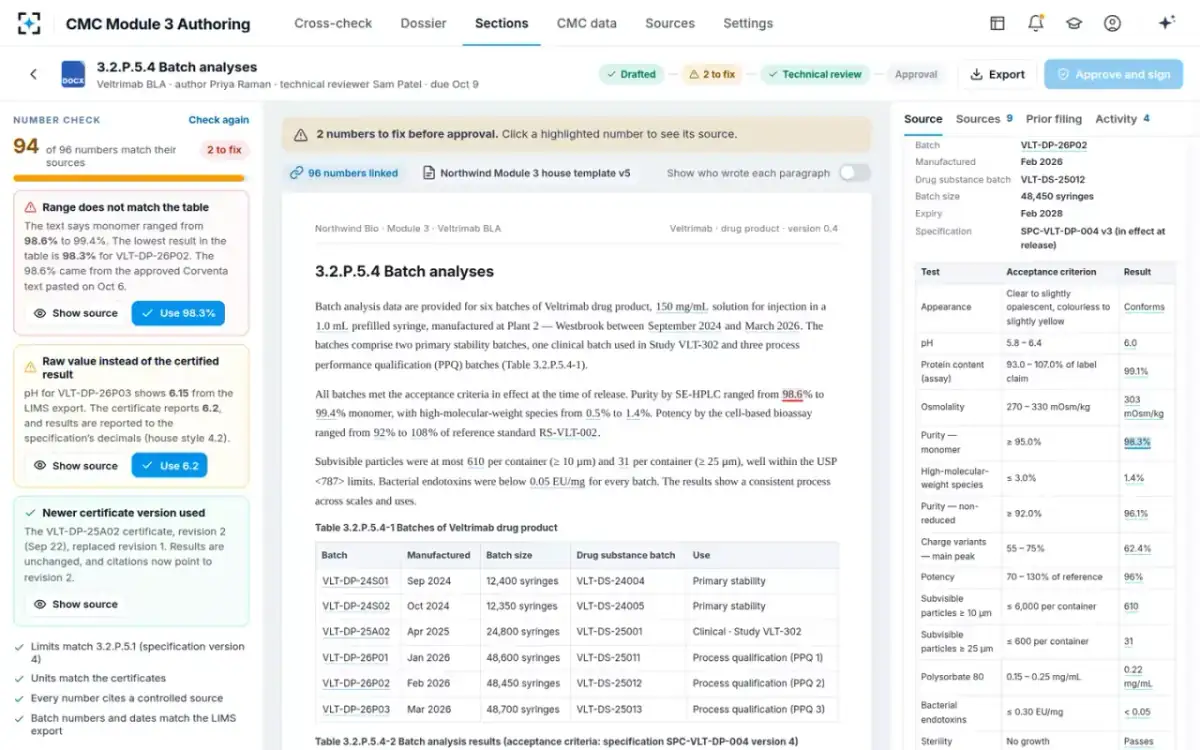
Reuse has a sharper edge than it first appears, and the demonstration filing is a good illustration because it reuses heavily and gets caught doing it. The drafted batch analyses section reuses 91% of the approved wording of an earlier product. That is a large and genuine saving. It is also how a monomer range of "98.6%" arrived in a section whose own lowest batch result was 98.3%: the sentence was right for the previous product and wrong for this one, and no amount of structure around the sentence would have noticed.
Reuse and number-checking are two different jobs
What reuse is good at: Starts every section from text a regulator has already accepted, so the argument and the house style are consistent across products.
What only a check against the source can do: Nothing. A check has no opinion about prose.
What reuse is good at: Carries them along with the sentence, which is exactly the problem: a reused sentence brings the previous product's values with it.
What only a check against the source can do: Compares every number in the draft with the document it claims to come from, for value, unit, decimals and source version.
What reuse is good at: Propagates the new value to every reference, instantly and completely.
What only a check against the source can do: Asks whether the new value is supported by the batch, stability and process data — which propagation never asks.
What reuse is good at: Keeps using the component until someone updates it.
What only a check against the source can do: Flags a number whose source is no longer the current version, even when the number itself is unchanged.
What reuse is good at: Guarantees they match, if both use the same component.
What only a check against the source can do: Finds them when they do not — including in sections written before the reuse began, and in a second filing for the same product.
What reuse is good at: A document assembled from approved parts.
What only a check against the source can do: A list of findings, each naming both sources and their pages, for a person to resolve.
A reused section in CMC Module 3 Authoring, and the certificate it is checked against
Is structured content authoring the same as AI drafting?
No, and conflating them is how evaluations go wrong. Structured content authoring is a way of storing and assembling content: deterministic, auditable, and entirely dependent on someone having written each component correctly in the first place. AI-assisted authoring is a way of producing a draft: faster at the blank page, and dependent on what it was given and on whether anything checks it afterwards.
They answer different questions. Structure answers "where does this sentence live and what else uses it". Drafting answers "what should this section say about this batch". A tool can do both, and the useful ones do, but a buyer should price them separately, because the risks are opposite: structure fails by propagating a wrong value efficiently, drafting fails by producing a plausible value nobody traced. The defence against the second is that no number may be written without a cited source, and a separate checker tests every one of them — which is the subject of what agents may draft and what they may never decide.
There is a third thing neither is: a data standard. Researchers describing a machine-readable alternative to the document put the current state bluntly — "the growing scale and complexity of pharmaceutical quality data across the product lifecycle are outpacing the capabilities of today's document-centric regulatory paradigm" (Abernathy and colleagues, International Journal of Pharmaceutics, 2026). Structuring your own content does not make your submission data; it makes your documents easier to assemble. That is worth having, and it is not the same promise.
What the M4Q(R2) drafting would change about reuse
The next revision of the quality module guideline, out for consultation as a Step 2b draft until October 2025, is relevant to this choice in two concrete ways. The first is organisational: material sections are "further organised using the following structure: Description, Manufacture, Control, and Storage" (ICH M4Q(R2), Step 2b draft), applied consistently across drug substances, intermediates, raw and starting materials, reference standards, excipients, impurities, drug products and devices. A dossier whose every material section follows the same four-part shape is a far better fit for component reuse than one whose sections each have their own structure.
The second is regional. The draft "aims to foster harmonisation of the quality dossier content, ideally enabling the submission of a single M4Q(R2) version of the dossier across countries or regions." If that lands, the strongest current argument for heavy reuse — maintaining near-identical dossiers for several regions — partly dissolves, and the remaining argument is about products and lifecycle rather than geography.
Neither change is in force, and a buying decision should not be made on a draft. The reason to read it now is to avoid choosing an approach that depends on the structure staying exactly as it is. The parent CTD guideline makes the point about why the structure exists at all: "A common format for the technical documentation will significantly reduce the time and resources needed to compile applications for registration of human pharmaceuticals and will ease the preparation of electronic submissions" (ICH M4(R4)). Format is a means; agreement between the sections is the end.
What do you need before you start?
When any of the three approaches fails early, the cause is usually not the software. It is that the inputs are not in a state anyone can write from. Before a pilot of any kind, assemble these.
What has to exist before any of the three approaches works
- A house template someone owns
Not three variants on three people's drives. One current version, with the regional variants named as variants, and a person who decides what changes in it.
- Specifications by version, with effective dates
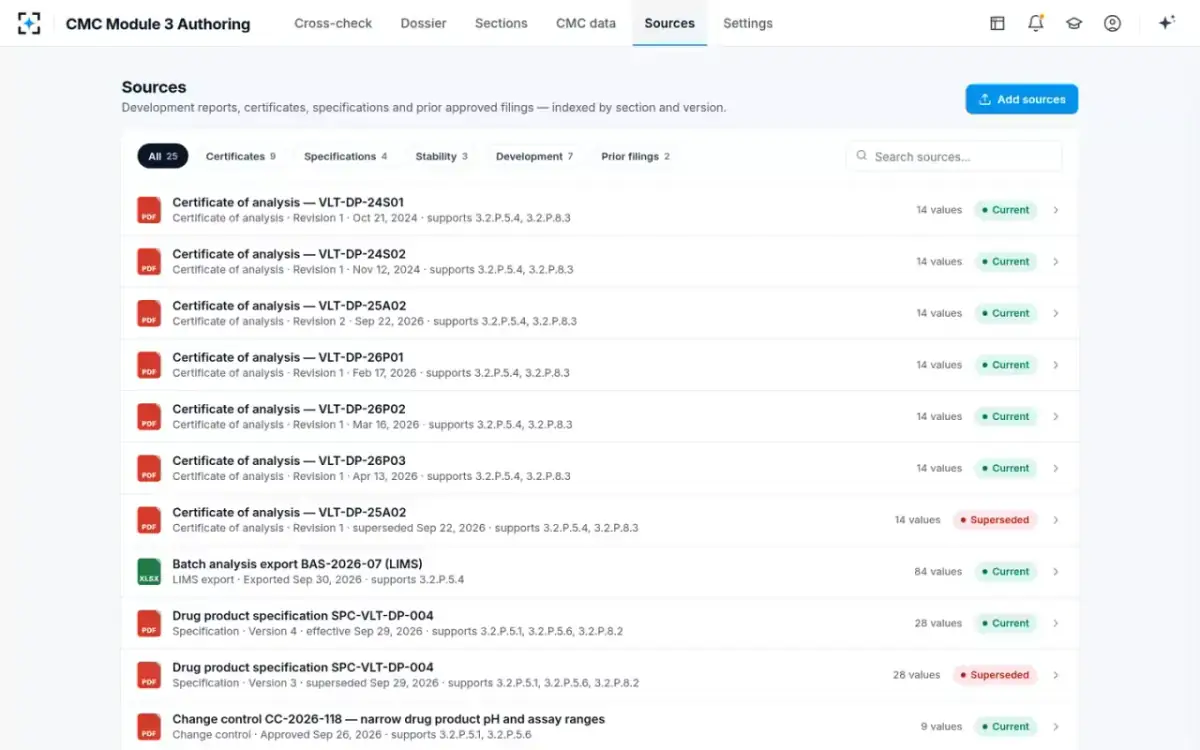
A frequent blocker. A tool cannot tell you a section quotes a superseded limit if it cannot tell which version was current when the section was written.
- Certificates of analysis for every batch you will cite
With their revisions. A superseded certificate must be available and marked, because a section may legitimately have been written from it at the time.
- Stability reports by batch, condition and time point
Including interim reports. A limit can only be tested against the shelf life you are proposing if every time point up to it is readable.
- Development, validation and process qualification reports
These carry the ranges, the characterisation and the justification evidence. Without them a drafted section can describe the process but cannot support it.
- At least one prior approved filing for the same or a similar product
This is what reuse reuses. It is also where inherited errors live, which is why it must be an input to the drafting and never the reference the checking is done against.
- A decision about who decides
Who resolves a contradiction between two sections, who approves a changed limit, and who signs. If those three names are not agreed, no approach will produce a signable section.
The sources behind a section in CMC Module 3 Authoring, with version and status
What to pilot first, and how to judge it in four weeks
Pick the section type you write most often and know best — batch analyses is usually the right answer, because it is dense with numbers and has an unambiguous source. Take twenty completed sections from your last filing, and the documents they were written from. Then run the three tests that discriminate.
First, draft the twenty sections and count what the draft got wrong against the certificates, not against your filed text. Measuring against your filed text measures agreement with yourself, which is what you are trying to stop doing. Second, change a limit halfway through the four weeks — a real one, through your normal change control — and count how many places the old value was found, in how long, in how many filings. Third, test a contradiction: hand the pilot a stability result that sits outside a limit at a time point inside the proposed shelf life, and see whether what comes back is a contradiction naming both sources, or a confident paragraph.
Judge the result on three numbers and one behaviour. Values read correctly, as a share of the values in the twenty sections. Places the changed limit was found, against the places you know of. Findings that were real, as a share of findings raised. And the behaviour: whether anything other than a named person was able to apply a fix or change a limit. A pilot that scores well on the three numbers and badly on the behaviour has not passed.
The questions that separate the three approaches
Six jobs, and what each approach does with them
| The job | A house template | A structured-content system | A chain of agents |
|---|---|---|---|
| Producing a first draft | The section order and the standard sentences; everything else is typed. | Assembles from components already written and approved. | Drafts from the closest approved prior text and fills the tables from extracted values. |
| Reusing approved wording | By copying a previous file, with whatever it carries. | The core strength: written once, referenced everywhere, changed in one place. | Reuses prior approved text as a starting point, then replaces every product fact and number from the current sources. |
| Tying a number to its source | Not possible. A value is a character in a file. | Possible if the component is the value, and only as good as the metadata put on it. | Every value carries its document, version and page, and the page opens at the passage. |
| Making sections agree with each other | Human memory and a late read-through. | Guaranteed between references to the same component; silent about everything else. | Every limit tested against the batch, stability, process, justification and summary sections that quote it. |
| Propagating a changed value | A search, by hand, in every open filing. | Automatic and complete wherever the component was referenced. | Every use found across every filing, and the update drafted as a tracked change a person approves. |
| Showing a reviewer that it was checked | A sign-off, and trust. | A version history of the components. | The findings raised, who resolved each, and the sources at their pages, beside the signature. |
One last question is worth asking of all three, and it is the cheapest to test: what does it do when it does not know? A template does nothing, because it cannot know anything. A structured-content system does nothing, because it is sure. An agent chain should raise a finding, name both documents, propose options and stop — and in the demonstration filing the settings that decide who receives that finding, who may resolve it and who signs are configuration with named people behind them, not something the software decides. See the grid on a real section from CMC Module 3 Authoring.
Questions people ask
What is structured content authoring in pharma?
Writing regulatory documents as reusable, metadata-tagged components — a specification table, a storage statement, a process step — rather than as whole files, so a component written once can be referenced in many documents and changed in one place. In the quality module its appeal is the repetition: one acceptance criterion appears in the specification, the justification, the stability summary and the overall summary.
Can you reuse Module 3 content between filings?
Yes, and most teams already do it informally by starting from the last approved text. The demonstration filing reuses 91% of an earlier product's approved wording in one section. The thing to control is what the reuse carries: in that same section a monomer range came across from the previous product and did not match the new batch data, which is why the reused draft has to be checked against the current sources rather than against the text it came from.
What happens to reused content when a specification changes?
In a template, nothing until someone searches for it. In a structured-content system, every reference to the component changes with the source — completely, and without asking whether the new value is supported. In an agent chain, every place the old value was used is found across every open filing and the update is drafted as a tracked change, and the new limit is separately re-tested against batch, stability and process data, which is the step the other two do not have.
What does the M4Q(R2) draft change about the structure of Module 3?
Two things relevant to reuse. Material sections are organised consistently as Description, Manufacture, Control and Storage across substances, intermediates, excipients, products and devices, which makes components far more interchangeable. And the draft aims at a single version of the quality dossier usable across regions, which would weaken the strongest current reason for maintaining several near-identical dossiers. It remains a Step 2b draft, so do not buy on it.
Do you need structured content authoring for Module 3?
No. A single-product company with a good template and a disciplined reviewer can file an excellent quality module. The threshold is usually the second product, the second region or the first late limit change — whichever arrives first. What you do need, in every case, is a way of testing that the sections still agree with each other after that change, and structure alone does not provide it.
How do you pilot regulatory authoring software?
Twenty completed sections of one type from your last filing, with their source documents; draft them and score the values against the certificates rather than against your filed text; change a real limit mid-pilot and count what was found and where; and hand it a stability result outside a limit inside the proposed shelf life to see whether it raises a contradiction or writes around it. Then check that nothing but a named person could apply a fix.