CMC in pharma regulatory affairs stands for chemistry, manufacturing and controls — the part of a drug application that says what the medicine is, how it is made, how each batch is tested, which limits it must meet and how long it lasts. The function that writes and defends that part is regulatory CMC, and the practical question for a sponsor is who does what: which desk owns each part of the quality module, and who signs it. The answer is that no one person does it. One section of the quality module passes five desks before it can be filed, and the sections only hold together because each desk owns something the others may not change. CMC Module 3 Authoring is Botminds' software for that chain: agents read the development records, draft each section and check every number, and the five people keep every decision.
The desks on this page are named after characters in a demonstration of the solution — Northwind Bio's filing for a fictional product, with invented people, batches and documents. The chain itself is not invented: it is the one a regulatory affairs job description describes, and the signature at the end of it is set by rule.
CMC Module 3 Authoring on one filing: five desks, forty-five sections
45sections
in the sample application, each with one author and one named technical reviewer
5desks
between a development report and a filed section: writer, analytical, process, quality assurance, regulatory lead
3–5a week
sections the writer in the sample filing carries, which is what makes the chain a queue
1signature
the last one, whose stated meaning is “Approved for submission”
What is CMC in pharma regulatory affairs?
CMC is the evidence that the product can be made the same way twice. For a US biologics licence application the rules ask for the manufacturing methods in full, the data behind the product's dating period, the results of the tests run on the lots submitted, and the address of every site involved in making it (21 CFR 601.2(a)). In the common technical document that evidence is Module 3, and its summary is Module 2.3. Regulatory CMC is the function that turns the development records into those sections, keeps them in agreement with each other, and answers the agency's questions about them for as long as the product is on the market.
The function is often confused with two neighbours. Regulatory affairs at large owns strategy, meetings, labelling and the clinical modules; CMC is the quality module and the manufacturing changes that follow approval. Quality assurance owns the systems that make the manufacturing records trustworthy — change control, deviations, the audit trail — and signs to say the change was controlled, not that the dossier reads well. A regulatory CMC desk sits between them, and its day is mostly reading: a specification version, a certificate of analysis, a stability table, a validation report, and the last approved text for the same section in an earlier filing.
The public job description matches. O*NET, the US Department of Labor's occupational database, lists among the tasks of a regulatory affairs specialist "Coordinate, prepare, or review regulatory submissions for domestic or international projects" and, separately, "Provide technical review of data or reports to be incorporated into regulatory submissions to assure scientific rigor, accuracy, and clarity of presentation." Two different sentences, and in a CMC team they are two different people. The first is the writer. The second is the technical reviewer, and the reviewer is usually not in regulatory affairs at all.
Five desks around one Module 3 section
Take one section — 3.2.P.5.4, batch analyses for a drug product — and follow it. The writer drafts it. The analytical development lead reviews it, because the limits it is tested against are theirs. If a limit has to move, quality assurance has to approve the change control that moves it. The process development lead reviews the sections that describe how the product is made. The regulatory CMC lead reads across all of them and signs. Each desk can stop the section; only one can file it.
The five desks, what each owns, and what changes when agents draft first
Today
Three to five sections a week. Finds the right report and version, retypes values out of certificates and stability tables, writes from the last approved text, then checks their own numbers.
With agents
Starts from a draft in the house template with every number already linked to the page it came from, and spends the week on the argument rather than the transcription.
Still theirs: the words — what the section claims, and how it reads to a reviewer
Today
Owns the specification. Hears about a narrowed limit when someone asks them to review the section that quotes it, which may be weeks after the change.
With agents
Receives the proposed change with both sources, the stability results it has to survive and the decider's note attached, and approves or refuses it.
Still theirs: every acceptance criterion, and the right to say the data do not support one
Today
Reviews process descriptions written by someone who was not in the characterisation studies, and finds ranges stated without saying which kind of range they are.
With agents
Sees each critical process parameter compared across the description, the controls, the validation batches and the development report, with the disagreement named.
Still theirs: the ranges, the set points and what counts as operating inside the process
Today
Asked to approve a change control with the decision already made elsewhere, and to reconstruct who decided what from documents.
With agents
Approves a limit change that arrives with the option chosen, the evidence behind it and the trail of who sent it and when.
Still theirs: change control, the audit trail, and whether the record can be inspected
Today
Can sign a section. Cannot see whether section 3.2.P.5.1 still agrees with 3.2.P.8.3 across forty-five sections and three open filings.
With agents
Reads one grid of every limit against every section that has to match it, decides each contradiction from options that name both sources, and signs.
Still theirs: the decision on every contradiction, and the signature
The division matters most when a number changes. A specification version that narrows a limit is a small event at the analytical desk and a large one everywhere else: the limit is quoted in the justification, tested against every stability time point, summarised in Module 2.3 and sometimes repeated in a second filing for the same product. The clearest case is a limit that holds at release and fails on stability, where the right answer is often two limits rather than one — and nobody but the desk that owns the specification can give that answer.
The writer's week: where the hours actually go
Ask a CMC regulatory writer what they do and they will describe writing. Ask them to account for a section and the writing is the smallest part. In the sample filing the estimated split for one section is thirteen and a half hours, of which two go to finding the right report, certificate and version, four to retyping values out of certificates and stability tables, three to writing from prior approved wording, two and a half to checking every number against its source, and two to re-reading the other sections and Module 2.3 for agreement.
A section's thirteen and a half hours, and the 5.8 hours it is designed to become
By hand — about 13.5 hours a section (estimated)
- Finding the report and version · 15%
- Retyping values · 30%
- Writing · 22%
- Checking numbers · 18%
- Re-reading other sections · 15%
With the agents — about 5.8 hours a section, a design target
- Finding the report and version · 9%
- Retyping values · 9%
- Writing · 34%
- Checking numbers · 22%
- Re-reading other sections · 26%
The shape of the second row is the whole argument of the function. The hours that disappear are the ones nobody defends in a review — locating a document, copying a number, re-reading a section to see whether it still agrees. The hours that grow as a share are the two a reviewer actually judges: what the section argues, and whether it agrees with the rest of the dossier. A writer whose week is 30% transcription cannot be the person who notices that a shelf-life claim has outrun its stability data.
The specification owner, and why stability has to hear from them
The analytical development lead owns the acceptance criteria: the tests, the methods and the numbers each batch must meet. In the sample filing that desk is also the named technical reviewer for the drug substance and drug product control sections, which is the right pairing — the person who set the limit reads the section that claims batches meet it.
A failure this desk knows well is silence after a change. A limit narrows for a good reason, usually because manufacturing capability has improved and a tighter limit is defensible. The change control is approved, the specification is reissued, and the stability sections are not re-read against the new number. They do not have to be wrong on the day of the change; they become wrong at the next time point, when a result that was comfortably inside the old band sits outside the new one. By then the justification in 3.2.P.5.6 may have been written from release data only, which is one way a limit arrives at the agency unsupported for the life of the product — the subject of how to write a justification of specification.
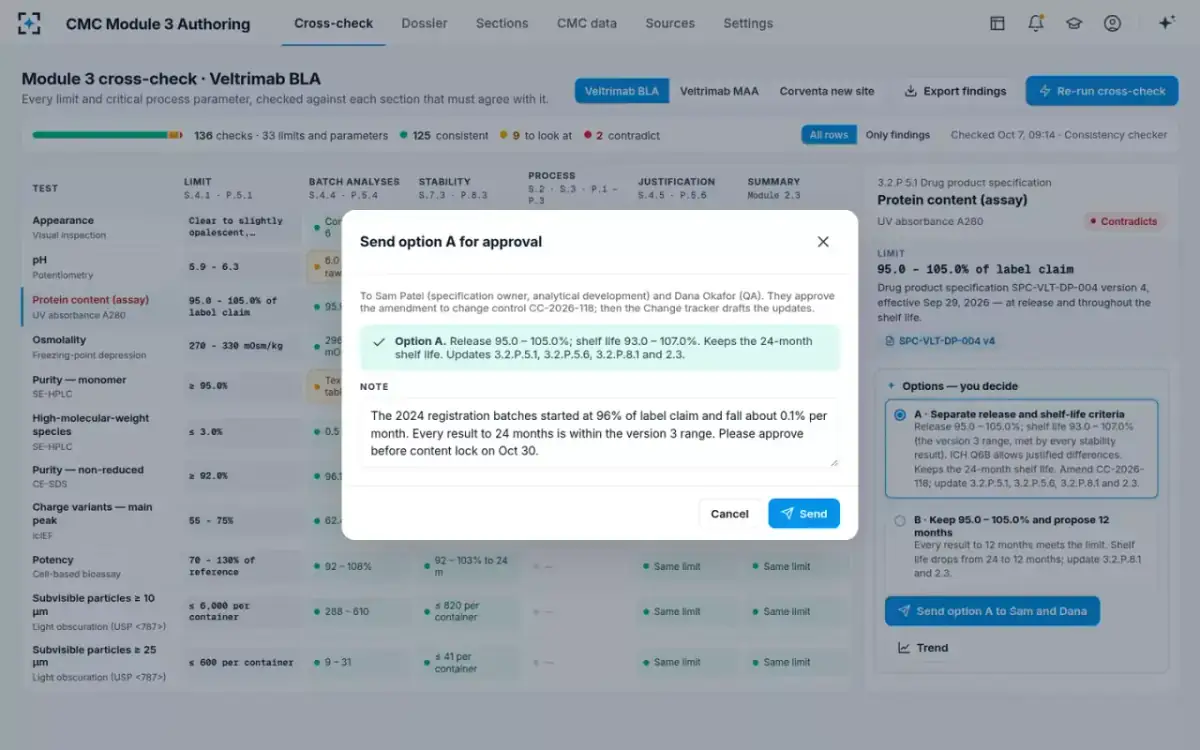
What the desk needs is not a report; it is the proposal, with its evidence, before anyone drafts text. In the sample filing a narrowed protein-content limit reaches the specification owner as one request carrying the option chosen, both source documents at their pages, and the lead's own note explaining the trend the stability batches show. The desk's job is then the one it is qualified for: deciding whether the data support the limit.
A limit change as the specification owner and quality assurance receive it
The process development lead and the two ranges
The process desk owns how the product is made: the steps, the set points, the ranges and what counts as operating inside the described process. Its characteristic complaint is a range stated without its kind. A process description gives one range for a parameter and the controls section gives a wider one, and both are correct — one is the normal operating range the plant runs to, the other the proven acceptable range characterisation established — but if neither says which, a validation batch run near the edge reads as a batch run outside its own process. In the sample filing exactly that happens to an anion-exchange load conductivity, and the difference between a proven acceptable range and a normal operating range is worked through parameter by parameter elsewhere in this series.
The reviewer at this desk is reading for something a writer cannot supply: whether the text describes the process that was actually validated. That is why the review cannot be delegated to the author of the section, and why a chain that collapses the two desks into one loses the check rather than saving the hour.
Quality assurance: the change control and the audit trail
Quality assurance owns the system, and the ICH's quality-system guideline is explicit that the system exists to be used across the whole life of the product: its elements and management responsibilities "are intended to encourage the use of science and risk based approaches at each lifecycle stage, thereby promoting continual improvement across the entire product lifecycle" (ICH Q10, §1.3). For a dossier that means two things. A limit may not move except through change control. And every step that moved it has to be reconstructible afterwards by someone who was not there.
The second is the part a dossier most often fails. The decision gets made in a meeting, the evidence lives in an inbox, and the record says only that version 5 superseded version 4. Part 11 asks for better of any system that keeps the records electronically, and one clause in it governs a drafting tool more than any other: a change to a record must never hide what the record said before (21 CFR 11.10(e)). A superseded certificate is kept and never cited, rather than overwritten; the earlier value stays readable beside the later one, which is what lets quality assurance reconstruct a decision months afterwards.
Who signs a regulatory submission, and what must the electronic signature show?
The regulatory CMC lead signs, after the named technical reviewer has signed first. If the signature is electronic, as it usually is now, the rule says what it must carry. A signed electronic record has to show, clearly, three things about the signing: the signer’s printed name, the date and time the signature was applied, and the meaning attached to it — the rule’s own examples are review, approval, responsibility and authorship (21 CFR 11.50(a)). The third item is the one teams forget to configure. "Signed" is not a meaning; "Approved for submission" is, and it is a different act from "Reviewed for scientific accuracy", which is what the technical reviewer does.
A second clause closes the obvious loophole. Whether the signature is electronic or handwritten, once it is applied to an electronic record it has to be bound to that record, so that nobody can cut it out, copy it or move it onto another record by ordinary means and so falsify it (21 CFR 11.70).
Read the two rules together and the chain has to be built, not asserted. Each signature names a person, a moment and a meaning, and is bound to the exact version of the section it was applied to. A section that changes after signature is a new section needing a new signature — which is why, in the sample filing, a proposed update to a limit arrives as a tracked change that still goes through the number check before anyone signs it again, and why a section with an open number finding cannot be signed at all.
Who owns what around a drug product control section, and what each signature means
| Desk | Owns | Reviews or signs | What its signature asserts |
|---|---|---|---|
| CMC regulatory writer | The text: the claim the section makes and how it reads | Authors 3.2.P.5.4 and the other control sections | Authorship — this is the section I wrote, and its numbers are the ones its sources give |
| Analytical development lead | The specification: tests, methods and acceptance criteria | Technical reviewer for the drug substance and drug product control sections | Review — the limits are mine, the data support them, and the section states them correctly |
| Process development lead | The process description, set points and ranges | Technical reviewer for the manufacture and process-control sections | Review — this describes the process that was characterised and validated |
| Quality assurance | Change control, deviations and the audit trail | Approves the change control behind any changed limit | Responsibility — the change was controlled, and the record of it can be inspected |
| Regulatory CMC lead | The dossier: whether the sections agree with each other | Signs each section after technical review, and decides every contradiction | Approval — “Approved for submission”, as 21 CFR 11.50(a)(3) requires a meaning to be stated |
What the public data says about the size of the function
There is less public data on this function than its size suggests, and what exists is broader than the desk. O*NET gives regulatory affairs specialists their own occupational code, 13-1041.07, with thirty listed tasks — but it reports employment for the wider group the code sits inside, compliance officers: 436,400 employees in 2025, with projected growth of 3% to 4% to 2035.
Read that as a direction, not a headcount for this desk. Compliance officers include environmental compliance inspectors, equal opportunity officers and customs brokers, a far wider group than the specialists writing the quality module of a biologics licence application. The useful figures in it are the two nobody disputes: the occupation is large, and it is growing at about the pace of the labour market rather than faster. Any claim that the function is about to be automated away has to explain a demand curve that is not falling.
For a loaded hourly rate in a business case, O*NET's published wage for the occupation is the only defensible public starting point, and it has to be adjusted openly — what a filing actually costs does that arithmetic in the open, with the multiplication shown.
What changes at each desk when agents draft the first version
The chain above has one property worth protecting: every judgement in it belongs to a named person who can refuse. So the test of any drafting software is not how much it writes but whether it moves a decision. In CMC Module 3 Authoring six agents do the reading and the arithmetic — four of them on the path of a single section, shown below — and each one has a line it does not cross.
One section from development report to signature, and who does each step
Agent
Source readerReads the development reports, certificates, specifications and prior filings, maps each to its section, and records version and effective date.
Never: indexes an unapproved draft as a source; superseded versions are kept and never cited
Agent
Data extractorPulls batch results, specification limits and stability results, each value carrying its document, version and page.
Never: stores only the raw instrument value where the certificate reports a different one
Agent
Section drafterWrites the section in the house template, starting from the closest approved prior text and filling its tables from the extracted values.
Never: writes a number without a cited source, or claims a shelf life the data do not support
Agent
Number checkerChecks every number in the draft against its source for value, unit, decimals, source version and the same value elsewhere.
Never: applies its own fix — findings propose, and a section with an open finding cannot be signed
A person decides
Writer applies the fixesReads each finding, applies the ones that are right, and rewrites the sentence where the finding shows the text is wrong rather than the number.
A person decides
Named technical reviewer signsThe specification owner or the process lead reviews the section whose limits or ranges are theirs, and signs for scientific accuracy.
A person decides
Regulatory CMC lead signsReads the section against the rest of the dossier, decides any contradiction from the options put to them, and applies the approval signature with its stated meaning.
Two desks change least. Quality assurance still approves every change control, and still reads a trail; it simply arrives complete. The regulatory lead still decides every contradiction and still signs; what changes is that the contradictions are found before content lock rather than by a reviewer at the agency months later. The desk that changes most is the writer's, and not by losing work: the transcription goes, the argument stays, and the hours that were spent re-reading other sections for agreement are spent on the two or three places where the sections genuinely disagree.
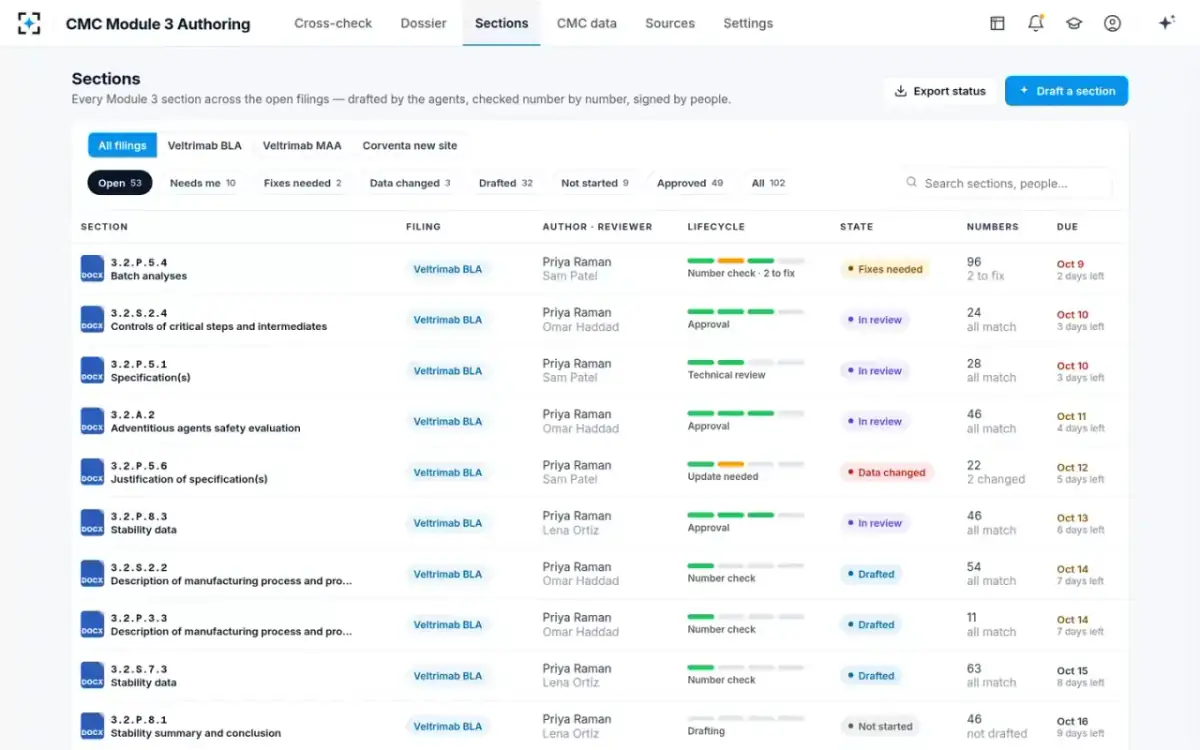
Every section in CMC Module 3 Authoring, with its author and its named reviewer
The chain also explains why a single chat assistant is the wrong shape for this work. A question-and-answer tool can draft a paragraph, but it cannot hold the property that makes the chain trustworthy: that the person who owns the limit is the person who approves a change to it. What agents may draft and what they may never decide takes that argument through the regulators' own words. To see the five desks on a real section, start from CMC Module 3 Authoring.
Questions people ask
What does a CMC regulatory affairs manager do?
They own the quality module of one or more applications: planning which sections are needed, assigning authors and technical reviewers, deciding how a contradiction between sections is resolved, approving the submission content and answering the agency's CMC questions after filing. In a small company the same person also writes sections; in a large one they mostly read across them and sign. The job is closer to an editor-in-chief with regulatory liability than to a writer.
What does a CMC regulatory writer do all day?
Three to five sections a week, in the sample filing, each assembled from a specification version, certificates of analysis, a stability report, a development or validation report and the last approved text for the same section. Most of the day is locating the right document and version and transferring values out of it: in our estimate of one section's thirteen and a half hours, about six go to finding and retyping, and three to writing.
Who owns the specification in a pharma company?
Analytical development, usually in the person who set the methods and the acceptance criteria, with quality assurance owning the change control that lets a criterion move. Regulatory CMC owns how the specification is stated and justified in the dossier, but not the numbers themselves. That split is why a narrowed limit needs two approvals and not one.
Who is the technical reviewer of a Module 3 section?
The person who owns the data the section rests on, not another regulatory writer. Control and batch-analysis sections go to the analytical lead; manufacture and process-control sections go to the process lead. O*NET lists exactly this task for the occupation — technical review of data or reports to be incorporated into regulatory submissions, to assure scientific rigour, accuracy and clarity — and it comes before, not after, the regulatory approval signature.
Will AI replace CMC regulatory writers?
Not on the evidence of what the chain actually requires. Every judgement in it — which fix to apply, whether a limit is supported, whether the process described is the one validated, whether to sign — is owned by a named person, and the final signature has to state a meaning and be bound to the record under 21 CFR 11.50 and 11.70. What agents remove is the transcription, which is where most of a section's hours go and none of its liability sits.