AI in regulatory CMC is already doing real work, and almost none of it is the work the word suggests. Agents read development reports and find the right version, pull values out of certificates and stability tables with the page they came from, draft a section in a house template from the closest approved prior text, check every number against its source, and compare every limit against every section that has to match it. What they do not do is decide anything: not a limit, not a range, not a shelf life, not a signature. CMC Module 3 Authoring is built on that division, and this guide is about where the line sits, who drew it, and how to tell whether a tool you are evaluating respects it.
The buying question most teams arrive with is the rules question — is this even allowed? — so that is the first section. The answer is more specific than either the optimists or the sceptics usually say, and it changes which questions are worth asking a vendor.
What one section and one filing look like when every number carries its source
96numbers
in one drafted section, each linked to the document, version and page it came from
2
of those 96 found wrong by the checker — and fixed by the writer, not by the agent
136checks
across 33 limits and critical process parameters, re-run the moment a stability report lands
0
limits, ranges or shelf lives changed by an agent — the number that has to stay zero
What does AI actually do in regulatory CMC today?
Six jobs, and they are all forms of reading. Finding the right document and version among thousands. Extracting a value and keeping its page with it. Assembling a first draft from approved prior wording. Checking a drafted number against the source it claims. Comparing a limit across the five or six sections that quote it. Noticing when a new version of a source lands and finding everywhere the old value was used.
None of those is writing in the sense that worries a quality lead. They are the mechanical half of a regulatory CMC desk's week — the half that, on our estimate of one section's thirteen and a half hours, consumes about six of them in finding and retyping alone. What each desk in the chain owns sets out whose hours those are.
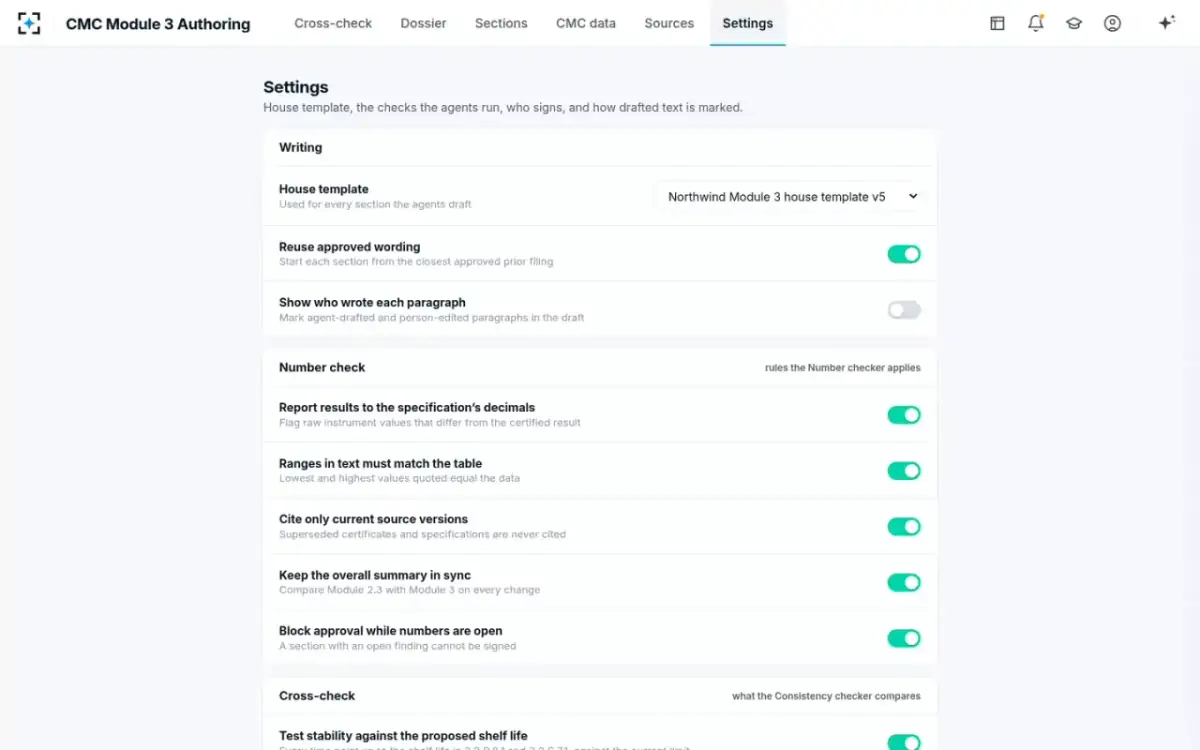
The jobs agents do not do are the ones with a name attached: choosing an acceptance criterion, deciding that a range is proven acceptable rather than normal operating, concluding that stability supports twenty-four months, applying a fix, approving a change control, signing. In the demonstration filing every one of those stays with a person, and the software is built so that it cannot be otherwise — a section with an open number finding cannot be signed at all.
Does the FDA's AI guidance apply to drafting a submission?
On its own words, no — and the distinction it draws is the one your quality system has to implement. The FDA's January 2025 draft guidance on AI for regulatory decision-making defines its scope twice. First, positively: it concerns AI models whose output is information or data meant to support a regulatory decision about a drug's safety, effectiveness or quality. Then, explicitly, it carves out the category a drafting tool falls into (FDA, Considerations for the Use of Artificial Intelligence To Support Regulatory Decision-Making for Drug and Biological Products, draft, January 2025).
The carve-out has two limbs. The guidance does not cover AI used in drug discovery, and it does not cover AI used for operational efficiency — the guidance's own examples are internal workflows, resource allocation and the drafting or writing of a regulatory submission — as long as that use has no impact on patient safety, drug quality or the reliability of nonclinical or clinical study results. The condition at the end of that sentence is the part that matters.
Three readings of that sentence are wrong and one is right. It does not say drafting with AI is approved — the agency approves products, not writing methods. It does not say the guidance is irrelevant to you: the exclusion is conditional on the use not impacting drug quality or the reliability of results, and a tool that silently changed a specification limit would fail that condition instantly. And it is not a loophole, because nothing in it touches what you file. The content of a biologics licence application is still governed by the rules that have always governed it, and the obligation is unforgiving about completeness: an application "shall not be considered as filed until all pertinent information and data have been received by the Food and Drug Administration" (21 CFR 601.2(a)). Whatever drafted it, the dossier is still yours.
The right reading is this. A tool that reads your documents, drafts from them and checks numbers against them sits outside that guidance's credibility framework, as the agency's own scope says — provided it does not produce the evidence. The moment a model generates a value rather than transcribing one, or predicts a stability outcome rather than reporting it, it has moved into the framework and owes the seven-step credibility assessment the guidance describes. The design question for a CMC authoring tool is therefore simple to state and easy to test: does it ever originate a number?
What the EMA expects of the applicant, not of the tool
Europe approaches it from the other end, and the result is the sentence a buyer should put in front of any vendor. The EMA's reflection paper on AI across the medicinal product lifecycle, adopted by the CHMP in September 2024, places the duty on the company rather than on the software. As a key principle, the paper makes the sponsor, the marketing authorisation applicant or holder, or the manufacturer responsible for ensuring that every algorithm, model, dataset and data-processing pipeline it uses is fit for purpose and meets the legal, ethical, technical, scientific and regulatory standards of EU legislation, GxP and current EMA guidance (EMA/CHMP/CVMP/83833/2023, §2.2).
That is not a formality. It means no vendor can transfer the obligation to itself, however the contract is drafted, and it means "the supplier is validated" is never a complete answer. The paper also supplies the vocabulary for sizing the risk: it "uses the term 'high patient risk' for systems affecting patient safety, while the term 'high regulatory impact' is used for cases where impact on regulatory decision-making is substantial." A drafting and checking tool is normally neither, because it neither treats patients nor produces the evidence — but only so long as the human decisions stay human. Remove the person who applies the fix and you have built a system of high regulatory impact without noticing.
The six jobs worth delegating to an agent
Here is the division as the demonstration filing implements it. Each agent has a job narrow enough to check and a line written into it.
The six agents of CMC Module 3 Authoring, each with a line it does not cross
Agent
Source readerReads development reports, certificates, specifications and prior filings; maps each to its section and records version and effective date.
Never: indexes an unapproved draft as a source — superseded versions are kept and never cited
Agent
Data extractorExtracts batch results, specification limits and stability results, each value carrying its document, version, page and a confidence.
Never: stores only the raw value: where a certificate reports a result, the reported result is what is kept
Agent
Section drafterWrites the section in the house template, starting from the closest approved prior text and filling its tables from the extracted values.
Never: writes a number without a cited source, or claims a shelf life the data do not support
Agent
Number checkerChecks every number in the draft against its source for value, unit, decimals, source version, the current specification and the same value elsewhere.
Never: applies a fix — it proposes, and a section with an open finding cannot be approved
Agent
Consistency checkerPuts every limit and process parameter on one grid against batch analyses, stability to the proposed shelf life, the process description, the justification and the summary, and proposes options for each contradiction.
Never: changes a limit, a range or a shelf life — options are proposed, the lead decides, the specification owner and quality assurance approve
Agent
Change trackerWatches the sources for new versions and new data, finds every place in every filing that uses a changed value, and drafts the update as a tracked change.
Never: commits an update — it arrives as a draft a person approves, and still goes through the number check
A person decides
The regulatory CMC leadDecides every contradiction from the options put to them, and signs each section after its named technical reviewer has signed.
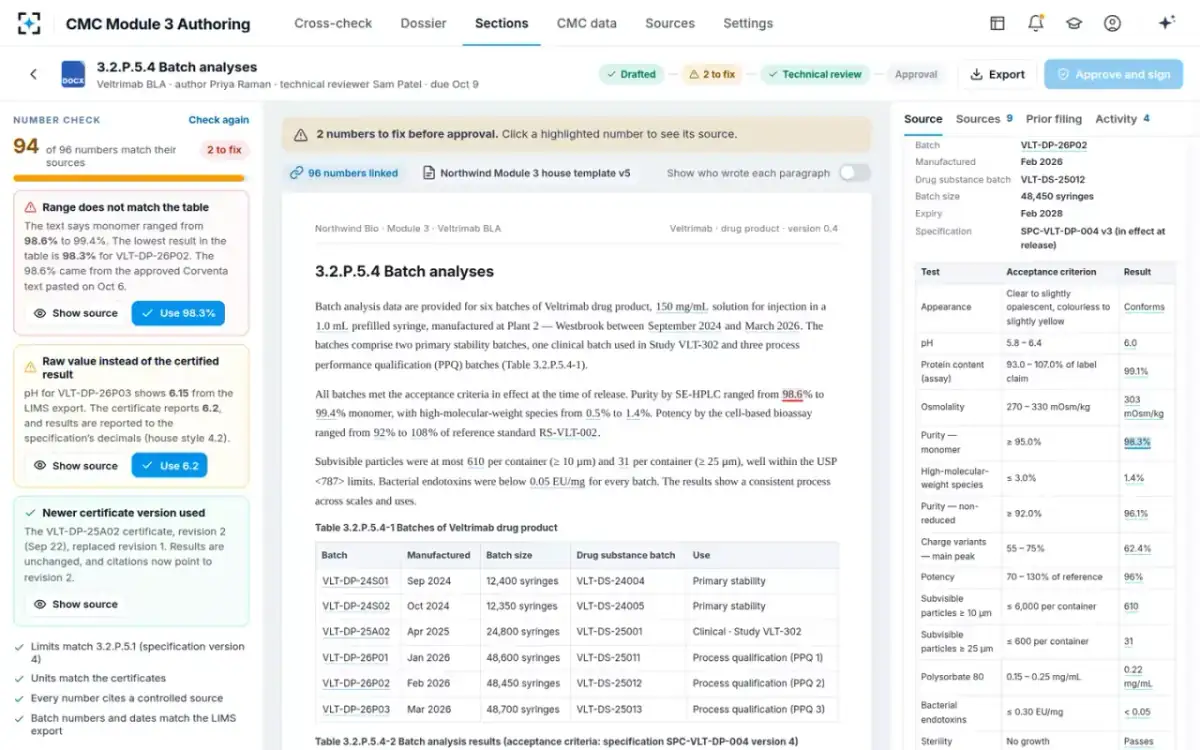
Notice what the division buys beyond speed. Separating the drafter from the checker means the text and the test are produced by different things, so a drafter that reuses a sentence from an earlier approved product cannot also be the judge of whether the number inside that sentence is still true. In the demonstration filing exactly that happens: a monomer range of 98.6% arrives with reused wording from a previous product while the lowest result in the new batch table is 98.3%, and it is the checker, not the drafter, that catches it.
The five things no agent may do
The five limits, what each one prevents, and how to test that a tool honours it
| No agent may… | Because | How you test it in an evaluation |
|---|---|---|
| Set or change an acceptance criterion | A limit is a commitment to the agency, owned by analytical development and moved only through change control approved by quality assurance. | Change a specification version mid-pilot and watch what the tool does. The right behaviour is to flag every section that quotes the old value and draft nothing until a person decides. |
| Set or change a proven acceptable or normal operating range | A range states what was characterised and validated. Widening it in text widens a claim nobody made in the laboratory. | Give it a parameter stated differently in two sections. It should name both sources and their pages and ask, not reconcile them silently. |
| Claim a shelf life the data do not support | The shelf life is one of the most consequential numbers in the quality module, and stability results run out before the claim does. | Feed it a stability result outside the limit at a time point inside the proposed shelf life. A correct tool raises a contradiction; a dangerous one writes around it. |
| Apply its own fix to a drafted section | If the thing that found the error also corrects it, nobody has reviewed anything and the signature means less than it says. | Look for a one-click fix that a person clicks. Then check whether a section can be signed while a finding is still open — it should not be. |
| Sign, or stand in for a signer | An electronic signature must carry a person's name, a time and a stated meaning, and must stay bound to the record it signed. | Ask whose name appears, what meaning is recorded, and what happens to the signature when the section changes afterwards. |
Of the five, the fourth is the easiest to under-test and the one that decides whether the rest hold. A tool that proposes a fix for a person to apply produces a reviewable trail of findings, decisions and reasons. A tool that applies its own fixes produces a clean document with no record of what it changed — which is a worse artefact than the messy one it replaced, because the errors it did not catch now look reviewed.
A finding that proposes, and a person who applies
Why a chat assistant is the wrong shape for a dossier
A common first experiment is a general assistant with documents attached, and it produces a convincing draft within an hour. The problem appears a month later, in review. The two approaches differ less in the quality of the prose than in what exists afterwards.
The same job — drafting a drug product control section from a certificate and a laboratory export
A chat assistant with documents attached: Somewhere in the attached files, or from the model. The draft reads the same either way, and the reader cannot tell which.
A chain of narrow agents: Each value carries the document, version and page it was extracted from, and the page opens at the passage.
A chat assistant with documents attached: Nothing happens. The assistant has no notion of versions unless the prompt mentions them.
A chain of narrow agents: Superseded documents are kept and never cited; a new version triggers a search for every place the old value was used.
A chat assistant with documents attached: The same model is asked to check its own output, which it does agreeably.
A chain of narrow agents: A separate checker tests every number against its source for value, unit, decimals and source version, and cannot apply its own fix.
A chat assistant with documents attached: Only for the sections pasted into the window, and only for as long as that window lasts.
A chain of narrow agents: Every limit is tested against every section that has to match it, re-run whenever a source changes.
A chat assistant with documents attached: A document and a conversation that is not part of the record.
A chain of narrow agents: A section, the findings raised on it, who decided what and when, and the sources at their pages.
A chat assistant with documents attached: Whoever is typing, with no distinction between the author and the owner of the specification.
A chain of narrow agents: Nobody, in the software. A change goes to the specification owner and quality assurance as a change control.
What the audit trail has to show
If the sections are drafted and checked electronically, Part 11 governs the records: a closed system needs secure audit trails, generated by the computer and time-stamped, that independently log when an operator creates, modifies or deletes an electronic record — and a change may never hide what was recorded before it (21 CFR 11.10(e)). For an agentic system that has a specific consequence: the agent's actions are operator entries too. Which source was indexed, which value was extracted from which page, which finding was raised, which option was proposed, who chose, who approved and who signed — each needs a time and an actor, and the earlier state has to remain readable.
The NIST AI risk framework makes the same requirement the foundation of trustworthiness: it ties trustworthy AI to accountability, and accountability in turn to transparency (NIST AI 100-1, §3.4). In a dossier, transparency is not an explanation of how the model works. It is the much more ordinary property that every assertion in a section can be traced to a document at a page, and every change to a person at a time.
Who decides, who approves and who signs: the settings in CMC Module 3 Authoring
Ten questions to ask any vendor, with the answer to listen for
Ten questions, and the rule behind each
- Where does each number in a drafted section come from, and can you open it?
Listen for: the document, its version and the page, opening at the passage. Anything vaguer means the draft cannot be checked faster than it could be rewritten.
- Can the tool change an acceptance criterion, a range or a shelf life?
The only safe answer is no, by design rather than by policy. Ask what happens when it finds the data contradict a limit: it should propose options and stop.
- Who applies a fix the checker proposes?
A person. Then ask whether a section can be signed with a finding still open — it should not be possible.
- What does it do with a superseded specification or certificate?
Keeps it and never cites it. A tool that deletes superseded sources cannot show a reviewer what the section said before.
- Does it ever generate a value it did not read?
This is the question that decides whether the FDA's credibility framework applies. A tool that transcribes and compares is outside it; a tool that predicts is not.
- What is recorded when an agent acts?
Time, actor, action and the previous state, under 21 CFR 11.10(e). Ask to see the trail for a change, not a description of it.
- Where do our source documents go, and are they used to train anything?
They should stay in your own environment and train nothing. Get it in the contract, not in the demonstration.
- How does the signature work?
Name, time and a stated meaning, bound to the version signed. Ask what happens to the signature when the section is edited afterwards.
- What happens on the day a specification version lands?
Every place the old value was used should be found across every open filing, and the updates drafted as tracked changes for a person to confirm.
- What will you measure in the pilot, and against what baseline?
If the vendor has no answer, write your own before you start. The baseline is your last completed filing, and it cannot be reconstructed afterwards.
How would you measure whether AI authoring worked?
Measure the thing the tool claims to do, not the thing that is easy to count. Four measures, all of them available inside a four-week pilot on your own documents, and none of them a speed figure.
First, extraction accuracy per field against a truth set you build by hand from twenty sections: how many values were read correctly, and of the errors, how many were silent rather than flagged low-confidence. Second, finding precision: of the checker's findings, how many were real errors and how many were noise. A checker that raises forty findings a section is likely to be switched off by the second week, whatever its recall. Third, the count that has to be zero — limits, ranges or shelf lives changed by an agent, and sections signed with a finding still open. Fourth, contradictions found before content lock, which is the measure that connects to money and is worked through in what a filing actually costs.
One warning about the first. Build the truth set from the certificates rather than from the previous filing's text, because the previous filing's text is exactly where inherited errors live. Checking a draft against the document it was copied from measures copying, not correctness.
And one about the second: a finding is only useful if it names both sources. "The number in this section disagrees with the number in that one" is actionable; "low confidence" is not. The clearest way to judge that in a demonstration is to ask for a contradiction to be shown — both documents, both pages, both values — and then ask who is allowed to resolve it. If the answer to the last part is anyone, or the software, stop there. For the harder cases behind those contradictions, how a limit is justified in the first place and how reuse and checking differ are the two arguments worth having before a pilot, not after it. To see the chain on a real section, start from CMC Module 3 Authoring.
Questions people ask
Is AI allowed in regulatory CMC submissions?
No rule forbids drafting a submission with software, and the FDA's AI guidance says in its own scope that it does not address AI used for operational efficiencies such as drafting or writing a regulatory submission, where that use does not affect patient safety, drug quality or the reliability of study results. What is regulated is the content you file and the records behind it, which remain yours. The practical limit is therefore internal: whatever your quality system can show was controlled.
Do you have to tell the FDA that AI drafted a section?
The draft guidance places drafting outside its scope, so it sets no notification duty for it; the duties it describes attach to AI that produces information or data supporting a regulatory decision. That is not a reason to be silent internally: the EMA's reflection paper makes the applicant responsible for every model and pipeline used, so the use belongs in your own quality system and its validation record even where no filing statement is required.
What should an AI CMC tool never do?
Five things: set or change an acceptance criterion, set or change a proven acceptable or normal operating range, claim a shelf life the data do not support, apply its own fix to a drafted section, or sign. The first three are commitments to a regulator; the fourth removes the review; the fifth is reserved to a person by the rules on electronic signatures.
How do you stop AI inventing numbers in a dossier?
By making the drafter unable to write a number it cannot cite, and by having a separate checker compare every number in the draft with its source for value, unit, decimals and source version. Two different components, so the thing that writes is not the thing that judges. Then test it adversarially in the pilot: hand it a value that appears differently in two documents and see whether it reconciles them silently or raises both.
Does Part 11 cover a CMC section drafted with AI?
It applies to the electronic records and signatures, however they were produced. In practice that means an agent's actions are recorded like anyone else's — what it indexed, extracted, drafted or flagged, with a time and an actor — and that changes must not obscure what was previously recorded. The signature on the finished section still needs a name, a time and a stated meaning, and must stay bound to the version it signed.
What questions separate a serious CMC tool from a general assistant?
Three. Can you open the source behind any number, at its page? Can the tool change a limit, and if it finds one contradicted, does it propose options and stop? And what exists after the section is written — a document, or a document plus the findings, the decisions, the approvals and the sources? A general assistant answers the first vaguely and the third with a conversation that is not part of the record.