A proven acceptable range and a normal operating range are two different claims about the same process parameter. The proven acceptable range is the characterised range over which the parameter has been shown to produce material of the required quality; the normal operating range is the narrower band the process is actually run in. Module 3 gives each a home — the process description in 3.2.S.2.2 and 3.2.P.3.3, the acceptance criteria in 3.2.S.2.4 and 3.2.P.3.4, and the characterisation data in the development sections — and the trouble starts when a section states a number without saying which of the two it is. Botminds’ CMC Module 3 Authoring puts every critical process parameter on one grid against the sections and reports that state it, so a range that appears twice with two values is a question raised before content lock rather than after filing.
The worked clash on this page is the solution’s sample filing: a fictional company, an invented biologic, invented batches and reports. ICH Q8(R2), Q11 and M4Q(R1) are quoted from their current Step 4 texts.
One parameter, two sections, three validation batches
6
critical process parameters on the sample filing’s grid
6.0 – 8.0mS/cm
the load conductivity range stated in the process description
5.0 – 8.0mS/cm
the range stated in the controls section for the same step
5.6mS/cm
what the second validation batch actually ran at
What is the difference between a proven acceptable range and a normal operating range?
ICH Q8(R2) defines one of the two terms and not the other, which is itself worth knowing: the proven acceptable range is a defined ICH term, and the normal operating range is an industry term that regulators use but ICH does not define in Q8.
A characterised range of a process parameter for which operation within this range, while keeping other parameters constant, will result in producing a material meeting relevant quality criteria.
ICH Q8(R2), Glossary, Proven Acceptable Range
Three words in that definition carry the whole distinction. Characterised: it comes from experiments, not from intention. While keeping other parameters constant: it is a univariate statement, which is why a set of them is not a design space. And relevant quality criteria: the range is only proven against the attributes that were measured.
The normal operating range is a different kind of claim altogether — it is where the process is run, and it is usually set well inside the proven acceptable range so that ordinary variation never reaches the edge. European regulatory guidance uses the term in exactly that sense when it describes scale-up: “during scale-up the commercial process is generally conducted and validated in a specific area of the design space, defined as the target interval or Normal Operating Range (NOR)” (EMA guideline on process validation for finished products). A target interval, in other words, chosen inside a wider characterised space.
Two ranges, two kinds of claim
Normal operating range: The band the process is intended to run in — a target interval around the set point.
Proven acceptable range: A characterised range over which the parameter has been shown to yield material meeting the relevant quality criteria.
Normal operating range: Process design and manufacturing experience: tight enough that ordinary variation stays inside it.
Proven acceptable range: Univariate experimentation, usually at small scale, reported in the development sections.
Normal operating range: A deviation against the batch instruction, investigated under the quality system. Not, by itself, a regulatory change.
Proven acceptable range: Operation outside the characterised evidence. What that means for the filing depends on what the dossier committed to.
Normal operating range: Manufacturing and process development, through the batch instruction.
Proven acceptable range: Process development, through the characterisation study that established it.
Normal operating range: Not a design space, and not necessarily what the dossier states.
Proven acceptable range: Not a design space either — Q8(R2) is explicit that a combination of them does not make one.
Why a combination of proven acceptable ranges is not a design space
This is one of the most useful passages in Q8(R2) for anyone writing 3.2.S.2 or 3.2.P.2, and it is two sentences long: “a combination of proven acceptable ranges does not constitute a design space. However, proven acceptable ranges based on univariate experimentation can provide useful knowledge about the process” (ICH Q8(R2), section 2.4.5).
The reason is the clause in the definition — while keeping other parameters constant. A proven acceptable range for temperature was established with pH, time and concentration held where they were. A proven acceptable range for pH was established with temperature held where it was. Nothing in either experiment says what happens at the edge of both at once, and interactions are exactly where processes fail. Drawing a box around the two ranges and calling it a design space asserts something neither experiment tested.
The distinction has a practical consequence, because a design space carries a regulatory status that a set of proven acceptable ranges does not. Q8(R2) is equally direct about that: “working within the design space is not considered as a change. Movement out of the design space is considered to be a change and would normally initiate a regulatory post approval change process.” That status attaches to a design space that has been described in the dossier and approved — and Q11 says where it has to be described: “any design spaces in the manufacturing process should be included as part of the manufacturing process description” (ICH Q11, section 4). A multivariate space that was never filed has no such status, however well characterised.
Where each range belongs in Module 3: 3.2.S.2.2 or 3.2.S.2.4?
M4Q(R1) does not use the words “proven acceptable range” or “normal operating range” anywhere. What it does is assign jobs to sections, and the jobs decide where each number belongs. For the drug substance:
Which section states what about a process parameter
| Section | What M4Q(R1) asks it for | What that means for a range |
|---|---|---|
| 3.2.S.2.2 Description of manufacturing process and process controls | A description of the process and its controls — and the section the guideline treats as the applicant’s binding undertaking on how the drug substance is made. | Whatever range appears here is a range the company has undertaken to work within. If it is the operating range, say so; if it is wider, say what it is. |
| 3.2.S.2.4 Controls of critical steps and intermediates | "Tests and acceptance criteria (with justification including experimental data) performed at critical steps identified in 3.2.S.2.2 of the manufacturing process to ensure that the process is controlled." | An acceptance criterion applied at a critical step, with the data behind it. It is a control, not a description of intent. |
| 3.2.S.2.6 Manufacturing process development | The development of the process, including the studies that characterised it. | Where a characterised range and the experiments that established it are reported, with the development report behind them. |
| 3.2.S.2.5 Process validation or evaluation | The description, documentation and results of the validation studies for critical steps. | Where the values the validation batches actually ran at are reported — the numbers a reviewer will compare with both of the above. |
| 3.2.P.3.3 and 3.2.P.3.4, for the drug product | The same two jobs on the product side. For the product, M4Q is explicit: "associated numeric values can be presented as an expected range. Numeric ranges for critical steps should be justified in Section 3.2.P.3.4." | A range in the process description is permitted and expected — and its justification lives one section later. |
Read that way, the question “where does the proven acceptable range go?” dissolves into a better one: what is this number doing in this section? A commitment to operate, a criterion to meet at a critical step, or evidence of what was characterised. The three can be the same number, and often are not.
The failure: a validation batch that reads as outside its own process
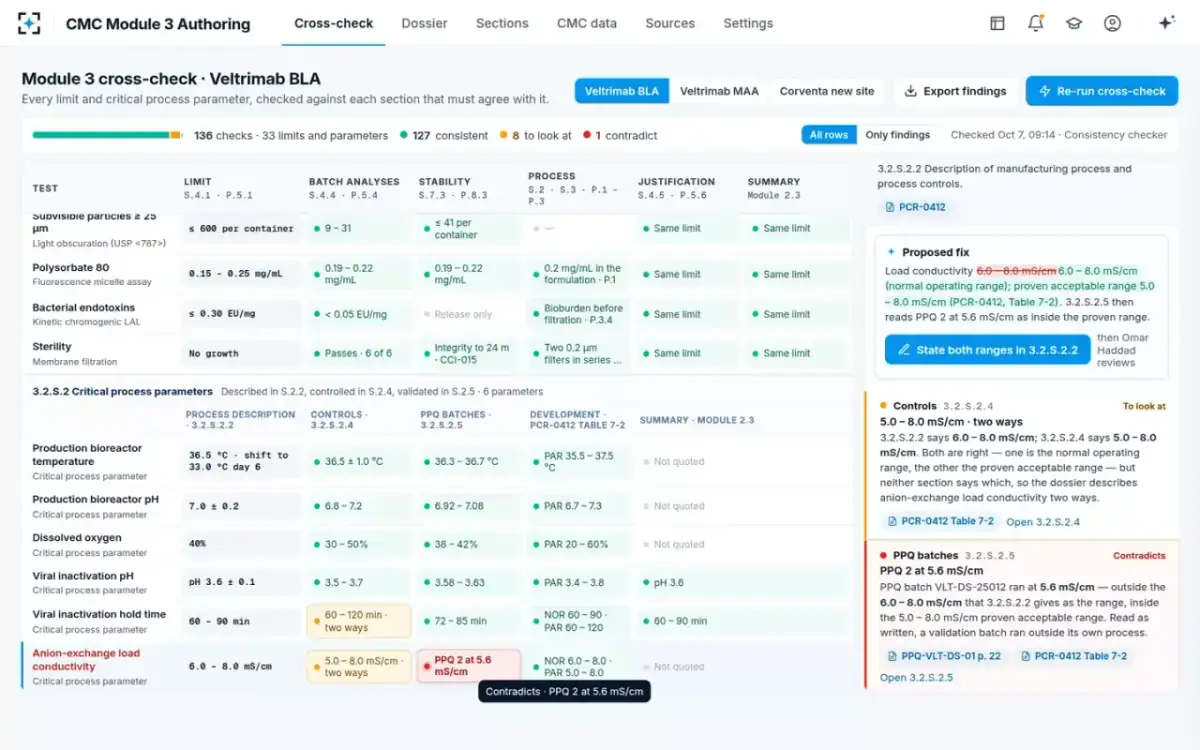
In the sample filing, the anion-exchange load conductivity is given as 6.0 – 8.0 mS/cm in the process description and 5.0 – 8.0 mS/cm in the controls section for the same step. The first is the normal operating range; the second is the proven acceptable range, characterised in a development report and reported in its Table 7-2. Both are correct numbers. Neither section says which it is.
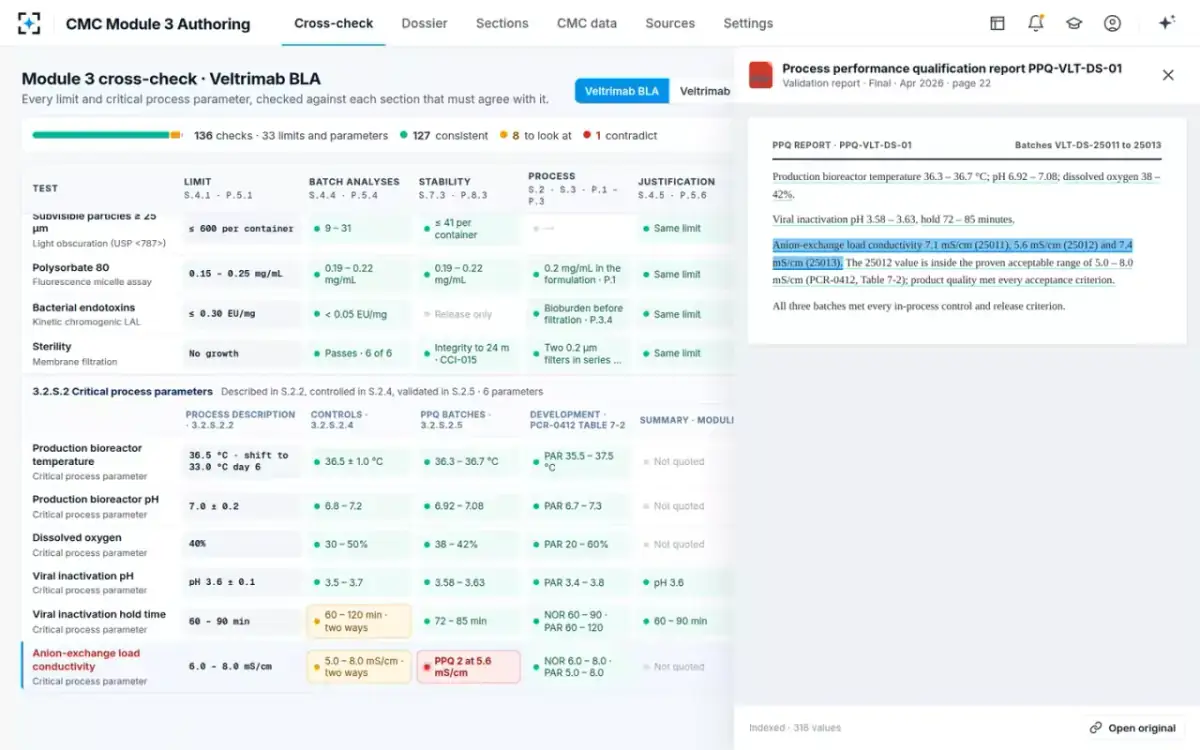
The second process performance qualification batch ran at 5.6 mS/cm. The validation report gives 7.1, 5.6 and 7.4 mS/cm for the three batches. Read against the controls section, 5.6 is inside the stated range and nothing is wrong. Read against the process description — the section the guideline calls the applicant’s commitment — 5.6 is outside it, and the dossier is reporting a validation batch that did not follow the process being registered.
One parameter, three statements about it, and the batch that falls between them
3.2.S.2.4 Controls of critical steps
3.2.S.2.2 Process description
Validation batches, as run
The 5.6 mS/cm batch is inside one stated range and outside the other. Which answer a reviewer reaches depends on which section they read first.
This is a documentation failure, not a manufacturing one. The batch did what the characterisation said it could do. What the dossier failed to do was say which of its two numbers was the commitment and which was the evidence.
Every critical process parameter compared across its sections, in CMC Module 3 Authoring
What the PPQ protocol has to say about ranges
The validation protocol is where the two ranges meet a decision, because it has to say what the batches will be run at and what will be done if one of them is not. Three choices have to be made in writing, before the batches run.
The first is where the batches will be set. Running all three at the set point demonstrates reproducibility at the target but tells a reviewer nothing about the stated range; running them across the operating range demonstrates the range but with fewer replicates at any point. Either is defensible if the protocol says which it is doing and why. What is not defensible is a protocol that is silent and batches that then scatter.
The second is how many batches. European guidance expects production-scale validation data in the dossier at submission for a biological or biotechnological product, or where a non-standard method of manufacture is proposed, and sets the expectation at “a minimum of 3 production scale batches” unless otherwise justified — with the number to be based on “the variability of the process, the complexity of the process / product, process knowledge gained during development, supportive data at commercial scale during technology transfer and the overall experience of the manufacturer” (EMA guideline on process validation for finished products). Three is the default rather than an absolute floor — the same guideline accepts data on one or two production-scale batches where pilot-scale batches and a justification support them — and the reasoning behind the number is itself part of the dossier.
The third is what the protocol says about a value outside a range. A protocol that defines in advance how an excursion will be assessed, and against which range, is a protocol that cannot be argued with afterwards. A protocol that leaves it open invites the assessment to be written after the result is known, which is the weakest position the applicant can be in.
How a reviewer reads 3.2.S.2.2 against 3.2.S.2.4 and the development report
A reviewer does not read the dossier in the order it was written. They read the process description to find out what is being registered, the controls section to find out what is controlled, and the validation report to find out what actually happened — and they compare the three. The questions follow mechanically from differences between them.
What a reviewer compares, and what each difference prompts
| What they compare | What a clean dossier shows | What a difference prompts |
|---|---|---|
| The range in the process description against the acceptance criterion in the controls section | Either the same number, or two numbers each labelled for what it is. | Which of these is the commitment? Why are they different? Was the wider one approved? |
| Each validation batch value against the process description | Every batch inside the range the dossier commits to. | Was this batch run outside the registered process, and if not, why does the section say it was? |
| The characterised range in the development section against both | The operating range inside the characterised range, with the characterisation data cited. | Is the stated range actually supported by experiments, or is it an intention? |
| The parameters called critical against the parameters given ranges | Every critical parameter has a range and a criterion; the criticality assessment explains the rest. | Why is this parameter critical but uncontrolled, or controlled but not called critical? |
| The design space, if one is claimed, against the process description | The design space described as part of the process description, as ICH Q11 asks. | Is this a design space with regulatory status, or a set of univariate ranges presented as one? |
The cited validation report, open at the page the value came from
Writing both ranges so that neither is ambiguous
The fix in the sample filing was not to change a number. It was to state both ranges in the process description and say what each one is. That is the general answer, and it costs one sentence per parameter.
How to write a parameter so a reviewer cannot misread it
- Name the range, every time it appears
Not "load conductivity 6.0 – 8.0 mS/cm" but "load conductivity is controlled at 6.0 – 8.0 mS/cm, within a characterised range of 5.0 – 8.0 mS/cm established in the process characterisation study." One sentence closes the question.
- Give the set point as well as the range
A range without a target leaves a reviewer unable to tell whether a value near the edge was intended or exceptional.
- Cite the study that characterised the wider range
A characterised range asserted without its experiment is an intention. Name the report and the table.
- Use the same words in every section
If the process description says "characterised range" and the development section says "proven acceptable range" for the same evidence, a reader has to work out that they are the same thing. Pick one term and keep it.
- Say what the criterion in the controls section is for
M4Q asks that section for tests and acceptance criteria at critical steps, with justification including experimental data. Write it as a criterion with its data, not as a second range.
- Reconcile the validation values before the section is signed
Every value in the validation report, against every range the dossier states. If one falls outside, the section has to address it rather than leave it to be found.
Is moving within a proven acceptable range a change?
It depends entirely on what the dossier states, and that is the honest answer rather than an evasive one. Q8(R2) gives the clear rule only for a design space: working within an approved design space is not considered a change, while movement out of it is a change that would normally initiate a regulatory post-approval change process. A set of proven acceptable ranges is not a design space, so that rule does not transfer to it.
What governs instead is what the process description commits to. If the registered description states the operating range, then running outside that range — even inside a wider characterised range — is operating outside the registered process, whatever the characterisation showed. If the registered description states the characterised range and identifies the operating range as a narrower internal target, then moving the target within it is a manufacturing decision handled under the quality system. The applicable regional post-approval change rules then decide what, if anything, has to be reported.
Which is why the writing matters more than the terminology. The sections decide the regulatory consequence, not the vocabulary. A team that cannot say which of its ranges is registered cannot say whether a change is reportable — and that is a question that arrives for the first time when a batch has already run.
Six checks to run on every critical process parameter
The comparison that catches this family of problems is mechanical, which is the point: it can be run on every parameter in every filing, not only on the ones somebody is worried about.
Six comparisons, per parameter, before content lock
- The process description against the controls section
Same step, same parameter: are the ranges the same, and if not, does each say what it is?
- Both against the characterisation data
Is the stated range inside the range the development study actually characterised, and is that study cited?
- Every validation batch value against both ranges
Each batch, each parameter. A value inside one and outside the other is the clash this page is about.
- The criticality list against the controlled list
Every parameter identified as critical in the process description should have an acceptance criterion in the controls section, as M4Q asks.
- The same parameter across filings
A parameter described one way in a licence application and another in a supplement for a second site is a question waiting in the second review.
- The summary against the sections
Module 2.3 quotes the process description. A range corrected in 3.2.S.2.2 and not in 2.3 reproduces the clash one module up.
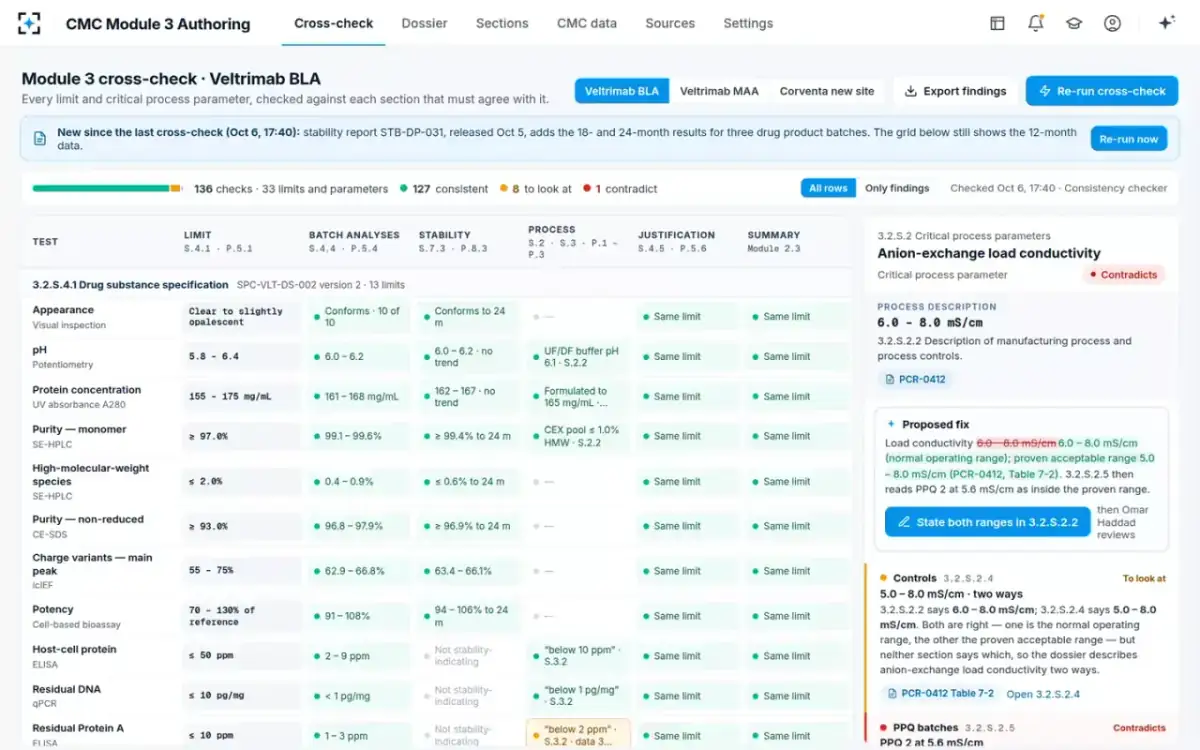
The whole grid, with the parameter rows among the limits
A parameter written this way is also easier to justify, because the criterion and the evidence are already named in the same sentence — the same discipline a justification of specification applies to acceptance criteria. The map of which Module 3 section has to agree with which is in what goes in each Module 3 section. To see the parameter grid on a filing of your own, start from CMC Module 3 Authoring.
Questions people ask
Where do you put the proven acceptable range in Module 3?
M4Q(R1) does not assign the term to a section, so the answer is decided by what the number is doing. A range the company commits to operating within belongs in the process description, 3.2.S.2.2 or 3.2.P.3.3. An acceptance criterion applied at a critical step belongs in the controls section, 3.2.S.2.4 or 3.2.P.3.4, with its justification and experimental data. The characterised range and the study that established it belong in the development sections. What matters most is that whichever sections carry a number say which of the three it is.
Is operating outside the normal operating range a deviation?
Against the batch instruction, yes: the operating range is what the instruction says, and a batch outside it is investigated under the quality system. Whether it is also a regulatory matter depends on what the dossier states. If the registered process description gives the operating range, operating outside it is operating outside the registered process; if the description gives a wider range and identifies the operating range as an internal target, it is not.
Do PPQ batches have to run at the set point?
No rule requires it, and either approach can be justified. Running at the set point demonstrates reproducibility at the target; running across the stated range demonstrates the range. What the protocol cannot do is leave the choice unstated, because an unplanned spread of values then has to be explained after the fact — and the explanation will be read against whatever range the dossier happens to state.
What belongs in 3.2.S.2.2 and what belongs in 3.2.S.2.4?
3.2.S.2.2 is the description of the manufacturing process and process controls, and M4Q(R1) treats what it says as the applicant’s binding undertaking on how the drug substance is made. 3.2.S.2.4 holds “tests and acceptance criteria (with justification including experimental data) performed at critical steps identified in 3.2.S.2.2”, plus the control of isolated intermediates. One describes what will be done; the other states what will be tested and what result is acceptable.
Can a design space be built from proven acceptable ranges?
No. ICH Q8(R2) states plainly that a combination of proven acceptable ranges does not constitute a design space, because each was established univariately, with the other parameters held constant, and nothing in those experiments covers the interactions. Q8(R2) does add that such ranges “can provide useful knowledge about the process” — they are evidence, just not a multivariate space.
Does a design space have to be in the process description?
ICH Q11 says so for the drug substance: “any design spaces in the manufacturing process should be included as part of the manufacturing process description.” That placement is what gives the space its regulatory status, because the process description is the applicant’s commitment. A multivariate space that was characterised but never described in the dossier is knowledge, not a design space with the consequences Q8(R2) attaches to one.