How much does it cost to file a BLA? The fee is the easy half of the answer and the smaller one: for fiscal year 2026 the US application fee for a human drug application requiring clinical data is $4,682,003, published in the Federal Register and the same whether the dossier is excellent or barely adequate. The expensive half is everything the fee does not buy — the hours inside the dossier, and the chance that the first review cycle is not the last. CMC Module 3 Authoring exists for the quality module of that second half: it drafts each section from the development records, checks every number against its source and puts every limit on one grid before content lock, because the cheapest contradiction is the one found before anybody else reads it.
Everything below separates three kinds of figure, and says which is which at each use: published rates and rules, peer-reviewed research, and our own arithmetic on those two with the multiplication shown. The filing described in the screens is a demonstration — a fictional company, product and batches.
The published numbers a filing's business case rests on
$4,682,003
US application fee for a human drug application requiring clinical data, fiscal year 2026
$442,213
annual programme fee per product identified in an approved application, same year
6months
the FDA review goal for a Class 2 resubmission of an NDA or a BLA
$985.3m
median capitalised research and development investment behind one approved new medicine
How much does it cost to file a BLA?
Three figures, in rising order of uncertainty. The fee is certain and public. The hours are estimable from your own last filing. The second cycle is a probability you can only price, not know — and it is the largest of the three.
The fee first. The FDA sets its rates once a year and publishes the arithmetic. For fiscal 2026 the agency divided the revenue to be raised from application fees, $311,207,600, by the average number of fee-paying applications over ten years: "The result is a fee of $4,682,003 per full application requiring clinical data, and $2,341,002 per application not requiring clinical data" (FDA, Prescription Drug User Fee Rates for Fiscal Year 2026). A biologics licence application requiring clinical data pays the first of those. Separately, once a product is approved, an annual programme fee of $442,213 is assessed for each product identified in an approved application as of 1 October of that year — which means a delayed approval postpones that fee rather than doubling it.
Two things the fee notice does not say are worth saying plainly. It sets no separate rate for a resubmission after a complete response letter: the published schedule has three rates, two application rates and the programme fee. And it sets no rate that varies with the quality of what you file. The money a better dossier saves is never saved on the fee.
The fee is not the filing: the hours inside the dossier
The quality module is the part of an application written by the most people over the longest period. In the demonstration filing it is 45 sections, each with one author and one named technical reviewer. A writer carrying three to five sections a week is, on that arithmetic, a quarter of a year of one person's time for the drafting alone — before the reviewers, the lead who signs each section, and the rounds that follow a late change.
There is no public figure for how long a Module 3 section takes to write, and we will not invent one. What we can do is set out our own estimated split and let a reader test it against their own last filing, which is the only measurement that matters for a business case.
Where one section's hours go, and what the agents are designed to change
| The work | By hand (estimated) | With the agents (design target) | Why it moves, or does not |
|---|---|---|---|
| Finding the right report, certificate and version | 2.0 h | 0.5 h | The sources are indexed by section, version and effective date, so the search becomes a lookup. It does not go to zero: somebody still decides which report is the right one. |
| Retyping values from certificates and stability tables | 4.0 h | 0.5 h | The largest single saving, and the least interesting work in the dossier. Values arrive extracted, each carrying its document, version and page. |
| Writing the text from prior approved wording | 3.0 h | 2.0 h | A draft in the house template starts from the closest approved prior text. The writer still writes: the hour saved is the blank page, not the argument. |
| Checking every number against its source | 2.5 h | 1.3 h | The check runs on every number rather than on a sample, but a person reads each finding and applies each fix, which is the part that keeps the time. |
| Re-reading other sections and the summary for agreement | 2.0 h | 1.5 h | Cross-section disagreement is surfaced rather than hunted. The hours left are spent on the two or three places where the sections genuinely disagree. |
| Total for one section | 13.5 h | 5.8 h, a design target | The second column is a design target for the solution, not a measured customer result. Treat it as the hypothesis your own pilot is testing. |
Turn that into money and the honesty of the arithmetic matters more than the result. The only defensible public wage for this work is O*NET's, and it is reported for the wider compliance officer group that regulatory affairs specialists sit inside: a 2025 median of $38.81 an hour. At that rate, 45 sections at 13.5 hours is 607.5 hours and about $23,600 of authoring time; at the 5.8-hour design target it is 261 hours and about $10,100. The difference, roughly $13,500 a filing, is real and it is also trivially small against a $4.68 million fee. Anyone selling authoring software on the labour saving alone is selling the wrong number — and the wage above understates a senior CMC desk, which is a further reason not to build the case on it. Who actually sits at each desk explains why the saved hours land where they do.
What a second review cycle costs: six months, by FDA's own goal
The real money is in the review cycle, and here the timetable is published rather than estimated. After a complete response letter on a BLA the applicant resubmits or withdraws (21 CFR 601.3), and a resubmission starts a new review clock. FDA's user-fee commitments set the clock for NDAs and BLAs alike: “review and act on 90 percent of Class 2 resubmitted original applications within 6 months of receipt”, and Class 1 resubmissions within two months (FDA, PDUFA VII performance goals, fiscal years 2023–2027). For an NDA the regulation says the same in its own words: a Class 2 resubmission “constitutes an agreement by the applicant to start a new 6-month review cycle beginning on the date FDA receives the resubmission” (21 CFR 314.110(b)(1)(ii)). The class is the agency's call, and the heavier the new data, the likelier the six.
Six months is not an administrative inconvenience. The BLA rule gives the applicant one year from the complete response letter before the agency may treat a failure to resubmit or withdraw as a request to withdraw, which tells you how long these cycles can run in practice. And the clock starts at receipt of the resubmission, not at the letter — so the months spent generating whatever the deficiency demanded sit on top.
How often is quality the reason for a complete response letter?
Often enough that it belongs in the business case, and the best public evidence is narrower and more useful than the round numbers in circulation. FDA authors analysed the refuse-to-file letters issued on new drug applications and efficacy supplements submitted from 2008 to 2017: 103 letters, 644 identified refusal reasons. "Overall, 84.5% (544 of 644) of the refusal reasons were for scientific deficiencies; most reasons were related to drug efficacy and safety (196 [30.4%]) and drug quality (125 [19.4%])" (Chahal, Mukherjee, Sigelman and Temple, JAMA Internal Medicine, 2021).
What 644 refusal reasons were about, in the FDA's own analysis of its refuse-to-file letters
644 refusal reasons in 103 refuse-to-file letters, new drug applications and efficacy supplements
- Drug efficacy and safety · 30%
- Drug quality · 19%
- Other scientific deficiencies · 35%
- Application organisation or legal · 16%
Refuse-to-file is the earlier and rarer event; a complete response letter comes after a full review. For that stage the sharpest recent evidence is a systematic review of approved cell and gene therapy products' regulatory histories, which found that "major amendments occurred in roughly half of applications, and complete responses had the most significant impact. Quality deficiencies appeared in all complete responses and were the predominant barrier, while clinical and labeling issues were less frequent but meaningful when present" (Babcock and Riggins, Cytotherapy, 2026).
Read the two together carefully, because they count different things. The first counts reasons inside refusal letters across all new drug applications and finds quality is about one reason in five. The second counts complete response letters for one modality and finds quality present in every one of them. Neither says most applications are rejected for quality. Both say quality is a recurring reason an application is sent back — and a quality deficiency is the kind a sponsor can see coming, because it is a disagreement between documents the sponsor already holds.
Pricing a day of delay against the cost of development
What does a day of delay cost? There is no published answer for an arbitrary product. There is a defensible way to bound it, using two published figures and one stated assumption.
Wouters, McKee and Luyten, counting the cost of failed trials, put the median capitalised research and development investment behind one new medicine at $985.3 million (95% CI $683.6 million to $1,228.9 million) and the mean at $1,335.9 million (JAMA, 2020), capitalising at a 10.5% real cost of capital. Take that capital rate at face value and apply it to the median investment for half a year: $985.3 million × ((1.105)0.5 − 1) is about $50 million, or roughly $277,000 for each day of a six-month second cycle.
That number is ours, not the study's, and it is a carrying cost on capital already spent — not lost revenue, which for a product with a market is usually larger. For a product whose development investment is well below the median it is proportionally smaller. Used honestly it does one job: it puts the authoring argument in scale. Thirteen thousand dollars of saved authoring time is noise. A changed probability of a second cycle is not.
What a filing actually costs, as a sum rather than a fee
The fee
$4,682,003
Fiscal 2026, application requiring clinical data. Published, certain, and unaffected by the quality of what you file.
Finance
The hours inside the dossier
sections × hours × loaded rate
Our estimate for the quality module alone: 45 × 13.5 h × $38.81 ≈ $23,600 of authoring, before reviewers and the lead who signs.
Regulatory CMC
The expected cost of a second cycle
P(second cycle) × 6 months of delay
Six months is FDA’s review goal for a Class 2 resubmission. Six months of carrying cost on the median capitalised development investment is about $50 million (our arithmetic).
The programme
What better agreement buys
a lower P, not a lower fee
Every contradiction found before content lock is one that cannot become a deficiency. That is the only term in this sum that authoring work can move.
The regulatory CMC lead
Where the time goes before the agency ever sees it
A filing has an internal deadline that matters more than the submission date: content lock, the day the sections stop changing. In the demonstration filing the application stands at 76% — 34 of 45 sections approved — with content lock 23 days away, beside two other open filings at 31% and 8%. The useful thing about that view is not the percentage but what sits behind it: which sections are blocked, and on what.
CMC Module 3 Authoring: one filing at 76%, content lock 23 days out
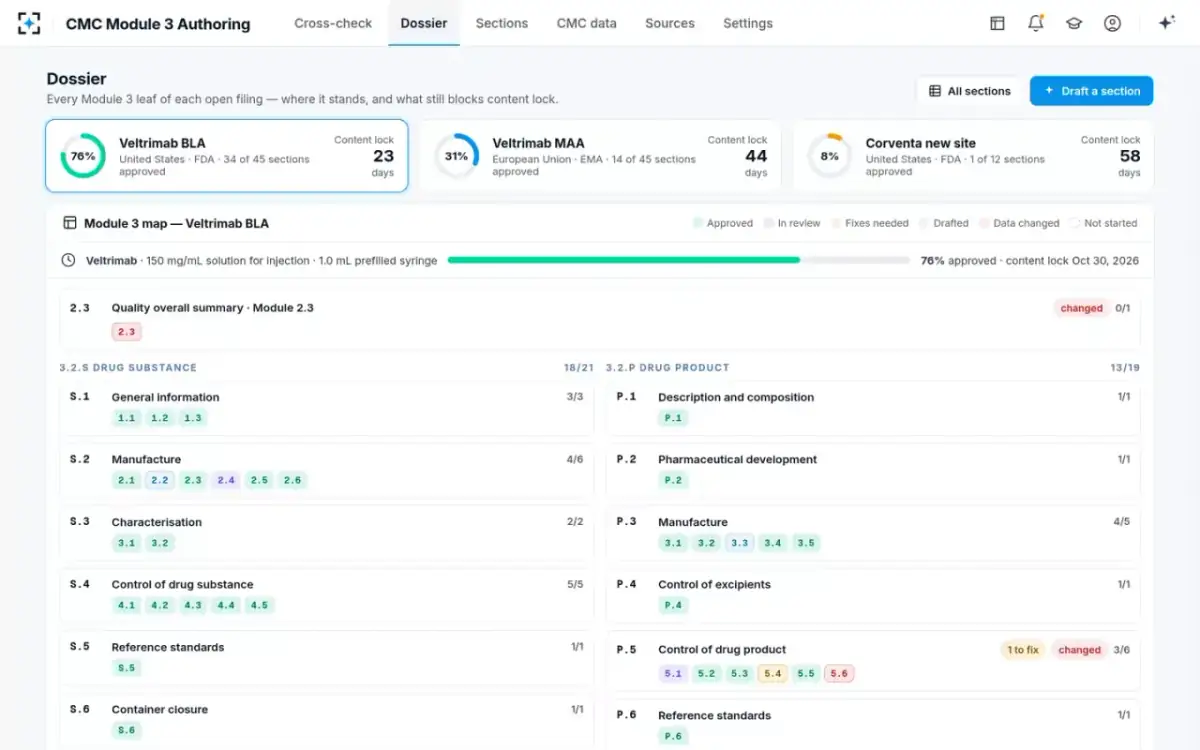
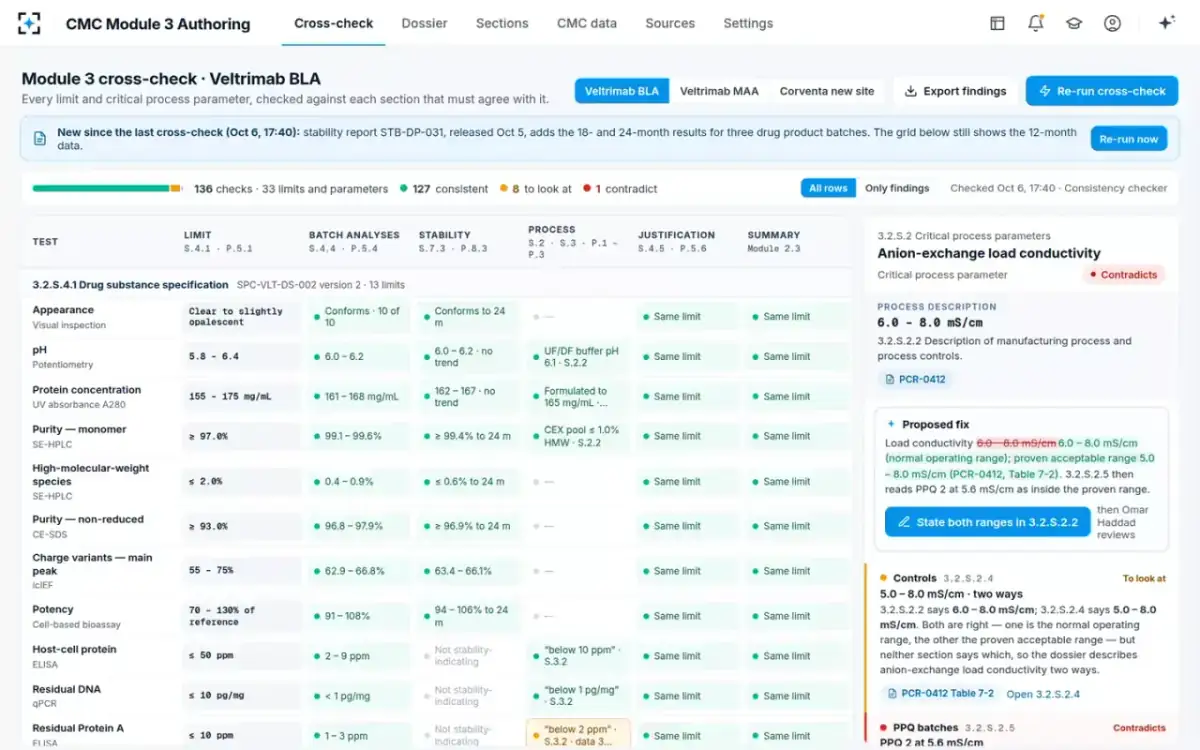
Late change is where a filing's cost is actually made. A specification version that narrows a limit three weeks before lock does not cost one section's hours; it costs every section that quotes the limit, plus the summary, plus the technical reviews those changes reopen, plus — if it is missed — the possibility of a reviewer finding the disagreement instead. In the demonstration filing a new stability report arriving 23 days before lock turns a limit red in two registration batches, and the choice between separate release and shelf-life limits is the decision that follows.
The CMC Module 3 Authoring cross-check: every limit against every section that must match it
The four numbers worth measuring before and after
A business case built on a vendor's hours estimate is a business case you cannot defend at the next budget round. Measure your own, on your own last filing, before anything changes. These four are available from records you already keep, and each one moves for a reason you can explain.
What to measure before and after, and what each number tells you
| Measure | Where to get it before | What a change in it means | What it does not prove |
|---|---|---|---|
| Sections finished per writer per week | Your own section tracker on the last filing | The drafting rate. The clearest early signal, and the first to move. | Nothing about quality: a faster writer producing the same contradictions has gained you nothing. |
| Numbers checked against their source, as a share of all numbers in a section | Usually not kept — which is itself the finding | Coverage. Checking a sample by hand and checking every number are different activities. | That the sources were right: a number can match a superseded certificate perfectly. |
| Open findings at the moment of signature | Review comments reopened after a section was signed | Whether signature means what it says. The target is zero, by rule rather than by effort. | That nothing was missed — only that nothing known was left open. |
| Contradictions found before content lock | Count the late changes on the last filing and ask when each was noticed | The only measure that prices the second cycle. Every one found here is one that cannot be found by a reviewer. | A causal claim about approval: no sponsor files the same dossier twice. |
Where agents change the arithmetic, and where they do not
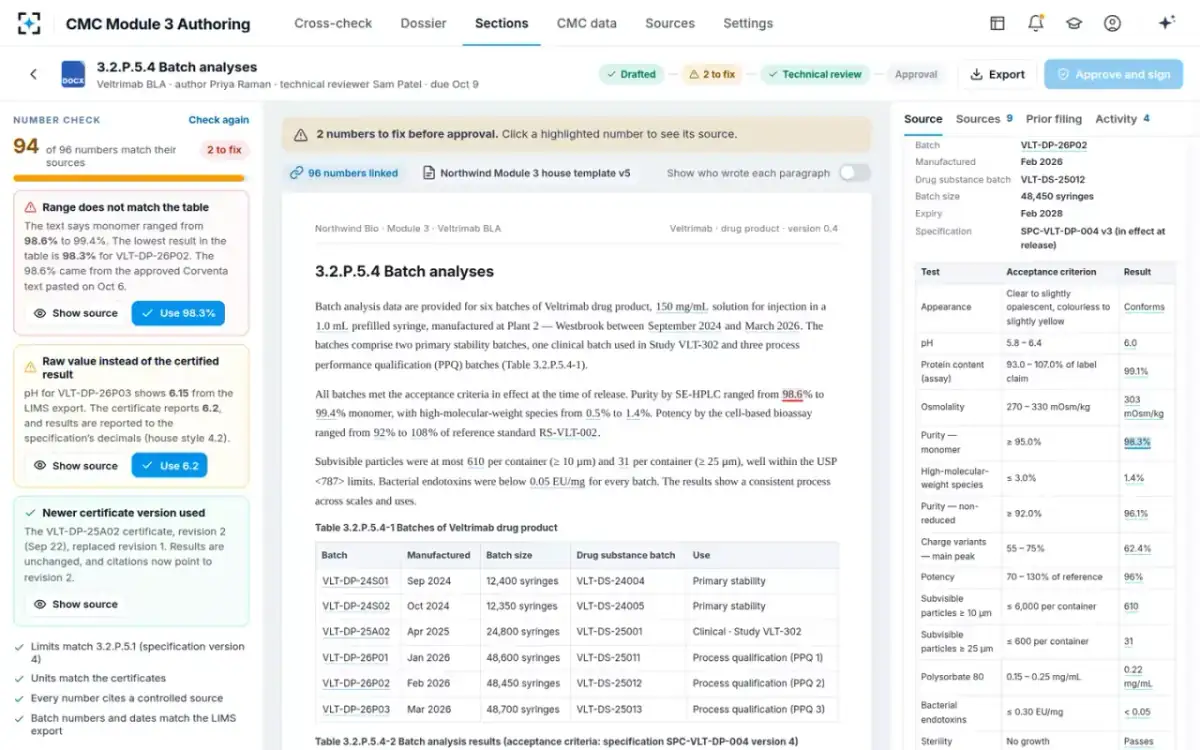
They do not change the fee. They do not shorten the review. They do not make a weak justification strong: a limit the stability data do not support is a limit the data do not support, whoever typed the section. What they change is how much of the dossier is checked, and when. Every number in a drafted section is compared with its source for value, unit, decimals and source version, and the same value is compared everywhere else it appears; every limit is tested against every stability time point up to the proposed shelf life, and against the process description, the justification and the summary. In the demonstration filing that is 136 checks across 33 limits, re-run the moment a new stability report lands, and 96 numbers checked in a single section with two found wrong — one of them inherited from the approved text of an earlier product, which is precisely the error reuse creates and reuse cannot catch.
Ninety-six numbers in one section, two of them wrong
The regulator's own direction of travel points the same way. The FDA's CMC development and readiness pilot exists because "products with accelerated clinical development activities may face challenges in expediting CMC development activities to align with the accelerated clinical timelines" (91 FR 59783) — the quality module is where fast programmes run out of road, and the agency's answer is more conversation earlier, not a lower standard. A sponsor whose sections agree with each other arrives at those conversations with something to discuss.
So price the change on the term it actually moves. Not the fee, which is fixed; not the authoring hours, which are real but small; but the probability that the dossier you file is internally consistent enough to be reviewed once. What the regulators say agents may and may not do sets the limits on how that is done, and CMC Module 3 Authoring shows the grid on a real section.
Questions people ask
How much does it cost to file a BLA with the FDA?
In fiscal year 2026 the application fee for a human drug application requiring clinical data is $4,682,003, and $2,341,002 for one not requiring clinical data. A separate annual programme fee of $442,213 is assessed per product identified in an approved application. Those rates are republished every year in the Federal Register, so always quote the current fiscal year rather than a remembered figure.
Is there a second fee if you resubmit after a complete response letter?
The published fee schedule sets three rates — two application rates and the annual programme fee — and no separate rate for a resubmission. What a second cycle costs is time: FDA's review goal for a Class 2 resubmission of an NDA or BLA is six months from receipt, and for a Class 1 resubmission two months. The programme fee is assessed on approved products, so a delay postpones it rather than charging it twice.
How long does a resubmission review take?
FDA's goal is to act on 90 percent of Class 2 resubmissions within six months and Class 1 resubmissions within two, measured from the date the agency receives the resubmission rather than from the complete response letter. The months spent producing whatever the deficiency required come before that clock starts. Under 21 CFR 601.3 a BLA applicant has a year from the letter before the agency may treat inaction as a request to withdraw.
How often is quality the reason an application is refused or rejected?
In the FDA's own analysis of 103 refuse-to-file letters containing 644 refusal reasons, 125 reasons (19.4%) concerned drug quality, within 84.5% that were scientific. A 2026 systematic review of complete response letters in cell and gene therapy found quality deficiencies present in every complete response examined and predominant among them. The two studies count different things; together they say quality is a recurring reason an application comes back.
What does a day of delay cost?
No published figure covers an arbitrary product. One defensible bound: six months of carrying cost at the 10.5% real cost of capital used in the JAMA development-cost study, applied to its median capitalised investment of $985.3 million, is about $50 million, or roughly $277,000 a day. That is our arithmetic on two published figures, it is a cost of capital rather than lost revenue, and it scales with your own product's investment.
What should you measure to show a CMC authoring change worked?
Four numbers, taken on your last completed filing before anything changes: sections finished per writer per week, the share of a section's numbers checked against their source, open findings at the moment of signature, and contradictions found before content lock. The last one is the only measure that speaks to the second review cycle, which is where the money is.