Release and shelf-life specifications are the two sets of acceptance criteria a drug product can carry: the limits it must meet when a batch is released, and the limits it must still meet at the end of the claimed shelf life. ICH allows the release limits to be tighter than the shelf-life limits where the applicant can justify it — but only for drug products, only in some regions as registered limits, and only at the price of rewriting several Module 3 sections at once. Botminds’ CMC Module 3 Authoring is the piece that makes the price visible: it tests every acceptance criterion against every stability result up to the proposed shelf life, so the question “does this limit still work at 24 months?” is answered before content lock rather than after the information request.
The worked decision on this page comes from the solution’s sample filing — a fictional company, invented people, an invented biologic. The guidelines quoted are real and linked where they appear.
One attribute, one filing, three weeks before content lock
95.0%
the lower limit for protein content in specification version 4, at release and throughout shelf life
94.6%
read by two registration batches at the 18-month time point
24
months of shelf life proposed in 3.2.P.8.1
2
options put to the lead: separate the limits, or claim a shorter shelf life
What is the difference between a release specification and a shelf-life specification?
A release specification is the set of tests and acceptance criteria a batch must meet to be released. A shelf-life specification is the set it must meet at any point up to the end of the shelf life, including the last one. In most filings they are the same document and the same numbers: one specification, applied at release and throughout. The concept of two different sets arises only where an attribute changes predictably with time — assay, potency, degradation products — and where the applicant wants a release limit tight enough to guarantee the shelf-life limit will still be met years later.
It is worth being exact about what a specification is before splitting one, because the word is used loosely. Q6A defines it as a list of tests, references to analytical procedures and appropriate acceptance criteria, and is unambiguous about its status: “specifications are critical quality standards that are proposed and justified by the manufacturer and approved by regulatory authorities as conditions of approval” (ICH Q6A, section 3.1.1). A registered limit is a condition of the licence. An internal limit the company applies to itself is not, which is the whole of the difference explored further down this page.
One attribute, two limits: the bands, and the two ways of writing them
Both limits registered
The specification carries two columns. A batch released at 95.2% is compliant; the same batch at 93.5% after two years is still compliant, because the shelf-life criterion is the one that applies then.
What Q6B contemplates for a biological product, where justified.
One registered limit, one in-house limit
One set of criteria applies from release throughout shelf life. The company holds a tighter internal release limit so that a batch released near the bottom will still pass at the end.
What Q6A records as the position in Japan and the United States for a chemical drug product.
Why a product can pass at release and fail on stability at 24 months
The arithmetic is unforgiving and it is the reason the concept exists at all. A batch is released at some value inside the criterion. The attribute then drifts for as long as the product is on the market. If the released value is near the bottom of the band and the drift is downward, the batch will cross the lower limit before the shelf life ends — and nothing was wrong at release.
On the other hand, if the assay value of a batch is lower than 100 percent of label claim at the time of batch release, it might fall below the lower acceptance criterion before the end of the proposed shelf life.
ICH Q1E, section 2.1
Q1E puts the other half of the trap in the same paragraph: if the batches supporting the application are released above 100% of label claim, “the shelf life proposed in the application can be overestimated”. A registration batch that happens to start high flatters the shelf life; a commercial batch that starts low fails it. Both errors come from reading a stability data set as if the batches in it were the batches that will be made.
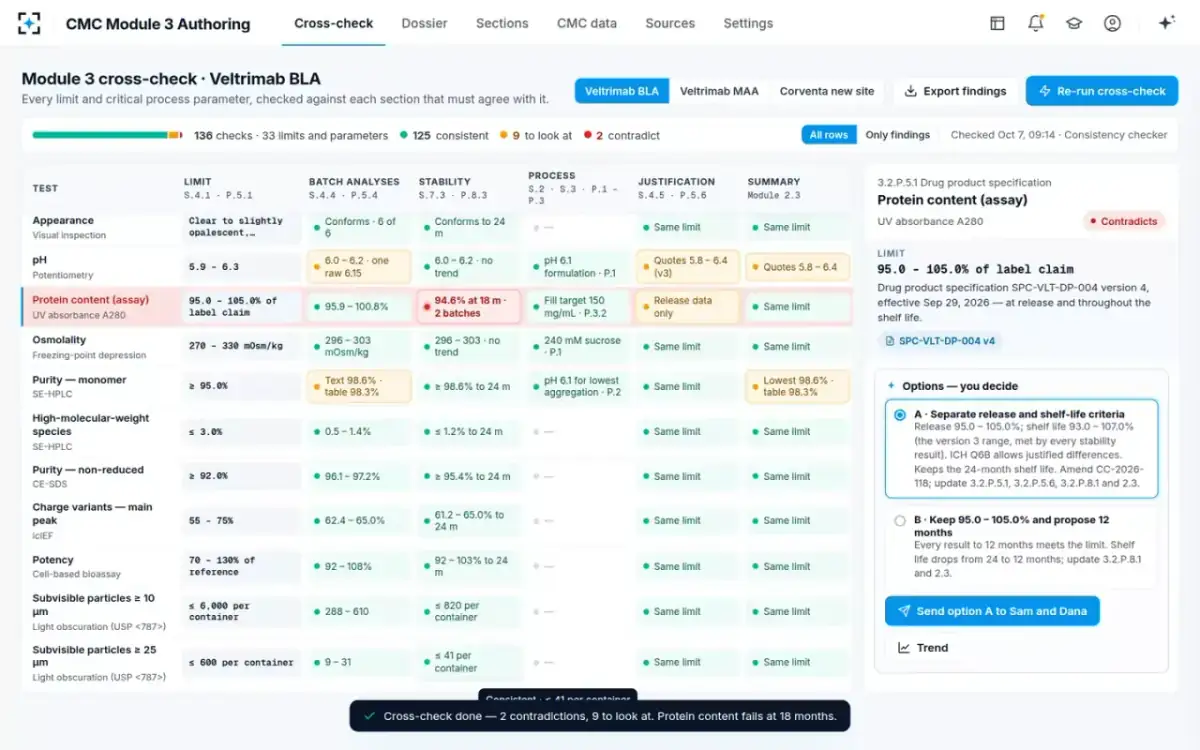
That is exactly what happened in the sample filing. Specification version 4, effective late September, set protein content at 95.0 – 105.0% of label claim at release and throughout the shelf life. The 24-month interim stability report arrived three weeks before content lock, and two registration batches read 94.6% at the 18-month point while 3.2.P.8.1 proposed a 24-month shelf life. A third batch, filled later, stayed above 99% throughout. Nothing in the chemistry was a surprise. The limit was simply written as if the whole life of the product looked like release.
Where the limit and the data stop agreeing, in CMC Module 3 Authoring
What ICH Q6B says about release limits, and for which products
Two ICH guidelines carry the concept, and they are not interchangeable. Q6B covers biotechnological and biological products; Q6A covers new chemical drug substances and products. Each permits the split, and each words the permission differently.
The concept of release limits vs. shelf-life limits may be applied where justified. This concept pertains to the establishment of limits which are tighter for the release than for the shelf-life of the drug substance or drug product.
ICH Q6B, section 2.5, Release Limits vs. Shelf-life Limits
Note what Q6B covers that Q6A does not: the drug substance as well as the drug product. Q6B names potency and degradation products as the attributes where the split is typically applicable, and adds the regional caution in its own words — in some regions the concept of release limits may only apply to in-house limits, not to the regulatory shelf-life limits.
Q6A, for a chemical drug product, is narrower on scope and blunter on region.
Q6A and Q6B on the same idea, and why the sample filing cites Q6B
ICH Q6A, section 2.2 (chemical drug products): Drug products only. The concept “applies to drug products only; it pertains to the establishment of more restrictive criteria for the release of a drug product than are applied to the shelf-life.”
ICH Q6B, section 2.5 (biological and biotechnological products): The drug substance or the drug product. The limits are “tighter for the release than for the shelf-life of the drug substance or drug product.”
ICH Q6A, section 2.2 (chemical drug products): Examples given are assay and impurity (degradation product) levels.
ICH Q6B, section 2.5 (biological and biotechnological products): “May be applied where justified”, with potency and degradation products as the examples.
ICH Q6A, section 2.2 (chemical drug products): “In Japan and the United States, this concept may only be applicable to in-house criteria, and not to the regulatory release criteria.” In those regions the registered criteria are the same from release throughout shelf life.
ICH Q6B, section 2.5 (biological and biotechnological products): Records the same caution more generally: in some regions the concept may only be applicable to in-house limits, not to the regulatory shelf-life limits.
ICH Q6A, section 2.2 (chemical drug products): Q6A states a regulatory requirement in the European Union for distinct release and shelf-life specifications where they differ.
ICH Q6B, section 2.5 (biological and biotechnological products): Q6B does not restate the regional detail; the applicable regional guidance governs.
Two things follow for a writer. First, cite the guideline that governs your product, not the one with the sentence you like. Second, never write that ICH permits two registered limits everywhere: Q6A records plainly that in Japan and the United States the concept may only be applicable to in-house criteria for a chemical drug product, and Q6B carries the same caution without naming regions.
Do EU filings need separate release and shelf-life specifications?
The three ICH regions do not land in the same place, and this paragraph is easy to misquote. Q6A, for chemical drug products, states that in the European Union there is a regulatory requirement for distinct specifications for release and for shelf life where they differ — and that in Japan and the United States the regulatory acceptance criteria are the same from release throughout shelf life, with an applicant free to hold tighter in-house limits at release “to provide increased assurance to the applicant that the product will remain within the regulatory acceptance criterion throughout its shelf-life.”
Three practical consequences, in descending order of how often they bite:
What the regional split means for a filing team
- The same product can need two specification presentations
A product filed in Europe and in the United States may carry distinct release and shelf-life criteria in one dossier and a single registered criterion with an internal release limit in the other. 3.2.P.5.1 has to say which it is, in each.
- An in-house limit is not a dossier commitment
A tighter internal release limit is a company control. Writing it into 3.2.P.5.1 as a registered criterion turns it into a condition of approval, and a batch that misses it becomes a reportable event rather than an internal decision.
- The guideline that governs follows the product, not the region
Q6A covers new chemical substances and products; Q6B covers biotechnological and biological products. For a biologic, the Q6B wording is the one to argue from, with the regional requirement checked separately.
- Neither guideline is a licence to widen the shelf-life limit
The split is justified by data showing the release limit guarantees the shelf-life limit, not by the inconvenience of the data you have. A widened shelf-life limit still has to be justified in 3.2.P.5.6 on its own evidence.
In-house release limits: the quieter way to do the same thing
An in-house release limit is a company-set criterion, tighter than the registered one, applied before a batch is released. It does the same arithmetic as a registered split without touching the licence. If the registered criterion is 93.0 – 107.0% from release throughout shelf life, and the data say the attribute drifts down by roughly a point and a half over the claimed life, releasing only batches above 95.0% is a control that keeps commercial batches inside the registered criterion at the end.
The trade is real, in both directions. The in-house route costs nothing in the dossier and nothing in post-approval change management; it is changed by a company procedure rather than by a variation. What it costs is batches: product that meets the registered criterion but misses the internal one is held, investigated or discarded, and that cost falls entirely on the company. The registered route makes the wider limit official and avoids those rejections, but every future change to either column is a regulatory change, and the wider limit has to be defended in the justification on its own evidence.
One rule applies to both: whichever limit is written in 3.2.P.5.1 is the one the batch analyses in 3.2.P.5.4 and every stability result in 3.2.P.8.3 will be read against. An internal limit that leaks into the specification section has been registered by accident.
How do you set a shelf-life acceptance criterion? Starting assay, slope and the lower limit
The method is the same for assay, potency or a degradation product, and it has four steps. None of them is a calculation you can do without the stability data.
Setting a shelf-life acceptance criterion, step by step
| Step | What you are establishing | Where the evidence comes from |
|---|---|---|
| 1. The release distribution | Where batches actually start, not where the label says they should: the range of released values across the consistency batches. | Batch analyses in 3.2.P.5.4, and the release data behind them |
| 2. The change pattern | Whether the attribute drifts, in which direction, and how linearly — the shape Q1E asks you to be able to defend. | Long-term stability in 3.2.P.8.3, at the labelled storage condition |
| 3. The worst credible batch | The lowest value a future batch could be released at, carried forward along the change pattern to the end of the proposed shelf life. | Steps 1 and 2 together, plus the analytical variability of the method |
| 4. The criterion, and whether one or two | A shelf-life criterion the worst credible batch still meets — and then whether release needs a tighter criterion to make step 3 true. | The justification in 3.2.P.5.6, which has to show this reasoning |
Step three is the easiest one to get wrong. It is tempting to carry the mean of the registration batches forward, and the mean is not the batch that fails. Q1E’s wording on this is about the release value of an individual batch, not the average of a data set, and a criterion set from an average has no margin for the batch released at the bottom of the distribution.
Can you extrapolate a shelf life to a limit a future batch would fail?
No, and Q1E says so in a single sentence that is worth writing above the desk of whoever proposes shelf lives: “any extrapolation should be performed such that the extended retest period or shelf life will be valid for a future batch released with test results close to the release acceptance criteria” (ICH Q1E, section 2.3). The test is not whether the registration batches survive the proposed shelf life. It is whether a batch released at the edge of the release criterion would.
Q1E adds two further constraints that bear on a late decision. An extrapolation assumes the observed change pattern continues, and there is no internal check on that assumption beyond the period the long-term data cover — so a shelf life granted on extrapolation “should always be verified by additional long-term stability data as soon as these data become available”, with a time point in the commitment protocol at the end of the extrapolated period. In other words, extending a shelf life is a promise to come back and prove it, and 3.2.P.8.2 is where that promise is written.
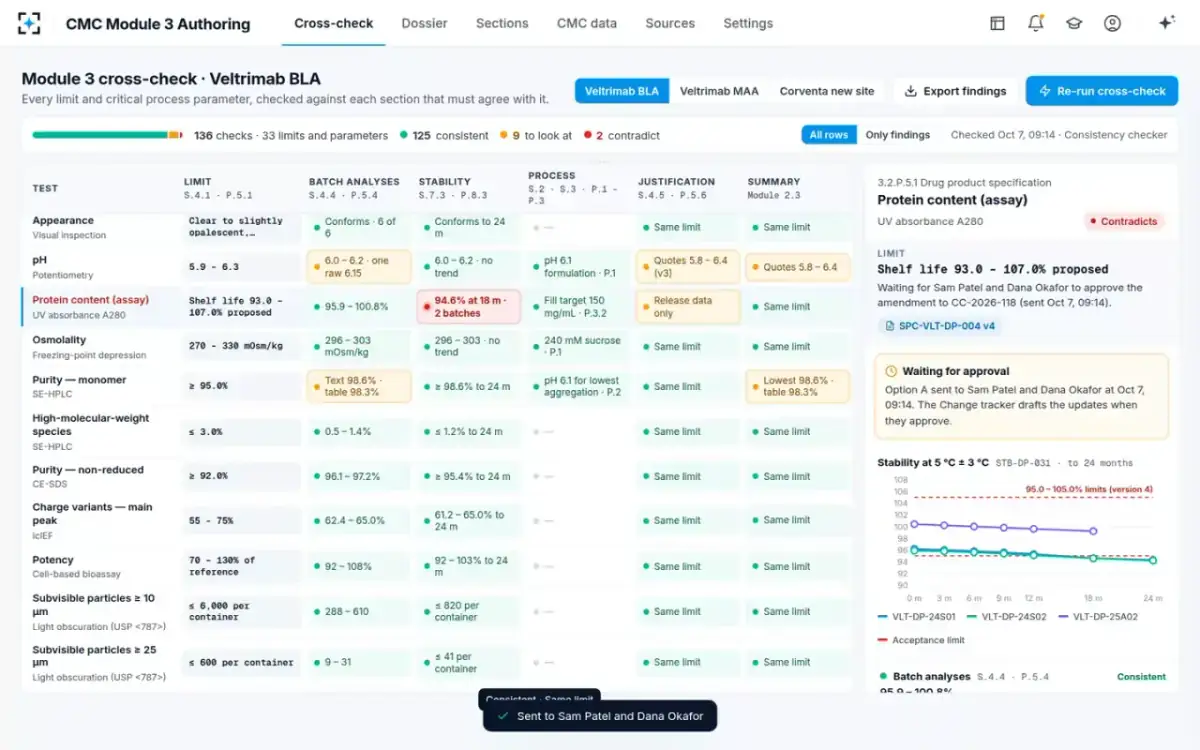
This is the question behind the sample filing’s two options. Option A separates the criteria — release at 95.0 – 105.0%, shelf life at 93.0 – 107.0%, which is the range the earlier specification version carried and which every stability result up to 24 months meets — and keeps the 24-month claim. Option B keeps one criterion of 95.0 – 105.0% and proposes 12 months. Option B is the conservative answer, and it halves the shelf life on the label.
A proposed limit, waiting on the two people who have to approve it
What has to change in the dossier when the two limits separate
Separating one attribute’s criteria is not a one-cell edit. The limit appears in several sections by design, and each of them states something different about it, so each needs a different change. In the sample filing the decision touched four sections and a change control; the table below is what each had to say afterwards.
Four sections and one change control, after one attribute gains a second limit
| Section | What it said before | What it has to say now |
|---|---|---|
| 3.2.P.5.1 Specification | One acceptance criterion for protein content, applied at release and throughout shelf life. | Two columns for that attribute, release and shelf life, with the rest of the specification unchanged — and which of them is registered. |
| 3.2.P.5.6 Justification | An argument for the single criterion, built from release data. | An argument for each criterion: why the release limit, why the wider shelf-life limit, and the stability evidence that the first guarantees the second. |
| 3.2.P.8.1 Stability summary | A shelf life concluded against the single criterion. | The same shelf life concluded against the shelf-life criterion, stating which criterion the conclusion is drawn against. M4Q asks this section for “conclusions with respect to storage conditions and shelf-life”. |
| Module 2.3 Quality Overall Summary | The single criterion, quoted. | Both criteria, quoted exactly as 3.2.P.5.1 now states them. The summary may add nothing of its own, so it can only follow. |
| The change control | Approved for the version that narrowed the limit. | An amendment carrying the chosen option, the reasoning behind it and the approvals of the specification owner and quality assurance, before any section is redrafted. |
3.2.P.5.4 is the section people forget, because the batch analyses do not change — but the table in it is read against the specification, and a reader who sees results listed against a criterion that no longer exists will raise a question. The same applies to the drug substance side if the attribute is a substance attribute, where 3.2.S.4.1, 3.2.S.4.5 and 3.2.S.7.1 play the same parts. The full map of which section has to agree with which is set out in what goes in each Module 3 section.
Testing a proposed limit against every stability time point
The check that would have caught this in the sample filing is mechanical, and it is the one worth automating in whatever form a team can manage. For every acceptance criterion, take every stability result at every time point up to the shelf life claimed in 3.2.P.8.1 and 3.2.S.7.1, at the labelled storage condition, and ask whether it is inside the criterion. Not the ends; every point.
Five checks on a release or shelf-life criterion before content lock
- Test to the claimed shelf life, not to the data you have
If 3.2.P.8.1 claims 24 months, the criterion has to hold at 24 months. A data set that stops at 18 is an extrapolation, with everything Q1E requires of one.
- Test every time point, not the first and last
A non-linear attribute can dip and recover. The criterion applies at every point in the life, so a single interior point outside it is a failure.
- Test against the specification version in force, by effective date
A narrowed criterion makes every prior stability conclusion provisional. The check has to run against the current version, not the one in force when the study started.
- Re-run the whole check when any stability report lands
An interim report does not only add rows; it can move an attribute across a limit that nothing else changed. The sample filing’s contradiction appeared on exactly such a re-run.
- Check the summary last, and check it every time
Module 2.3 quotes the criterion. Any change to either column is a change there too, and it is the section most often left holding the old number.
Extracted stability values behind one criterion, each linked to its page
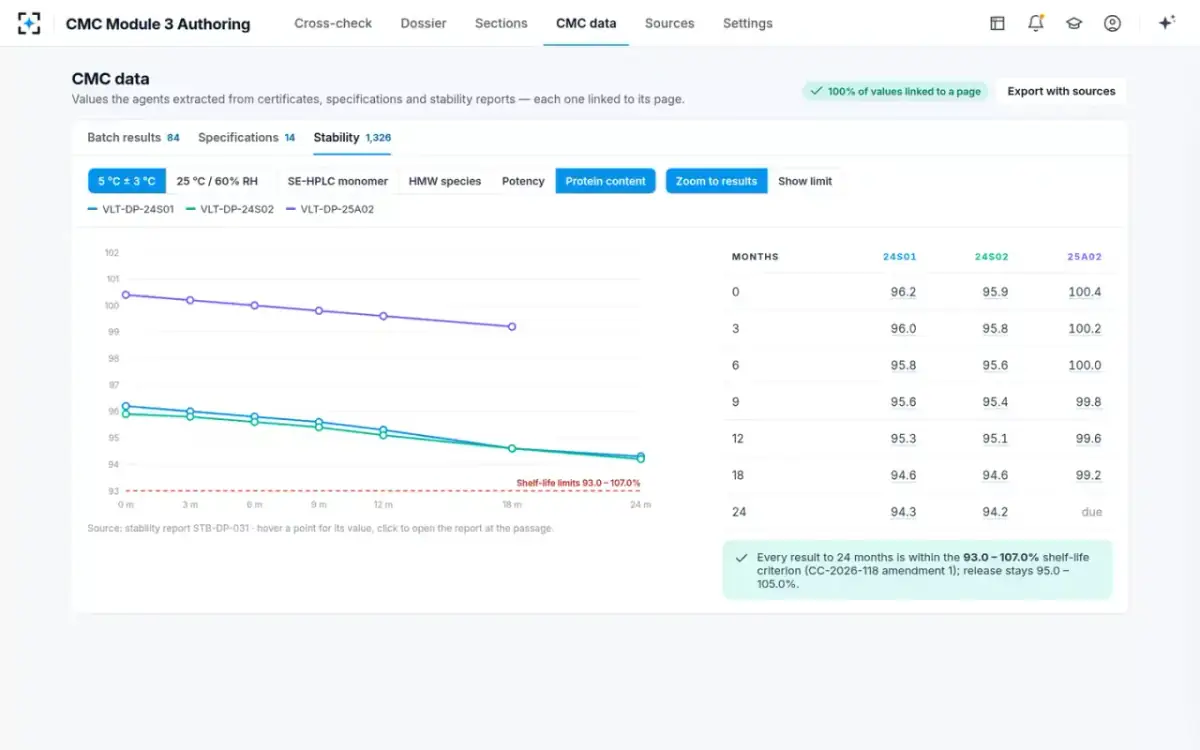
A criterion that has been tested this way is also a criterion that can be justified, because the evidence and the argument are the same material. That is the subject of how to write a justification of specification for 3.2.P.5.6. To see the grid, the options and the approvals on a filing of your own, start from CMC Module 3 Authoring.
Questions people ask
Can release and shelf-life acceptance criteria be different?
Yes, where it is justified. ICH Q6B says the concept of release limits against shelf-life limits “may be applied where justified” for a biological drug substance or drug product, and Q6A permits more restrictive release criteria for a chemical drug product. Both add that in some regions the tighter release limit may only be an in-house criterion rather than a registered one, so the answer depends on the product and on where you are filing.
Does the FDA accept different release and shelf-life limits?
ICH Q6A records that in Japan and the United States the concept “may only be applicable to in-house criteria, and not to the regulatory release criteria” for a chemical drug product, with the registered criteria the same from release throughout shelf life. An applicant may still hold a tighter internal release limit. What a particular application is granted is a matter for the assessor and the regional guidance, so the position should be confirmed for the product in question rather than assumed from the guideline.
What is an in-house release limit?
A criterion the company applies to itself at release, tighter than the registered acceptance criterion, so that a batch released at the bottom of the internal range will still meet the registered criterion at the end of its shelf life. It is a company control rather than a condition of approval: it is changed by procedure, not by a variation, and a batch that misses it is an internal decision rather than a reportable deviation from the licence.
What happens to the shelf life if the limit is narrowed?
Every stability conclusion drawn against the old limit becomes provisional. A narrowed criterion can put an existing time point outside the specification, which means the shelf life concluded in 3.2.P.8.1 is no longer supported by the data in 3.2.P.8.3. That is why a change control that narrows a limit should trigger a re-read of the stability sections, not only of the specification and its justification.
How many batches does a shelf-life criterion need behind it?
ICH Q1E describes the purpose of a formal stability study as establishing, from a minimum of three batches, a retest period or shelf life applicable to all future batches made and packaged under similar circumstances — and notes that the variability between those batches is what determines the confidence that a future batch will stay inside the criteria. Three is a floor, not a target; a variable process needs more to support the same claim.
Does a tighter release limit shorten the shelf life?
No — it does the opposite, which is why the concept exists. A tighter release limit raises the worst value a batch can start at, so the same change pattern reaches the shelf-life criterion later. The cost is not shelf life but yield: batches that meet the registered criterion but miss the tighter release criterion cannot be released.