A justification of specification is the section of Module 3 that argues why each test in the specification is there and why each acceptance criterion is set where it is — 3.2.P.5.6 for the drug product, 3.2.S.4.5 for the drug substance. The rule in ICH M4Q(R1) is one sentence; the requirement a reviewer actually applies lives in Q6A and Q6B, and between them they name five bodies of evidence: development data, the batches used in toxicology and clinical studies, the batches that demonstrated manufacturing consistency, the stability data, and the expected analytical and manufacturing variability. Botminds’ CMC Module 3 Authoring drafts the section with every number linked back to the certificate, report or specification it came from, and then tests each criterion against the data in the sections that have to carry it, so the argument and the evidence stay the same material.
The worked example below is the solution’s sample filing — a fictional company, an invented biologic, invented batches and people. The guidelines are real and quoted from their current Step 4 texts.
The five bodies of evidence a justification has to cite, and where each one lives
| The evidence | What it proves about the criterion | Where it lives in Module 3 | The words that ask for it |
|---|---|---|---|
| Development data | That the attribute matters, that the test measures it, and how the criterion was arrived at rather than inherited. | 3.2.P.2 and 3.2.S.2.6, with the development reports behind them | Q6A 3.1.2: justification should refer to relevant development data |
| Toxicology and clinical batches | That material inside the criterion is the material whose safety and efficacy were demonstrated. | 3.2.P.5.4 and 3.2.S.4.4, against the nonclinical and clinical modules | Q6B 4: data obtained from lots used in preclinical and/or clinical studies |
| Consistency batches | That a routine commercial process can hold the criterion, not only that one campaign did. | 3.2.P.5.4, with 3.2.P.3.5 and 3.2.S.2.5 for the validation batches | Q6B 3: specifications should be based on data obtained from lots used to demonstrate manufacturing consistency |
| Stability data | That the criterion still holds at the end of the claimed shelf life, not only at release. | 3.2.P.8.3 and 3.2.S.7.3, concluded in 3.2.P.8.1 and 3.2.S.7.1 | Q6A 3.1.2: results from accelerated and long term stability studies, as appropriate |
| Analytical and manufacturing variability | That the criterion has room for the method and the process as they actually behave. | 3.2.P.5.3 for method validation; 3.2.P.3.4 and 3.2.P.2.3 for process variability | Q6A 3.1.2: a reasonable range of expected analytical and manufacturing variability should be considered |
What is a justification of specification?
It is the argument, not the data. The specification itself sits in 3.2.P.5.1; the batch results sit in 3.2.P.5.4; the stability results sit in 3.2.P.8.3. The justification is the only section whose job is to connect them and say: given all of that, these are the right tests and these are the right numbers. A reviewer reads it to decide whether the acceptance criteria are conditions worth approving, which is exactly what Q6A says a specification becomes once approved.
Two things follow from that, and both shape how the section should be written. It is argumentative prose, not a table — a justification that is a table of limits with the word “justified” in the last column has not made an argument. And it has to be written from evidence that exists elsewhere in the dossier, which means every number in it is a number that can disagree with its source.
The one sentence of the rule, and where the real requirement lives
M4Q(R1) gives 3.2.P.5.6 a single line: “justification for the proposed drug product specification(s) should be provided”, with references to Q3B, Q6A and Q6B. For the drug substance, 3.2.S.4.5 is shorter still: “justification for the drug substance specification should be provided” (ICH M4Q(R1)). That brevity is deliberate. M4Q is an organisational guideline: it says where things go, not what they must contain. The content requirement is in the quality guidelines it points at.
Q6A, for a chemical drug product, is the most explicit of the three.
When a specification is first proposed, justification should be presented for each procedure and each acceptance criterion included. The justification should refer to relevant development data, pharmacopoeial standards, test data for drug substances and drug products used in toxicology and clinical studies, and results from accelerated and long term stability studies, as appropriate.
ICH Q6A, section 3.1.2, Justification of Specifications
Two words in that sentence do most of the work. Each: the section argues procedure by procedure and criterion by criterion, not specification by specification. And refer: the argument cites evidence that lives elsewhere, which is why a justification is also the section where a stale cross-reference is most costly. Q6A adds the fifth body of evidence immediately afterwards — “additionally, a reasonable range of expected analytical and manufacturing variability should be considered” — and then the sentence that decides which batches carry the most weight: “test results from stability and scale-up / validation batches, with emphasis on the primary stability batches, should be considered in setting and justifying specifications.”
The five bodies of evidence every justification has to cite
Q6B reaches the same five from a different direction, for biological and biotechnological products, and its framing is the more useful one to keep in mind while drafting, because it starts from what a specification is for.
Since specifications are chosen to confirm the quality rather than to characterize the product, the manufacturer should provide the rationale and justification for including and/or excluding testing for specific quality attributes.
ICH Q6B, section 3, Justification of the Specification
Confirm, not characterise. A characterisation study tells you what the molecule is; a specification confirms, batch after batch, that it is still that. A justification that reads like a characterisation report — pages on the attribute, nothing on why this limit — has answered a different question. Q6B then sets out its own four linkages, which map onto the five: specifications are linked to a manufacturing process; they account for the stability of the substance and product; they are linked to preclinical and clinical studies; and they are linked to the analytical procedures that measure them. Its section 4 states the combination outright: acceptance criteria “should be established and justified based on data obtained from lots used in preclinical and/or clinical studies, data from lots used for demonstration of manufacturing consistency, and data from stability studies, and relevant development data.”
The one of the five that is most often missing is the last, and it is the one a reviewer can check without reading anything else. If the criterion is 95.0 – 105.0% and the method’s own validated precision is a percentage point, the criterion has five points of room on each side for the process and the method together. If the method’s precision were three points, it would not.
Is there an FDA template for a justification of specifications?
We know of no FDA or ICH template for the section, though people search for “justification of specification FDA template” often enough. What exists instead is better: the content requirement written out in Q6A section 3.1.2 and Q6B sections 3 and 4, which between them say what the section has to contain. A template built from those two passages is the closest thing to an official structure, and it is the structure the rest of this page uses.
There is a practical reason no template is issued. The justification is product-specific by construction: a criterion for a biologic’s charge variants is justified from different evidence than a criterion for a tablet’s dissolution, and a template that fitted both would say nothing. What is portable is the method — the order in which the five bodies of evidence are brought to bear on one number — not the words.
How to justify one acceptance criterion, step by step
Take one criterion at a time, and build the paragraph in this order. The order matters: each step is an answer the next step depends on, and writing the conclusion first is an easy way to end up with a criterion the evidence does not reach.
Eight steps, and the evidence each one needs in hand
- 1. State the attribute and why it is tested at all
A criterion for an attribute that does not need controlling is a criterion you will defend for the life of the product. Q6B asks for the rationale for including — and for excluding — testing for each attribute.
- 2. Name the procedure and its validated performance
Accuracy, precision and the range over which the method was validated, from 3.2.P.5.3. A criterion cannot be tighter than the method can discriminate.
- 3. Give the development history of the criterion
What the attribute did across development, what range was seen, and what, if anything, a pharmacopoeial monograph says about it.
- 4. Bring in the clinical and toxicology batches
The range of results for the material used in the studies that established safety and efficacy. This is the band the criterion should not exceed without an argument.
- 5. Bring in the consistency batches
The commercial-scale batches that demonstrated the process does the same thing repeatedly, with their observed range and, where you have it, the process capability.
- 6. Bring in the stability data
Every time point up to the proposed shelf life, at the labelled condition. This is the step that decides whether one criterion will serve, or whether release and shelf life need separate ones.
- 7. Add the variability allowance, and show the arithmetic
Observed range, plus analytical variability, plus the drift seen on stability, against the proposed criterion. A reviewer should be able to reproduce the number from the paragraph.
- 8. State the criterion, and say what would change it
The conclusion, and the condition under which it would be revisited — a new site, a wider process range, a longer shelf life.
A well-formed paragraph from step five reads like the sample filing’s pH criterion. Version 4 of the drug product specification narrowed pH from 5.8 – 6.4 to 5.9 – 6.3, and the argument recorded for the change was that thirty-one batches had ranged 5.95 – 6.18, with a process performance index (Ppk) of 1.9. Both halves matter: the observed range shows where the process sits, and the capability figure shows how much of the criterion that range consumes. The figures are sample data from the fictional filing, not a benchmark — a capability index is a property of one process and one criterion, and quoting someone else’s is meaningless.
Why a justification from release data alone fails on stability
A common structural fault in a justification is also the easiest to commit: argue the criterion from the batch release results, because they are the data in front of you, and leave the stability set for the stability sections. The argument is coherent, every number in it is true, and it collapses the moment a long-term time point lands outside the criterion.
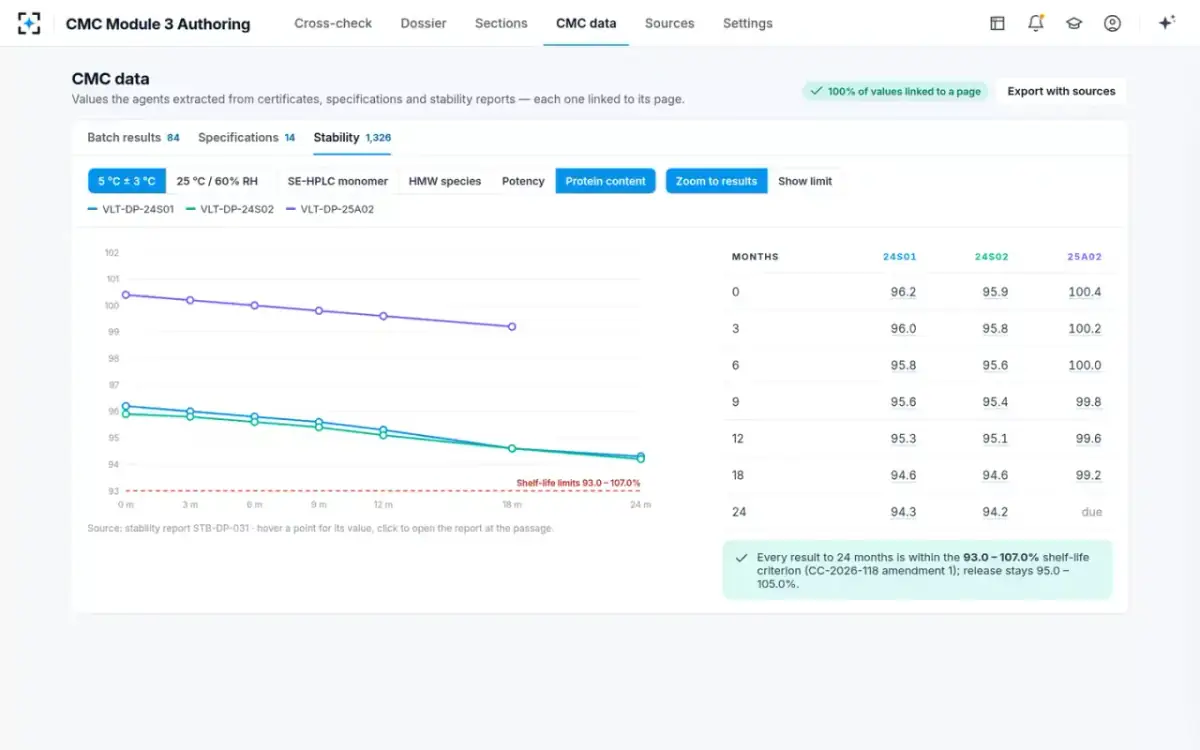
That is the fault the sample filing carried. Its 3.2.P.5.6 justified protein content from release data only. Two registration batches then read 94.6% at the 18-month time point against a 95.0% lower limit, while 3.2.P.8.1 proposed a 24-month shelf life — and the justification had nothing to say about it, because it had never looked. Q6A’s instruction about where the emphasis belongs is the direct antidote: the primary stability batches, not the release set, carry the most weight in setting and justifying a criterion.
The same criterion, justified two ways
From release data alone: The release results of the registration batches, and the method validation.
From release, stability and capability: The same, plus every stability time point to the proposed shelf life, plus the observed process range and its capability.
From release data alone: That batches are released inside the criterion. Nothing about the rest of the product’s life.
From release, stability and capability: That batches are released inside it and stay inside it to the end of the shelf life claimed in 3.2.P.8.1.
From release data alone: Can contradict it outright, with no sentence in the section that anticipated the result.
From release, stability and capability: Adds points inside an argument that already allows for drift, or triggers a defined revisit.
From release data alone: A criterion asserted at release and assumed for shelf life — the gap a question is written about.
From release, stability and capability: A criterion whose two ends are each argued, and a stated reason for one limit or two.
From release data alone: Less, once.
From release, stability and capability: More, once — and nothing when the interim report lands, which is when the first version has to be rewritten anyway.
Do you have to justify leaving a test out of the specification?
Yes, and it is the harder of the two arguments. Q6B asks the manufacturer for “the rationale and justification for including and/or excluding testing for specific quality attributes”, so an omission is as much a decision as an inclusion. Q6A is specific about what the exclusion argument has to rest on: “justification for proposing exclusion of a test from the specification should be based on development data and on process validation data (where appropriate).”
That is a narrower evidential base than the inclusion argument, and deliberately so. You are not arguing that the attribute does not matter; you are arguing that the process controls it so reliably that routine testing adds nothing — which is a claim about the process, demonstrated in development and confirmed in validation. Three exclusions that often need this treatment are an attribute tested at an earlier stage and shown never to change afterwards, an attribute controlled by a process parameter rather than by a release test, and a pharmacopoeial test the dosage form makes inapplicable. Each needs its own paragraph with its own data; a single sentence covering all omissions is a sentence a reviewer will ask about.
What makes a justification weak when a reviewer reads it?
A weak justification is rarely wrong. It is usually true, complete-looking and unfalsifiable — which is the problem, because a criterion that could not have come out differently has not been justified. Six patterns recur.
Six ways a justification reads as weak, and what each should say instead
- The criterion is justified by its own existence
"The acceptance criterion of not less than 95.0% is based on the product specification." The specification is what is being justified. Say what the criterion was derived from.
- The range cited is the criterion, not the data
Quoting the limits back instead of the observed results hides whether the process uses ten percent of the criterion or ninety. Give the observed range, then the criterion.
- Compendial by reference, with nothing else
A pharmacopoeial criterion is a legitimate starting point, and Q6A names pharmacopoeial standards among the evidence. It is not a substitute for showing that this product meets it with room to spare.
- No stability argument for a stability-sensitive attribute
An assay or degradation-product criterion justified only from release results. The criterion applies at every point in the life of the product, so the argument has to reach that far.
- Numbers that do not match their sources
A range in the prose that is not the range in the table, or a value carried over from an earlier filing. Each one is a question, and each is cheap to find and expensive to leave.
- Written once and never revisited
The justification is drafted early and the specification changes late. A criterion that moved under change control leaves a justification arguing for a number that is no longer in 3.2.P.5.1.
One criterion, with the extracted values behind it in CMC Module 3 Authoring
When a limit moves, what has to be rewritten?
A changed acceptance criterion is a change to the justification by definition — the section argues for a number that no longer exists. In practice it is also a change to three or four other places, and the justification is easy to leave behind, because it is prose rather than a table and nothing in a document system flags it.
From a changed limit to a rewritten justification
Agent
The change is noticed, and the criterion re-testedA new specification version or stability report lands; every section quoting the changed value is listed across every open filing, and the criterion is re-tested against the batch analyses, every stability time point to the proposed shelf life, the process description and the summary.
Never: changes a limit, a range or a shelf life
A person decides
The regulatory CMC lead decidesPicks between the options, records the reasoning, and sends it to the specification owner and quality assurance as an amendment to the change control.
A person decides
The specification owner and quality assurance approveApprove the amendment before any section is redrafted. Until then nothing in the dossier moves.
Agent
The affected sections are drafted as tracked changesThe specification section, the justification, the stability summary and Module 2.3 are updated as tracked changes, each number still checked against its source.
Never: applies a change without a person confirming it
A person decides
The author confirms, and the section goes for technical reviewAccepts or edits each tracked change, clears any open number finding, and sends the section to its named technical reviewer.
The section that is easiest to forget is Module 2.3, because it quotes the criterion and may add nothing of its own — the Quality Overall Summary and the limit it has to match follows that sweep in full. The decision the sample filing actually took, and the four sections it touched, is worked through in release against shelf-life specifications.
A worked justification for protein content, paragraph by paragraph
Here is the shape of a justification paragraph for one criterion, with the evidence each sentence rests on named in brackets. It is written for the sample filing’s protein content criterion after the decision to separate release and shelf-life limits; the figures are sample data.
One criterion, one paragraph, five bodies of evidence
| The sentence | What it does | The evidence behind it |
|---|---|---|
| Protein content is a critical quality attribute for a solution for injection, because the delivered dose depends on it directly, and is measured by ultraviolet absorbance. | Establishes why the test is in the specification at all. | Development data; 3.2.P.2 |
| The procedure was validated over 70 to 130% of the nominal concentration, with the accuracy and precision reported in 3.2.P.5.3. | States what the method can discriminate, before any criterion is proposed. | Method validation; 3.2.P.5.3 |
| The batches used in the pivotal clinical study released between 97.1 and 102.4% of label claim. | Fixes the band of material whose clinical performance is known. | Clinical batches; 3.2.P.5.4 |
| The three process performance qualification batches released between 96.0 and 101.2%, and twelve further commercial-scale batches lie inside that range. | Shows the routine process holds the attribute, not only one campaign. | Consistency batches; 3.2.P.5.4 and 3.2.P.3.5 |
| At the labelled storage condition the attribute falls over the shelf life; the lowest result across all batches and time points to 24 months is 94.2%. | Carries the argument to the end of the claimed shelf life, which is where it has to hold. | Stability data; 3.2.P.8.3 |
| A release criterion of 95.0 – 105.0% and a shelf-life criterion of 93.0 – 107.0% are therefore proposed: the release criterion is met by every batch made, and a batch released at the 95.0% release limit that fell as far as the lowest registration result did (from about 96% to 94.2%, under two points) would still sit above 93.0% at 24 months. | States the conclusion, and shows the arithmetic that produces it. | All five, plus the analytical variability allowance |
Read that against the weak patterns above and the difference is visible in one line: a reviewer can reproduce the conclusion from the paragraph. The release criterion is not asserted — it is the number that makes the last sentence true.
The upkeep problem, measured on one drafted section
96
numbers in one drafted batch analyses section, each traced to a source
94
matched their source on value, unit, decimals and version
2
did not: a range carried over from an earlier filing, and a raw instrument value where the certificate reports another
0
of those two were scientific errors — both were transcription
The rules a team sets for its own number and cross-checks
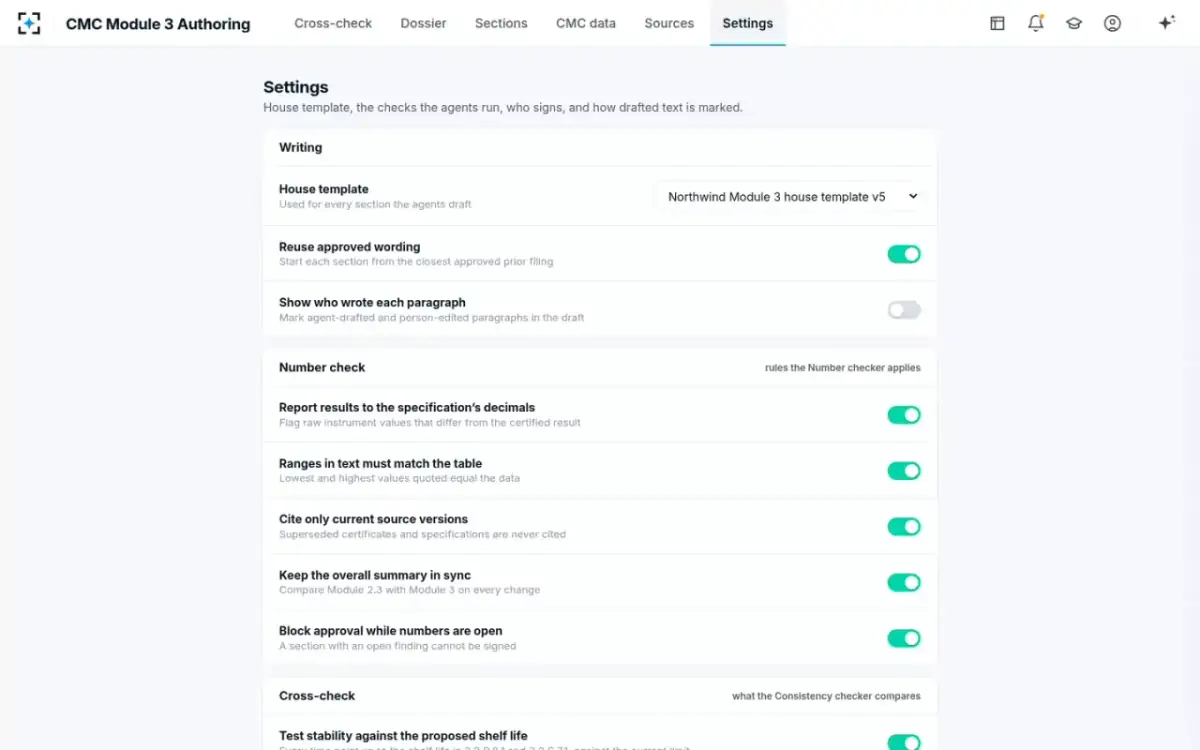
To see a justification drafted with every number traced to its page, and the criteria it argues tested against the sections that carry them, start from CMC Module 3 Authoring.
Questions people ask
What goes in 3.2.P.5.6?
The justification of the drug product specification: why each test is included, why each is excluded, and why each acceptance criterion sits where it does. M4Q(R1) asks only that the proposed drug product specification be justified, and points to Q3B, Q6A and Q6B. The drug substance equivalent is 3.2.S.4.5, and the excipient equivalent is 3.2.P.4.4.
How many batches do you need to justify a specification?
ICH does not give a number, and any number quoted without a process behind it is a guess. What the guidelines say is which batches count: Q6A puts the emphasis on the primary stability batches among the stability and scale-up or validation batches, and Q6B asks for lots used in preclinical and clinical studies, lots demonstrating manufacturing consistency, and stability lots. A variable attribute needs more batches to support the same criterion than a stable one.
How do you justify a specification for a biologic?
Through Q6B rather than Q6A, which changes two things. Q6B covers the drug substance as well as the drug product, and it frames the task as confirming quality rather than characterising the product — so the argument has to connect the criterion to the manufacturing process, to the stability profile, to the preclinical and clinical lots and to the analytical procedures, all four of which Q6B names as linkages a specification has.
Does the justification have to be updated when a limit changes?
Yes, and it is an easy section to miss. The justification argues for a specific number; if that number moves under change control, the section is arguing for a criterion that is no longer in 3.2.P.5.1. The sweep is the specification section, the justification, the stability summary where the shelf life is concluded against the criterion, and Module 2.3 — which may add nothing of its own and so can only follow.
Can a justification cite a prior approved filing?
It can refer to approved wording as a starting point, and reusing the structure of an approved justification is ordinary practice. What it cannot do is carry the prior product’s numbers. Every product fact in a reused paragraph has to be replaced from this filing’s own sources, and a value that survives a copy is a value nobody re-derived — in the sample filing, a monomer range opening at 98.6% came through exactly that way, where this product’s own lowest result is 98.3%.
Where does process capability belong in a justification?
In the consistency-batch argument, as supporting evidence for how much of the criterion the process actually uses. It is useful because it answers the question an observed range leaves open: whether the range sits comfortably inside the limits or presses against them. It is not a criterion of its own, and a capability index from another product or another process says nothing about this one.