A plain language summary tool is software that takes a clinical study report and helps a team produce the layperson summary of results that a public register requires — drafting the required sections, checking the numbers, measuring how plainly it reads, handling translations, and carrying the approvals. Choosing one is harder than it looks, because almost every candidate will demo well: the drafting is the easy part, and a fluent draft is what a demo shows. The hard part is proving afterwards that each sentence is true to the report, and that is what a tool should be judged on. Clinical Trial Lay Summaries is Botminds' software for this work, and this guide is written to be usable against it and against anything else on your list.
The product details below describe how this solution behaves; the studies and people it names are sample data on fictional studies and fictional people. The regulatory text and the research are linked where they appear.
What should you look for in a plain language summary tool?
Nine capabilities, and they are not a wish list — each one answers a question somebody will ask you later, and each leaves behind an artefact you can produce when they do. Write them into the requirements document in this order, because the first one determines whether the rest are worth having.
Nine capabilities, the test that proves each, and what the test leaves behind
- A source passage for every factual sentence
Test: open any sentence in a finished summary and ask where it came from. It should give a page or table in the final study report, not a paraphrase. Leaves behind: a sentence-to-passage list you can hand a reviewer.
- A number comparison against the report
Test: plant a rounding in a draft — 64.7% written as “about 7 out of 10” — and see whether it is flagged and by how much. Leaves behind: a list of every number difference, with its size.
- Reading grade per sentence, not per document
Test: ask which sentences are above your house maximum. A document-level score cannot answer it. Leaves behind: the sentences a reviewer has to look at.
- A non-promotional check with a neutral alternative
Test: feed it “worked very well and is a safe treatment” and see whether it both flags the wording and proposes a neutral sentence. Leaves behind: the flag, the reason, and what was accepted.
- A comprehension test, not a score
Test: ask it what a reader would take away, with no access to the study report, then compare those answers with the report. Leaves behind: the questions got wrong, each tied to a sentence.
- A glossary locked per language
Test: ask what happens to a term with no agreed translation. It should raise a query, not invent one. Leaves behind: the query, and who resolved it.
- A number read-back after translation
Test: ask how the Polish version was checked. Reading it is not an answer; comparing every number against the master is. Leaves behind: a comparison per language.
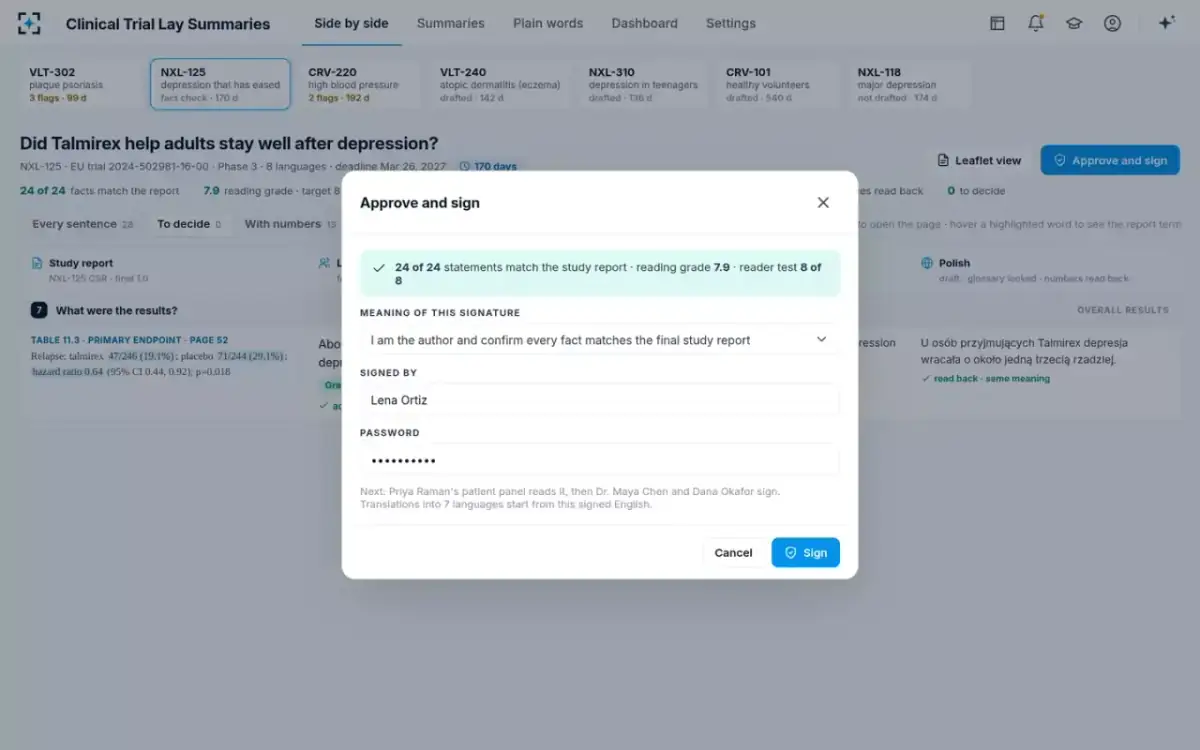
- A named signature carrying its meaning
Test: ask what a signature asserts. “Approved” is not enough; authorship, medical accuracy and the non-promotional check are different assertions. Leaves behind: the signed record, with the meaning on it.
- A posting calendar that counts backwards
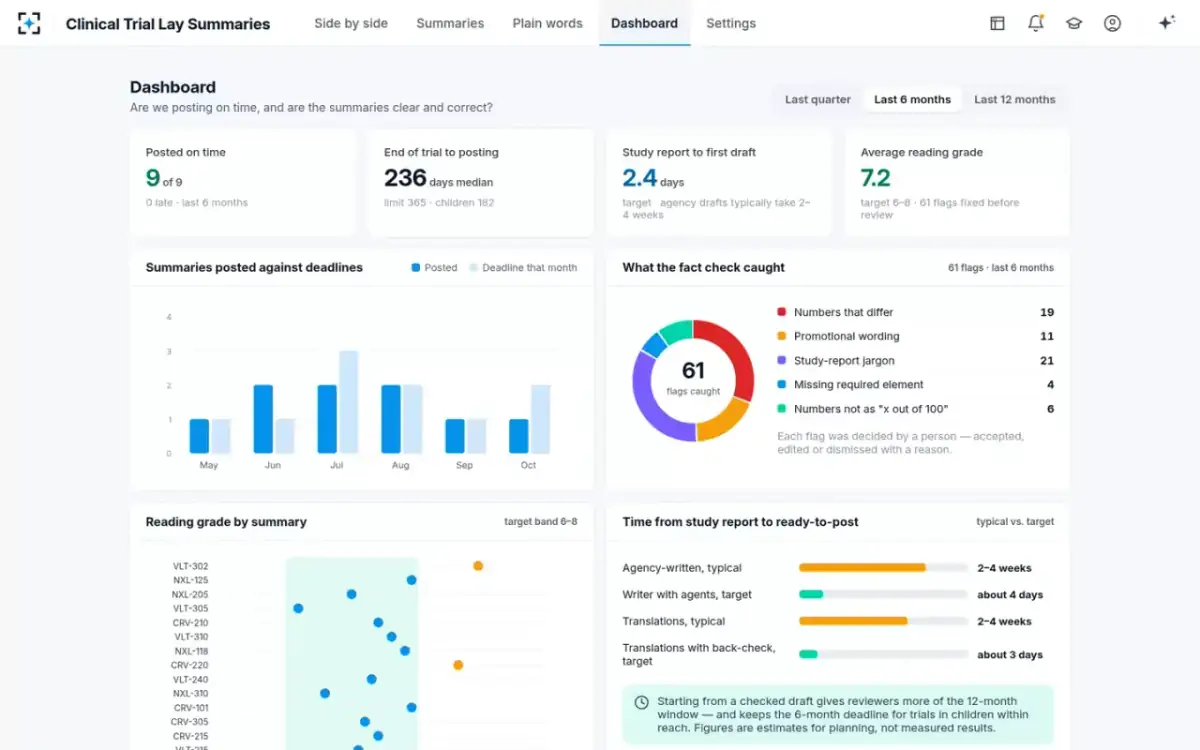
Test: ask which summaries are due in sixty days and who holds each one. Leaves behind: the schedule you will be asked for when one is late.
The one question a tool has to answer
For every factual sentence in this summary, which passage of the study report does it come from? Everything else on the list above is downstream of that question, and a tool that cannot answer it has failed in a way no other feature compensates for.
The reason is structural rather than technical. A lay summary is a report of one trial's results, written for people who cannot check it. Its only claim to accuracy is that each statement traces to the final study report, and that someone looked at both. A tool that produces fluent prose without that trace has moved the hardest part of the work — verification — from the software back to the writer, while making it look as though the software did it. That is a worse position than a blank page, because a plausible draft invites less scrutiny than an empty one.
There is a second-order version of the question worth asking in a demo: when the writer edits a sentence, what happens to its source link? A link that survives drafting and dies on the first edit is a link that will not exist on the version you post.
How do you check that a tool's numbers match the study report?
Plant errors and see which ones come back. This is the single most useful hour of any evaluation, and it needs nothing but a study report you already have and a draft you have deliberately damaged.
Plant five classes of error, because they fail differently. A rounding that moves a figure by more than your tolerance — 277 of 428 is 64.7 per cent, and “about 7 out of 10” is 70. A swapped arm, so the placebo figure is attributed to the medicine. A time point moved from week 16 to week 12. A denominator taken from the wrong population, safety instead of efficacy. And a sentence with no source at all, invented to fill a required section. A tool that catches the first and misses the last four is a rounding checker, not a fact checker.
Then ask what it does with what it finds. The guidance's expectation on review is that different reviewers are briefed to look for different things: Good Lay Summary Practice describes a review in which each specialist is briefed separately — the medical reviewer on whether the disease is described adequately, the legal reviewer on compliance and on keeping the summary non-promotional, the language reviewer on whether the lay language works. A tool that collapses those into one undifferentiated list of warnings makes the human review harder, not easier.
Reading grade per sentence, not per document
A document-level reading score is almost useless for this work, for a simple arithmetic reason: a summary with twenty sentences at grade 6 and four at grade 14 averages out comfortably below a grade 8 target, and the four sentences at grade 14 are the entire problem. The reviewer needs the four, and an average hides them.
The deeper limitation is one the guidance states outright. Good Lay Summary Practice warns that a meaningless sentence of short words still scores well, because a good score and real readability are not directly connected, and it recommends readability formulae only as a supplement — not least because the tests are not available in every official EU language. A tool whose quality story is a readability number is selling you a measure its own source document describes as a supplement.
So ask for three things rather than one. The grade of every sentence against a maximum you set. The study-report terms it found, each with the plain alternative it proposes. And a comprehension test whose answers can be wrong, which is a different kind of evidence entirely.
A readability tool against a lay summary tool
A readability tool: Text. It does not need to know what the text is about.
A lay summary tool: The final study report and the text, so every sentence can be checked against a passage.
A readability tool: One or more scores, and often a list of long words and long sentences.
A lay summary tool: A grade per sentence, a source passage per fact, a flag per promotional phrase, and what a reader would take away.
A readability tool: Nothing. A score is a count; it cannot disagree with the report.
A lay summary tool: Plenty, which is the point: a fact check and a comprehension test can both fail, and a check that cannot fail is not a check.
A readability tool: The score, and the version it was run on.
A lay summary tool: The passage behind any sentence, every flag and how it was decided, the comparison per language, and who signed what.
A readability tool: A supplement, explicitly, and not developed in all official EU languages.
A lay summary tool: The substance: factual accuracy, non-promotional language, and content a reader can actually use.
Does a plain language summary tool need to be validated?
That depends on whether the summary is a record your quality system owns, and for most sponsors running trials in the EU the answer is yes — not because a specific rule names this software, but because the summary is part of a regulated disclosure and your own procedures say how such records are produced. The sensible question to put to a quality colleague is not “is this validated software?” but “what does our validation policy require of a system that drafts and signs a regulated disclosure?”
Whatever the answer, the controls worth demanding are the ones that make the output defensible, and they are easy to name because an existing rule names them. Validation itself is first on that list: 21 CFR part 11 opens its controls for closed systems with validation for accuracy, reliability and consistent intended performance, and for the ability to spot a record that is invalid or has been altered. Ask what the supplier's validation covers, what you are expected to validate yourself, and what evidence comes with the licence.
Two more are worth writing into the requirements even where no rule compels them. An audit trail that cannot be rewritten, and a signature that cannot be moved — and that states, on the record, what it means: review, approval, responsibility or authorship are the examples the rule gives.
Does 21 CFR Part 11 apply to a lay summary tool?
By its own terms, not to the EU layperson summary itself. Part 11 covers electronic records created, changed, kept, archived, retrieved or sent under the FDA's own record-keeping rules, and electronic records submitted to the FDA. A summary posted to the EU's register under the Clinical Trials Regulation is neither: the duty is European, and the recipient is not the FDA.
That is the legal answer and it is not the practical one. Three things pull Part 11 controls into the conversation anyway. Many sponsors apply a single set of electronic-records controls across all regulated systems rather than maintaining two standards. The underlying study report and its source data usually are FDA records, so a tool that reaches into them is in scope through that door. And the three controls Part 11 names happen to be exactly what a disclosure function needs when a posting is questioned years later.
Those three are worth writing into a requirements document regardless of jurisdiction. An audit trail: secure, computer-generated and time-stamped, recording on its own every entry and action that creates, changes or deletes a record, without ever hiding what was there before. A signature that carries its meaning, as above. And a signature that cannot be detached — linked to its record so that it cannot be cut out, copied or moved onto another one by ordinary means.
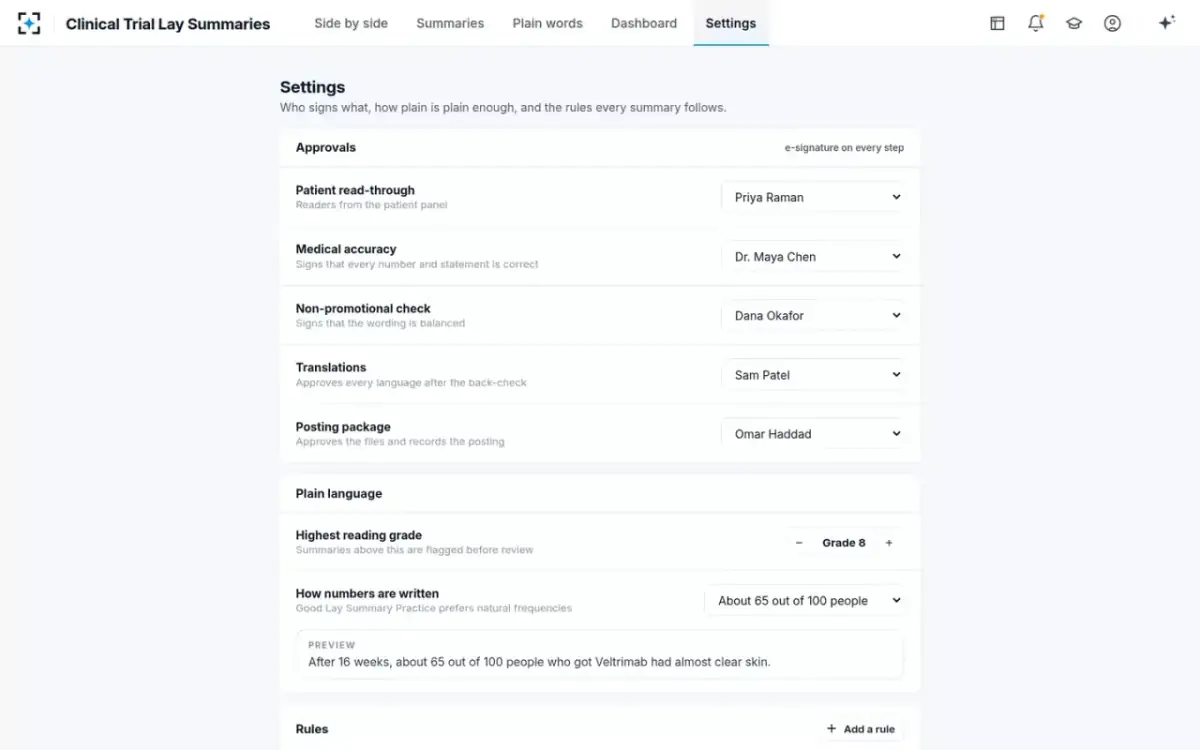
Ask the supplier which of the three it implements and how you would demonstrate each in an inspection. In the sample settings behind this solution, an approver is named for each step — the patient read-through, medical accuracy, the non-promotional check, translations and the posting package — and each signature carries what it asserts rather than a generic approval.
The settings a team actually owns: approvers, reading grade, and how numbers are written
Can a tool translate a lay summary, and what does that mean here?
It can produce the translations; what it must also do is prove they survived. The published guidance is comfortable with the tooling — “Technology and automation tools: Computer assisted translation and revision tools and translation memories can help ensure language accuracy, consistency and configure terminology to the trial at hand” — and equally clear about the two things around it.
The first is sequence: the guidance strongly recommends that the master summary be reviewed, finalised and approved before any translation starts. A tool that lets translation start from an unsigned draft without saying so is making a scheduling decision on your behalf with quality consequences. The second is terminology: it suggests a style guide for writing and translating the summary, and a glossary built ahead of need — ideally for a whole therapeutic area rather than one trial. Ask where the glossary lives, who may add to it, and what happens to a term with no locked translation. Back translation and the number read-back covers how that check is actually run.
What should a lay summary tool never do?
Three things, and all three are usually sold as features.
Three claims to refuse, and the question that exposes each
“Our readability score proves the summary is understandable.”
A score counts syllables and sentence length. Good Lay Summary Practice says plainly that short words in a meaningless sentence still score well.
Ask: show me a summary that scored well and that a reader still misunderstood. If they have never seen one, they have never tested comprehension.
“The model checks its own output for accuracy.”
The component that wrote a sentence is the worst possible judge of whether it is true to the table. A check has to come from the source, independently.
Ask: what reads the study report during the check, and can the checker change the text? If it can, nobody decided anything.
“The translation is finished — it reads beautifully.”
Fluency is not fidelity. The errors that matter in a translated summary are numeric and structural, and they read perfectly in both languages.
Ask: how was every number in the Hungarian version compared with the English, and who signed for that language by name?
A fourth belongs in the same family, though it is rarely claimed out loud: editing a sentence without a person accepting the edit. Good Lay Summary Practice sets the expectation for reviewers in general — they are to be told the summary must not promote and must avoid biased language — and that instruction is addressed to people. In this solution the fact checker and the plain-language checker cannot change a sentence themselves; they propose, and the medical writer accepts, edits or dismisses each flag with a reason. It is worth asking any candidate where that line sits, because a tool that silently improves a sentence has broken the trace between the posted text and the writer who signed for it.
What does a lay summary cost to produce today?
There is no published benchmark figure, and anyone who quotes one to you should be asked for its source. What the guidance does say is where the money goes: “The major costs will account for staff or contractors for the production and translation of the lay summary.” Staff and translation — not software, not review tooling. A tool's business case therefore has to be made against writer days and translation vendor spend, or it is not made at all.
Good Lay Summary Practice adds a budgeting trap that bites academic and smaller commercial sponsors hardest: “It should be noted that most funding bodies do not foresee budget allocation for LS preparation.” It goes on to explain why that is worse than it sounds — funders generally require costs to be incurred inside the funding period, and the summary falls due after the project has ended. If you are a sponsor of that kind, the cost question is not “what does this cost?” but “from which budget, in which year?”
Three ways teams produce a lay summary today
| Approach | How the draft is made | What drives the cost | Where the evidence lives | Who carries the deadline |
|---|---|---|---|---|
| A writer with a template | One medical writer takes the study report into the ten required sections, by hand, against a house template and style guide. | Writer days per summary, and the review cycles each draft needs. | In the writer's working files and an email trail, unless a document system captures it. | The writer, informally. The deadline is visible to whoever asks. |
| An agency | The draft is contracted out; the sponsor reviews, comments and signs. Translations are usually bought from the same supplier. | A fee per summary and per language, plus the sponsor review time nobody budgets for. | With the supplier, in whatever form the contract specifies. Getting the evidence back is a procurement question. | The supplier holds the schedule; the sponsor holds the duty. |
| Software the sponsor runs | The study report is read into facts; each section is drafted, graded, checked against its source passage and tested for comprehension before a person sees it. | Licence and configuration, plus the writer time the checking does not remove. | In the system, attached to each sentence and each signature, exportable. | A posting calendar, with an owner and a stage per summary. |
Build or buy a lay summary tool?
Build if the drafting is the only part you need, and buy if the checking is. That sounds glib, and it is the honest line. Generating readable prose from a study report is a capability a competent internal team can stand up in a quarter. The rest of the list — a source passage per sentence that survives editing, a planted-error test suite, a glossary locked across eighteen languages, a signature that carries its meaning and cannot be detached, and a calendar across a portfolio — is a product, and it is years of unglamorous work that nobody gets promoted for.
Three questions settle it in most organisations. How many summaries a year, and in how many languages? A sponsor with two summaries a year in two languages should think hard before buying anything. Who would own validation and audit evidence for something you built? If the answer is a team with no quality function behind it, the build is cheaper to start and more expensive to defend. And what happens when the guidance changes? A published standard that moves is a release for a supplier and a project for you.
One more consideration belongs in the decision and rarely makes it: whichever way you go, the writer does not leave the process. The guidance assigns the judgements — what a reader needs, what reads as promotion, which reviewer looks for what — to briefed people, and a business case built on removing them is a business case that will not survive first contact with a quality review.
How do you pilot a plain language summary tool so it produces evidence?
Pick the study report you would least like to be wrong about, run the whole chain on it, and keep what the run leaves behind. A pilot that produces a nice draft and an enthusiastic email has proved nothing; a pilot that produces a sentence-to-passage list, a planted-error result, a comprehension test with wrong answers and a signed summary has produced a procurement file.
Four rules make the difference. Use a real final study report, not a sanitised one, because the messiness is the test. Plant the five error classes before anyone sees the draft, and have someone outside the evaluation do the planting. Run the comprehension test before the patient read-through rather than after, so the wrong answers can still be fixed. And score the pilot on the evidence it produced, not on how the draft read.
On the comprehension test, there is a published model worth borrowing even though it was written for package leaflets. The Commission's readability guideline sets a measured bar — a satisfactory outcome is information found by 90 per cent of participants, 90 per cent of whom show they understood it, which works out at 16 of 20 participants for each question — and it rules out the obvious gaming of writing easy or trivial questions just to make the test pass. Write the questions before you see the draft, and write the ones you would be embarrassed for a participant to get wrong.
What a signature asserts, and what it is asserting it about
What this solution will not do for a lay summary
Being specific about the limits is more useful in a buying guide than another list of strengths, so here they are. It does not run the patient panel: a read-through by real participants is people meeting people, and the software's contribution is to arrive at that meeting with the eight key questions already answered and each wrong answer tied to an open flag. It does not replace a medical or legal reviewer: the medical accuracy signature and the non-promotional signature belong to named people and the guidance expects them to be briefed differently. And it posts nothing while a fact is unchecked or a flag is open, which is a constraint before it is a feature — a team that wants to post a summary with an open flag will find the software in the way.
Two further boundaries are worth stating. The study report is the source of truth, so a defect in the report propagates; nothing here audits the trial. And reading grade is a setting rather than a standard: the sample maximum is grade 8, while the EU Expert Group's published ideal is sixth grade, so a team that sets grade 10 will get grade 10 and should not mistake the setting for a benchmark.
The measures a programme is actually run on
If you want to run the nine tests above against a study report of your own, start from Clinical Trial Lay Summaries. The companion question — whether a model can write the summary in the first place, and what the measured evidence says — is taken up in can AI write trial results.
Questions people ask
What does a lay summary tool need to do that a writing assistant does not?
Tie every factual sentence to a passage in the final study report, and keep that tie when the sentence is edited. A general writing assistant improves prose; a lay summary tool has to make a claim about fidelity to a specific document that someone will sign for. The second capability implies the study report is in the system, which most writing assistants never see.
Does a plain language summary tool need to be validated?
Ask your quality function rather than the supplier, because the answer comes from your own procedures for systems that produce regulated disclosures. Whatever that answer is, demand the three controls 21 CFR part 11 names for closed systems — validation for accuracy and consistent intended performance, an audit trail that does not obscure what it replaces, and signatures that carry their meaning and cannot be transferred.
Can a tool post the summary to the register for us?
It can assemble the package — a file per language and the approval record — and hold the date. Submission into the register itself is an account-holder action by the sponsor, and should stay that way: the submission is a regulatory act by a named person with authority, not a step to automate away.
How do you compare two tools fairly?
Give both the same study report, the same planted errors and the same comprehension questions, written before either tool is opened. Then compare what each produced as evidence, not what each produced as prose. Most differences that matter show up in the artefacts: whether the source link survived an edit, whether the planted swap was caught, whether a flag records who decided it and why.
What should we ask about translations in a tool evaluation?
Three questions. Does translation start only from an approved master, and what stops someone starting earlier? What happens to a term with no agreed translation — a query, or an invention? And how was each language checked: reading it, or comparing every number against the master, with a named approval per language?
Is a plain language summary tool worth it for a small portfolio?
Often not, and that is worth saying plainly. The cost of this work is dominated by staff and translation, so the saving scales with the number of summaries and languages. A sponsor producing two summaries a year in two languages is usually better served by a good template, a plain-word glossary and a disciplined checking routine. The case strengthens sharply once a portfolio runs to several trials a year across many languages, or once a missed posting date becomes a live risk.