Almost every clinical trial lay summary example you can find is a finished leaflet: the sentences that survived, with no sign of the ones that did not. This page is the other kind. It takes four sentences from two draft summaries, shows the study-report table each came from, says what is wrong with it, and gives the sentence that replaced it. Writing a lay summary is hard because the four failures below are all failures of a correct sentence — a true percentage rounded into a friendlier fraction, a term copied faithfully out of the report, a point estimate reported exactly as the statistician wrote it, and a conclusion that reads as a compliment. Clinical Trial Lay Summaries is Botminds' software for this work: it drafts each required section from the study report, grades and checks every sentence, and hands the writer the flags to decide.
The studies, medicines and people named here are sample data on fictional studies and fictional people: VLT-302, Veltrimab in plaque psoriasis, and NXL-125, Talmirex in adults whose depression has eased. The rules the sentences are judged against are published, and linked where they appear.
The four sentences, and where each came from
All four sentences are true to a table. None of them was invented, and a fact check that only asked “does this match the report?” would have passed every one. What separates them is whether a participant reading the finished page would take away what the table actually says.
Three of the four sit in sections the law requires by name. Annex V of the EU Clinical Trials Regulation lists ten elements a layperson summary must address, among them the adverse reactions and how often they happened, and comments on the outcome; the ten Annex V elements are set out one at a time elsewhere in this series. The fourth sentence is the overall result, which is what most readers come for.
Four draft sentences, the rule each breaks, and what replaced it
| Section | Where it came from | The draft sentence | What is wrong | The replacement | Grade |
|---|---|---|---|---|---|
| One · Overall results | Table 11.4, page 52 — PASI 90 at week 16: 277 of 428 (64.7%) | “After 16 weeks, about 7 out of 10 people who got Veltrimab had almost clear skin.” | A friendlier fraction that is 5.3 points higher than the table | “After 16 weeks, about 65 out of 100 people who got Veltrimab had almost clear skin.” | 6 → 6 |
| Two · Adverse reactions | Table 12.2, page 63 — any event: 249 of 428 (58.2%) against 110 of 214 (51.4%) | “In the first 16 weeks, 58 out of 100 people on Veltrimab and 51 out of 100 people on placebo had treatment-emergent adverse events.” | A study-report term carried into a page written for participants | “In the first 16 weeks, 58 out of 100 people on Veltrimab and 51 out of 100 people on placebo had at least one medical problem. Not all of these were caused by the study medicine.” | 11 → 7 |
| Three · Overall results | Table 11.3, page 52 — relapse: 47 of 246 (19.1%) against 71 of 244 (29.1%); hazard ratio 0.64 (95% CI 0.44 to 0.92) | “The risk of relapse was reduced with Talmirex versus placebo during the randomized withdrawal phase (hazard ratio 0.64; 95% confidence interval 0.44 to 0.92).” | Correct, cited, and unusable by the reader it is written for | “About one in three fewer people on Talmirex had their depression come back.” | 14 → 7 |
| Four · Comments on the outcome | No table — a conclusion drawn by the drafter | “Veltrimab worked very well and is a safe treatment for psoriasis.” | A judgement one trial cannot support, in the words a medicine is advertised in | “This was one study. It cannot show whether the medicine is safe for everyone, and other studies may find different results.” | 9 → 7 |
Read down the “what is wrong” column and a pattern appears. Nothing here is a factual error of the kind a numbers check catches. Each sentence fails at the step after the numbers check: the moment a reader turns the sentence into a belief.
Sentence one: 64.7 per cent, and why “about 7 out of 10” is wrong
The first sentence rounds. Table 11.4 of the VLT-302 study report gives the primary endpoint — almost clear skin at week 16 — as 277 of 428 people, which is 64.7 per cent. The drafter wrote “about 7 out of 10”. Seven out of ten is 70 per cent, so the summary tells the reader a number 5.3 points higher than the one the trial produced, in a form that sounds deliberately approximate and therefore trustworthy.
The guidance pushes in the opposite direction. The EU Expert Group's recommendations ask writers to “Present absolute numbers but also consider conveying numerical information in other ways such as a percentage, rather than relative risks, odds ratios etc.” and to describe outcomes as so many people out of so many, with the percentage in brackets. The same document prefers whole numbers to decimals wherever that does not add confusion. Whole numbers, not round numbers: 65 out of 100 is a whole number and 7 out of 10 is a rounded one.
The rounding test, written out on the VLT-302 result
What the table says
277 ÷ 428 = 64.7%
Almost clear skin at week 16, Table 11.4, page 52.
Study report
What the draft said
“about 7 out of 10” = 70%
A fraction a reader converts to a percentage without being asked to.
Draft summary
The overstatement
70.0 − 64.7 = 5.3 points
In the direction that flatters the medicine, which is the direction that matters.
Our arithmetic
The house tolerance
more than 2 points → flagged
The sample setting: any rounding that moves a number by more than two points is raised for the writer.
Sample settings
How much rounding is too much in a lay summary?
There is no published number of percentage points at which rounding becomes misreporting, so a team has to set one and apply it the same way every time. Two points is a defensible place to start, for a reason that has nothing to do with statistics: two points is roughly where a rounded figure stops being the same claim. Sixty-five rounded to “about 65 out of 100” is the same claim. Sixty-five rounded to “about 7 out of 10” is a different claim, and a reader quoting it back has been given a figure the trial did not produce.
Three rules of thumb follow from the published guidance and survive contact with real drafts. Round to the nearest whole number per hundred, not to a neat fraction, because fractions carry an implied precision of their own. Round in the direction that does not flatter the result where the choice is genuinely open. And apply the same rounding to both arms: a summary that rounds the medicine's number up and the placebo's down has manufactured a difference twice over.
One further case has its own rule. Where a numerical difference is not statistically significant, the Expert Group asks that the reader be told so whenever the summary mentions a difference that was not statistically significant. Rounding a non-significant gap into a clean-sounding fraction is the worst version of this failure, because the arithmetic and the inference are wrong together.
Sentence two: how do you write side effects in a lay summary?
Write what happened to people, say how many, and say plainly that not everything counted was caused by the medicine. The second draft sentence does the first two and not the third: “In the first 16 weeks, 58 out of 100 people on Veltrimab and 51 out of 100 people on placebo had treatment-emergent adverse events.” The numbers match Table 12.2 — 249 of 428 against 110 of 214 — and the phrase at the end of the sentence is lifted out of the study report.
“Treatment-emergent” is a term of art with a precise meaning. ICH E3, the guideline that sets out what a clinical study report contains, describes identifying “treatment emergent signs and symptoms” (TESS; those not seen at baseline and those that worsened even if present at baseline). It means an event that appeared or got worse after dosing started — not an event the medicine caused. A participant reading it has no way to know that, and the 51 out of 100 on placebo is the proof: half the comparison group had one too.
Good Lay Summary Practice names the trap directly, warning that the side effects listed on a product label can be confused with the reactions a trial reports, and that “The reader should not be expected to make analytical judgements based on the relative incidence of events versus a placebo group.” The replacement sentence does the judging instead of delegating it: “at least one medical problem”, followed by “Not all of these were caused by the study medicine.” The grade falls from 11 to 7 and the sentence gets longer, which is the trade the guidance expects.
“Indeed, just translating medical terms into ‘simple’ equivalents, without explanatory context, can be more misleading and confusing than technical language itself.”
Good Lay Summary Practice, European Commission and the EU Clinical Trials Expert Group
That line is the test for every swap. “Medical problem” on its own would have been a simple equivalent with no context, and arguably worse than the jargon, because it sounds like the medicine caused it. The added sentence is the context, and it is what makes the swap honest rather than merely shorter.
Sentence three: how do you rewrite a hazard ratio for a lay summary?
Go back to the same table and take the counts. The NXL-125 draft reported the relapse result the way the statistical analysis did: “The risk of relapse was reduced with Talmirex versus placebo during the randomized withdrawal phase (hazard ratio 0.64; 95% confidence interval 0.44 to 0.92).” Nothing in it is wrong. It matches Table 11.3, and ICH E3 asks for exactly this in the report: the size of the difference as a point estimate, its confidence interval, and the result of any hypothesis test. That is what a study report is for. A lay summary is for something else.
The Expert Group is blunt about which terms may not travel: “Refrain from using technical terms such as ‘number needed to treat’, ‘odds ratio’, ‘confidence interval’ etc. If technical terms are included, then they need to be explained in simple language.” Good Lay Summary Practice adds the reason — most lay people have no understanding of statistical concepts and the writer therefore should decode them into lay language. Decode, not delete: the result still has to be in the summary, in a form the reader can use.
The same Table 11.3 holds what the rewrite needs. Relapse happened in 47 of 246 people on Talmirex and 71 of 244 on placebo — 19.1 and 29.1 out of 100. The fall from 29.1 to 19.1 is 10 points in absolute terms and 34 per cent of the placebo figure, which is where “about one in three fewer” comes from.
One relapse result, three ways of saying it
What it says: Hazard ratio 0.64, 95% confidence interval 0.44 to 0.92, p = 0.018, over the randomised withdrawal phase.
What a participant takes away: Nothing usable. Two of the three terms are on the list the guidance asks writers to keep out of a lay summary.
What it says: Relapse in 47 of 246 people on Talmirex and 71 of 244 on placebo — 19 and 29 out of 100.
What a participant takes away: Both arms, in absolute numbers. Correct, complete and still a small arithmetic problem for the reader.
What it says: “About one in three fewer people on Talmirex had their depression come back.”
What a participant takes away: The comparison, done for the reader. It needs the counts beside it, or “one in three fewer” floats free of what it is one third of.
The flagged sentence, the table it came from, and the proposed rewrite
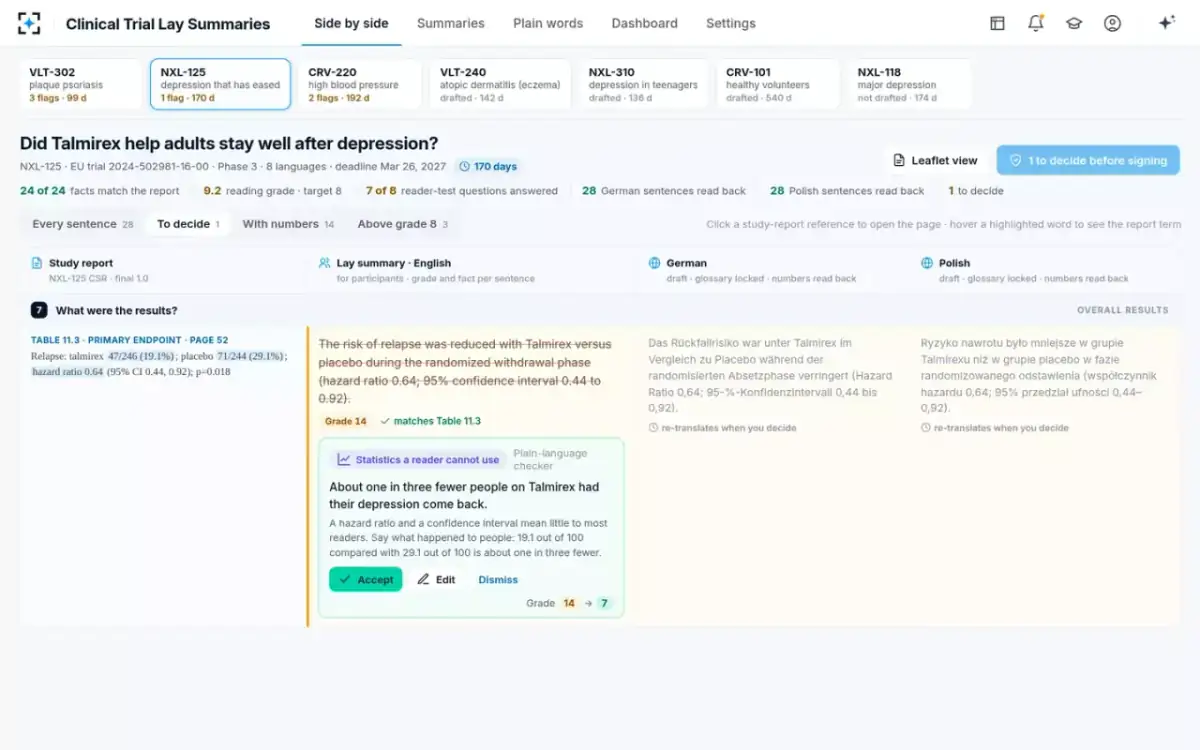
Can you say “about one in three fewer people”?
Yes, with the counts next to it. “One in three fewer” is a relative statement, and relative statements are the ones that mislead when they stand alone: a third fewer of a rare event is a small change in how many people it happens to, and a third fewer of a common one is a large change. Here the event is common — it happened to 29 out of 100 people on placebo — so the relative figure and the absolute one tell a similar story, and the sentence is fair.
The guidance asks for the absolute numbers either way. Presenting absolute numbers is the first instruction in the Expert Group's numeracy section, and relative risks are named as the thing to present something else instead of. So the honest form of the rewrite is both: “About one in three fewer people on Talmirex had their depression come back — 19 out of 100 on Talmirex, against 29 out of 100 on placebo.”
There is a second limit on how far a lay summary may go with a secondary result. Good Lay Summary Practice notes that a writer “should appreciate and be able to explain that clinical trials are usually or often powered to demonstrate differences in the primary endpoint and are often not powered to show a difference in secondary endpoints.” A striking “one in three fewer” drawn from a secondary endpoint is a sentence that reads like a finding and is not one.
Sentence four: what is wrong with saying a treatment is safe and effective?
Two things, and they fail in different directions. “Veltrimab worked very well and is a safe treatment for psoriasis” is promotional, which the rules forbid outright, and it is a claim the trial design cannot support, which no amount of rewording fixes.
On the first, the Expert Group's instruction is one line — no promotional content, with its neutral-language annex as the guide. Good Lay Summary Practice repeats it in substance: factual, objective language, nothing designed to promote or to favour. “Worked very well” is a judgement with no number behind it, and “safe” is the single word a medicines regulator spends years deciding.
On the second, a trial of 642 adults over 16 weeks can show what happened to those adults in those weeks. It cannot show that a medicine is safe for people who were not in it. Good Lay Summary Practice asks the comments section to carry that limit explicitly: say which population the results apply to, name the most important limitations, and make clear that this is one trial and that others may find something different.
The neutral pattern: name the groups, give the comparison, stop
The draft
“Veltrimab worked very well and is a safe treatment for psoriasis.”
Two claims, no numbers. “Worked very well” grades the result; “is a safe treatment” generalises beyond the people who took part.
The neutral pattern
“After 16 weeks, about 65 out of 100 people who got Veltrimab had almost clear skin, against [x] out of 100 who got the dummy treatment. This was one study. It cannot show whether the medicine is safe for everyone, and other studies may find different results.”
The comparison, in absolute numbers — the placebo figure taken from the same table, shown here as a placeholder in the Expert Group's own bracket style — and the limit stated rather than implied.
The replacement is longer than the draft, and that is the normal outcome of this work. Every one of the four rewrites on this page is longer than the sentence it replaced. The length buys the context without which a simpler word is a worse sentence.
What a grade 7 sentence looks like next to a grade 14 one
Reading grade is a count of syllables per word and words per sentence, turned into a US school year. It is crude, and it is not nothing. The hazard-ratio sentence runs to 24 words, with “randomized withdrawal phase” in the main clause and “hazard ratio” and “confidence interval” packed into one parenthesis: it grades at 14, the reading level of a university undergraduate. The rewrite is 13 words long, every one of them in ordinary use, and grades at 7.
The published target is lower than most teams assume. The Expert Group's own guidance names sixth grade as the ideal, close to the literacy level of the general population, and asks writers who cannot reach it to get as near as they can. A house maximum of grade 8, as in the sample settings behind this worked example, is a working compromise and should be presented as one; what a good lay summary reads like takes the reading-level question on its own.
Grade is also the one measure on this page with outside evidence behind it. In a study of twenty actively recruiting urologic oncology trials, the brief summaries published on ClinicalTrials.gov scored a mean Flesch-Kincaid grade of 18.2 against 7.0 for generated replacements (Cano et al., Current Oncology, 10 December 2025). Those are registration summaries rather than results summaries, and the comparison is of readability only, not of whether the facts survived — which is the subject of what the measured evidence says about generated summaries.
The NXL-125 summary before and after the writer's four decisions
14 → 7grade
on the relapse sentence, once the plain rewrite is accepted
9.2 → 7.9grade
across the whole summary, against a house maximum of 8
24 of 24
statements matching the study report when the writer signs
7 → 8of 8
questions the reader test answers correctly from the summary alone
The three answers a reader got wrong from the first draft
The useful test of a lay summary is not its grade; it is what someone takes away from it. In the first VLT-302 draft, the reader test answered five of eight key questions correctly, and the three it got wrong map one-to-one onto three of the four sentences above.
Asked how many people on Veltrimab had almost clear skin, it answered “about 7 out of 10” — the draft's figure, not the report's 65 out of 100. Asked whether people had medical problems and how common they were, it could not explain “treatment-emergent adverse events”. Asked whether this one study shows the medicine is safe for everyone, it answered yes, because the summary said “a safe treatment”. Each wrong answer is tied to the flag that caused it, which is the point: a comprehension failure with no sentence attached is a complaint, and one with a sentence attached is a fix.
Eight questions answered from the summary alone, and the three that came back wrong

Who decides whether a rewritten sentence is accepted
The writer, by name, and nobody else. In this worked example the plain-language checker and the fact checker produce the proposed sentences on this page and cannot put any of them into the summary: each flag is accepted, edited or dismissed with a reason by the medical writer. That is a deliberate division of labour rather than a limitation — the proposals are mechanical, and the judgement about whether a shorter sentence is still true to Table 11.3 is not.
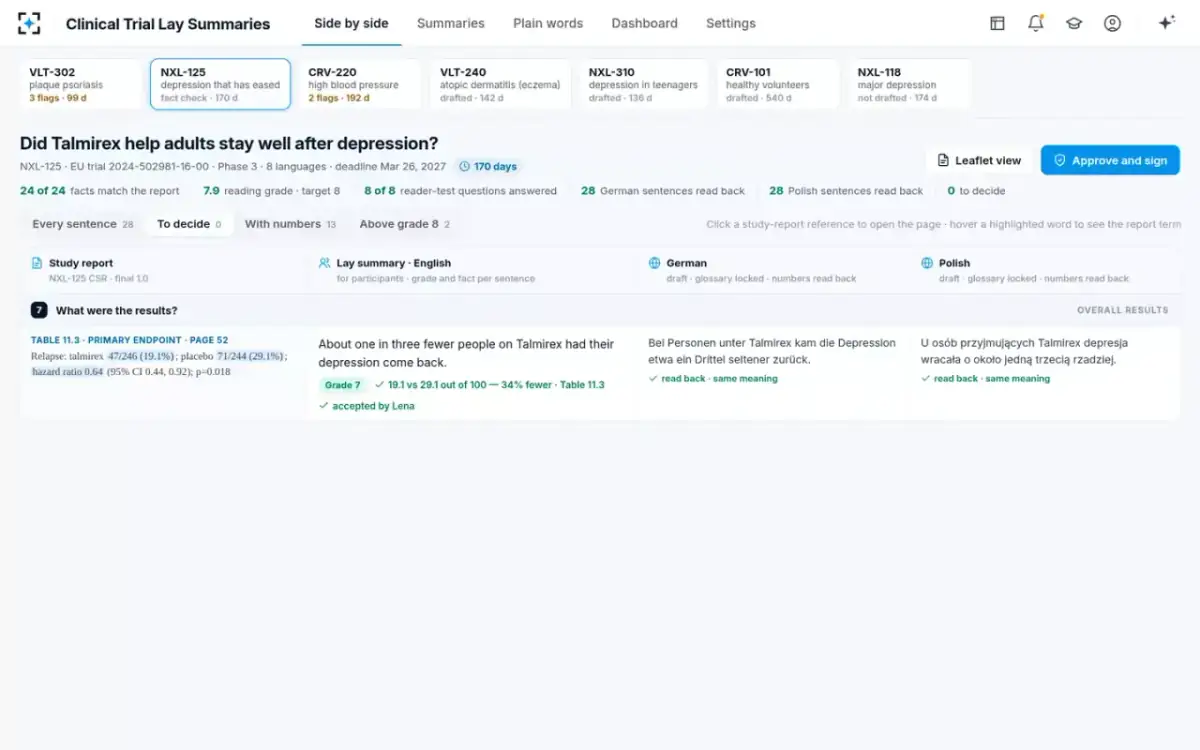
When the rewrite is accepted, three things follow in order. The sentence takes its new grade and its fact tick, carrying the figures it rests on — “19.1 vs 29.1 out of 100 — 34% fewer · Table 11.3”. The German and Polish drafts re-translate from the accepted English and are read back into English so that every number can be compared; back translation and what it catches covers that step. And the summary's totals move: in NXL-125, 24 of 24 statements matching, grade 7.9, and the reader test at 8 of 8.
Taking apart a sentence of your own
- Find the table it came from, by page
If you cannot, the sentence is not a fact yet. Every factual sentence in a lay summary should be traceable to a passage in the final study report.
- Recompute the number from the counts
277 of 428 is 64.7%, not 7 in 10. Do the division yourself rather than trusting the rounding in the draft.
- Underline every term that came from the report
Treatment-emergent, randomised withdrawal, hazard ratio, confidence interval, endpoint. Each either goes, or gets a plain sentence of explanation.
- Ask what the sentence lets a reader conclude
Then ask whether the trial tested that. “Safe” and “worked very well” almost never survive this question.
- Give both arms, in the same form
Same rounding, same units, same direction. A comparison written two different ways is a comparison the reader cannot make.
- Read the rewrite back against the table, not the draft
The draft is the thing you are trying to improve on. The table is the thing you have to stay true to.
After the writer accepts: the new grade, the figures behind it, and both translations re-run
To see the four flags, the reader test and the translation read-back on a summary of your own, start from Clinical Trial Lay Summaries.
Questions people ask
Is there a published example of a clinical trial lay summary?
Yes. Annex 1 of the EU Expert Group's recommendations carries templates with example wording for each of the ten Annex V elements, and Annex 2 gives neutral example sentences by endpoint type — mortality, morbidity, non-inferiority, patient-reported outcomes and incidence. They are specimens of finished wording rather than worked rewrites, which is why this page shows the drafts as well.
How do you write a percentage in a lay summary?
As a count out of a round base, with the percentage beside it where it helps: the Expert Group's form is “x out of xx people [xx%]”. Use whole numbers where you can, use the same base for both arms so the comparison is readable, and do not convert a percentage into a fraction such as “7 in 10” — fractions sound approximate and are read as precise.
How do you explain a confidence interval to a participant?
In most lay summaries you do not include one. “Confidence interval” is among the terms the EU Expert Group asks writers to refrain from using, and if a technical term is included it has to be explained in simple language. Where the uncertainty genuinely matters to what the reader should conclude, the usual route is to report the counts in both arms and say in a sentence that the result could be somewhat larger or smaller than the single figure suggests.
Can you say a medicine is safe in a lay summary?
No. “Safe” is a conclusion about a medicine in general, and a single trial measures what happened to the people in it. Both the EU Expert Group's recommendations and Good Lay Summary Practice require factual, non-promotional language, and Good Lay Summary Practice asks the summary to state that it reflects one trial and that other trials may show other results. Report what happened in each arm and leave the judgement where it belongs.
Does every sentence in a lay summary need a source in the study report?
Every factual sentence does. A lay summary reports the results of one trial, so each number, group, time point and side-effect frequency should be traceable to a passage in the final clinical study report. Sentences that are not factual claims — the thank-you to participants, an explanation of what a placebo is — come from the house glossary instead, and that is where which numbers to take from which table starts.
Who signs off a rewritten sentence?
The medical writer accepts, edits or dismisses each proposed rewrite and signs as author of the summary. After that the summary goes to a patient read-through, a medical reviewer who signs for accuracy, and a reviewer who signs that the wording is non-promotional — the division of review that Good Lay Summary Practice describes, in which a medical specialist, a legal specialist and a language specialist each look for something different.