A lay summary from the CSR is written table by table, not paragraph by paragraph. The clinical study report is the only permitted source of facts for an Annex V summary, and ICH E3 tells you where each kind of fact lives in it: the synopsis in section 2, patient disposition in 10.1, demographics in 11.2, efficacy results in 11.4, adverse events in 12.2, and the summary tabulations in section 14. A writer who notes the page and table behind every sentence turns the review into a comparison that can be finished in an afternoon; a writer who paraphrases from memory hands the statistician a re-derivation. Botminds' Clinical Trial Lay Summaries reads the study report once into the facts the ten sections need, each with its page or table, and compares every number in the draft back to the passage it came from.
The worked figures on this page come from the solution's sample data — the fictional VLT-302 study of Veltrimab in plaque psoriasis and the fictional NXL-125 study of Talmirex in depression, with fictional people around them. The rules and section numbers come from ICH E3, the Regulation and the Commission's guidance, linked where they appear.
The two documents, and the one place they touch
A clinical study report and a lay summary have almost nothing in common except their facts. One is a few hundred pages written to let a reviewer reconstruct an analysis; the other is two pages written to let a participant understand what happened. They touch at exactly one point: every factual sentence in the summary must be true of a specific passage in the report, and a reviewer must be able to get from the sentence to the passage without searching.
That is why the first step is extraction rather than drafting. Pulling the facts out — with their page, their table and their exact figures — separates two jobs that writers usually do at once: finding out what the trial found, and deciding how to say it. Done together, a rounding decision gets made while the writer is still reading, and nobody can tell later whether the number in the summary is a copy or a choice.
Where do you get the numbers for a lay summary?
From the final study report's synopsis first, then from the tables it points to. ICH E3 asks for A brief synopsis (usually limited to 3 pages) that summarises the study
, and then makes it useful for exactly this purpose: The synopsis should include numerical data to illustrate results, not just text or p-values.
A well-written synopsis carries most of what elements 3, 4, 5 and 7 need.
What the synopsis will not give you is the texture: which adverse reactions were common and how common, how many people stopped treatment, how the groups differed at baseline. Those come from the body sections and the summary tables, and the draft has to be built on both. Working only from the synopsis is how a summary ends up accurate and unanswerable — correct on the headline result, silent on the questions a participant actually has.
Each Annex V element and its home in the clinical study report
| Element | Where it lives in the CSR | What to copy out |
|---|---|---|
| 1 · Trial identification | Title page and synopsis (ICH E3 sections 1 and 2). | Trial title, protocol number, EU trial number, sponsor identifiers — exactly as written. |
| 2 · Sponsor name and contact | Title page; administrative structure in section 6. | The sponsor name as registered, and the contact route the sponsor will actually answer. |
| 3 · General information about the trial | Synopsis; overall study design in 9.1; objectives in section 8. | Countries and sites, start and end dates, the main objective in one sentence, and why the trial was run. |
| 4 · Population of subjects | Disposition of patients in 10.1; demographics in 11.2 and the section 14.1 tables; eligibility in 9.3. | Numbers randomised, treated and analysed; age and sex breakdowns; the main inclusion and exclusion criteria. |
| 5 · Investigational products used | Treatments administered in 9.4; identity of the product; the blinding description in 9.4.6. | What was given, how, how often and for how long — and what the comparator was. |
| 6 · Adverse reactions and frequency | Adverse events in 12.2, with the summary tabulations in 14.3.1; causality as the investigator assessed it. | Counts and percentages per group for the reactions judged related, serious ones first. |
| 7 · Overall results | Efficacy results and tabulations in 11.4; the primary endpoint analysis in 11.4.1. | The primary endpoint result for both groups, in counts and percentages, with the measure and the time point. |
| 8 · Comments on the outcome | Efficacy conclusions in 11.4.7; the discussion and overall conclusions in section 13. | The population the result applies to and the limitations the report itself names. |
| 9 · Follow-up trials foreseen | Not in the report. The development plan, or a decision nobody has written down. | A one-line answer agreed with the programme team before the summary is drafted. |
| 10 · Where more information is found | Not in the report. The register entry and any publication. | The public register entry for the trial, and a contact that is monitored. |
Which CSR tables does a lay summary use?
Four families of table do nearly all the work. The disposition table says how many people entered, how many were randomised, how many were treated and how many finished — the numbers element 4 needs. The demographic tables give the age and sex breakdowns in the same place. The efficacy tables in section 11.4 give the primary endpoint for each group. And the adverse event tabulations give the safety picture: ICH E3 asks that All adverse events occurring after initiation of study treatments … should be displayed in summary tables (section 14.3.1)
, with the narrative in 12.2 summarising them.
The order in which a writer opens them matters more than it looks. Starting with the efficacy table produces a summary built around the result, with the population bolted on afterwards; starting with disposition produces one built around the people, which is the order a reader needs — who took part, what they were given, what happened, what it means.
One study report read into its facts, each with its page and table

Can you write the lay summary before the final CSR?
You can draft the half that does not depend on results, and you probably should. Elements 1, 2, 3, 5 and the eligibility part of 4 are settled by the protocol: who the sponsor is, where and when the trial ran, what the medicines were, who could take part, and why the trial was done at all. None of that changes when the analysis lands. Good Lay Summary Practice recommends developing the summary in parallel with the source documents rather than after them, precisely so the results have somewhere to be dropped into.
What cannot be pre-written is any sentence with a number in it. A draft that carries placeholder results tends to keep the sentence shape chosen when the result was still a hope, and the shape of a sentence is itself a claim. The discipline that works is to write the result sections last, from the tables, and to leave visible gaps rather than provisional numbers — a gap gets filled, a provisional number gets approved.
Why do the participant numbers differ between the CSR and the lay summary?
Because a trial has several true counts and the two documents reach for different ones. Screened, randomised, treated, and included in an analysis set are four different numbers, and a report may use a fifth for a particular endpoint. The study report states which set each table uses; the lay summary has no room to, so it has to choose one spine and explain any difference in words.
The guidance asks for exactly that, and adds an alignment rule worth writing into a house style: as far as possible, the numbers should align with the number of trial participants referred in the results section
. In the sample VLT-302 study, 642 adults took part, 428 on Veltrimab and 214 on placebo, and the efficacy table uses those same 428 — so 428 is the spine, and the people who stopped early are described rather than subtracted.
One sentence, two numbers, five points of difference
277of 428
people on Veltrimab had almost clear skin, from Table 11.4
64.7%
the percentage that table gives
70%
what “about 7 out of 10 people” tells a reader
5points
of overstatement, from one rounding in one sentence
What does treatment-emergent mean, and can you use it in a lay summary?
Treatment-emergent is a counting rule, not a diagnosis. ICH E3 describes the convention of identifying in the adverse event tables treatment emergent signs and symptoms (TESS; those not seen at baseline and those that worsened even if present at baseline)
. A treatment-emergent adverse event is therefore any medical problem that appeared or worsened after treatment started — whether or not the medicine caused it.
It cannot survive into a lay summary in that form, for two reasons. It reads at a graduate level, and it implies causation that the counting rule does not claim. Element 6 asks for adverse reactions, which are the subset the investigator judged might have been caused by the medicine, so a sentence built on the treatment-emergent table is reporting the wrong population of events in language nobody outside the industry uses. The repair is a plain sentence plus an explicit caveat: how many people had at least one medical problem, and that not all of those problems were caused by the study medicine.
The same translation problem runs through the whole safety section. The guidance is explicit that Medical dictionary preferred terms as defined in the Medical Dictionary for Regulatory Activities (MedDRA) will often need to be translated into terminology more understandable to a non-scientific reader
— and a locked glossary is how a sponsor keeps that translation the same in every summary it writes.
A flag beside the passage it came from, in Clinical Trial Lay Summaries
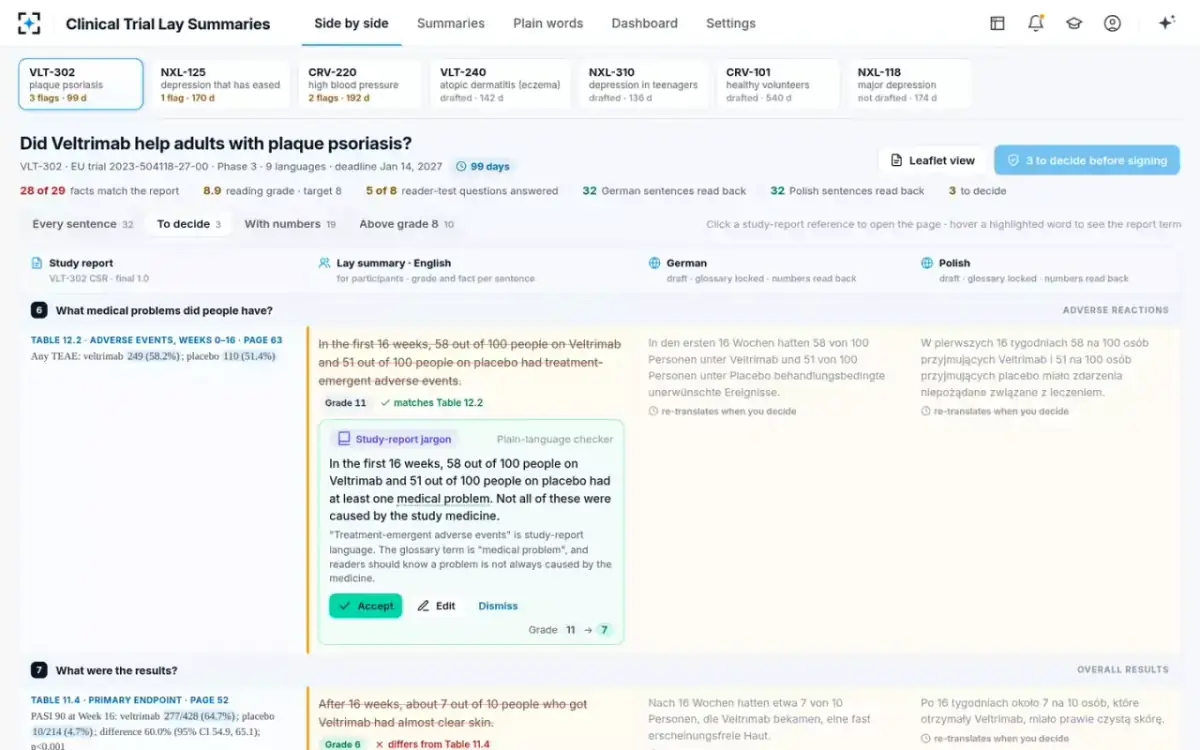
The four places a number drifts between the table and the summary
Number errors in lay summaries are not random. Four substitutions account for many of them, and each has a signature a reviewer can look for.
The four drifts, and what each looks like on the page
- Randomised swapped for treated
The denominator changes by a handful of people and every percentage in the section moves with it. Look for a count that matches no table.
- An event reported as a reaction
A number copied from the treatment-emergent table into a sentence about side effects. The figure is right and the claim is wrong.
- A relative measure reported as an absolute one
“A third fewer relapses” standing in for 19.1% against 29.1%. The Expert Group asks for absolute numbers first, and for ratios to be explained rather than printed.
- A rounded figure overtaking the reported one
64.7% written as “about 7 out of 10”. Rounding to a friendlier fraction is a common fact-check failure, and it tends to round in the direction that flatters the result.
The third drift is the one with a rule attached. The Expert Group's Recommendations ask writers to lead with absolute numbers and to reach for percentages rather than relative risks or odds ratios, and to keep out terms such as number needed to treat, odds ratio and confidence interval — or, where one has to stay, to explain it in simple words. Both instructions point the same way: start from the people.
“The analysis should show the size (point estimate) of the difference between the treatments, the associated confidence interval, and where utilised, the results of hypothesis testing.”
ICH E3, section 11.4.1, Analysis of Efficacy
That sentence is why the drift happens. The study report is required to present the result as an estimate with its uncertainty, and that presentation is correct, complete and unusable by a lay reader. The same table almost always carries the counts the estimate was computed from, and those counts are what the summary needs.
The same result in three forms, from one table
As the study report states it: Risk of relapse reduced with Talmirex versus placebo during the randomised withdrawal phase: hazard ratio 0.64, 95% confidence interval 0.44 to 0.92.
As the lay summary can use it: Not usable as written. Reads at graduate level, and the guidance asks for ratios and intervals to be avoided or explained.
As the study report states it: Relapse in 47 of 246 people on Talmirex and 71 of 244 on placebo.
As the lay summary can use it: “Depression came back in 47 of 246 people taking Talmirex, and in 71 of 244 people taking placebo.”
As the study report states it: 19.1% against 29.1%.
As the lay summary can use it: “That is about 19 out of 100 people, compared with about 29 out of 100.”
As the study report states it: The hazard ratio expresses the difference over time.
As the lay summary can use it: “About one in three fewer people taking Talmirex had their depression come back” — the relative statement, offered after the absolute numbers, not instead of them.
Rounding: how much movement is an error
Rounding is allowed and expected — the Expert Group asks writers to Use whole numbers rather than decimals to the extent this is possible without increasing confusion should the lay summary be cross referenced with the scientific summary
. The question is how far a number may move, and the answer a sponsor needs is a figure written down before any particular sentence is argued about.
Two points is a defensible threshold, and it is what the solution uses: any rounding that moves a number by more than two percentage points is flagged for the writer. 64.7% to 65% passes. 64.7% to “about 7 out of 10” moves five points and does not. The direction matters too: rounding a benefit up or a harm down is the pattern a reviewer should be most suspicious of, because it is the one that happens without anybody deciding to do it.
How do you cite a source for a sentence in a lay summary?
Not in the published document — a lay summary with footnotes is a worse lay summary. The citation belongs in the working version: each factual sentence carries the page and table it came from, visible to the writer and to every reviewer, and stripped from the leaflet a participant reads.
That split is what makes the review cheap. A medical reviewer who disagrees with a sentence opens the passage behind it rather than asking for the derivation. A statistician confirms twelve numbers against twelve cells instead of re-running an analysis. And when the summary is translated, the same addresses travel with each sentence, so a translator's question about a number has a single answer rather than a thread.
One sentence, from table cell to signed summary
Agent
Study report readerPulls the fact out of Table 11.4 with its page: 277 of 428 on Veltrimab, 64.7%, almost clear skin at week 16.
Never: Rounds or rewords anything at this step
Agent
Annex V drafterWrites the element 7 sentence from that fact and the plain-word glossary, with both groups and the time point.
Never: Uses a fact that is not in the extraction
Agent
Fact checkerCompares every number, unit, group and time point in the sentence back to the same cell, and flags a rounding of more than two points.
Never: Edits the sentence itself
Agent
Plain-language checkerScores the sentence’s reading grade, finds study-report terms with a glossary entry, and flags promotional wording.
Never: Overrides the writer’s wording
A person decides
Medical writerAccepts, edits or dismisses each flag with a reason, then signs as author that every fact matches the final study report.
How do you check a lay summary against the study report?
Sentence by sentence, against the passage each one names, with a written list of what is being compared: the number, the unit, the group it belongs to and the time point it was measured at. Those four are where mismatches hide. A number can be right for the wrong arm, or right for week 12 when the summary says week 16, and both read perfectly.
Three checks are worth making explicit in a procedure. Every factual sentence has a source — a sentence with no address is not yet checkable, and “it is in the synopsis” is not an address. Every number in the summary appears somewhere in the report, which catches arithmetic the writer did themselves. And the counts in the results section reconcile with the counts in the population section, which catches the randomised-against-treated drift before a reviewer finds it.
What this cannot tell you is whether the summary is readable, or whether a reader will take the right meaning from it. Those are separate passes, covered in how to write a good lay summary; completeness against the ten elements is a third, covered in the ten Annex V elements, one at a time.
What happens to the lay summary if a table is re-run?
Every sentence that cites that table is in question again, and knowing which ones they are is the difference between an afternoon and a fortnight. A re-run happens more often than the plan allows for: a data query resolved after the first report draft, a reclassified adverse event, an analysis set corrected, a late protocol deviation. The study report gets a new version, and the summary inherits it.
With addresses on every sentence, the impact is a lookup: these four sentences cite Table 12.2, three of their numbers changed, and the German and Polish versions of those three need re-translating and reading back. Without addresses, the only safe response is to check the whole document again — and, because that is expensive, the common response is to check the headline numbers and hope. A summary drawn from a superseded table is wrong in the one way the Regulation cares about: it says something about a medicine that the sponsor's own report does not support.
The late stretch of the work is the reason to care. A number that changes after the English is signed does not cost one correction; it costs the correction, the re-approval, and every language version drawn from that sentence, which is why the back-check across languages is built around the numbers rather than around the prose. To see the extraction, the flags and the citations on one of your own study reports, start from Clinical Trial Lay Summaries.
Questions people ask
What is in the synopsis of a clinical study report?
A summary of the whole study, usually limited to about three pages, covering the objectives, the design, the population, the treatments, the results and the conclusions. ICH E3 asks that it include numerical data to illustrate results rather than text or p-values alone, which is what makes it the right first stop for a lay summary writer — and why a thin synopsis slows the whole document down.
Who checks the numbers in a lay summary?
In many sponsors, the writer checks them first, a statistician or the clinical lead confirms them, and the signature for medical accuracy carries the confirmation. What matters is less who does it than what they are given: a comparison against named passages is a different task from re-deriving the result, and only the first can be finished reliably under a deadline.
Can you use a p-value or a confidence interval in a lay summary?
Better not to. The Expert Group's Recommendations ask writers to refrain from technical terms such as number needed to treat, odds ratio and confidence interval, and to explain any that are kept in simple language. Where a difference was not statistically significant, the guidance does ask for that to be explained to the reader — in words, not in notation.
Does the lay summary have to use the same participant numbers as the study report?
It has to be consistent with it, and the guidance asks the numbers to align as far as possible with those in the results section. Where randomised and treated counts differ, present the difference clearly rather than choosing silently; a reader who finds two different totals in one document stops trusting both.
How many facts does one lay summary rest on?
More than teams expect. In the solution's sample data, a newly arrived study report is read into 56 facts, each with its page and table, drawn from the synopsis and 14 results tables — for a document of about two pages. That ratio is the reason extraction is worth doing once, properly, instead of four times by four reviewers.
What if the study report itself is wrong?
Then the summary waits. A lay summary may only state facts from the final clinical study report, so a discrepancy found while drafting is a question for the report's authors, not something to be written around in plain words. Fixing it in the summary alone would leave two public documents that disagree, with the lay one carrying the correction nobody can trace.