To write a good lay summary you need three things the Annex V content list does not give you: a reading level to aim at, a convention for words and numbers, and a way of finding out whether people understood it. The published targets are specific — an ideal of sixth-grade reading, a document accessible to a reader of twelve, and text suitable for the level 2 to 3 literacy that is the European average — and they are harder than they look, because the facts come from a document written for specialists. What makes the work hard is that readability cannot be proven by scoring: a page of short, simple sentences can explain nothing at all. Botminds' Clinical Trial Lay Summaries grades every sentence as the writer edits, flags study-report jargon and promotional wording with a plain alternative, and runs a reader test that answers eight key questions from the summary alone.
The studies, medicines and people named here from the solution — VLT-302 and Veltrimab, NXL-125 and Talmirex, and the team around the summary — are sample data on fictional studies and fictional people. The targets, rules and test methods come from the Commission's guidance and published research, linked where they appear.
The published targets a lay summary is written against
6th
grade: the ideal reading level the EU Expert Group names
12years
the age from which a well written lay summary should normally be accessible
70+
Flesch Reading Ease score at which text counts as easy to read
2–3level
the average literacy proficiency across Europe the text must suit
What reading level should a lay summary be written at?
Aim at sixth grade and accept what you can reach. The Recommendations are unusually direct about both halves of that: An ideal reading grade level is 6th grade, which is close to the literacy level of the general population. Even if the writer cannot achieve this, strive to get as close to this as possible.
Alongside it sits an age test that is easier to apply in review — A well written lay summary would normally be accessible by young people from the age of 12 years upwards
— and a population test: Text should be suitable for people with a low to average level of literacy. Across Europe, the average proficiency level is 2 -3.
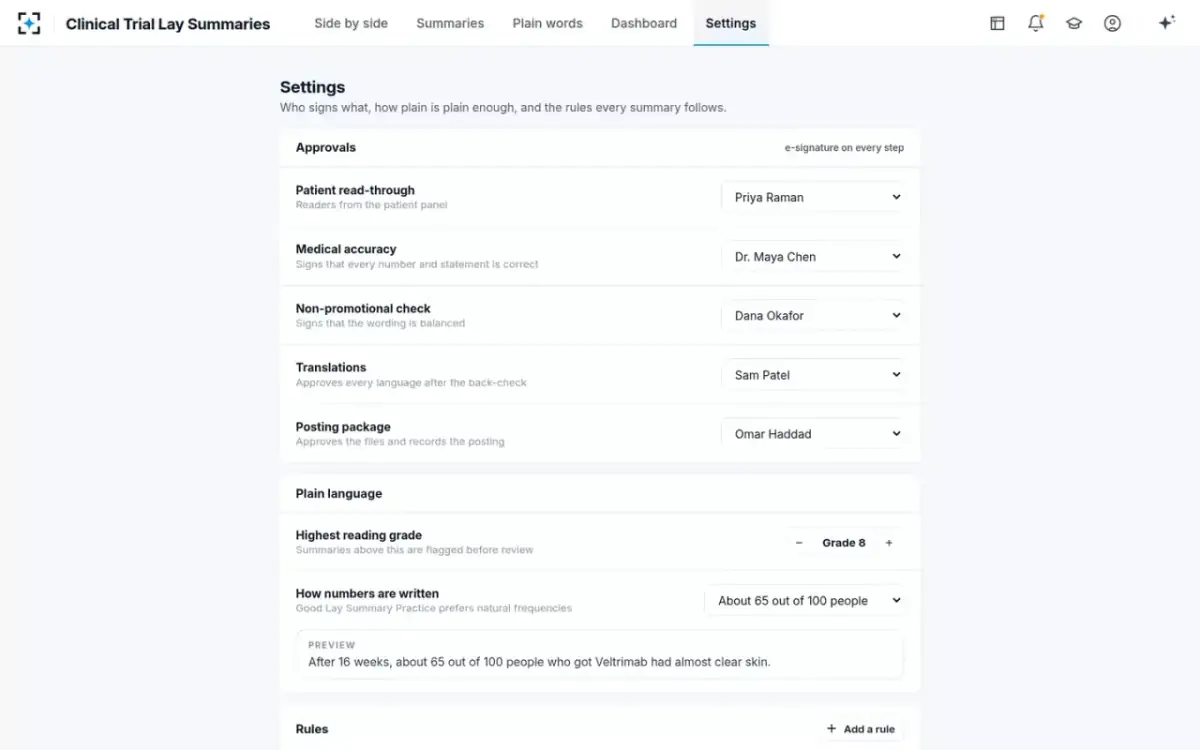
In practice a sponsor needs a number it can hold a draft against, and most set it above the ideal. A house maximum of grade 8, inside a range of 6 to 10, is a defensible setting: it is reachable on a Phase 3 oncology trial without inventing meanings, and it leaves the reader of twelve within range. What matters is that the setting is written down as a setting, with the published ideal of sixth grade named beside it, rather than quietly becoming the target. In the solution the maximum grade is a setting in the trial team's own rules, and any sentence above it is flagged before review starts.
The rules a sponsor writes down once, in Clinical Trial Lay Summaries
Why a readability score is not a check
Because the formulae measure the surface of the text and nothing else. Flesch-Kincaid counts words per sentence and syllables per word; it cannot know whether a sentence means anything. The Recommendations put the failure mode plainly: Many simple sentences together may explain little or nothing despite the fact that each sentence is simple, straightforward and grammatically correct.
“a short sentence with short words that make no sense at all will result in a good readability score because there is no direct correlation between an acceptable readability score and the actual readability of the content”
Good Lay Summary Practice, European Commission, 2021
Good Lay Summary Practice therefore demotes the formulae to a supporting role: it is recommended only to use readability formulae as a supplement to gauge the reading level and because current available tests are not developed in all official languages.
That second clause matters for any sponsor with eight language versions — a score exists for the English master and may not exist for the Czech one.
There is a worse failure than a meaningless sentence, and chasing a score produces it. The guidance warns that swapping a medical term for a simple equivalent, with no context to explain it, can mislead and confuse more than the technical word did. Swapping “myocardial infarction” for “heart attack” helps. Swapping “progression-free survival” for “time without the cancer getting worse” helps only if the sentence also says how it was measured and over what period.
Is a Flesch-Kincaid score enough to prove a lay summary is readable?
No, and the state of public trial text shows what happens when a score is the only discipline. In a study of trials registered on ClinicalTrials.gov from 2000 to April 2025 for six urologic cancers, Baskin and colleagues identified 17,175 unique clinical trials related to urologic cancers
and measured the lay-facing description of each. The average FKGL was 18.7 (SD: 5.1)
— a graduate reading level, in the field of the text that is specifically required to be written in language intended for the lay public.
Those are trial descriptions on a US registry rather than EU lay summaries, so the figure is not a measurement of Annex V practice. It is a measurement of what happens to plain-language intentions when nothing checks them: a published target, no measurement at the sentence level, and a median length of 24 words per sentence. The useful conclusion for a sponsor is that a score at the document level, computed once at the end, changes nothing. A score per sentence, recomputed as the writer edits, changes what gets written.
A readability score against a comprehension test
Readability score: Sentence length and syllable counts — the surface of the text.
Comprehension test with readers: Whether a reader can find a fact in the document and say it back in their own words.
Readability score: Meaning. A page of short, simple sentences that explains nothing scores well.
Comprehension test with readers: Little, if the questions are well made — which is the whole difficulty.
Readability score: That the text is short-sentenced. Nothing about understanding.
Comprehension test with readers: That the people tested could use the document for the purpose it exists for.
Readability score: Free, instant, repeatable per sentence as the writer edits.
Comprehension test with readers: Days, and people. Worth running on a representative summary rather than on every one.
Readability score: Formulae do not exist for every official EU language.
Comprehension test with readers: Works in any language, with readers of that language.
Readability score: As a supplement, per sentence, to catch what has drifted upward.
Comprehension test with readers: As the check that decides whether the summary works, before the patient read-through.
How do you test whether people understand a lay summary?
Give the summary to readers, ask them questions phrased differently from the text, and count how many can answer. This is not an invention of the lay-summary world: it is the user test European medicines law asks for on package leaflets — consultation with target patient groups under Article 59(3) of Directive 2001/83/EC, in the form the Commission's 2009 readability guideline sets out — and Good Lay Summary Practice recommends the same method for lay summaries, noting that A key feature of this methodology is that respondents are initially asked to use the LS to find and answer questions and then enquired about their opinion on the actual use of the LS.
The user test, as the readability guideline sets it out
- Twenty participants, drawn from the people the document is for
The guideline’s criterion is expressed as 16 out of 20 participants, so twenty is the working size for one round.
- A pass is per question, not across the test
“A satisfactory test outcome … is when the information requested within the package leaflet can be found by 90% of test participants, of whom 90% can show that they understand it. That means to have 16 out of 20 participants able to find the information and answer each question correctly and act appropriately.”
- Questions phrased differently from the text
They must “be phrased differently from the text of the leaflet to avoid participants providing answers based merely on identifying groups of words”.
- Answers in the reader’s own words
Ask participants, once they have found the information, “not to read it directly from the leaflet but to put it into their own words where appropriate”.
- No easy questions
“Drafting easy or trivial questions simply with an aim of ensuring success must not occur.” A test designed to pass tells you nothing you did not already believe.
- Results cannot be averaged
“The success criteria will need to be achieved with each question. Results cannot be aggregated.” One question that fails is a finding, not a rounding error.
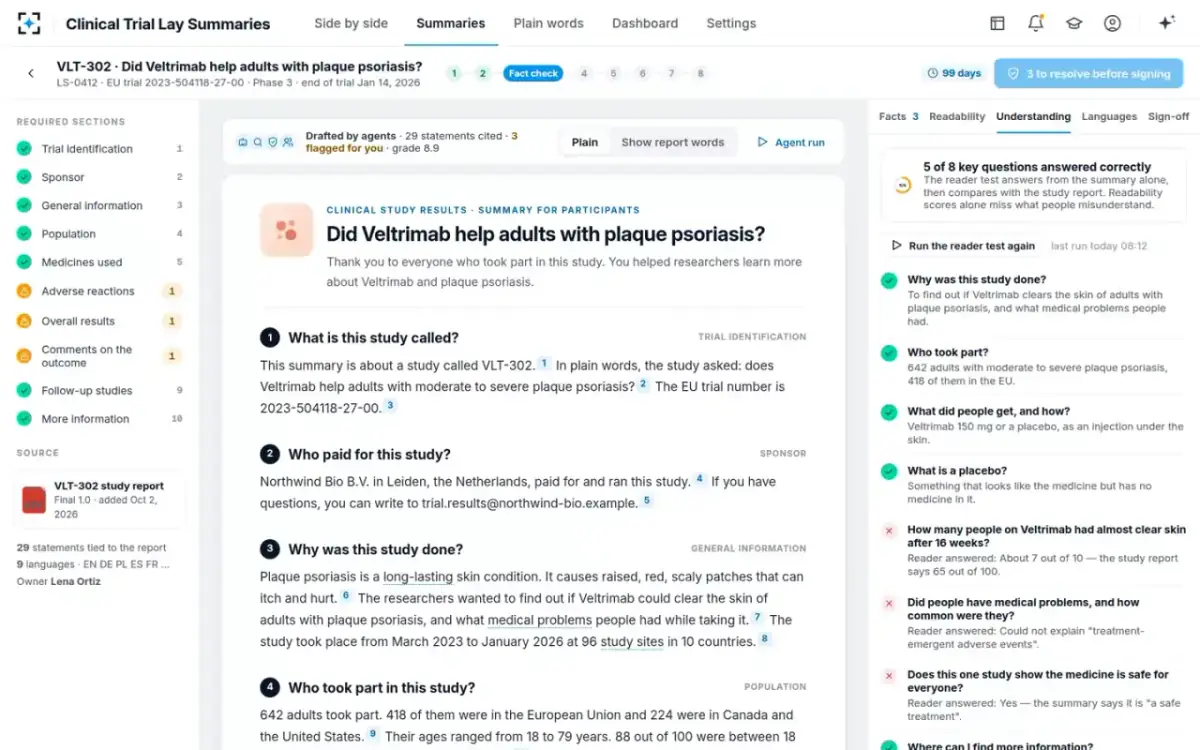
A test with people takes days, which is why most summaries never get one. The pass the solution applies before a human panel ever sees the draft is a cheaper rehearsal of the same idea: the reader test answers the eight key questions a participant would ask using only the summary, and an answer is marked wrong if it differs from the study report or if the summary does not let a reader answer it at all. On the sample VLT-302 draft it scores 5 of 8 — a reader takes away “about 7 out of 10” for the main result, cannot explain “treatment-emergent adverse events”, and concludes from one study that the medicine is safe for everyone, because the summary says “a safe treatment”. Each wrong answer points at an open flag, and the house rule is that at least 7 of 8 must be answered before the patient read-through begins.
Eight questions, answered from the summary alone
What words should you avoid in a lay summary?
Three families, and the third is the one writers defend. Jargon first: the Recommendations ask writers to Avoid jargon, technical, medical or scientific language (for example, use “high blood pressure” rather than “hypertension”)
. Abbreviations second: Avoid the use of unfamiliar abbreviations, acronyms and medical terms, for example “RCT” for Randomised Controlled Trial. Explain the concept simply.
The Commission's readability guideline says the same thing for leaflets in one line: Medical terms should be translated into language which patients can understand.
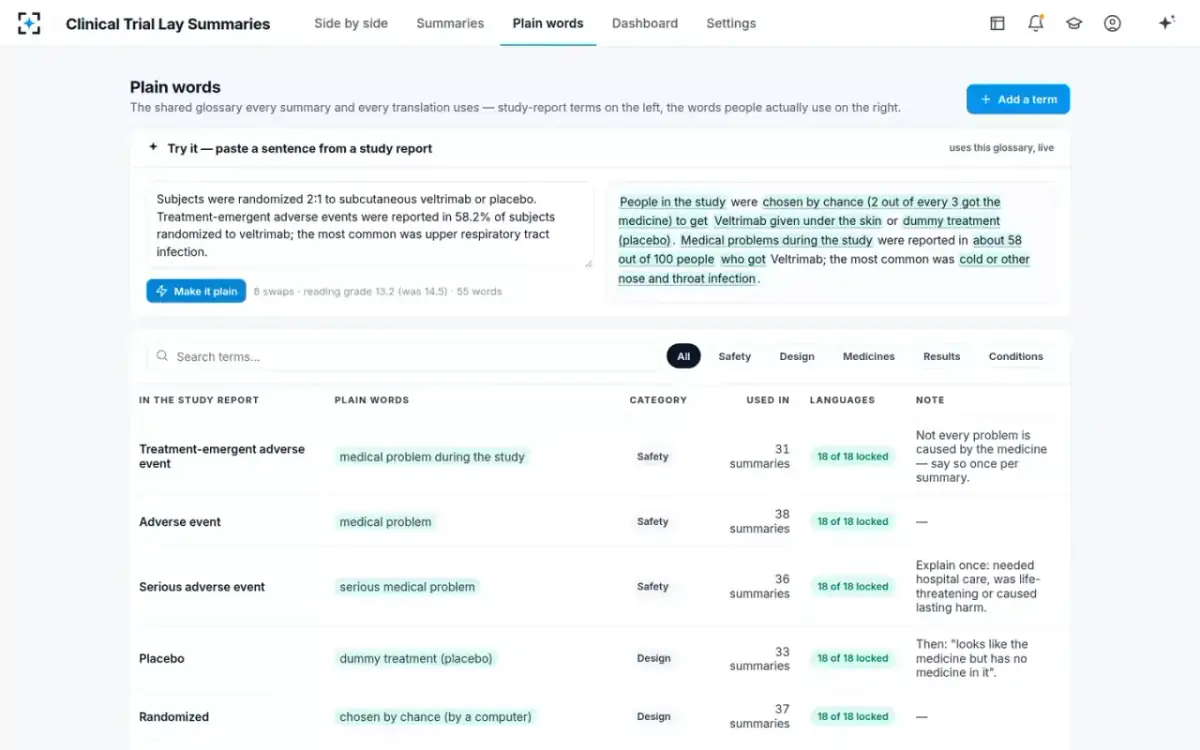
The third family is the vocabulary of the study report itself — participants, subjects, arms, cohorts, endpoints, treatment-emergent, discontinuation, titration. These words are not jargon to the writer, which is exactly the problem: they are invisible. A shared glossary is the only reliable defence, because it turns a judgement call into a lookup, and it keeps the same answer across every summary and every language version. In the solution that glossary runs to 412 terms locked in 18 languages, and a new term goes to the patient panel rather than being decided by a writer under deadline.
Twelve study-report terms, the plain words, and the context each still needs
| In the study report | In plain words | What the sentence still has to add |
|---|---|---|
| Participants were randomised 2:1 | People were put into two groups by chance | Why: to make the groups as alike as possible, and that twice as many were in one group. |
| Double-blind | Neither the people in the study nor their doctors knew which treatment they were given | Why it was done: so that knowing would not change the results. |
| Placebo-controlled | Some people were given a dummy treatment with no medicine in it | That they were still cared for, and why a comparison group is needed at all. |
| Treatment-emergent adverse event | A medical problem that started or got worse during the study | That not all of these problems were caused by the study medicine. |
| Adverse reaction | A side effect the study doctors thought was caused by the medicine | How often it happened, in people out of a hundred. |
| Primary endpoint | The main thing the study was measuring | What it was measuring and when — at week 16, not “at the end”. |
| Secondary endpoint | Something else the study measured | That the study was not designed to answer it on its own. |
| Discontinued treatment | Stopped taking the medicine before the end of the study | How many, and the main reasons, if the report gives them. |
| Hazard ratio | Not translatable in three words — give the counts instead | The two groups’ numbers, then the comparison in words: about one in three fewer. |
| Statistically significant | The difference was unlikely to be down to chance | And where a difference was not significant, that it may be chance — the guidance asks for this to be explained. |
| Open-label extension | A second part of the study where everyone knew what they were taking | Who went into it and what was being watched for. |
| Titration | The dose was increased slowly | From what to what, and over how long. |
Numbers: absolute first, percentage second, ratios never
Numbers are where a plain summary most often stops being plain, and the fix is a convention written down once rather than a decision per sentence. One house style, applied to every summary: counts first, percentage in support, and no ratio printed without the counts it came from. The solution makes it a setting — “about 65 out of 100 people”, or “65% of people”, or both — so that one choice governs every sentence in every study rather than being re-argued by each reviewer.
Two rules travel with the convention. Where a difference was not statistically significant, say so in words: the Recommendations ask that If reference is made to numerical differences that are not statistically significant, this should be explained to the reader.
And where the study report expresses a result as a hazard ratio or an odds ratio, the summary reaches for the counts in the same table instead — the mechanics of that substitution, and the four ways a number drifts on the way out, are worked through in the lay summary from the CSR.
One results sentence at four reading grades, and what changed at each step
Grade 14
“The risk of relapse was reduced with Talmirex versus placebo during the randomized withdrawal phase (hazard ratio 0.64; 95% confidence interval 0.44 to 0.92).”
The study report’s own sentence. Correct, cited, and unusable: two technical measures, a phase name, and a comparison expressed as a ratio.
Grade 11
“Fewer participants treated with Talmirex experienced a relapse of depressive symptoms than those receiving placebo during the withdrawal period.”
The statistics are gone, but the vocabulary is not: participants, experienced, depressive symptoms, withdrawal period. Still no numbers, so a reader cannot judge how much fewer.
Grade 9
“Fewer people taking Talmirex had their depression come back than people taking placebo: 47 of 246 people, compared with 71 of 244.”
Plain words and the counts from the table. One long sentence doing two jobs, which is what keeps it above the target.
Grade 7
“Depression came back in 47 of the 246 people taking Talmirex. It came back in 71 of the 244 people taking placebo. That is about one in three fewer people.”
One idea per sentence, the absolute numbers first, and the comparison offered last in words. The meaning of the study report’s sentence, at half its grade.
The ladder shows where the grade actually falls, and it is not at the vocabulary step. Between grade 11 and grade 9 the technical words go, and the grade barely moves; between grade 9 and grade 7 one long sentence becomes three short ones, each carrying one idea. The CDC's plain-language guidance gives the same instruction for health materials in four words — Limit each sentence to 1 idea
— alongside Strive for an average of 20 words per sentence
and Limit paragraphs to 1 topic and 5 sentences
.
How do you explain randomisation and blinding in plain words?
By saying what was done and why, in that order, and by borrowing sentences that have already been through this. The Expert Group's Recommendations print worked examples, and they are better than most house attempts: People with diabetes were put into 2 groups by chance (randomised) to reduce differences between the groups.
Note the shape — the action, the plain word, the technical term in brackets for the reader who has met it, and then the reason.
Blinding gets the same treatment: This trial was also “double-blinded”. This means that neither patients nor doctors knew who was given which treatment/drug. This was done to make sure that the trial results were not influenced in any way.
Three sentences, one idea each, and the purpose stated rather than assumed. A reader who understands why a trial was blinded is also a reader who can understand why the result means something, which is the real reason these two concepts are worth the words.
The shared glossary, and a sentence made plain in front of the writer
What counts as promotional language in a lay summary?
Any wording that grades the result rather than reporting it. Good Lay Summary Practice sets the standard for the whole document — The content of the LS should be presented in factual and objective language and should not be designed as promotional or favourable
— and asks that reviewers should be instructed that LS must not be promotional and that biased language is to be avoided
.
In practice the offending words are a short list, and they are rarely written by a marketer. “Safe” is a conclusion no single trial supports. “Effective” is the regulator's word, not the summary's. “Well tolerated” is a judgement standing where numbers should be. “Worked very well” is enthusiasm from someone who gave four years to the programme. The solution flags those and words like them with a neutral alternative, and element 8 — the comments on the outcome — is where they cluster; what that element has to say instead is set out in the ten Annex V elements, one at a time.
How long should a lay summary be?
As short as it can be while still being usable. The guidance declines to give a page count and gives a principle instead: The LS should be as brief as is consistent with an understandable and navigable document.
It also warns against reading that as a licence to compress — a readable document can be achieved with good layout and design for trials of intermediate complexity, while More complex trials may require more description.
Two practical consequences. A trial with three arms, two populations and a crossover cannot be explained in the space a single-arm study needs, and cutting it to that length produces a document that is short and wrong. And length is mostly decided by what you leave out: element 10's pointer to where more information can be found is what allows a summary to stop, because the reader who wants the full list of outcomes has somewhere to go.
Should a lay summary use graphs?
Sparingly, and with the axes honest. Good Lay Summary Practice is most pointed about the failure mode: Do not exaggerate the positive or minimise negative results through the choice of axes.
A bar chart whose axis starts at 55% turns a five-point difference into a cliff, and a reader with no statistical training has no defence against it.
The guidance also has a view on colour that surprises teams who have just had a template designed: Use black and white print as a general rule. Colours may be used, however avoid brand colours which may be perceived as promotional.
A summary set in the sponsor's palette, with its logo at the top, is making an impression before a reader has read a word — and the document's own rule is that it must not be designed as promotional or favourable.
Who should review a lay summary, and what is each reviewer briefed on?
Several reviewers, each with one question, because a reviewer with a general brief reads for whatever they happen to notice. Good Lay Summary Practice describes the division: a medical specialist is briefed to look at whether the description of the disease is adequate, a legal specialist may focus on aspects of compliance and on the non-promotional nature of the LS, and a language specialist will focus on the appropriate use of lay language
, with a patient reviewer alongside them.
The sequence matters as much as the list. A patient panel reading a draft that still has open fact-check flags spends its attention on the wrong sentences, which is why the reader-test threshold sits before the panel rather than after it. In the solution each step is signed by a named person for a stated meaning — the author confirming every fact matches the study report, then the patient read-through, medical accuracy, the non-promotional check, each language and the posting package — and nothing can be posted while a fact is unchecked or a flag is open.
Written down together, those settings and that sequence are a sponsor's lay-summary standard: the grade, the number style, the promotional-word list, the test threshold and who signs what. Writing it once is what turns the craft on this page into something a team of five can apply to forty summaries a year. To see it on one of your own study reports, start from Clinical Trial Lay Summaries.
Questions people ask
Is a maximum of grade 8 good enough when the ideal is grade 6?
It is a defensible setting, as long as it is named as a setting. The Recommendations call sixth grade the ideal and ask writers to get as close to it as they can, so a house maximum of grade 8 is a compromise with the source material, not a target to be proud of. Set it, record it, and keep the published ideal next to it so nobody mistakes the one for the other.
Does a lay summary have to pass a user test?
The Regulation does not require one. Good Lay Summary Practice recommends the user-testing method that European regulators already apply to package leaflets, and that guideline's criterion — 16 of 20 participants able to find and understand the information, for each question — is the usual benchmark. Treat it as the check that tells you whether the document works, not as a box to be ticked.
How many readers do you need, and what counts as a pass?
Twenty participants in a round, with the criterion applied question by question: 16 of 20 able to find the information and answer correctly. Results cannot be aggregated across questions, so one question that fails is a finding to act on. And the questions must be phrased differently from the text, with answers given in the reader's own words, or the test measures word-matching rather than understanding.
Can you say a medicine was well tolerated?
No. It is an evaluation, and the guidance requires factual, objective language that is not designed as promotional or favourable. Report instead how many people had side effects and which ones, in counts and percentages — and if the comparison with placebo is the point, give both groups' numbers and let the reader draw the conclusion.
Should a trial in children have a separate version for young readers?
The Regulation requires one summary, and the Recommendations' accessibility target is a document readable from about age 12. For a trial whose participants were younger than that, a second version written for them is doing what the guidance is reaching for rather than adding an obligation; the solution writes one for ages 8 to 12 whenever a trial in children is summarised. Either way, the version for adults still has to meet the grade target on its own.
What is the quickest way to lower a sentence's reading grade without losing its meaning?
Split it. Most high-grade sentences in a lay summary are carrying two or three ideas, and the formulae punish length before they punish vocabulary — the CDC's guidance asks for one idea per sentence, an average of about 20 words, and paragraphs of one topic and no more than five sentences. Replacing a technical word usually moves the grade by less than a point; breaking the sentence into three moves it by several, and it is the change a reader actually feels.