Back translation in clinical trials is the practice of having a second, independent translator turn a translated document back into the source language, so the two English versions can be compared and the places where meaning shifted can be found. It exists because the alternative — asking a bilingual reviewer whether a translation reads well — produces an answer nobody can check. On a lay summary of trial results it matters more than on most documents, because the thing most likely to move in transit is a number, and a number that drifts in the Polish version is almost invisible to the English-speaking team that owns the deadline. Clinical Trial Lay Summaries is Botminds' software for this work; its translator agent works from the approved English with glossary terms locked per language, reads each translation back into English, and compares every number, group and time point before a named person approves the language.
The trial, medicine and people named from the product below are sample data on fictional studies and fictional people — CRV-210, Corventa in atrial fibrillation. The published research and guidance are linked where they appear.
What back translation is in clinical trials, and what it is for
The mechanism is simple and the discipline is in keeping the two halves apart. One translator takes the approved source text into the target language. A second translator, who has not seen the source, takes that target text back into the source language. A third person compares the two source-language versions and raises every place they differ. The second translator's ignorance of the original is the whole point: a back translator who has read the English will reproduce it from memory, and the exercise proves nothing.
Good Lay Summary Practice sets out the same three steps as the standard to aim at: “An ideal translation process involves forward translation and back translation by two different native speakers or translators fluent in the target, respectively source language and a subsequent review by a third person.” It is a recommendation rather than a rule, and it is worth noticing which parts of it carry the weight. Two different people, each fluent in the right direction, and a third who adjudicates.
What the method finds is a narrow class of error, found reliably. It catches a number that changed, a group that swapped, a time point that moved, a negation that disappeared, and a term that took on a meaning in the target language that the source never had. It does not tell you whether the translation is idiomatic, whether a patient in Poznań would find it natural, or whether the target text is written at a reading level anyone can manage. Those are different checks with different people.
One language, end to end, from the signed master to the coordinator's approval
A person decides
Signed English masterThe writer has signed as author; the medical, non-promotional and patient reviews are done. This is the only text translation may start from.
Never: No draft, no “nearly final” version
Agent
Forward translationInto the target language, with the glossary terms locked for that language and the trial's own terms carried from the memory of earlier summaries.
Agent
Back translationThe target text rendered back into English, independently of the master.
Agent
Number comparisonEvery number, unit, group and time point in the back translation compared with the master; any difference raised as a query.
A person decides
Third-person reviewThe two English versions read side by side. Differences are resolved against the target text, not against the back translation.
A person decides
Coordinator approves the languageOne named approval per language, after the back-check and the numbers. A language with an open glossary query cannot be approved.
Does the EU require a lay summary in every country's language?
No — and it is one of the most often overstated points in the whole subject. The Clinical Trials Regulation requires the summary of results to come with a second summary that laypersons can understand, and says nothing about languages. Good Lay Summary Practice is explicit about the gap: “While the EU CTR does not request translations, the EU Expert Group on Clinical Trials Recommendations suggest that as a minimum, the LS should be provided in the local language(s) of each of the countries where the trial took place, matching the languages employed in the PIS/ICF.”
Read that carefully, because the practical consequence is large. The translation duty is a recommendation, not a legal requirement; the benchmark it offers is the languages already used in the participant information sheet and informed consent form for that trial; and “local language(s)” is plural for a reason — a trial run in Belgium has more than one.
The honest way to put it to a sponsor is this: you are not legally obliged to translate, you are strongly expected to, the expectation is pegged to the consent documents you already produced, and a sponsor who posts an English-only summary for a trial run in seven countries will be asked why. Teams that describe the duty as “every country's language” over-scope their programme and under-resource the thing that actually takes the time, which is checking the translations rather than producing them.
Why the master has to be signed before translation starts
Because every defect in the source is multiplied by the number of languages. Good Lay Summary Practice puts it in one sentence: “Any ambiguous, promotional or biased content in the master LS will carry over to the final translated LS.” An ambiguous sentence in English becomes nine ambiguous sentences, each ambiguous in a slightly different way, and the review that would have caught it once now has to catch it nine times in languages the reviewer may not read.
The recommendation that follows is unambiguous: “Given the importance of the source text during translations, it is highly recommended that the master LS be carefully reviewed, finalised, and approved before translations commence.” In practice that means the full chain — the numbers checked against the study report, the reading grade settled, the non-promotional review done, the patient read-through complete, and a named author's signature on the English — before a single word goes to a translator.
“Any ambiguous, promotional or biased content in the master LS will carry over to the final translated LS.”
Good Lay Summary Practice, European Commission and the EU Clinical Trials Expert Group
There is one cost to that discipline, and a team should price it honestly: waiting for the signature compresses the translation window. That is the reason the dual-step option exists, and the reason it has to be chosen deliberately rather than drifted into.
The process end to end: forward translation, back translation, review
Set against a twelve-month posting clock, the two strategies look different mostly in where the risk sits. In the single-step process, nothing is translated until the English is signed; the translation window is short, and every word translated is a word that will ship. In the dual-step process, a draft master goes out to translators early and the final, adjusted translation is produced again once the English is signed; the window is long, and some of the work is done twice.
Good Lay Summary Practice does not pick one. It asks that the choice be made at the start: “it is advised to clarify upfront whether the language translation(s) can be performed in the above recommended single-step process based on the final master LS or whether a dual-step process with initial translation of a draft master LS followed by a final, adjusted translation is the only option”. The phrase “is the only option” is the tell. Dual-step is the fallback for a programme that cannot otherwise make the date, not the default.
Two translation strategies against the same twelve-month clock
- Study report to signed English master8 months
- Forward and back translation, nine languages2 months
- Coordinator approvals and posting package2 months
- Study report to draft master5 months
- Draft translations beside the English3 months
- Master signed; translations re-run and back-checked2 months
- Coordinator approvals and posting package2 months
What is the difference between back translation and linguistic review?
Back translation produces a comparable artefact; linguistic review produces a judgement. A back translation can be laid beside the master and read by someone who speaks only English, which is exactly why it travels well through a disclosure function. A linguistic review is a target-language reader saying the text is or is not fit for its audience, and it can only be done by someone who reads that language.
They catch different things, and a programme that runs only one of them has a known blind spot. Back translation misses fluency, register, and the sentence that is technically accurate and reads like a machine. Linguistic review misses the number that moved, because a reviewer reading only the target text has nothing to compare it with.
Back translation against linguistic review: what each is for
Back translation: A second translator who has not seen the source, plus a third person who compares the two English versions.
Linguistic review: A native reader of the target language, often a patient representative or a reviewer at the local affiliate.
Back translation: A second English text, comparable line by line with the master. Readable by the people who own the deadline.
Linguistic review: A verdict and a list of suggested edits, in the target language.
Back translation: Numbers, groups, time points, negations, dropped qualifiers, and terms that acquired a meaning the source never had.
Linguistic review: Register, idiom, tone, medical terms that are correct but unused, and sentences that are accurate and unreadable.
Back translation: Whether anyone in the country would want to read it. A stilted translation can back-translate perfectly.
Linguistic review: Everything the reviewer has no original to compare against — above all, a number that changed.
Back translation: Named as the ideal process, with two translators and a third reviewer.
Linguistic review: Implied by the reading-level and comprehension expectations; a readability score alone is explicitly not enough.
What do you do when a term has no word in the target language?
You stop, you decide once, and you write the decision down where every later summary will find it. The failure mode is a translator inventing a workable phrase under deadline pressure, a different translator inventing a different one next quarter, and nobody noticing that the same medicine has two names for the same side effect across two summaries.
The problem is well documented outside trial summaries. In a study of the recruitment materials used for maternal health studies in Zambia, one interview participant told the researchers plainly: “Pre-eclampsia in our local language, we don't have it, it's not there, so a translator needs to have a rich vocabulary and full understanding for you to come up with the correct translation.” The researchers also laid participant information leaflets beside their back translations from Nyanja and found what the method is for. A paragraph whose English said there would be no financial compensation for taking part came back with a sentence the original never contained: “there will be no funerals of any kind because you have taken part in this research study”.
That example is worth sitting with, because it is not a subtle shift of register. The authors allow that some of the discrepancies they found may be plain errors rather than language barriers — the added word “funerals” among them — and that is exactly the point: an error of either kind in a document about money and risk was found by back-translating and reading the two versions side by side. Their conclusion is the practical one: “this highlights the importance of performing back translation (not always required by ethical review bodies), and allowing sufficient time for translators and researchers to meet face to face and discuss their work”.
Medical vocabulary carries the same risk in a quieter form. Good Lay Summary Practice notes that MedDRA preferred terms will often have to be turned into words a reader without a science background understands. A MedDRA preferred term is a controlled, searchable label; a reader's word for the same thing is neither, and the mapping between them is a decision somebody has to own.
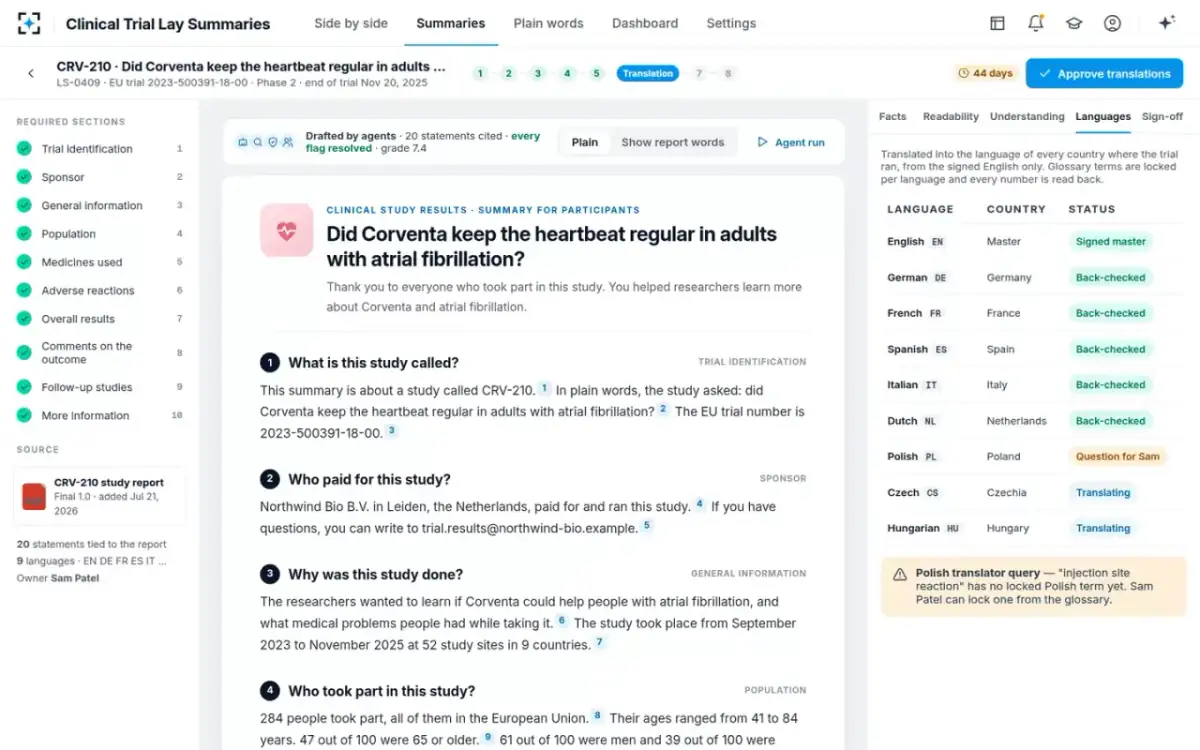
Nine languages against the signed master, with the one open question visible
The numbers that move in transit, and how to catch them
Numbers move for ordinary reasons, and every one of them is mechanical enough to check automatically. Decimal separators differ across the languages of the EU: 64.7 in English is 64,7 in German, French, Italian, Polish and most of the rest, and a careless round trip can turn one into six hundred and forty-seven. Thousands separators invert with them. Dates reorder. Units occasionally convert when nobody asked. And a group label — Group A, the dummy treatment, the medicine — can swap sides in a sentence that otherwise survives intact, which reverses the result while reading perfectly.
The check that catches these is a comparison rather than a reading: pull every number, unit, group and time point out of the back translation and compare it with the master, item by item. In the sample data behind this page that comparison runs on every language and raises a query for anything that differs, and a translation memory holds the trial's own terms so the same sentence is not re-decided each time it reappears. Good Lay Summary Practice endorses the tooling in principle: computer-assisted translation and revision tools, and translation memories, can help keep language accurate and consistent and set the terminology for the trial at hand.
The comparison a back-check should make, item by item
- Every number, with its unit
Counts, percentages, doses, ages, durations. Compare the digits, not the sentence: 64.7 and 64,7 are the same number and 647 is not.
- Every group, by the name the summary gave it
The medicine, the dummy treatment, the dose arm. A swapped pair reverses the result and reads perfectly in both languages.
- Every time point
Week 16, the first 16 weeks, after one year. A time point that drifts changes what the number is a measure of.
- Every negation and qualifier
“Not all of these were caused by the study medicine” is the sentence most likely to be lost, and the one doing the most work.
- The ten required sections, still ten
A section can be merged away in translation. Check the structure survived, not only the sentences.
- Every term against the locked glossary
A term rendered two ways across two summaries of the same medicine is a defect even when both renderings are defensible.
Can machine translation be used for a lay summary, and under what control?
Yes, as a first draft under a control that a person signs. The guidance explicitly contemplates computer-assisted translation and translation memories, and in a programme of nine languages across a dozen trials a year they are the difference between a feasible calendar and an impossible one. What the guidance does not contemplate is a machine output going to a public register without a named approval behind it.
Two controls do most of the work. The first is the back-check, because a machine translation's failures are exactly the kind back translation finds: a dropped negation, a number rendered in the wrong convention, a term translated literally where the field uses something else. The second is the locked glossary, because an untethered model will produce a plausible new rendering of “injection site reaction” every time it meets one.
There is a third check people reach for that does not work in this setting. Running a readability score on the target language sounds like an obvious safeguard, and Good Lay Summary Practice warns against relying on it: readability formulae are a supplement only, and the tests that exist have not been developed for every official EU language. The EU Expert Group's own annex of readability tests by country shows why — Dutch has the Leesindex, French the Kandel and Moles adaptation, German a recalculated Flesch index and the Hohenheim comprehensibility index, Italian the GULPEASE formula. They are different instruments on different scales, and a grade in one is not a grade in another.
When should translation of a lay summary start?
Plan it from the trial's start and begin the work when the English is signed. The planning half is not a platitude: the languages are known the day the participant information sheet is approved, the glossary for a therapeutic area can be built years before the first summary, and the translation vendor's capacity for nine languages in a six-week window is a conversation to have early rather than in month eleven.
The executing half is where teams lose time, and the reason is usually that translations were treated as the last task rather than as the largest one. In the sample estimate behind this solution, translations and checking their numbers are the biggest single block of working days on a Phase 3 lay summary — more than drafting, more than the numbers check, more than readability review. That is the solution's own estimate for one summary, not a measured industry figure, and it is worth testing against your own files. If translations are not your largest block, either your language list is short or your checking is thin.
One middle course exists for trials where the English will not change much. In the sample settings here, Phase 3 trials get German and Polish drafted beside the English early, and both are re-run on the signed version — a dual-step in miniature, limited to the two languages where early sight is most useful, with the re-run built in rather than hoped for.
A locked glossary, and who adds to it
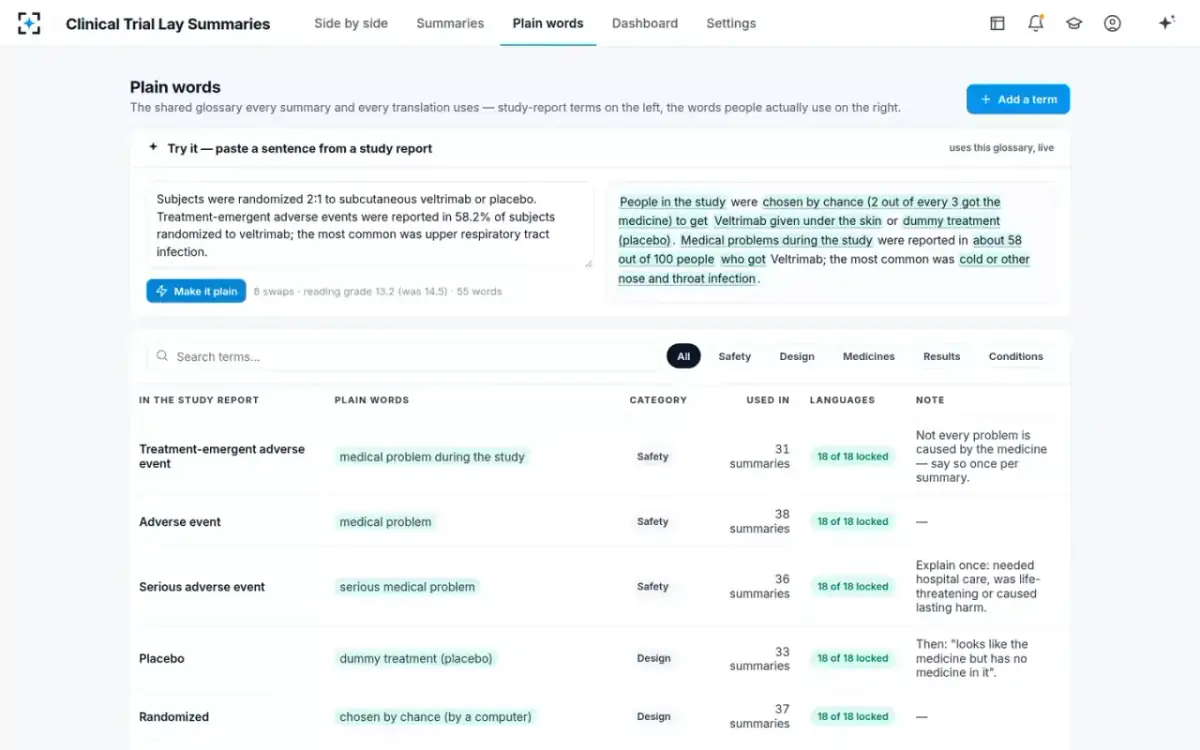
A glossary is not a list of words; it is a set of decisions with an owner. Good Lay Summary Practice recommends building one ahead of need: “To control lay content throughout the trial (or even for all trials within a therapeutic area or a clinical development plan), it is ideal to set up a style guide for the writing and translation of the LS and to proactively develop a glossary of terms.” The phrase “for all trials within a therapeutic area” is the useful part. The terms that recur are not trial-specific, and deciding them once is the only way nine languages stay consistent across a programme.
Locking matters as much as deciding. A locked term is one a translator may not quietly improve on: if the Polish for a study-report phrase has been agreed, it is used, and if it has not, the translator raises a query rather than inventing one. In the sample data here that is what holds the Polish version of CRV-210 — “injection site reaction” has no locked Polish term, so the language waits for a decision instead of shipping a guess. The glossary behind the sample programme holds 412 terms locked across 18 languages, and new terms go to the patient panel rather than being settled by the translator alone.
CRV-210: nine languages, their back-check status, and what each is waiting on
| Language | Country | Status | What it is waiting on |
|---|---|---|---|
| English | Master | Signed | The approved source. Nothing starts until it is signed. |
| German | Germany | Back-checked | Read back into English; every number, group and time point compared. |
| French | France | Back-checked | Back-check clean. |
| Spanish | Spain | Back-checked | Back-check clean. |
| Italian | Italy | Back-checked | Back-check clean. |
| Dutch | Netherlands | Back-checked | Back-check clean. |
| Polish | Poland | Question for the coordinator | “Injection site reaction” has no locked Polish term yet. |
| Czech | Czechia | In translation | Forward translation under way. |
| Hungarian | Hungary | In translation | Forward translation under way. |
The shared glossary: study-report terms on the left, the words people use on the right
Who approves a translated lay summary?
A named person, one approval per language, after the back-check and the number comparison have both run. That is the practice in the sample programme behind this page, and it reflects how Good Lay Summary Practice frames review generally — different reviewers briefed to look for different things, each signing for what they actually checked.
The approval has to mean something specific, which is why “the translations are approved” as a single act is weaker than it looks. Nine languages approved in one click means nobody can say which language the approver read. Nine approvals, each after its own back-check, means a question about the Hungarian version has an answer and a date. In the sample data behind this page the translation coordinator approves each language and answers the translators' open questions from the locked glossary; the four sentences worked through elsewhere in this series show what happens upstream when the writer accepts a rewrite — both translations re-run and are read back before the summary moves on.
The readability guideline for package leaflets makes the general point about target-language proof rather than target-language opinion. It asks for medical terms to be put into language patients can understand, and sets a measured bar for user testing: information found by 90 per cent of test participants, 90 per cent of whom can show they understood it — in practice 16 of 20 participants finding the information and answering each question correctly. That is a leaflet standard rather than a lay summary one, but it is the nearest published measure of what “understandable” has to survive, and it is a comprehension test rather than a score.
To see the nine languages, the back-check and the locked glossary on a summary of your own, start from Clinical Trial Lay Summaries.
Questions people ask
Is back translation required for a clinical trial lay summary?
Not by the Clinical Trials Regulation, which does not require translations at all. Good Lay Summary Practice describes forward and back translation by two different translators, with a review by a third person, as the ideal process, and the published research on trial documents notes that back translation is not always required by ethical review bodies. In practice it is the step that makes the quality of a translation checkable by people who do not read the language.
How many languages does a lay summary usually need?
As many as the trial's participant information sheet and consent form used, which is the benchmark Good Lay Summary Practice offers. For a multinational Phase 3 trial that can easily run to several languages, and a country with more than one official language counts for more than one. The number is knowable at the start of the trial, long before the summary is written.
How long do translations of a lay summary take?
There is no published figure, and the honest answer is that the translating is fast and the checking is not. Forward translation of a short document is days; the back translation, the side-by-side comparison, resolving glossary queries and getting a named approval per language is where the weeks go. Plan the calendar backwards from the posting date with the checking as the long pole, not the translating.
Can one bilingual reviewer replace back translation?
Not for the errors back translation is best at. A single bilingual reviewer reading both versions can confirm the target text is good, but cannot produce an artefact anyone else can audit, and is reading the source and the target with the same pair of eyes. The value of a second translator who has not seen the source is precisely that the two renderings are independent.
What happens if a translated number does not match the English?
Treat it as a query against the target text rather than a correction to the back translation. The back translation is evidence, not a document anyone will publish, so the fix belongs in the target language and the back-check is re-run on the corrected version. Nothing should be approved while a number comparison is open.
Should a readability score be run on each translated version?
Only as a supplement, and with care about which instrument you are using. Good Lay Summary Practice recommends readability formulae be used only as a supplement, partly because the available tests are not developed in all official EU languages. Dutch, French, German and Italian each have their own adaptations on their own scales, so a grade in one language is not comparable with a grade in another, and none of them measures whether a reader understood.