The clinical trial results disclosure requirements a sponsor has to meet now come from three separate rules with three separate clocks, and the part teams most often get wrong is not the deadline but the trigger date. In the European Union, results are due within one year of the end of the trial in all Member States concerned, and must be accompanied by a summary written for laypersons. In the United States, results are due no later than one year after the primary completion date, and no layperson version is required at all. In the United Kingdom, results are due within twelve months of the day after the conclusion of the trial, and a summary understandable to laypersons must be offered to the people who took part. A programme built only for ClinicalTrials.gov will therefore be short exactly one document — the one written for the people who took part. Clinical Trial Lay Summaries is Botminds' software for producing and posting that document, and this guide is the map behind it.
What follows is a reading of published rules and regulator guidance, linked where it appears, and not legal advice; the people and studies named from the product are sample data on fictional studies and fictional people. Check the current text before you rely on a date.
What are the clinical trial results disclosure requirements?
In their simplest form: register the trial before it starts, post its results on the same register within a year of its end, and — in two of the three regimes — produce a version a participant can read. Everything else is detail about which date starts the clock, what the results have to contain, and who the plain-language version is for.
The EU duty is the broadest, and the one that creates the extra document. Article 37(4) of the Clinical Trials Regulation requires the sponsor, whatever the outcome, to submit a summary of the results to the EU database within one year of the end of the trial in all Member States concerned, with its content set by Annex IV. The next sentence is the one that matters most here: that summary must come with a second one, written so that laypersons can understand it, whose content is set by Annex V (Regulation (EU) No 536/2014, Article 37). Two documents, one technical and one not, both due at the same time.
“Irrespective of the outcome” deserves a moment. The duty does not depend on whether the trial worked, whether the programme continued, or whether the sponsor still has an interest in the compound. A terminated trial, a failed one and a successful one are all reportable, and the trials nobody is still championing are the ones whose deadlines are easiest to lose.
The EU, US and UK results duties side by side
| European Union | United States | United Kingdom | |
|---|---|---|---|
| The register | CTIS, the EU clinical trials information system | ClinicalTrials.gov | A WHO-network public registry of the sponsor's choosing, the one the trial was registered in |
| The clock | Within one year | No later than one year | Within 12 months |
| Counted from | The end of the trial in all Member States concerned | The primary completion date | The day after the conclusion of the trial |
| A technical results summary | Required, to the content set out in Annex IV | Required: participant flow, demographics and baseline, outcomes and statistical analyses, adverse events, and the protocol with the statistical analysis plan | Required: a summary of results in the public registry |
| A layperson version | Required, to the ten elements of Annex V | Not required in the results. Lay language is required in the registration title and brief summary | Required, but offered to relevant persons rather than published |
| Who it goes to | The public, through the register | The public, through the register | The public for the results summary; relevant persons for the layperson version |
| Where the rule sits | Article 37 of Regulation (EU) No 536/2014, with Annexes IV and V | 42 CFR part 11, §§ 11.44 and 11.48 | Regulation 25, inserted by the 2024 amendment regulations |
Where do you have to post clinical trial results?
On the register the rule names, which is not always the register you would choose. The EU duty points at one system: results go into CTIS, the EU's clinical trials information system, which is also where the application was made. The US duty points at ClinicalTrials.gov. The UK duty is different in kind — it does not name a register, it points back at whichever one you used. Regulation 25 requires the sponsor to “publish a summary of the results of the clinical trial in the same public registry” as the trial was registered in, and defines a public registry as a primary or partner registry of, or a data provider to, the WHO International Clinical Trials Registry Platform, provided it gives public access to information about the trial in the United Kingdom.
That design has a practical consequence worth planning for. A UK trial registered on ClinicalTrials.gov discharges its UK publication duty there; a UK trial registered on ISRCTN discharges it there. The choice made at registration, often years earlier and often by someone else, determines where the results have to appear. The first question a disclosure function should be able to answer about any trial in its portfolio is which registers it is on.
The EU: a technical summary and a layperson summary, within one year
The EU rule produces two documents from one trial, and the two have different audiences, different content lists and the same deadline. The technical summary follows Annex IV. The layperson summary follows Annex V, which sets out ten elements — among them the general information about the trial, the population, the medicines used, the adverse reactions and how often they happened, the overall results, comments on what the outcome means, and where to find more information. The ten Annex V elements are worked through one at a time elsewhere in this series.
Three variations on the one-year clock are easy to miss. Good Lay Summary Practice states the submission deadlines compactly: twelve months from the protocol-defined end of the trial, six months for paediatric studies, and up to thirty months for non-therapeutic Phase 1 trials. Trials in children get half the time, and the trials that get longest are early-phase ones with no therapeutic intent.
The Regulation also provides an escape valve, and it is narrower than it sounds: where scientific reasons set out in the protocol make one year impossible, the summary is due as soon as it is available, and the protocol has to say when that will be and why (Article 37(4)). The justification has to be in the protocol, which means it is a decision made before the trial starts rather than an excuse available afterwards.
And there is a separate, earlier deadline that teams routinely treat as administrative: the end-of-trial notification, which is due within 15 days of the end of the trial in the last Member State concerned. That notification is what starts the results clock. A late notification does not buy time; it only makes the date harder to see.
Finally, submission and publication are not the same event. Under the revised CTIS transparency rules adopted by the EMA Management Board in October 2023, for Category 2 and 3 trials — the therapeutic exploratory, confirmatory and therapeutic-use trials that make up most of a clinical portfolio — the final summary of results and its layperson summary are published as soon as they are submitted. For an early-phase Category 1 trial run only in adults, the same rules hold the summary in the secure part of CTIS on submission — expected within twelve months of the end of the trial in the EU or EEA — and publish it thirty months after that end. One thirty-month figure is a submission deadline for non-therapeutic Phase 1 trials and the other is a publication date for adult-only Category 1 trials; they are different numbers about different things, and merging them is an easy error to make in this part of the map.
One multiregional trial, three clocks, three different start dates
- Results information due no later than one year after primary completion12 months
- The trial is still running in the last Member Statemonths later
- Technical and layperson summaries due within one year of that end12 months
- Publish in the same registry, and offer a layperson summary to relevant persons12 months
What is the deadline for results on ClinicalTrials.gov?
One year after the primary completion date, with two routes to a later date. The rule is plain: for applicable clinical trials, clinical trial results information is due no more than a year after the trial's primary completion date. The primary completion date is the date of final data collection for the primary outcome measure, which on most trials falls earlier than the end of the trial as the EU defines it.
The results themselves are a defined set rather than a narrative. Section 11.48 requires participant flow, demographic and baseline characteristics, outcomes and statistical analyses, adverse event information, and the protocol with the statistical analysis plan. It is a structured submission into a form, and it is read by people who already know what a confidence interval is.
The two routes to a later date are both conditional. A responsible party may certify, before the deadline, that the trial involves a product for which an application seeking approval, licensure or clearance of the use being studied is planned or pending; the results then become due on a trigger tied to that application. And a request to delay for good cause may be made to the agency. Neither is a general extension, and neither is available retrospectively.
Does the US require a plain language summary of results?
No. This is the single most consequential difference between the regimes, and it surprises teams who assume US disclosure is the strictest because it is the oldest.
Lay language appears in the US rule, but only at registration and only for two fields. A “Brief Title means a short title of the clinical trial written in language intended for the lay public, including any acronym or abbreviation used publicly to identify the clinical trial”, and a “Brief Summary means a short description of the clinical trial, including a brief statement of the clinical trial's hypothesis, written in language intended for the lay public.” Both describe the trial before it runs. Neither is a summary of what it found.
So a sponsor running one trial across the US, the EU and the UK produces structured results for ClinicalTrials.gov, a technical summary and an Annex V layperson summary for CTIS, and a results summary plus an offered layperson version for the UK register. Only one of those four documents is written in plain words for a general reader, and it is the one no US process will have produced for you.
Does the UK require a lay summary?
Yes, since the 2024 amendment regulations — and with a twist that changes how the work is planned. Regulation 25(2) requires that, within the period of 12 months beginning with the day after the conclusion of the trial, the sponsor must publish a summary of the results in the same public registry, and must “offer to all relevant persons a summary of the results written in a manner that is understandable to laypersons”. The MHRA's own guidance restates both limbs: publish a summary of the results in the registry the trial was registered in, and “offer an accessible summary of the results to the trial participants”.
“offer to all relevant persons a summary of the results written in a manner that is understandable to laypersons”
Regulation 25(2)(b), inserted by the Medicines for Human Use (Clinical Trials) (Amendment) Regulations 2024
The twist is “offer to all relevant persons” rather than “publish”. The UK layperson summary is a document put in front of named people, not posted to a register — which means a sponsor needs a route to reach them, and that route has to survive the years between the last visit and the posting date. The regulations define a relevant person broadly: the participant; where the participant is a child or an adult unable to consent, the person who gave consent on their behalf; where a participant has since lost capacity, someone caring for them or interested in their welfare; and where a participant has died, someone who was caring for them or interested in their welfare.
The UK regime also has its own deferral structure. The Authority may defer the requirement for up to 30 months from the day after the conclusion of the trial — the regulations give protecting commercially confidential information as an example — and a further deferral may be applied for before the first expires. The MHRA notes that Phase I trials may be eligible for an automatic deferral of up to 30 months, extendable on request. In exceptional circumstances the requirement may be waived outright.
Do you have to give results to trial participants?
In the UK, yes, by the regulation quoted above. In the EU, the obligation is framed as publication rather than delivery, but the participant is told in advance that it is coming: Good Lay Summary Practice records that “According to EU CTR Article 29.6 the trial participant must be informed that a LS will be made available in the EU Database and, to the extent planned, when the LS will become available”, and describes the purpose of the duty as the broadest possible transparency about results, for participants and the public alike, which is why the Regulation makes publication in the public EU database mandatory. In the US, nothing requires results to be given to participants.
The practical upshot is that a sponsor promises something at consent and has to keep it years later. If your consent form says participants will be told when the summary is available, somebody has to be able to tell them — and the people to tell may have moved, lost capacity or died in the interval. That is a planning problem rather than a writing problem, and it belongs in the protocol rather than in the final month.
When does a clinical study report have to be disclosed?
In the EU, when the trial's results are used to support a marketing authorisation. The Regulation gives the applicant for the marketing authorisation 30 days after the authorisation is granted — or the procedure completed, or the application withdrawn — to submit the clinical study report to the EU database. The CTIS transparency rules then publish it: for every trial category, a study report whose results were used in a marketing authorisation procedure is published when it is submitted.
This is a separate duty from the results summary, on a separate clock, triggered by an authorisation decision rather than by the end of a trial. It also makes the study report a public document in those cases, which is worth remembering when drafting the lay summary from it: the same reader may be able to open the source.
What “lay language” means in each rule
The three regimes use similar words for different documents, which is how a programme ends up believing it has met a duty it has not. Setting the definitions side by side is the quickest way to see what each one actually asks for.
Three rules, three meanings of plain words
What the rule asks for: A summary of the results written in a manner understandable to laypersons, addressing ten listed elements, posted to the public register alongside the technical summary.
What it means in practice: A standalone document of several pages, written for a general reader, covering the medicines, the population, the adverse reactions and their frequency, the results and comments on them.
What the rule asks for: A summary of the results written in a manner understandable to laypersons, offered to all relevant persons.
What it means in practice: The same kind of document, but delivered rather than published — which means a route to participants, their consenting representatives, their carers or their next of kin.
What the rule asks for: A brief title and a brief summary written in language intended for the lay public, at registration.
What it means in practice: Two fields describing what the trial will do, written before it runs. No plain-words account of what it found is required at any point.
One practical consequence follows directly. An EU Annex V summary and a UK layperson summary are close enough that one piece of writing can serve both, with the delivery differing. Neither of them can be built out of a ClinicalTrials.gov results submission, because that submission contains no prose written for a general reader. The four sentences worked through elsewhere in this series show what writing that document actually involves.
Who inside a sponsor owns results disclosure?
Often a transparency or disclosure function of one to a handful of people, sitting between regulatory affairs, medical writing, biostatistics and the trial teams — and owning none of the inputs it depends on. That structural weakness is the reason disclosure programmes fail quietly: the owner of the deadline is not the owner of the document.
Five roles touch each summary, and naming them is more useful than naming a department. Someone writes it, from the study report. Someone signs that the medicine and the results are described accurately. Someone signs that the wording is not promotional. Someone approves each translated language. And someone approves the posting package and holds the date. In the sample programme behind this page those are five named people, and each signature carries what it asserts rather than a generic approval — which is also what makes a late summary attributable rather than everyone's problem.
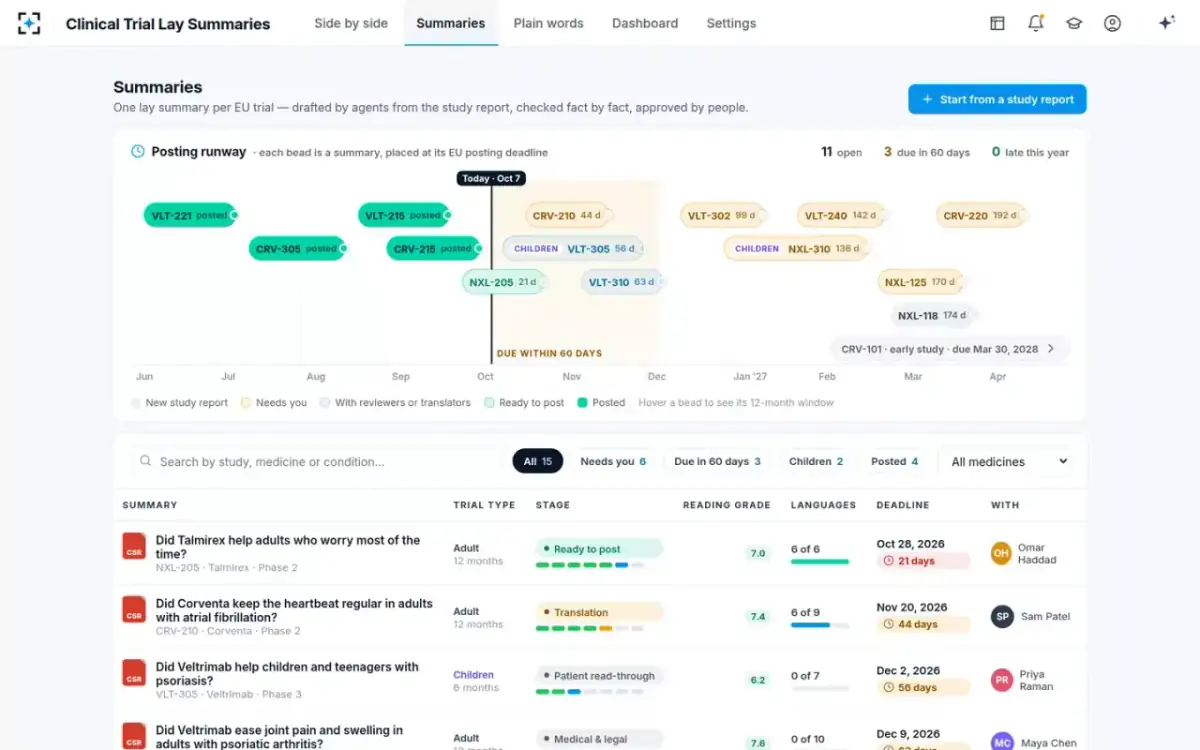
Every summary placed at its posting deadline, with its stage and its owner
Building one calendar across three regimes
The calendar is the deliverable, not the spreadsheet of rules. A disclosure function that can answer “which summaries are due in the next sixty days, and who holds each one?” has the thing that prevents a missed posting; one that can recite the deadlines but has to assemble the answer by email does not.
Three design decisions make the difference. First, store the trigger date, not the deadline: primary completion for the US, end of trial in the last Member State for the EU, conclusion of the trial for the UK. Deadlines derived from a stored trigger survive a protocol amendment; deadlines typed in by hand do not. Second, hold the clock per trial type — six months for a trial in children is not an exception to the twelve-month rule but a different rule, and treating it as an exception is how it gets missed. Third, separate submission from publication, because in CTIS the two coincide for most therapeutic trials and diverge for adult-only early-phase ones.
What a disclosure function has to hold, per trial
- A register inventory
Which registers this trial is on, and which of them the UK publication duty points at. Recorded at registration, not reconstructed at the end.
- A trigger-date source
Primary completion, end of trial in the last Member State, and conclusion of the trial — each from the system that owns it, with the date it was last confirmed.
- A named owner per summary
One person who holds the date. A summary owned by a function is owned by nobody when the function is busy.
- A language plan
The languages the participant information sheet and consent form used, decided when they were approved rather than when the summary is drafted.
- A signature per step
Authorship, medical accuracy, the non-promotional check, each language, and the posting package — each by a named person, each carrying what it asserts.
- An audit trail that survives the people
Who decided what, when, and on what basis. Disclosure questions arrive years later, by which time the team has changed.
- A deferral position, if you are taking one
Which deferral or certification, under which rule, with the justification in the place that rule requires — in the EU, in the protocol.
Whether the programme is posting on time, and what the checking caught
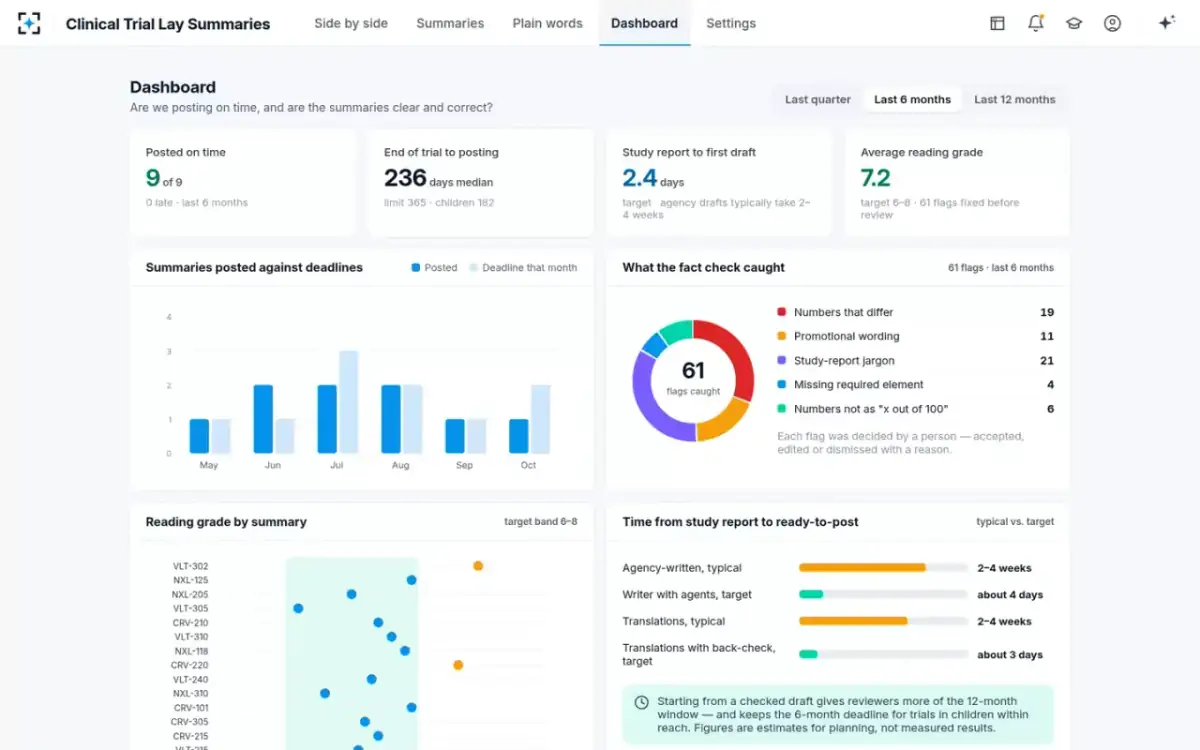
To put your own portfolio on one runway, with the EU clock, the children's clock and the owner of each summary visible together, start from Clinical Trial Lay Summaries. If you are drawing up requirements rather than dates, what to look for in a tool turns this map into a specification.
Questions people ask
What is the difference between the EU and US results requirements?
Three things. The clock starts on a different event — the end of the trial in all Member States concerned in the EU, the primary completion date in the US. The content differs: the US rule prescribes a structured submission of participant flow, baseline characteristics, outcomes, adverse events and the protocol, while the EU requires a technical summary to Annex IV. And the EU requires a second document, written for laypersons to the ten elements of Annex V, which the US does not require at all.
What happens if you miss a results deadline?
Each regime has its own consequences. In the EU, Article 94 of the Regulation leaves penalties to each Member State, and names failures to submit information meant for the public database among the breaches national rules must cover. A missed posting is visible on a public register, it is attributable to a named sponsor, and the UK regulations allow the licensing authority to take an unrectified failure to publish a results summary in the registry into account when considering the same sponsor's later applications.
Does a trial in children have a different deadline?
In the EU, yes — six months rather than twelve, as Good Lay Summary Practice sets out alongside the twelve-month adult deadline and the up-to-thirty-month deadline for non-therapeutic Phase 1 trials. Plan a paediatric summary as a different piece of work rather than an urgent version of the normal one, because the halved window usually has to absorb a patient read-through and a version written for younger readers as well.
Do you need a lay summary for a terminated trial?
In the EU the duty applies irrespective of the outcome of the trial, so an early termination does not remove it; what changes is the content, which has to describe honestly what was and was not learned. Terminated and negative trials are worth checking first in your own portfolio, because the team that would have written the summary has often moved on.
Can one layperson summary serve the EU and UK duties?
In substance, usually yes: both ask for a summary of results written in a manner understandable to laypersons, and the EU's ten Annex V elements are a superset of what the UK rule describes. The difference is delivery rather than drafting — the EU version is published on the register, while the UK version has to be offered to relevant persons, a group the regulations define to include participants, their consenting representatives, carers and next of kin.
When is the EU layperson summary actually visible to the public?
For most therapeutic trials, as soon as it is submitted: the revised CTIS transparency rules publish the final summary of results with its layperson summary when it is submitted in CTIS for Category 2 and 3 trials. The exception is an early-phase Category 1 trial run only in adults, where the summary is submitted to the secure domain within the expected twelve months and published thirty months after the end of the trial in the EU or EEA.