The lay summary guidelines a sponsor is judged against are short: Annex V of the EU Clinical Trials Regulation lists ten elements the summary of results for laypersons must contain, and Good Lay Summary Practice, published by the European Commission with the EU Clinical Trials Expert Group, explains what each one means in practice. Taken together they are a content standard rather than a style guide, and that is where teams come unstuck — a draft can read beautifully and still be missing an element, or carry all ten and still be wrong in four of them. This guide takes the elements one at a time, in the Regulation's order, and marks the decision inside each. Botminds' Clinical Trial Lay Summaries writes the ten sections from the study report with each sentence tied to its source, and checks completeness separately from readability, because they are different questions with different answers.
The studies, medicines and people quoted from the solution on this page — VLT-302 and Veltrimab in plaque psoriasis, and the team around the summary — are sample data on fictional studies and fictional people. The rules come from the Regulation and the Commission's guidance, linked where they appear.
What are the requirements for a clinical trial lay summary?
Three requirements, in this order of enforceability. The summary must cover all ten Annex V elements. It must be understandable to laypersons, which is Article 37(4)'s own test and the only quality test the Regulation states. And it must be submitted to the EU database within the deadline — one year from the end of the trial in all Member States concerned, with the shorter paediatric figure that the posting clock explains.
Everything else that governs the document — the reading level to aim at, how numbers are written, whether to use graphs, how many reviewers to brief — is guidance rather than law. That does not make it optional in any practical sense: it is the Commission's own account of how the duty is met, and it is the document a question from a Member State will be answered from.
The ten elements, what each must contain, and the decision inside it
| Element | What it must contain | The decision it hides |
|---|---|---|
| 1 · Clinical trial identification | Title of the trial, protocol number, EU trial number and other identifiers. | Whether the title a reader sees is the scientific one or a plain one. Both can be shown; only one can come first. |
| 2 · Name and contact details of the sponsor | Who ran the trial and how to reach them about it. | Which route is genuinely answered — a monitored mailbox or a page that redirects. |
| 3 · General information about the trial | Where and when it ran, the main objectives, and the reasons for running it. | How much design detail belongs here. This is where a summary quietly becomes a protocol synopsis. |
| 4 · Population of subjects | Numbers in the Member State, in the Union and in third countries; age and sex breakdowns; who could and could not join. | Which count is reported — randomised, treated or analysed — and whether it matches the results section. |
| 5 · Investigational medicinal products used | The medicines given, with route and regimen, and the comparator. | How to name a medicine without advertising it, and how often a code name can appear before the page is unreadable. |
| 6 · Description of adverse reactions and their frequency | The reactions judged related to the medicine, with frequencies in counts and percentages. | Reactions, not events — and which frequency cut-off is used to decide what is listed. |
| 7 · Overall results of the clinical trial | What the trial measured and what it found, at minimum for the primary endpoint. | Whether secondary endpoints appear, and how a result is stated without over-claiming. |
| 8 · Comments on the outcome of the clinical trial | The population the result applies to, the most important limitations, and that this is one trial. | Where a neutral page turns promotional. This is the element reviewers argue over most. |
| 9 · Indication if follow-up clinical trials are foreseen | Whether more trials are planned. | What to say when the programme is undecided or confidential — silence is not an option, vagueness is. |
| 10 · Indication where additional information could be found | Where a reader can read more. | Which destinations are information and which are marketing. |
What is Good Lay Summary Practice, and what standing does it have?
It is an 85-page guidance document, developed with the Roadmap Initiative to Good Lay Summary Practice, adopted by the EU Clinical Trials Expert Group on 9 July 2021 and published by the Commission on 4 October 2021, and it sits in EudraLex Volume 10 beside the Regulation. It is not law. It does not add elements, change the deadline or create an obligation a Member State could penalise on its own. What it does is fix the meaning of words the Regulation leaves open — layperson, understandable, promotional — and set out how sponsors are expected to get there.
Alongside it sits the Expert Group's earlier Recommendations on summaries of clinical trial results for laypersons, whose second version was discussed by the group in February 2018. That document is more concrete: reader-friendly headings, example sentences, and numeric style. The two are read together, and both are cited through this series.
The most useful thing Good Lay Summary Practice says about Annex V is how much freedom a sponsor has with the form: Sponsors must cover all 10 elements but may combine them or change their order
. The content list is mandatory; the shape of the document is the writer's.
Elements 1 to 3: identifying the trial without writing a protocol synopsis
The first three elements answer a reader's first three questions: is this my trial, who ran it, and why was it done. They are the easiest to complete and the easiest to overbuild.
Element 1 asks for Clinical trial identification (including title of the trial, protocol number, EU trial number and other identifiers)
. A participant does not recognise their trial from a scientific title; they recognise it from the medicine's code name, the hospital and the dates. So lead with a plain description of the study and carry the identifiers under it, where someone checking a reference can find them.
Element 2 is the sponsor's name and contact details — one line, and one decision about whether the address given is actually answered. Element 3, general information, is where drafts swell: it asks for where and when the trial ran, the main objectives, and an explanation of the reasons for conducting it. Design belongs here only where a reader needs it to understand the result. The test is whether a sentence helps someone decide what the trial means for them; a dose-escalation scheme rarely does, and the sentence explaining why the trial was run at all almost always does.
Element 4: how do you report the number of participants in a lay summary?
Report the counts the Regulation asks for, in plain numbers, and make sure they are the same counts the results section uses. Element 4 is the longest line in Annex V: Population of subjects (including information on the number of subjects included in the trial in the Member State concerned, in the Union and in third countries; age group breakdown and gender breakdown; inclusion and exclusion criteria);
. Three geographies, two breakdowns and the eligibility rules — more structure than most study reports present in one place.
The trap is that a trial has several participant counts, and they are all correct. Screened, randomised, treated, and analysed are different numbers, and a results table may use a different one again. Good Lay Summary Practice asks for the difference to be handled in the open: Where there are differences in the numbers of randomised and treated trial participants, information should be presented clearly to avoid confusion.
The guidance adds that, as far as possible, the numbers should align with the participant numbers in the results section — which means the writer has to choose one count as the summary's spine and label the others.
Write them the way the Expert Group's Recommendations write all outcomes: Outcomes should be described using numeracy (x out of xx people [xx%]) and plain language principles.
“642 adults took part: 428 received Veltrimab and 214 received placebo” is a sentence a reader can hold. “The safety analysis set comprised 642 subjects” is not. One caution applies in rare disease: a breakdown fine enough to identify a single participant has gone too far, and the guidance warns against it explicitly.
Element 5: naming the medicine without advertising it
Element 5 is Investigational medicinal products used
— the medicines, how they were given and on what schedule, and the comparator, whether that was a placebo or an active treatment. The guidance adds two instructions in one sentence: When describing investigational products and comparators, sponsors should not provide promotional information. Repetitive use of compound code names may impair readability.
Both halves bite. The first rules out the sentence that explains how the medicine works in the language of a product page. The second is a readability point writers forget: a summary that says VLT-302 forty times reads like a laboratory notebook. Name the code once, say plainly what kind of medicine it is and how it was taken — a weekly injection under the skin, a tablet each morning — and then use ordinary words for it.
What is the difference between an adverse event and an adverse reaction in a lay summary?
An adverse event is anything medical that happened during the trial; an adverse reaction is an event the investigator judged might have been caused by the medicine. Element 6 asks for the second: Description of adverse reactions and their frequency;
. The clinical study report counts the first, in tables that, as ICH E3 puts it, should list each adverse event, the number of patients in each treatment group in whom the event occurred, and the rate of occurrence
. Copying those tables into a lay summary reports the wrong thing — more of it, and with the wrong implication.
“Description of adverse reactions and their frequency;”
Regulation (EU) No 536/2014, Annex V, element 6
Good Lay Summary Practice resolves the causality question by pointing at the investigator's own assessment: the sponsor should define adverse reactions as those adverse events for which the investigator has indicated at least a reasonable possibility of an established causal relationship between the event and the IMP based on an analysis of available evidence
. It also warns about a second confusion — that terms such as “side effects” and “adverse reactions” described in the product label may be confused with the adverse drug reactions (ADRs) described in a clinical trial
. A reader who has a package leaflet at home will read the summary against it, so the summary should say plainly that it is describing what happened in this trial.
What the study report counts, and what element 6 reports
Adverse events, in the clinical study report: Every medical problem that occurred after treatment started, related or not.
Adverse reactions, in the lay summary: Only those the investigator judged might have been caused by the medicine.
Adverse events, in the clinical study report: Nobody has to: the table reports occurrence.
Adverse reactions, in the lay summary: The investigator’s causality assessment, as the guidance defines it.
Adverse events, in the clinical study report: More — often two or three times as many rows.
Adverse reactions, in the lay summary: Fewer, and each one defensible as a reaction.
Adverse events, in the clinical study report: Counts and rates per treatment group, by preferred term.
Adverse reactions, in the lay summary: Counts with percentages, serious reactions first, then common ones by frequency.
Adverse events, in the clinical study report: Medical dictionary preferred terms, abbreviated.
Adverse reactions, in the lay summary: Plain words for the same problem, with the trial context made clear.
Adverse events, in the clinical study report: An input to an analysis.
Adverse reactions, in the lay summary: Whether this happened often, and whether it was serious.
Two further rules shape the list. Order: the Expert Group's Recommendations ask that serious adverse reactions be listed first, then other common reactions by frequency, in numbers and percentages, and that it be made clear these are the results of a single trial. Cut-off: there is no fixed percentage. The guidance says the appropriate percentage cut-off is likely to vary according to the safety profile of the investigational product, the reporting interval, and the trial population
, and asks the clinical and scientific experts who ran the safety analysis to set it for each summary.
Element 7: what goes in the overall results section of a lay summary
The question the trial asked, and the answer it got, in counts a reader can picture. Element 7 is three words — Overall results of the clinical trial;
— and the guidance sets the floor: the summary should reflect at a minimum the results of the primary endpoint(s) and potentially also patient-relevant secondary endpoints
. Below that floor the summary is incomplete. Above it, every addition is a judgement about what a reader can carry.
Element 7 in practice, as Clinical Trial Lay Summaries drafts it
- Say what the trial was trying to measure, before the number
A reader cannot judge a result without knowing what was being counted, and by when.
- Give the absolute counts, then the percentage
The Recommendations ask for outcomes as x out of xx people, with the percentage in brackets.
- Give both groups
A result on the active arm alone is not a result. The comparator number is what makes it one.
- Keep the number the study report gives
Rounding 64.7% into “about 7 out of 10” overstates it by five points — an easy failure to miss, because the rounded figure sounds modest.
- Say it is one trial
The guidance asks for that caveat beside the side effects in element 6 and again in element 8; the results are where a reader most needs it.
- Point to the complete list of outcomes
Element 10 carries the route to everything the summary left out, which is what allows the summary to stay short.
Do you have to report secondary endpoints in a lay summary?
No — and the guidance would rather you were careful than complete. The primary endpoint is the floor; patient-relevant secondary endpoints are a possibility, not a duty. The reason is statistical, and the guidance states it plainly: Secondary endpoints may lack statistical power and presenting such endpoints should therefore aim to avoid lay readers placing undue emphasis on these results
.
In practice that gives a usable rule. Include a secondary endpoint when a participant would ask about it — did the itching stop, could people work again, how long did the effect last — and then say, in the same breath, that it was not the trial's main question and that the trial was not designed to answer it on its own. Leave out the endpoints that exist for the analysis rather than for the patient. A summary that lists eleven endpoints has not been generous; it has moved the work of deciding what matters onto the reader.
Element 8: what has to go in the comments on the outcome section
The population the result applies to, the limitations that matter, and the fact that this is one trial. Element 8 is Comments on the outcome of the clinical trial;
, and Good Lay Summary Practice is unusually directive about it: this section should state whether the results are applicable to a specific population and should describe the most important limitations. Sponsors should reinforce that the LS reflects the outcome of one single trial and that other trials may show other results or other outcomes.
It is also the element where a neutral document turns into a promotional one, which is why the Expert Group's Recommendations attach the instruction to Ensure that no promotional content is included (See neutral language guidance in Annex 2).
The failure is rarely a marketing claim smuggled in; it is an enthusiastic sentence written by someone who worked on the trial for four years.
One element 8 sentence in three drafts, and why two of them fail
Promotional — fails
“Veltrimab worked very well and is a safe treatment for psoriasis.”
Two claims the trial cannot support: “very well” grades the result, and “is a safe treatment” generalises one trial into a property of the medicine. The guidance asks for factual, objective language and no promotional design.
Hedged into emptiness — fails
“Results were generally consistent with expectations and the medicine was well tolerated overall.”
Nothing a reader can use, and still an evaluation. “Well tolerated” is a judgement about side effects without the numbers that would let a reader reach their own.
Neutral and useful — passes
“In this study, more people taking Veltrimab had almost clear skin than people taking placebo. This is the result of one study in adults with moderate to severe plaque psoriasis. Other studies may find other results, and these results may not apply to other groups of people.”
States what happened, names the population, and carries the single-trial caveat the guidance asks element 8 to reinforce. The limitation is in the same voice as the result, not in smaller type.
Each flag beside its study-report passage, with a proposed fix
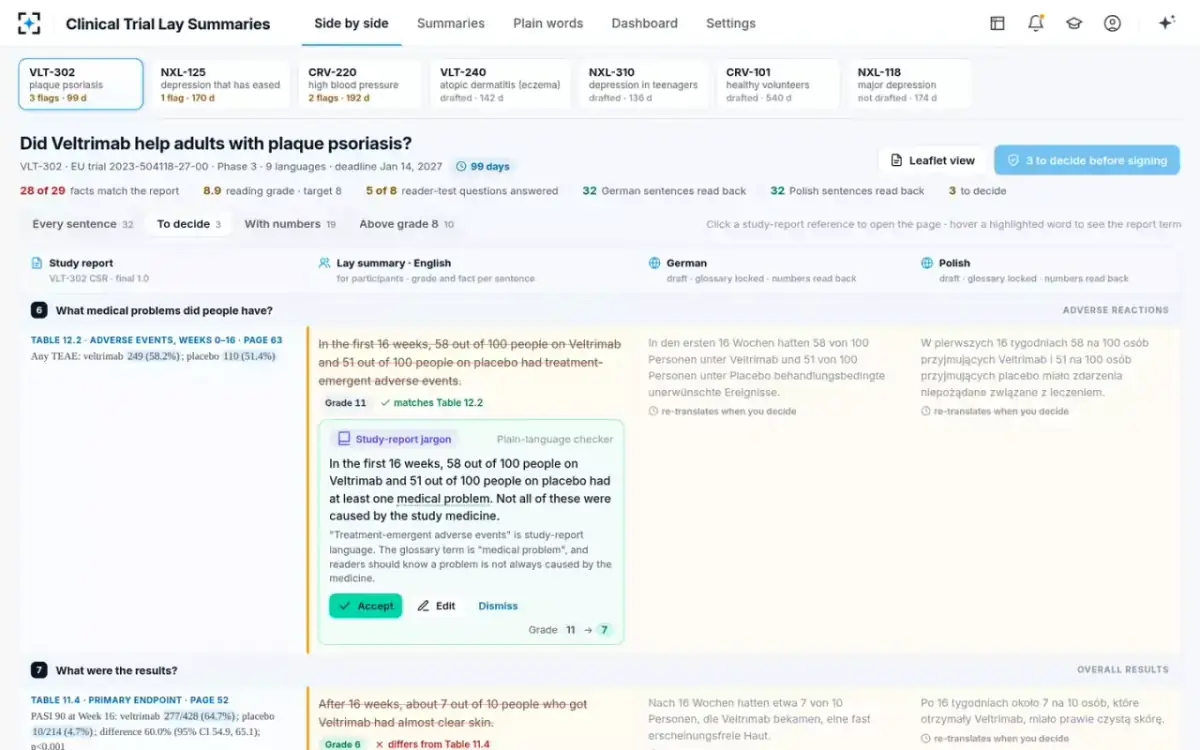
Elements 9 and 10: can you link to a company website from a lay summary?
You can point a reader somewhere to read more — that is exactly what element 10 requires, in the words Indication where additional information could be found.
What you cannot do is let that pointer become promotion. A trial's own entry in the public register, the publication of its results, a patient organisation's page about the condition and a monitored contact address are all information. A product page is not, and a corporate page whose purpose is to present the sponsor rather than the trial sits somewhere in between — judge it by what the reader gets when they arrive.
Element 9, Indication if follow up clinical trials are foreseen
, asks a question sponsors often cannot answer cleanly. The honest answers are usually short: more trials in this medicine are planned, no further trials in this condition are planned, or no decision has been taken. Each is a sentence. The one unacceptable answer is to leave the element out, because a participant reading a summary wants to know whether the story continues.
Can you combine or reorder the Annex V elements?
Yes. The guidance says so directly, and the Expert Group publishes examples of reader-friendly headings that cover the content of all ten elements. Many published summaries use questions as headings — why was the study done, what happened during the study, what were the results, what side effects were there — because that is how a reader looks for a fact.
Two constraints come with the freedom. A combined section must still contain each element's required information, so the merge has to be deliberate rather than a side effect of writing. And whoever checks the draft needs to be able to show where each element is answered, which is why a mapping from heading back to element is worth keeping even when the headings are plain.
A completeness check that is not a readability check
Completeness and comprehensibility fail differently and are found by different reviewers. A medical reviewer reading for accuracy will not notice that element 9 is missing. A patient reader will not notice that the frequency cut-off was never set. Running the two checks together is how a summary gets signed with a gap in it.
In Clinical Trial Lay Summaries the ten sections are drafted from the facts pulled out of the study report, and the leaflet view marks each required section as complete or flagged — with adverse reactions, overall results and comments on the outcome the three that are flagged most. The reading-grade and promotional-word checks run beside it, as a separate pass, and are the subject of how to write a good lay summary. Where each element's facts come from in the study report is in the lay summary from the CSR, and a worked example takes a finished summary apart sentence by sentence.
The ten required sections, marked complete or flagged

Where a lay summary's working days go today, by section of the work
The order of those bars is the argument for checking completeness early. The two largest items — translation and sign-off — run last and depend on an English version nobody will reopen, so an element found missing at the patient read-through costs the whole tail again.
Questions people ask
What makes a lay summary incomplete rather than merely badly written?
A missing element. All ten of Annex V must be covered; a summary with no follow-up statement, or with no inclusion and exclusion criteria, is incomplete whatever its reading grade. Badly written is a separate failure, judged against Article 37(4)'s test that the summary be understandable to laypersons — and a document can fail either test alone.
How do you report the number of participants when the study report gives randomised and treated figures?
Give one count as the summary's spine, label it in words, and explain the difference where it matters. Good Lay Summary Practice asks that differences between randomised and treated participants be presented clearly to avoid confusion, and that the numbers align as far as possible with those in the results section. “428 people were given the medicine; 12 of them stopped before the end” does more for a reader than a disposition table rendered as prose.
Is there a required frequency cut-off for listing adverse reactions?
No. The guidance declines to set one, because the right cut-off varies with the safety profile of the medicine, the reporting interval and the trial population, and asks the clinical and scientific experts involved in the safety analysis to decide it for each summary. Whatever is chosen, serious reactions are listed first and the frequencies are given in numbers and percentages.
Can a lay summary say that a medicine was safe and effective?
No. Good Lay Summary Practice requires the content to be presented in factual and objective language and not designed as promotional or favourable, and element 8 has to reinforce that one trial may not be repeated by others. Report what happened to how many people, name the population, and leave the conclusion to the reader and to the regulator who approves the medicine.
Do you have to name the comparator?
Yes. Element 5 covers the investigational medicinal products used, and the guidance treats comparators alongside them: route and regimen should be stated, and no promotional information given about either. A reader who is not told what the other group received cannot read the results section at all.
Where should a reader be sent for more information?
Element 10 asks for an indication of where additional information could be found, and leaves the destination to the sponsor. The useful answers are the trial's own public register entry, the publication of its results if there is one, and a contact address that is answered. Keeping that pointer narrow is what lets the rest of the summary stay short.