A lay summary of a clinical trial is a second, separate summary of that trial's results, written so that a person with no medical training can understand it. The EU Clinical Trials Regulation requires it beside the technical summary of results: Article 37(4) gives the sponsor one year from the end of the trial in all Member States concerned to submit both to the EU database, and Annex V names the ten elements the lay version has to cover. It is not a shortened study report and not a journal abstract, which is what makes it hard — every sentence has to carry a fact from the final clinical study report and still read at the level of a school leaver. Botminds' Clinical Trial Lay Summaries drafts the ten sections from the study report itself, marks each sentence with its source and its reading grade, and leaves every flag for the medical writer to accept, edit or dismiss.
The studies, medicines and people named on this page from the solution — VLT-302 and Veltrimab in plaque psoriasis, NXL-125 and Talmirex in depression, CRV-210 and Corventa in atrial fibrillation, and the team around them — are sample data on fictional studies and fictional people. Every rule and figure comes from the Regulation, the European Commission's own guidance or the other laws cited, linked where it appears.
What is a lay summary in a clinical trial?
It is the plain-language half of the results a sponsor owes the public. Article 37(4) of Regulation (EU) No 536/2014 puts both halves in one sentence and one deadline: Irrespective of the outcome of a clinical trial, within one year from the end of a clinical trial in all Member States concerned, the sponsor shall submit to the EU database a summary of the results of the clinical trial.
That first summary is the technical one, and its content is Annex IV. The next sentence creates the lay summary.
“It shall be accompanied by a summary written in a manner that is understandable to laypersons. The content of that summary is set out in Annex V.”
Regulation (EU) No 536/2014, Article 37(4)
Three words in that sentence decide the work. Accompanied means a separate document, not a section of the technical summary and not an executive summary of it. Understandable to laypersons sets a test the sponsor cannot meet by shortening: the reader is a participant, a carer or a patient-group volunteer, not a reviewer. And Annex V turns the test into a content list of ten elements, so a summary can be beautifully written and still incomplete.
The Commission's own guidance, Good Lay Summary Practice, is blunt about the skill the document needs. Developing a lay summary requires insights and skills into writing for a general audience, and a fundamentally different approach to that of medical writing for regulatory purposes or a technical or scientific readership
(GLSP, October 2021). It is a different craft from the one that produced the source document, performed on the same facts.
Who has to write a lay summary of clinical trial results?
The duty is the sponsor's, and it does not move. Article 37(4) names the sponsor, and it attaches to every interventional trial of a medicine authorised under the Regulation in the EU or EEA — commercial or academic, successful or not, since the words are irrespective of the outcome
. A university that runs one investigator-led trial carries the same obligation as a company that runs two hundred — often without anybody whose job it is.
Inside a company the work is often shared by five people, and the lay summary is the first-named task of none of them. A medical writer drafts it. A statistician or the clinical lead confirms that the numbers match the study report. A patient engagement lead runs the read-through. A translation coordinator handles the language versions. A disclosure lead owns the CTIS deadline and the posting package. In the solution those five are the named signers of one summary, each signing for a different thing, which is the practical answer to the question people really ask when they ask who must write it: who is accountable when it is late.
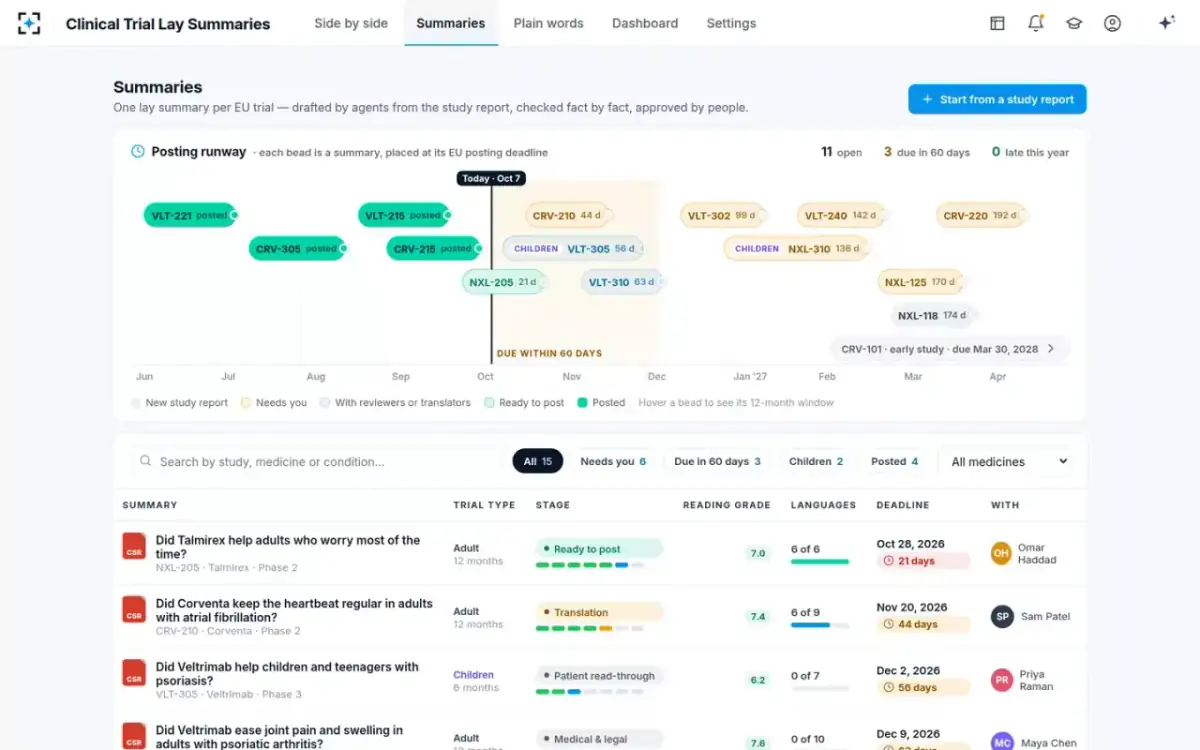
Every open summary at its EU posting deadline, in Clinical Trial Lay Summaries
What is the difference between a lay summary and the summary of results?
They are two documents, submitted together, drawn from the same study report and written for different readers. The summary of results follows Annex IV: a structured technical record with the trial's design, the statistical analysis and the results tables, read by regulators and researchers. The lay summary follows Annex V: ten plain sections, read by the people who took part. An expensive mistake is to treat the second as a shortening of the first, because the lay summary needs facts the technical one states in a form no lay reader can use, and leaves out detail the technical one must carry.
The Annex IV summary of results against the Annex V lay summary
Summary of results (Annex IV): Regulators, researchers and other sponsors — readers who can read a results table.
Lay summary (Annex V): Trial participants and the public, with no medical training assumed.
Summary of results (Annex IV): Annex IV: trial information, subject disposition, baseline characteristics, endpoints, adverse events, statistical analysis.
Lay summary (Annex V): Annex V: ten elements, from trial identification to where more information can be found.
Summary of results (Annex IV): Point estimates with confidence intervals, p-values, hazard and odds ratios, as the analysis produced them.
Lay summary (Annex V): Counts and percentages a reader can picture; ratios explained or replaced.
Summary of results (Annex IV): One version, in the technical English the study report uses.
Lay summary (Annex V): One summary understandable to laypersons; local-language versions are an Expert Group recommendation, not a demand of the Regulation.
Summary of results (Annex IV): Submitted to the EU database under Article 37(4).
Lay summary (Annex V): Submitted with it, and published on the public CTIS site.
Summary of results (Annex IV): Clinical and statistical ownership, as a results document.
Lay summary (Annex V): An author, a medical reviewer, a non-promotional check, often a patient read-through and a translator per language.
Is a lay summary the same thing as a plain language summary or an abstract?
In ordinary speech, lay summary and plain language summary name the same craft; in the Regulation they are not interchangeable. The lay summary is a regulatory document with ten named elements and a deadline. A plain language summary of a journal article is voluntary, follows the journal's policy, and summarises a publication rather than a trial. Good Lay Summary Practice draws the line itself: Although some shared principles may apply, other types of result information to lay audiences, such as plain language summaries of journal publications and conference abstracts, are out of scope.
The craft does travel: the same plain-language principles serve both, and a team that has learned to write one well writes the other better. What does not travel is the compliance question: only the Annex V document can be late.
Three documents that are not the lay summary
| Document | What it is for | Why it is not the lay summary |
|---|---|---|
| Annex IV summary of results | The technical record of the trial, submitted to the EU database in the same act as the lay summary. | Written for readers who can read a results table; the Regulation requires the lay version to accompany it, not replace it. |
| Journal abstract, and the plain language summary of a publication | Carrying a paper to peers, and increasingly carrying that paper to patients. | It summarises a publication, on the journal’s terms and timetable; Good Lay Summary Practice puts both out of its scope. |
| Participant information sheet | Explaining a trial to someone deciding whether to join it, before it starts. | It is written before there are results; the lay summary reports what happened. Its language versions are a useful guide to which languages the lay summary needs. |
The ten elements the law names
Annex V is ten lines long. It opens The summary of the results of the clinical trial for laypersons shall contain information on the following elements:
and then lists them, starting with the trial's identification — its title, protocol number, EU trial number and other identifiers. Four of the ten carry a decision rather than a fact, which is why they are worked through one at a time in the Annex V elements, one at a time.
Annex V, element by element, and what a reader wants from each
- 1 · Clinical trial identification
Title, protocol number, EU trial number and other identifiers — so a reader can tell whether this is the trial they were in.
- 2 · Name and contact details of the sponsor
Who ran the trial, and a route to ask a question about it.
- 3 · General information about the trial
Where and when it ran, its main objectives, and why it was done at all.
- 4 · Population of subjects
How many people took part in the Member State, in the Union and in third countries, with age and sex breakdowns and who could join.
- 5 · Investigational medicinal products used
What the medicines were, how they were given and on what schedule — named, not advertised.
- 6 · Description of adverse reactions and their frequency
Which medical problems were judged to be caused by the medicine, and how often, in counts and percentages.
- 7 · Overall results of the clinical trial
What the trial set out to measure, and what it found, with the single-trial caveat attached.
- 8 · Comments on the outcome of the clinical trial
What the result does and does not mean: the population it applies to and the main limitations.
- 9 · Indication if follow-up clinical trials are foreseen
Whether the story continues — a question participants reasonably ask.
- 10 · Indication where additional information could be found
Where to read more — the register entry, the publication, a contact — without becoming a route to promotion.
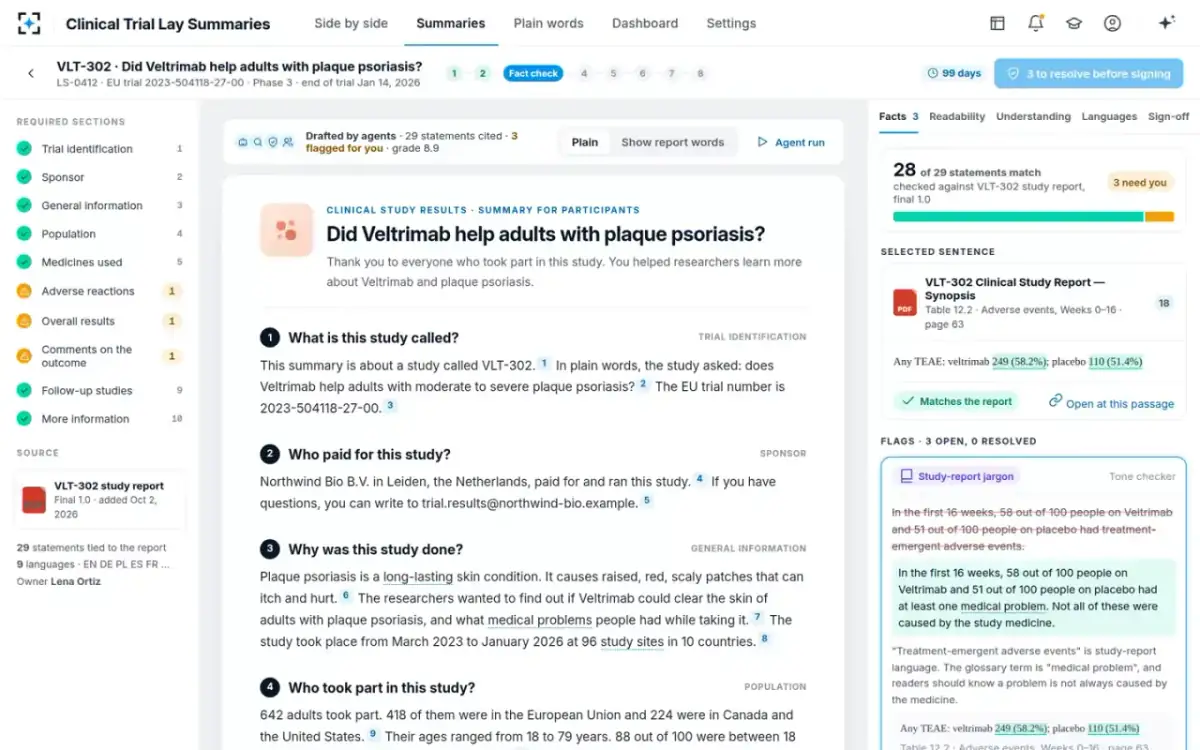
The ten elements as a participant meets them
When is the lay summary due?
Within one year of the end of the trial in all Member States concerned — the same clock as the technical summary, from the same start date. Two shorter and one longer figure are often quoted with it, and none of them is in Article 37(4): Good Lay Summary Practice gives twelve months from the protocol-defined end of the trial, six months for paediatric studies, and up to thirty months for non-therapeutic Phase 1 trials. If you are asked where the six months comes from, that is the source; the Regulation itself says one year.
From the last patient to a published summary
- Study report, draft, checks, review, translation — submitted at 12 months12 months
- Held in the CTIS secure domain until publication18 months
- Study report, draft, checks, review, translation — submitted at 6 months6 months
The paediatric lane is the one that catches teams out, and for two reasons at once: half the time to write, and no delay between submitting and being read. Both clocks, the terminated-trial rule and the interim-analysis rule are worked through in CTIS results posting: the deadlines, and when the summary goes public.
Where is the lay summary published, and who actually reads it?
On the public CTIS website, as part of the trial's own entry, which is what makes the document unusual among regulatory submissions: it is written to be read by strangers. Good Lay Summary Practice is explicit that this is the point — In the interest of the broadest possible transparency about clinical trial results to the trial participants and the public, the EU CTR makes LS dissemination through the publicly accessible EU Database mandatory for sponsors
.
Submission and publication are two different dates. Under the revised CTIS transparency rules, the lay summary of a Category 1 trial run only in adults goes into the secure part of CTIS when it is submitted and is published thirty months after the end of the trial in the EU or EEA, while for a Category 1 trial in a paediatric population, or one that is part of a paediatric investigation plan, it is published as soon as it is submitted. A sponsor that writes for the deadline rather than for the reader may find the document public on the day it arrives.
Who reads it: the participants and their families first; then patient organisations, who use posted summaries to brief their members; clinicians looking for a result they can discuss in a ten-minute appointment; journalists; and other sponsors, since a posted summary is a public statement about a medicine that cannot be withdrawn once a regulator, a competitor or a patient group has read it.
Do trial participants get the lay summary?
Under the Regulation, participants get it the same way everyone else does: it is published in the EU database, and they are told during consent that it will be. The Regulation creates no duty to post a copy to each person who took part. Some sponsors do more than the law asks — a letter, an email, a link handed over at the final visit — because a trial that asks people for a year of their lives and then publishes its thanks on a government website has met the rule without quite meeting the expectation.
Other jurisdictions have written the stronger duty down. The United Kingdom's 2024 amendment to its clinical trials regulations requires a sponsor to offer every relevant person — the participants first among them — a summary of the results that laypersons can understand (legislation.gov.uk) — an offer to the participants, alongside publication in a register. For a sponsor running one trial across the EU and the UK, that is one document and two different distribution obligations.
Is a lay summary required in the US?
No. There is no US equivalent of the Annex V duty. Under 42 CFR part 11, results information for an applicable clinical trial is due within a year of its primary completion date, and what is submitted is structured registry data — participant flow, baseline characteristics, outcome measures, adverse events — not a document written for a lay reader.
The US does ask for lay language, in a different place. The registry rule defines the Brief Summary as a short description of the trial, with a brief statement of its hypothesis, written in language meant for the lay public (42 CFR part 11, eCFR). That is the description of the trial, written before it runs, rather than its results. A sponsor running the same molecule on both sides of the Atlantic therefore owes plain words about the trial in the US, and plain words about the result in the EU — and only one of the two has a ten-element content list. The whole picture, jurisdiction by jurisdiction, is in clinical trial results disclosure requirements, country by country.
Who writes it, and why the work lands late
The sequence explains why deadlines slip. The lay summary is drawn from the final clinical study report, so it can only start in earnest once that report is final — and the report is itself the end of a long queue of database lock, analysis and review. What is left is a hand-written rewrite of a document that can run to hundreds of pages into ten plain sections, a check of every number against the tables, a patient read-through, and then translations, each of which has to be checked again. Good Lay Summary Practice names the risk directly: a lay summary that waits for the final study report turns its writing and its translations into the tasks that decide whether the deadline is met.
That is the shape Clinical Trial Lay Summaries is built to change. The study report is read once into the facts the ten sections need, each tied to its page or table; the draft arrives already graded sentence by sentence; the number check is a comparison rather than a re-derivation; and the open flags are a short list a writer decides instead of a document to rebuild. The solution's design targets are 2.4 days from study report to a checked first draft, and nine out of nine summaries posted before their EU deadline in six months — targets the solution is built to hit, not a measured customer result.
One summary, sentence by sentence, against the study report
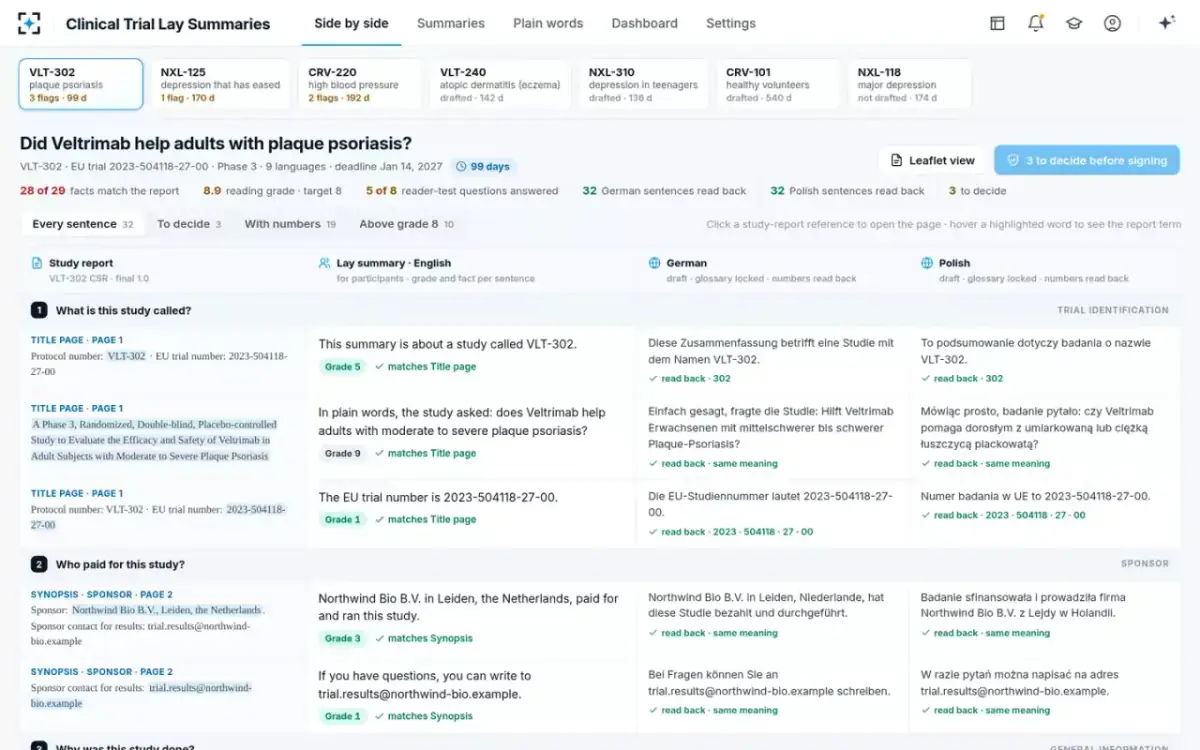
Where the facts come from, table by table, is the subject of the lay summary from the CSR; how to make the result readable rather than merely short is in how to write a good lay summary. To see the ten sections, the flags and the posting runway on one of your own study reports, start from Clinical Trial Lay Summaries.
Questions people ask
What happens if a sponsor does not post a lay summary?
The Regulation leaves enforcement to the Member States. Article 94 requires each to lay down penalties that are effective, proportionate and dissuasive
, and names non-compliance with submitting information intended to be made publicly available to the EU database as one of the things those rules must address. In practice the first consequence is public: the end-of-trial date is published, so a missing summary is visible to anyone who looks for it.
Does a lay summary have to be translated into the language of every country where the trial ran?
No. The Regulation requires one summary understandable to laypersons; Good Lay Summary Practice states that the EU CTR does not request translations, and that local-language versions are the Expert Group's recommendation, usually matching the languages of the participant information sheet and consent form. Many sponsors translate anyway, because a summary a participant cannot read fails its own test. The back-check that keeps the numbers right across languages is covered in back translation in clinical trials.
Is a lay summary needed for a trial that stopped early?
Yes, and the clock starts earlier. Article 37(7) treats the date of an early termination as the end of the trial, so the one-year deadline runs from termination. The duty applies irrespective of the outcome, which includes a trial that stopped for futility or for slow recruitment.
Does a lay summary have to be written by a medical writer?
The Regulation names no profession; the skill is what matters. Good Lay Summary Practice describes writing for a general audience as a fundamentally different approach from regulatory medical writing, and recommends that reviewers be briefed on what each is looking for. In practice the draft comes from a medical writer, an agency or a patient-communications team, and is reviewed by a clinician, a legal reviewer and often patients themselves.
Who signs a lay summary before it is posted?
Whoever the sponsor's procedure names — the Regulation is silent. A common pattern, and the one the solution follows, is six signatures for six different meanings: the author confirming every fact matches the final study report, the patient read-through, medical accuracy, the non-promotional check, each language version, and the posting package itself. Keeping them separate matters because the question “is this accurate?” and the question “can a reader use this?” are answered by different people.
Where do the facts in a lay summary come from?
The final clinical study report and nothing else: its synopsis, the disposition and demographic tables, the efficacy tables and the adverse event tables. Working that way is what makes a lay summary checkable — every factual sentence has a page or table behind it, so a reviewer confirms a number instead of recalculating it. A worked example of one sentence, end to end, is in a clinical trial lay summary example, taken apart sentence by sentence.