CTIS results posting is governed by one deadline and two publication rules that are easy to confuse. The deadline: within one year of the end of the trial in all Member States concerned, the sponsor submits both the technical summary of results and the layperson summary to the EU database. The publication rules: whether those documents become public the day they arrive or thirty months after the trial ended depends on the trial's category under the revised CTIS transparency rules — and the shorter paediatric deadline, six months rather than twelve, comes from the Commission's guidance rather than from the Regulation's own article. Botminds' Clinical Trial Lay Summaries places every open summary on its posting runway against that clock, with its stage, its reading grade, its languages and the person who currently holds it.
The studies and people named here from the solution are sample data on fictional studies and fictional people. The deadlines come from Regulation (EU) No 536/2014, Good Lay Summary Practice and the European Medicines Agency's revised CTIS transparency rules; the penalties rule from Article 94 of the Regulation. Each is linked where it appears.
When do clinical trial results have to be posted in CTIS?
Within one year of the end of the trial in all Member States concerned. Article 37(4) of the Regulation puts the duty on the sponsor whatever the outcome of the trial, and the submission is two documents in one act: the summary of results whose content is set out in Annex IV, and the layperson summary whose content is set out in Annex V. Submitting one without the other does not satisfy the article.
One year is the only figure in the article. Every other number quoted in a posting calendar — six months, thirty months, fifteen days, thirty days — comes from somewhere else in the Regulation or from guidance, and keeping track of which is which is most of the work of owning a disclosure calendar.
What counts as the end of a clinical trial for the results clock?
The protocol-defined end of the trial in the last Member State concerned — not the last patient visit at your own sites, not database lock, and not the date the study report is signed. For a trial that recruited in eight countries and finished in Spain nine months before it finished in Poland, the clock starts with Poland.
The Regulation builds three notifications on the same event, each with its own scope: the end of the trial in one Member State, the end in all Member States concerned, and the end in all Member States and third countries. The middle one is the one the results clock hangs from: That notification shall be made within 15 days from the end of the clinical trial in the last Member State concerned.
Under the revised CTIS transparency rules, an end-of-trial notification is published as soon as the sponsor submits it, which means the start of your twelve months is public from the beginning.
Twelve months, six months, and where each figure comes from
This is an attribution internal procedures often get wrong. The Regulation says one year, with no distinction by population. The shorter and longer figures are in Good Lay Summary Practice: the summary must be submitted to the CTIS via the EU Portal no later than 12 months from the protocol-defined end of the clinical trial, 6 months for paediatric studies, and up to 30 months for non-therapeutic Phase 1 trials.
So a procedure that cites Article 37(4) for a six-month paediatric deadline is citing the wrong source, and one that ignores the six months because it is “only guidance” is taking a risk no disclosure lead should take on a trial in children. Write both down, with the right attribution against each.
Submission is not publication: the revised CTIS transparency rules
The rules that decide when a submitted document becomes readable are the European Medicines Agency's revised CTIS transparency rules, EMA/263067/2023, adopted by the Agency's Management Board on 5 October 2023. They keep the three trial categories that CTIS has used since launch — Category 1 for pharmaceutical development trials, Category 2 for therapeutic exploratory and confirmatory trials, Category 3 for therapeutic use trials — but, in the document's own words, that classification is retained no longer in connection with the use of deferrals
. Publication timing is now a property of the category, not something a sponsor negotiates.
That matters for the layperson summary in a way that catches teams by surprise: for every Category 2 and Category 3 trial, the layperson summary is published When submitted in CTIS
. There is no quiet period. The day a disclosure lead approves the posting package is the day a participant, a patient organisation or a competitor can read it.
Publication timing for a results submission, by trial category
| Trial category | What it covers | When the layperson summary is published |
|---|---|---|
| Category 1, paediatric population or part of a paediatric investigation plan | Pharmaceutical development trials — Phase I, Phase 0, bioequivalence and bioavailability, biosimilar similarity — run in children or under a PIP. | When submitted in CTIS. |
| Category 1, adults only | The same pharmaceutical development trials, run only in an adult population. | Submitted in the CTIS secure domain, expected within 12 months of the end of the trial in the EU/EEA, and published 30 months after the end of the trial in the EU/EEA. |
| Category 2 | Therapeutic exploratory and confirmatory trials — integrated Phase I/II, Phase II and Phase III. | When submitted in CTIS. |
| Category 3 | Therapeutic use trials — integrated Phase III/IV, Phase IV, and low-intervention trials. | When submitted in CTIS. |
| All categories | The clinical study report, where the results were used in a marketing authorisation procedure. | When submitted in CTIS. |
When does the layperson summary become public in CTIS?
For a Category 1 trial run only in adults, thirty months after the end of the trial in the EU or EEA: the rules place the document in the secure domain on submission, expected within 12 months from the end of trial in the EU/EEA
, and publish it published 30 months after the end of trial in the EU/EEA
. For a Category 1 trial in children or under a paediatric investigation plan, and for every Category 2 and Category 3 trial, it is published when it is submitted.
Two thirty-month figures now exist in the same sentence of many internal procedures, and they are not the same thing. Good Lay Summary Practice allows up to thirty months to submit the summary of a non-therapeutic Phase 1 trial. The revised transparency rules publish an adult-only Category 1 trial's summary thirty months after the end of the trial. One is a drafting deadline, the other a publication date; a calendar that merges them will be eighteen months wrong on a trial that submitted at twelve.
Can you defer publication of results in CTIS?
Not in the way sponsors remember from the system's first years. The deferral mechanism built into CTIS at launch let a sponsor ask for key documents, including the protocol, to be published at the end of a deferral period rather than at the application decision — for certain trials, up to seven years from the end of the trial in the EU or EEA. The revised rules keep the categories but cut them loose from deferrals, and they have applied since 18 June 2024, when the Agency launched an updated version of the CTIS public portal (EMA CTIS newsflash, 14 June 2024).
For results, the practical answer is that the sponsor controls one date and not the other. You choose when to submit, inside the twelve months. The publication date follows from the category. Protecting commercially confidential information and personal data is handled by redaction and by the published or not-for-publication versions of a document, not by holding the layperson summary back — and a layperson summary with commercially confidential content in it has a drafting problem rather than a publication problem.
What if the results are not ready in twelve months?
The Regulation provides for it, in advance and in the protocol. Article 37(4) continues: However, where, for scientific reasons detailed in the protocol, it is not possible to submit a summary of the results within one year, the summary of results shall be submitted as soon as it is available. In this case, the protocol shall specify when the results are going to be submitted, together with a justification.
Read the conditions carefully, because three of them disqualify most late submissions. The reasons must be scientific — a long-term follow-up endpoint qualifies; a backlog in medical writing does not. They must be detailed in the protocol, which means the decision was taken before the trial ended, not after the deadline passed. And the protocol must say when the results will come. A sponsor that discovers in month eleven that the study report will not be final has no route under this paragraph; what it has is a late submission and a decision about how to explain it.
Terminated, halted and interim: three clocks people miss
The Regulation sets the end-of-trial date for three awkward cases, and each shortens or adds a deadline that a calendar built around “last patient, last visit” will miss.
“In the case of early termination of the clinical trial, the date of the early termination shall be deemed to be the date of the end of the clinical trial.”
Regulation (EU) No 536/2014, Article 37(7)
Three endings, three clocks
What happened: The sponsor stops the trial — for futility, for safety, or because recruitment failed.
What the Regulation makes of it: The date of early termination is deemed the end of the trial, so the one-year clock starts then. The duty is unchanged: results are owed irrespective of the outcome.
What happened: A trial is paused and the pause becomes permanent.
What the Regulation makes of it: If it is not resumed within two years, the end of that period — or the sponsor’s earlier decision not to resume — is deemed the end of the trial.
What happened: The protocol sets an analysis date before the end of the trial, and those results exist.
What the Regulation makes of it: A summary of those results is owed within one year of the intermediate data analysis date, without prejudice to the end-of-trial duty. One trial, two submissions.
The interim case is the one that surprises teams, because it creates a layperson summary for a trial that has not ended. A protocol with a planned interim analysis is a protocol with a disclosure obligation attached to it, and the time to notice that is when the protocol is written.
What the clinical study report adds, and when
The clinical study report rides a different clock, driven by the marketing authorisation rather than by the end of the trial. Where the trial was intended to support an authorisation, the applicant for marketing authorisation shall submit to the EU database the clinical study report within 30 days after the day the marketing authorisation has been granted
— or after the procedure is completed, or the application is withdrawn. Under the revised transparency rules that report is published when it is submitted, for every category.
For a lay summary writer, the study report's own timing matters for a different reason: it is the source document. Every factual sentence in the summary should be traceable to a page or table in the final report, which is why writing the summary from the CSR is a separate discipline with its own failure modes.
What happens if a sponsor misses the CTIS results deadline?
The Regulation leaves the consequence to each Member State, and names this failure specifically. Article 94 obliges every Member State to set its own penalties for breaches of the Regulation, and lists among the breaches those rules must cover a sponsor's failure to submit information meant to be made public in the EU database (Regulation (EU) No 536/2014, Article 94). A missing layperson summary is exactly that kind of information, so the exposure is national, and it differs from one Member State to the next.
The exposure that does not differ is public. The end-of-trial notification is published when it is submitted, so anyone can see when the twelve months began; and the summary, for most categories, is published when it arrives. A gap between the two is visible to participants, patient organisations and researchers who count such gaps, without anyone having to ask the sponsor.
How much of the runway is left once the study report is final
Working the clock backwards from the deadline
A calendar that counts forwards from the end of the trial produces one date and no plan. Counting backwards produces the dates that actually bind, and the first of them is not a disclosure date at all — it is when the study report will be final. Good Lay Summary Practice names the risk in one sentence: if the creation of the LS awaits the final CSR or full set of structured trial results, the authoring and translations of the LS may become time critical activities for meeting the regulatory deadlines
, and it suggests developing the summary in parallel with the source documents instead.
One summary's runway, counted back from a twelve-month deadline
- Study report6 months
- Draft and checks2 months
- Reviews and sign-off2 months
- Translation and posting2 months
- Study report10 weeks
- Draft and checks6 weeks
- Reviews1 month
- Translation and posting1 month
The second lane is the uncomfortable one, and it is why trials in children need their own calendar rather than a flag on an adult one. Six months of total runway, with a study report that arrives when it arrives, leaves weeks rather than months for the work a patient panel and a translator cannot be hurried through.
Every open summary at its deadline, in Clinical Trial Lay Summaries
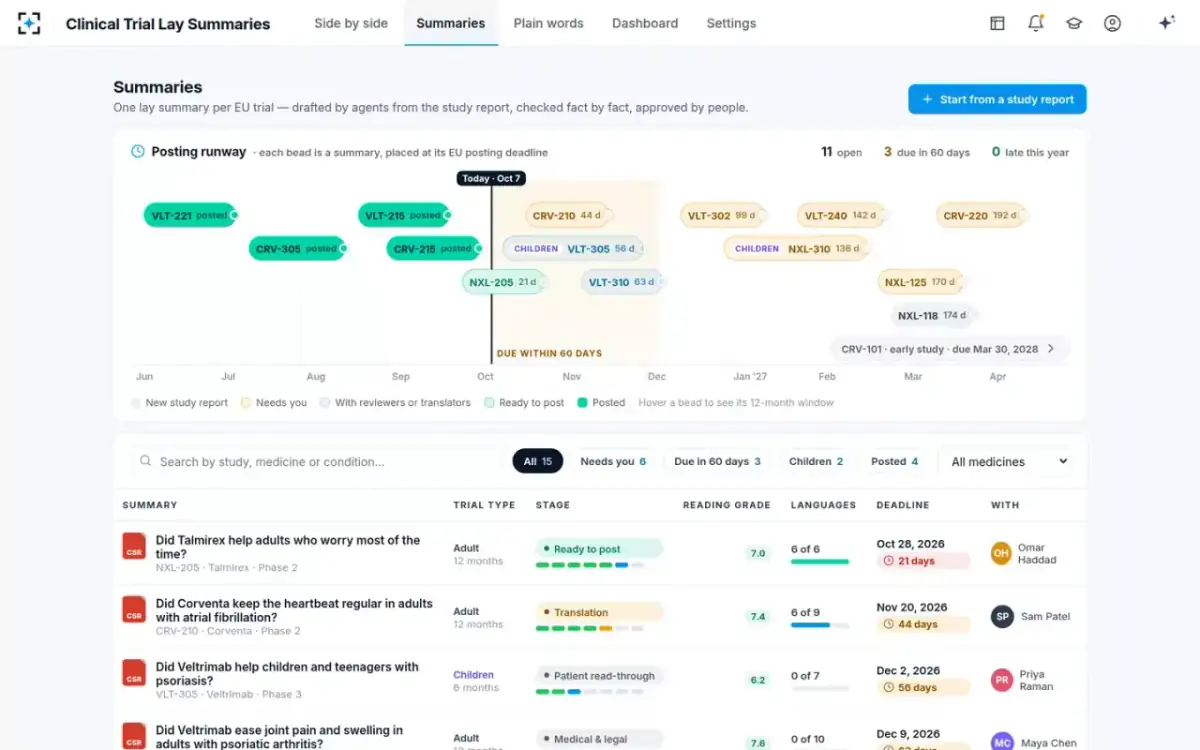
The solution's design targets are 2.4 days from a final study report to a checked first draft, and nine of nine summaries posted before their EU deadline across six months. Both are targets the solution is built to meet rather than a measured customer result — but they describe where the time has to come from if a paediatric summary is to be written twice over, once in English and once in every language a participant reads.
A new study report read, drafted and checked, step by step
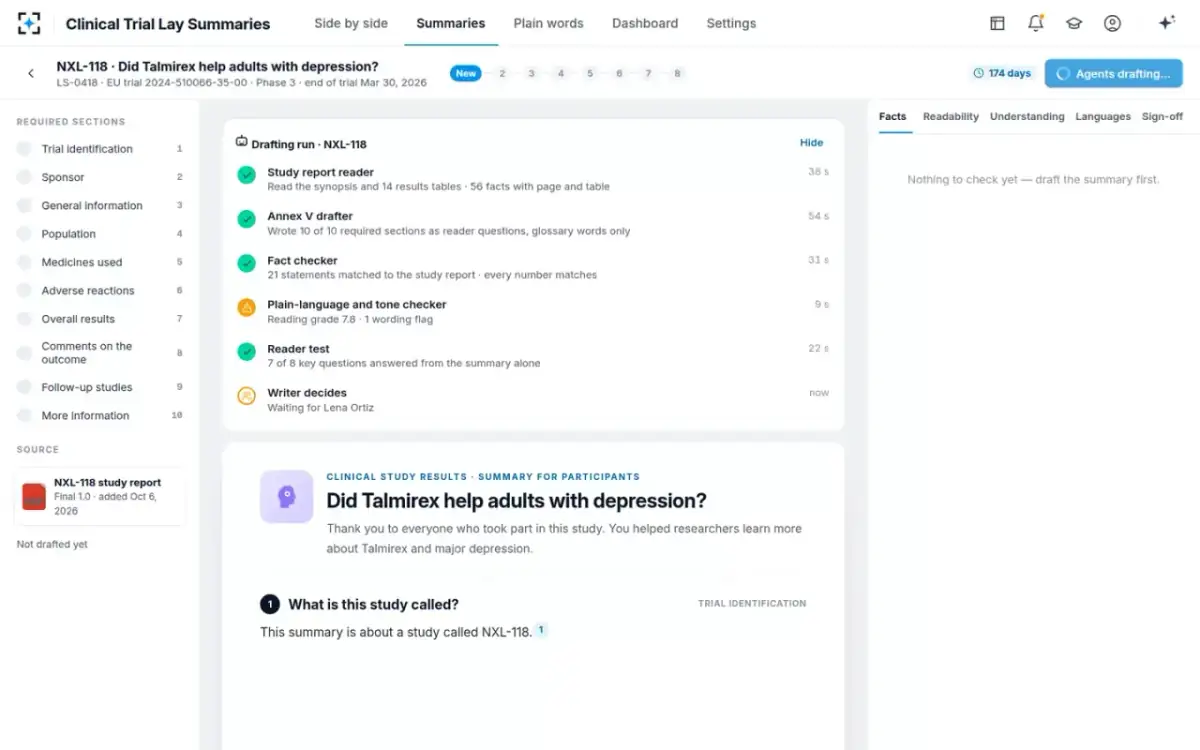
What the deadline buys a sponsor is one shot at a document the public reads. How to make that document worth reading is in how to write a good lay summary; the duty itself, and who owns it, is in what a lay summary of a clinical trial is. To see the runway on your own portfolio, start from Clinical Trial Lay Summaries.
Questions people ask
Does the twelve months run from the end of the trial in my country?
No. It runs from the end of the trial in all Member States concerned, which for a multinational trial is the last country to finish. The Regulation also requires an end-of-trial notification within 15 days of that date, so the start of the clock is recorded and published before the work begins.
Do you have to post results for a terminated trial?
Yes. The duty applies irrespective of the outcome, and Article 37(7) deems the date of early termination to be the date of the end of the trial — so a trial stopped at month eight owes a summary of results and a layperson summary within a year of the day it stopped. Terminated trials are an easy place to miss the clock, because the team that would have written the summary has usually been reassigned.
Do you have to post the results of an interim analysis?
Where the protocol provides for an intermediate data analysis date before the end of the trial and those results are available, Article 37(8) requires a summary of them within one year of that analysis date, without prejudice to the end-of-trial duty. In practice it means a running trial can owe a public summary, and the obligation was created by the protocol.
Is the layperson summary public as soon as it is submitted?
For most trials, yes. Under the revised CTIS transparency rules it is published when submitted for Category 2 and Category 3 trials and for Category 1 trials in children or under a paediatric investigation plan. Only a Category 1 trial run solely in adults has its summary held, and published 30 months after the end of the trial in the EU or EEA.
Can a sponsor ask for more time if the study report is late?
Only on scientific grounds set out in the protocol in advance, with the protocol stating when the results will be submitted and why. An operational delay is not a ground, and the provision cannot be used retrospectively. The practical defence against a late study report is to draft the summary alongside the source documents rather than after them, which is what the guidance recommends.
When is the clinical study report due in CTIS?
Within 30 days after the marketing authorisation is granted, the procedure is completed, or the application is withdrawn, where the trial was intended to support an authorisation. It is published when submitted. That is a different clock from the results summary, and a trial can owe its layperson summary long before the report that supports a filing exists.