A visit window in a clinical trial is the range of days around a target day on which a protocol-specified visit may take place: Week 16 at Day 113, plus or minus three days, counted from the first dose. The window is a protocol provision and the protocol is the governing document — but few site coordinators schedule straight from the full protocol. They schedule from a scheduling guide, from a calendar built at start-up, or from a printed visit card generated by the guide's own calculator. When an amendment narrows a window, the protocol changes and the card does not, and the out-of-window visits that follow look exactly like site carelessness while being nothing of the kind. This page follows one such number through a study, and shows how Clinical Study Document Search — Botminds' search over a study's own documents and data — turns "which other document states this?" into a daily list instead of an inspection finding.
The study is fictional: VLT-302, a Phase 3 study of veltrimab in plaque psoriasis at 88 sites in 11 countries, the sample study the solution ships with. The people, sites and sponsor are invented; the guidance quoted is real and linked where it appears.
What is a visit window, and who sets it?
The sponsor sets it, in the protocol, as part of the schedule of activities, and the design decides how wide it can be. A pharmacokinetic sample has a window measured in minutes. A primary endpoint assessment has one measured in days, narrow enough that the measurement still means what the statistical analysis assumes it means. A long-term safety follow-up can have one measured in weeks. The window is not administrative slack; it is part of the measurement.
What the window obliges is unambiguous. ICH E6(R3) states the investigator's duty in one line: "The investigator should comply with the protocol, GCP and applicable regulatory requirements." A visit booked outside the window is non-compliance with the protocol, whatever document the booking was made from. That is precisely why the question of which document a site actually reads is not a trivial one.
Where the number actually lives: protocol, schedule of activities, site guide, visit card
Ask where a visit window is written down and the honest answer is "in at least four places, only one of which governs". The protocol body and its schedule of activities carry the provision. A site-facing scheduling guide restates it in a form a coordinator can use. A printed or exported visit card carries it per participant, usually with no version and no date. And the electronic systems that schedule and validate visits carry it as configuration.
That last one has a rule of its own, and it is the rule that makes the whole cascade per-site rather than study-wide. ICH E6(R3): "The trial-specific systems (including updates resulting from protocol amendments) should only be implemented, released or activated for individual investigator sites after all necessary approvals for the clinical trial relevant to that investigator site have been received." A narrowed window therefore takes effect in the systems at different dates at different sites — correctly — which also means a study cannot answer "when did the new window start?" with a single date.
How one protocol number becomes a deviation, link by link
1
The protocol provision
Week 16 is Day 113, window ± 3 days, every window counted from Day 1, the first dose.
One sentence, in protocol v4.0, section 1.3, approved 14 August.
2
The documents that restate it
Scheduling guides, schedules of activities, monitoring checklists, training slides — each written once, from whichever protocol version was current then.
In the sample study: the site visit scheduling guide v1.0, page 4, issued 20 January.
3
What is printed from them
The guide’s own window calculator, on page 11, prints a visit card for each participant. The card carries no version number and no date.
Count your own: how many site-facing aids generate something a coordinator keeps on a desk?
4
The sites that work from the print
A coordinator booking next week reaches for the card, not for the full protocol.
Count your own: which sites were given the guide, and when were they last told it changed?
5
The visits booked
Every booking made from the wider window is correct against the card and wrong against the protocol.
Count your own: bookings since the amendment, at the affected visit number.
6
The deviations recorded
They arrive one at a time, attributed to the site, weeks after the document that caused them.
Count your own: out-of-window deviations by site and by visit, plotted against the amendment date.
The case: a window narrowed from five days to three, and a guide that was not re-issued
On Wednesday 7 October at 07:31, a CRA covering the United Kingdom and Canada asked a plain question: what is the Week 16 visit window, and how many visits fell outside it last month? The first half has two answers in the study's own files.
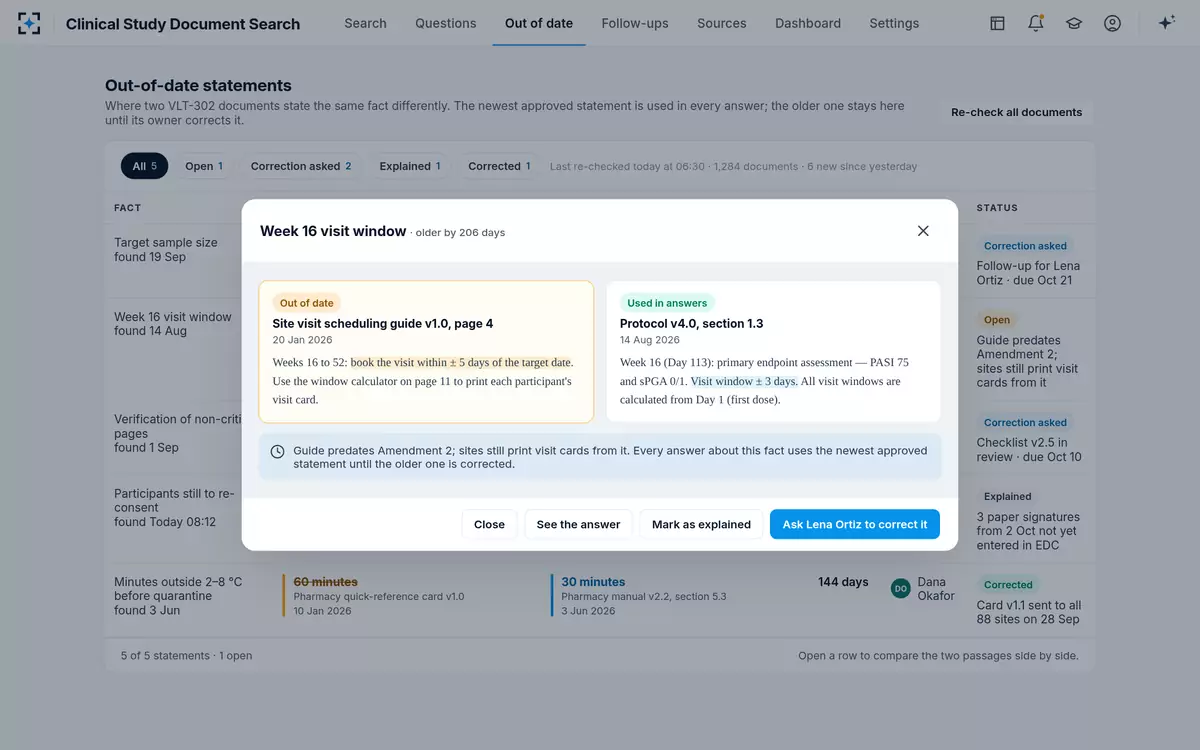
Two current documents, one number: the Week 16 visit window
Site visit scheduling guide v1.0, page 4: 20 January 2026, before the amendment that narrowed the window
Protocol v4.0, section 1.3: 14 August 2026, approved with Amendment 3
Site visit scheduling guide v1.0, page 4: "Weeks 16 to 52: book the visit within ± 5 days of the target date. Use the window calculator on page 11 to print each participant’s visit card."
Protocol v4.0, section 1.3: "Week 16 (Day 113): primary endpoint assessment — PASI 75 and sPGA 0/1. Visit window ± 3 days. All visit windows are calculated from Day 1 (first dose)."
Site visit scheduling guide v1.0, page 4: Site coordinators booking next week — and every visit card printed from its calculator
Protocol v4.0, section 1.3: Anyone who opens the protocol, which is rarely a coordinator with a diary open
Site visit scheduling guide v1.0, page 4: Still the current version of that guide, and 206 days older than the newest approved statement of the window
Protocol v4.0, section 1.3: The newest approved statement, and the one every answer uses
Site visit scheduling guide v1.0, page 4: Marked as explained, or sent to its owner to correct and re-issue — by a person
Protocol v4.0, section 1.3: Nothing. It is already right.
206 days between the guide’s statement and the newest approved one
- Guide v1.0 says ± 5 days20 Jan · 206 d
- Protocol v4.0 says ± 3 days14 Aug · 54 d
The two passages opened side by side in Clinical Study Document Search
Why the deviations cluster, and why they look like site errors
Out-of-window visits caused this way have a signature, and it is visible before anyone knows the cause. They concentrate at one visit number, because only that visit's window moved. They concentrate at the sites that work from the derived document, which may be most of them. They start at a date — the date the narrower window took effect at that site — and they keep arriving at a steady rate, because nothing has changed at the sites. And each one is individually defensible from the site's point of view: the coordinator booked within the window printed on the card in front of her.
Read one at a time in a monitoring report, that pattern is invisible. Each deviation is logged against a site, discussed at that site's next visit, and closed with a retraining action. Twelve of them can produce twelve retraining actions and no change to the document. This is the mechanism by which a study can correct the same problem a dozen times without fixing it once.
The sponsor is not a bystander here. ICH E6(R3) expects deviation information to flow in both directions: the investigator documents those they find, and "In addition to those identified by the investigator themselves, protocol deviations relevant to their trial participants and their conduct of the trial may be communicated to them by the sponsor". A sponsor that can see the cluster across eighty-eight sites is better placed to spot a document problem than any single site that can only see its own three.
Is an out-of-window visit an important protocol deviation?
Sometimes, and the test is one the sponsor has to write down in advance rather than decide case by case. ICH E6(R3): "The sponsor should determine necessary trial-specific criteria for classifying protocol deviations as important. Important protocol deviations are a subset of protocol deviations that may significantly impact the completeness, accuracy and/or reliability of the trial data or that may significantly affect a participant's rights, safety or well-being."
Applied to windows, that usually resolves into a few sensible rules. A visit carrying the primary endpoint assessment, missed by enough days to change what the measurement means, is a strong candidate for important — in the sample study, Week 16 is the primary endpoint visit, which is why its window is the narrow one. A safety follow-up visit a day late usually is not. A dosing visit missed by enough to interrupt treatment may be important for a different reason, because it touches the participant rather than the data. What matters is that the criteria exist before the deviations do; classification invented after the fact is the kind of judgement an inspector will test.
What the analysis does with a visit outside its window
Two things, and study teams often conflate them. The first is the scheduling window in the protocol. The second is the analysis window in the statistical analysis plan, which decides which observation counts as the Week 16 measurement for analysis purposes — and these are not required to be the same range.
ICH E3 lists the kinds of restriction a report may have to describe when it explains the sets analysed, naming "all patients with an observation during a particular time window, only patients with a specified degree of compliance" among them. The practical consequence is that an out-of-window visit can be handled in several defensible ways: counted as the visit, counted at its actual day, excluded from a per-protocol set while remaining in the full analysis set, or counted in a sensitivity analysis both ways. Which one applies should be prespecified, not chosen once the deviations are known.
The report then has to say what happened. ICH E3 asks for every important deviation to be described — whether it concerns the inclusion or exclusion criteria, the conduct of the trial, patient management or patient assessment. A cluster of window deviations with one documentary cause is a far better story to tell at that point than a scattering of site errors with none.
Acceptable ranges: the protocol design choice that prevents this
Some of this is avoidable at design time, and the current good clinical practice guideline says so directly.
"Building adaptability into the protocol, for example, by including acceptable ranges for specific protocol provisions, can reduce the number of deviations or in some instances the requirement for a protocol amendment. Such adaptability should not adversely affect participant safety or the scientific validity of the trial."
ICH E6(R3) Guideline for Good Clinical Practice, Appendix B, on clinical trial protocols and protocol amendments
A window written as an acceptable range from the start — wide enough to absorb a public holiday, narrow enough to preserve the measurement — produces fewer deviations and fewer amendments than one written tight and relaxed later. The second sentence is the limit on the idea: a range chosen to make operations comfortable rather than to protect the measurement is not adaptability, it is a weaker trial.
The design choice does not help a study already running, though, and narrowing a window mid-study is the harder direction. Widening one makes previously non-compliant visits compliant and raises its own questions; narrowing one, as in this case, makes a previously correct printed card wrong at every site that holds it. What an amendment is obliged to do, and what it quietly leaves behind sets out the rest of that cascade.
How to find every document that restates a window
This is a search problem with an awkward shape: the fact is a number, the number is expressed differently in each document, and the documents are not in one place. Done by hand it means opening the protocol, the schedule of activities, every site-facing guide, the monitoring checklist, the training material and the trackers, for each of the provisions that changed. On a study with more than a thousand documents, nobody does it twice.
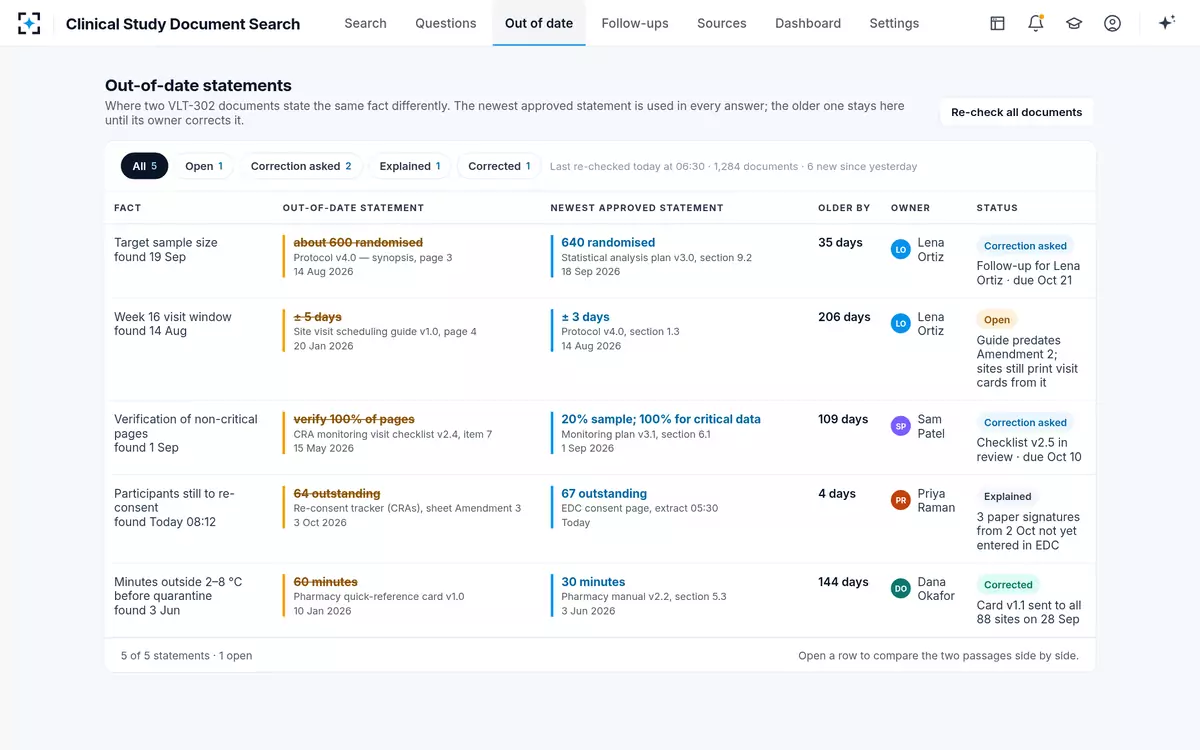
Done mechanically it is a daily job, and the output is a list of facts that two current documents state differently, ranked by how far apart the statements are in time. The sample study's list is five rows long, and the spread is the interesting part.
Five facts in one sample study, and how much older the out-of-date statement is
Two features of that spread are worth naming. The longest-standing differences are in operational documents rather than governing ones: a site guide and a pharmacy card, not the protocol. And the shortest is not an error at all. A list that cannot tell those apart creates work rather than removing it, which is why each row carries a status as well as an age.
Every fact two documents state differently, re-checked each morning
What to do when you find one: explain, correct, or re-issue
There are only three honest endings for a difference between two current documents, and choosing among them is a judgement rather than a rule.
Explain it. Sometimes the two documents are both right because they are about different things, or because one lags the other for a known and acceptable reason. The difference is recorded as explained, with the explanation, and it stays visible rather than disappearing. The four-day consent lag in the sample study ends this way.
Correct it. The owner of the older document amends it, on whatever approval route that document requires. Where the older statement sits inside a governing document — the protocol synopsis, say — correcting it means an amendment, and the correction waits for the next one.
Re-issue it. For a site-facing aid, correcting the master is not enough: the sites are holding printed copies. The pharmacy card in the sample study ended this way, with version 1.1 sent to all 88 sites. The visit scheduling guide had not, at the point shown, and that is the honest state of it — flagged, owned, open.
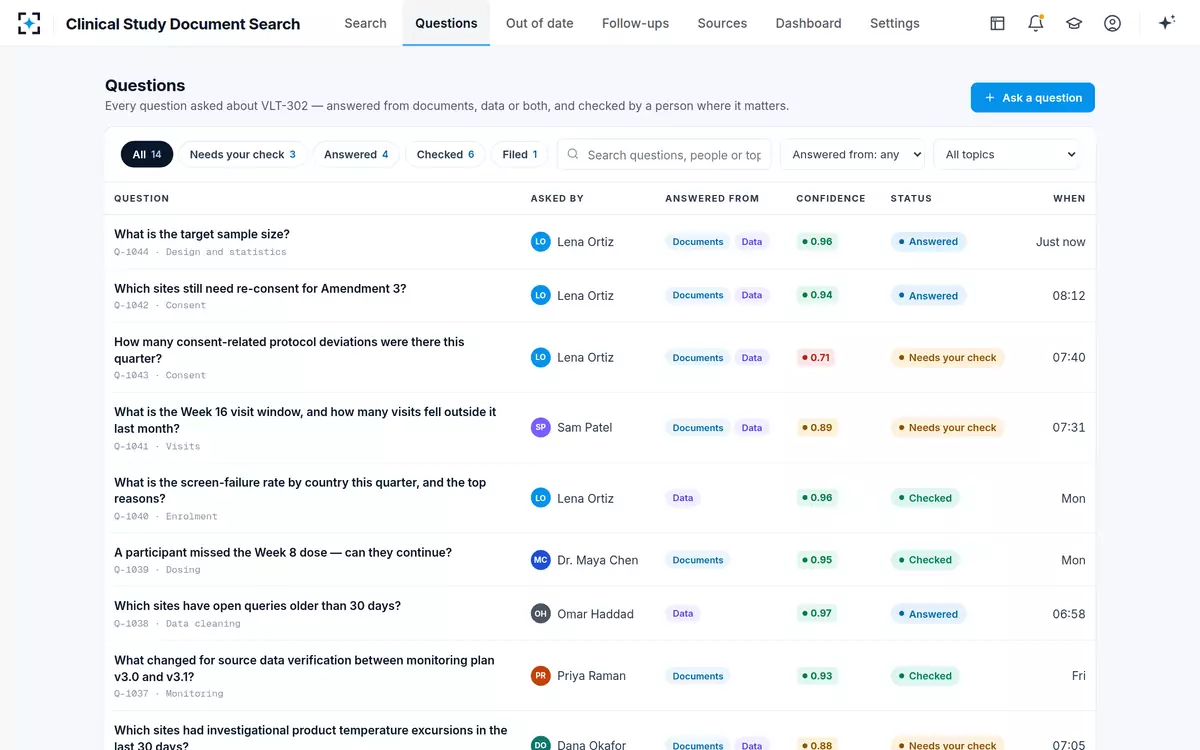
One thing the solution deliberately does not do is any of the three. It finds the difference, dates it, names the owner, and holds the answer; a person decides whether it is explained, corrected or re-issued, and a person sends it. Answers it is not sure about do not get published at all: the CRA's question about the Week 16 window came back at 0.89 confidence and was held for the study manager's check, because the second half of the question — how many visits fell outside the window last month — depends on which window you count against.
Low-confidence answers wait for a person
The underlying requirement is unremarkable: a study has to be able to find things in its own files. ICH E6(R3) asks that the systems a trial stores records in allow them to be identified, version-tracked, searched and retrieved. Treating "which other document states this number?" as a question the files can answer, rather than a thing somebody must remember, is simply taking that requirement seriously. The same mechanism applied to a number that moved for statistical reasons is covered in what happens when the enrolment target changes, and the division of labour between the documents and the systems in which system holds which answer. To see the comparison screen and the morning re-check on a study, start from Clinical Study Document Search.
Questions people ask
What is a visit window in a clinical trial?
It is the permitted range of days around a target study day on which a protocol-specified visit may take place, written into the protocol's schedule of activities. Windows are usually anchored to a fixed origin rather than to the previous visit — in the fictional sample study, every window is calculated from Day 1, the first dose — so one early visit does not shift the whole schedule. The width is a design decision: the narrower the window, the more the timing of the measurement matters to the analysis.
What happens if a visit is outside the window?
The visit still happens and the data are still collected; what follows is a documented protocol deviation, and a decision about how the observation is treated in the analysis. The investigator records the deviation, the sponsor classifies it against criteria it set in advance, and the statistical analysis plan decides whether the measurement counts as that visit, counts at its actual day, or falls outside a per-protocol set. Nothing about an out-of-window visit removes the obligation to collect and report the data.
Where is the visit window written down?
Formally, in the protocol and its schedule of activities, and that is the only statement that governs. Practically, it is also in the site scheduling guide, in the visit cards printed from it, in the scheduling and validation rules configured in the study's systems, and often in monitoring checklists and training slides. Any of those can be left behind by an amendment, and only the first one is ever re-approved as a matter of course.
Can a site use a scheduling guide instead of the protocol?
In practice sites do, and that is a reasonable way to run a busy clinic — a coordinator with eight appointments to book cannot read the protocol for each. What makes it safe is treating the guide as a controlled document: a version number, an issue date, a named owner, and a re-issue every time the provision it restates changes. The failure in this case study is not that the site used the guide; it is that the guide was never re-issued and carried nothing to tell anyone it predated an amendment.
How do you reduce out-of-window visits?
Start at design time, with windows wide enough to survive weekends and public holidays and narrow enough to protect the measurement; the good clinical practice guideline explicitly supports building acceptable ranges into the protocol for this reason. During the study, make every derived document carry its version and its source provision, re-issue them as part of each amendment, and look at deviations as a pattern rather than one at a time. A cluster at one visit number across many sites often points to a document rather than a training problem.
Who has to be told when a visit window changes?
Every site that books that visit, every person who holds a document restating the old window, and the systems that validate visit dates — the last of which can only be activated at a site once that site's approvals are in place. The thing most often missed is the printed artefact: a visit card on a coordinator's desk is not reached by an email to the principal investigator, and a study that has not listed where its numbers are printed cannot know which desks to reach.