Sponsor oversight in clinical trials is the sponsor's duty, set out in section 3.9 of ICH E6(R3), to ensure that trial design and conduct, the processes used and the data generated "are of sufficient quality to ensure reliable trial results, trial participants' safety and appropriate decision making", and it stays with the sponsor when a contract research organisation does the work. In practice that oversight is exercised by answering questions: whether a late visit is a deviation, which consent version a participant should have signed, what the current target sample size is. Each one crosses the protocol, its amendments, the plans and the CTMS and EDC data, and the study team in Botminds' fictional sample study estimates 30 to 60 minutes to answer one by hand. Clinical Study Document Search answers from the newest approved version, cites the page and flags every older document that still says otherwise.
This guide is for the head of clinical operations, the study leads and the quality partners who answer for oversight at inspection. The rules come from ICH E6(R3), adopted in January 2025, and FDA's IND regulations; the worked example is VLT-302, a fictional Phase 3 study with invented sites and people, and its figures are labelled as estimates or design targets.
Oversight is the sponsor's, whoever runs the study
3.6.6
the E6(R3) section that keeps ultimate responsibility with the sponsor when activities go to a service provider
91.1%
of oncology protocols amended at least once in a 2024 benchmark; 72.1% of non-oncology
30–60min
to answer one question that crosses documents and data by hand, in the sample study team’s estimate
What does sponsor oversight require under ICH E6(R3)?
It requires the sponsor to ensure quality of conduct and data, compliance with the protocol and related documents, trial-specific criteria for important deviations, risk-based decisions, oversight proportionate to the trial's risk, and timely escalation of issues. Section 3.9 sets these out in six provisions that read, together, as a description of a study team's working week.
Section 3.9 of ICH E6(R3), and the question each provision makes a team answer
| Provision | What the guideline says | The question it puts to the study team |
|---|---|---|
| 3.9.1 | Conduct, processes and data of sufficient quality for reliable results, participant safety and decision making. | Is what we are doing at every site what the current documents say? |
| 3.9.2 | Processes conducted in compliance with the protocol, related documents and requirements. | Which version of the rule applies today, and does every site have it? |
| 3.9.3 | Trial-specific criteria for classifying protocol deviations as important. | Is this deviation important under our own criteria? |
| 3.9.4 | Decisions assessed for their impact on participants and on the reliability of results. | What does this decision change, and in which documents? |
| 3.9.5 | Oversight fit for purpose and tailored to risk; selection and oversight of investigators and service providers are fundamental. | What is our service provider doing, and how do we know? |
| 3.9.6 | Appropriate and timely escalation and follow-up of issues. | Who was told, when, and what was done? |
Two features of the revision matter for how oversight is staffed. It is explicitly proportionate: "the range and extent of oversight measures should be fit for purpose and tailored to the complexity of and risks associated with the trial", so there is no single prescribed oversight plan. And it is explicitly about information as well as activity: the quality of "the information and data generated" is part of what the sponsor must ensure, not only whether visits happened.
Oversight of a CRO: delegation without transfer of responsibility
A sponsor may hand any or all of its trial activities to a service provider, but E6(R3) is unambiguous that "the ultimate responsibility for the sponsor's trial-related activities, including protection of participants' rights, safety and well-being and reliability of the trial data, resides with the sponsor" (section 3.6.6). The guideline's principles repeat it: where activities are delegated, responsibility "resides with the sponsor or investigator", who "should maintain appropriate oversight".
FDA's regulation adds a documentary edge. Under 21 CFR 312.52 a sponsor "may transfer responsibility for any or all of the obligations" in the IND regulations to a CRO, but "any such transfer shall be described in writing", and "any obligation not covered by the written description shall be deemed not to have been transferred" (21 CFR 312.52). The CRO that assumes an obligation is then held to it, but the sponsor keeps its general responsibilities under 312.50, including "ensuring proper monitoring" and that the study is conducted according to the protocols in the IND (21 CFR 312.50).
The practical consequence for a head of clinical operations is that outsourcing changes who answers a site's question, not whether the sponsor can show the answer was right. A sponsor oversight plan that samples a CRO's monitoring reports but cannot itself say which version of a visit window the sites were working to has delegated the work and kept a blind spot.
Why oversight runs on questions
Oversight shows up in the study team's day as a stream of questions from sites, monitors, functional leads and the CRO, each needing an answer that is correct for today's approved documents. The questions cross boundaries, which is why they land on the few people who hold the whole study.
Five seats around one study's questions, and what each keeps
Today
Answers questions that cross documents and data, owns the amendments, and cannot be sure the latest version was the one opened.
With agents
Gets each value with the date it is true as of, its document and version, and any still-current document that disagrees.
Still theirs: What to correct, explain or reopen, and the signature when an answer is filed.
Today
Prepares visits by checking windows, consent and deviations across documents that disagree.
With agents
Gets the protocol’s rule with its page, and the out-of-date site guide flagged beside it.
Still theirs: What to raise with the site, and what it means for one participant.
Today
Answers dosing and eligibility questions from investigators, and wants the rule and the page.
With agents
Gets the rule quoted from its protocol section, checked against the question list she keeps.
Still theirs: The clinical judgement; nothing about a participant is decided by a lookup.
Today
Will not trust a number until he has seen the query behind it.
With agents
Sees the read-only query and the rows behind each data answer, with each source’s freshness.
Still theirs: What counts as clean, and when an extract may be relied on.
Today
Learns about a stale document when it becomes a deviation or an inspection finding.
With agents
Sees the open out-of-date statements, their owners and the follow-ups across studies.
Still theirs: Priorities, resourcing and what goes to the sponsor’s quality committee.
The study manager is where most of these questions end, because every other seat has a boundary. The monitor owns the site, the medical monitor the medicine, data management the extracts; a question that needs two of those (the rule from the protocol and the count from EDC, say) needs someone who holds both. That concentration is a capacity limit for the whole oversight model, and a single point of failure when the person who knows where everything is goes on leave.
What does one study question cost the operations team?
By the sample study team's estimate, 30 to 60 minutes for a question that crosses documents and data, and about three days of a five-day week on that class of question. Most of that time is spent locating, not answering: finding the current version, finding the passage, pulling the matching numbers.
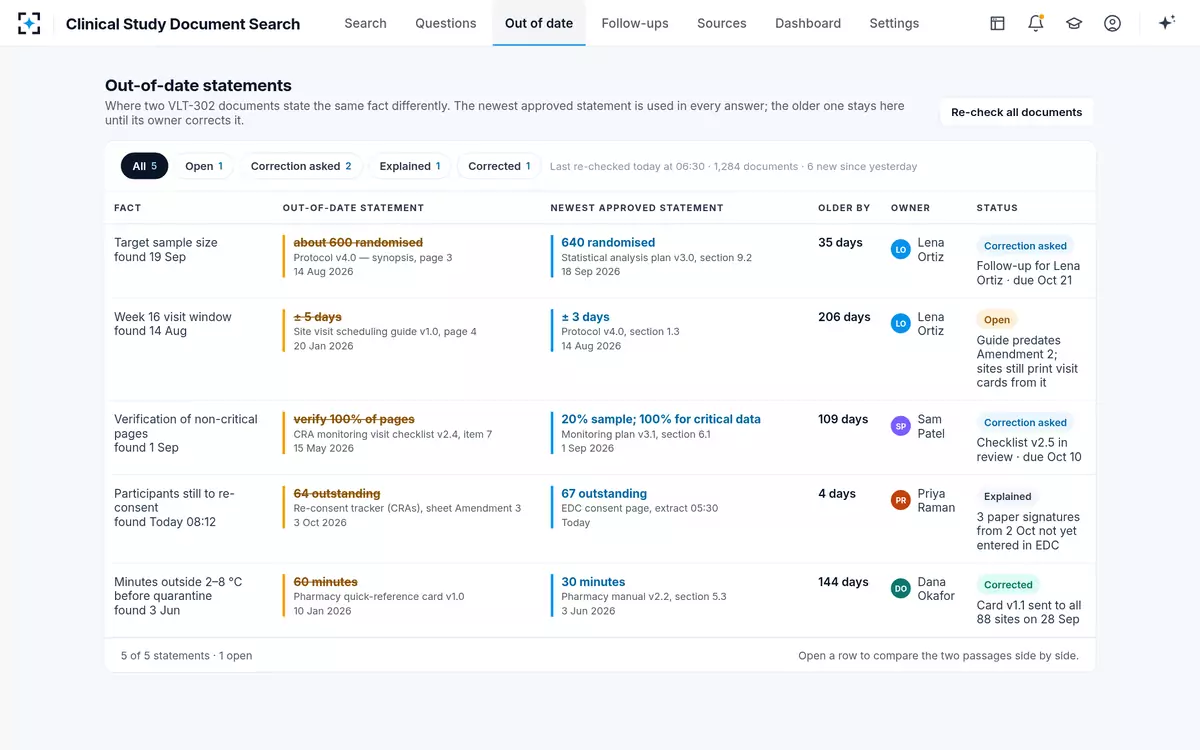
Take the question VLT-302 is built around: what is the target sample size? The protocol synopsis says about 600. The analysis plan version 2.0 says 600. The decision log records the steering committee raising it to 640 after a blinded review, and the analysis plan version 3.0 says 640, approved on 18 September, 35 days after the protocol. Answering correctly means finding all four, dating them, knowing the newest approved statement wins and noticing that the synopsis now needs correcting. Answering quickly means opening the protocol and sending 600. The way that number moved is the subject of blinded sample size re-estimation.
A study manager's week of study questions, by hand and with search
By hand, about three days
- Finding the current version · 25%
- Finding the passage and page · 17%
- Pulling CTMS, EDC and tracker numbers · 25%
- Checking documents that disagree · 17%
- Writing, citing, follow-ups · 16%
With search, about half a day
- Finding the current version · 10%
- Finding the passage and page · 10%
- Pulling CTMS, EDC and tracker numbers · 10%
- Checking documents that disagree · 20%
- Writing, citing, follow-ups · 50%
For a head of clinical operations the arithmetic that matters is not the salary line but the share of senior time spent on retrieval. If two of every three hours on study questions go on finding things, retrieval is the largest single cost of oversight, and it buys nothing an inspector can see. The row that falls hardest, finding the current version, is also the row that produces the errors.
The superseded statement: how amendments create oversight risk
Every amendment leaves older statements behind. The protocol changes, but the synopsis, the site guide, the pharmacy card, the checklist and the tracker keep their old wording until someone retires them, and nobody's job description says to look. A 2024 Tufts analysis of 950 protocols and 2,188 amendments found 91.1% of oncology and 72.1% of non-oncology protocols amended at least once (Tufts CSDD, 2024).
E6(R3) sets the standard the stale copy fails. Essential records "should be identifiable and version controlled (when appropriate) and should include authors, reviewers and approvers as appropriate, along with date and signature" (Appendix C.2.1). A sponsor can satisfy that for each document and still have two current documents that disagree, because version control works per file and the conflict sits between files. On the sample study a site visit guide still carried a visit window the protocol had narrowed 206 days earlier, a case followed in the visit window, and the site guide behind it.
“The sponsor should ensure appropriate and timely escalation and follow-up of issues to allow the implementation of appropriate actions in a timely manner.”
ICH E6(R3), section 3.9.6
The stale statement is found, if at all, by accident: as a deviation at a site, as a question nobody can answer consistently, or as an inspection finding. The only reliable control is a standing comparison across every current document, which is not a task a person can schedule. In the sample study it runs each morning at 06:30, after the TMF index and the data extracts arrive, and every value two documents state differently is listed with the older wording, the newest approved one, how much older it is, its owner and its status.
Every value two documents state differently, with its owner
Important deviations, and how a wrong answer becomes one
E6(R3) asks the sponsor to set "trial-specific criteria for classifying protocol deviations as important": those that may significantly affect data reliability or a participant's rights, safety or well-being (section 3.9.3). A surprising share of deviations start upstream of the site, in an answer given from the wrong document.
The mechanism is ordinary. A site asks whether a Week 16 visit three days late is in window; someone answers from a site guide carrying the old window; the site schedules accordingly; the monitor later finds the visit out of window under the current protocol. The deviation is real, its root cause is the sponsor's own documentation, and the corrective action (find and retire every stale copy) is the comparison the team did not have time to run. When the team answers from the newest approved statement with the page cited, that class of deviation stops originating at the sponsor.
Inspection evidence: answers that become essential records
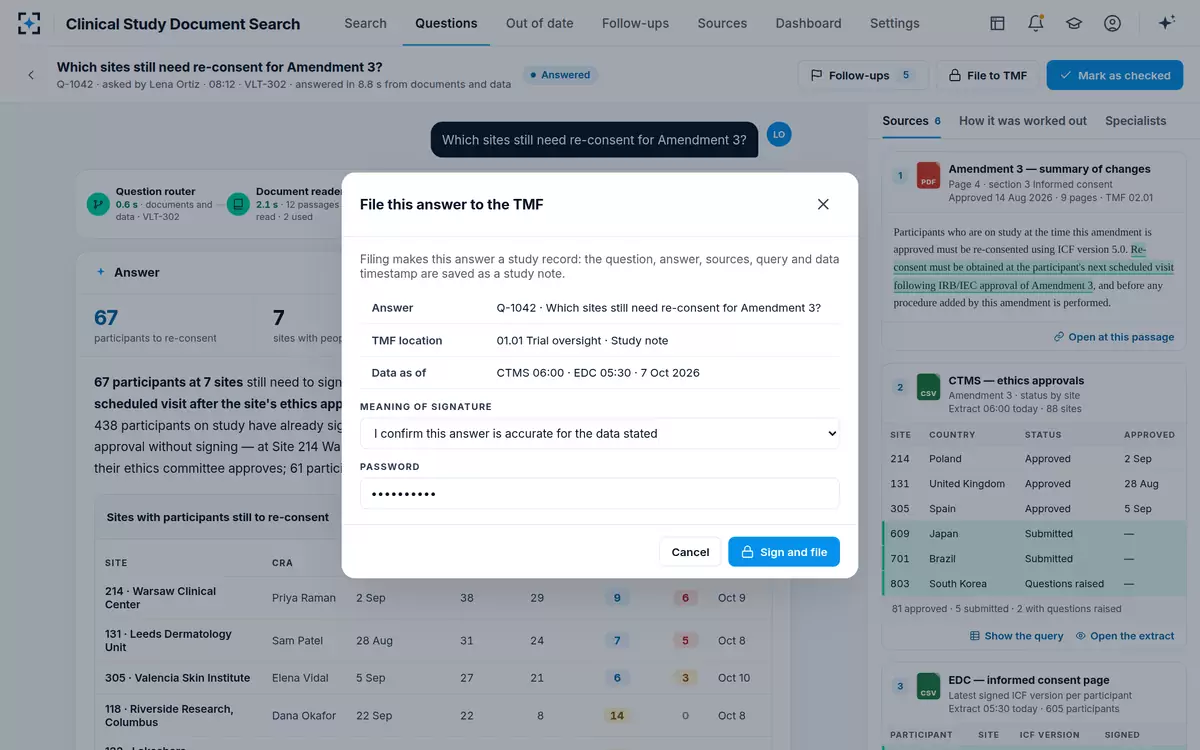
An answer that changes what a site does is part of the trial's conduct, and E6(R3) expects essential records to "remain complete, readable and readily available" and to be "directly accessible upon request by regulatory authorities, monitors and auditors", with any alteration "traceable" (Appendix C.2.6). An answer given in an email thread meets none of those tests unless someone files it.
What an inspector can ask a sponsor to show about one study question
- The question, who asked it and when.
Including which site or service provider it came from.
- The answer, and the documents and versions it rests on.
Section and page, and the data extract with its as-of time where numbers were used.
- Any current document that disagreed, and what was done.
Corrected, explained or escalated, with the owner and date.
- Who checked and signed the answer, with the meaning of the signature.
Where the answer was filed to the TMF, and its location there.
- Whether the answer led to a deviation assessment.
Against the trial’s own criteria for important deviations.
- The follow-up, and when it closed.
Section 3.9.6’s timely escalation and follow-up, shown rather than asserted.
An answer filed to the TMF with its signature and meaning
Measuring oversight: what a head of clinical operations should count
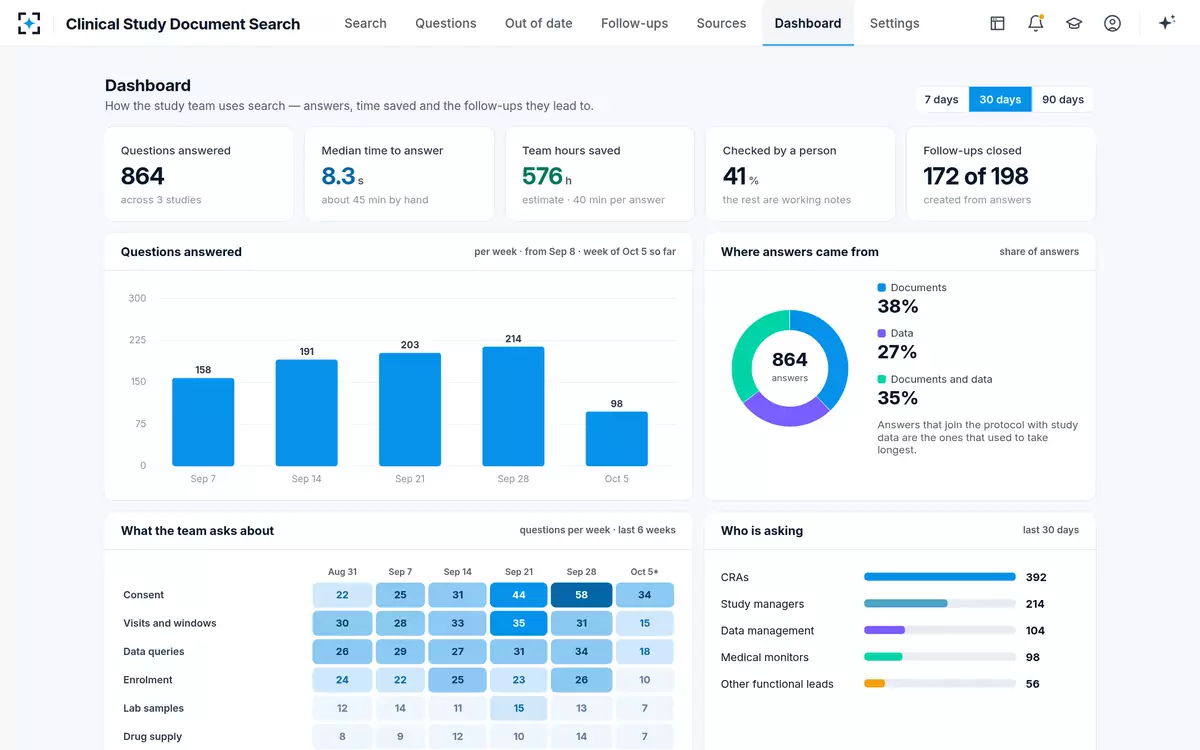
Five measures describe whether a study team's oversight is keeping up: questions asked per week and by whom, median time to a cited answer, the share of answers a person checked, open out-of-date statements by owner and age, and follow-ups closed against those raised. Each is a count from the team's own work, and together they show capacity, reliability and backlog.
On the sample dashboard, across three fictional studies, 864 questions were answered, 41% were checked by a person with the rest kept as working notes, and 172 of 198 follow-ups were closed. CRAs asked the most questions and study managers the second most. The median time to answer is a design target of 8.3 seconds against about 45 minutes by hand, and the 576 hours saved is an estimate at 40 minutes per answer, not a measurement. A figure like that sizes the problem; it does not promise a saving.
Questions, answer time and follow-ups across three sample studies
Where Clinical Study Document Search fits in sponsor oversight
Clinical Study Document Search sits on the study's documents, the TMF index, the trackers and daily CTMS and EDC extracts. A question in plain words is routed to the documents, the data or both; the answer comes from the newest approved statement with its date, document, version, section and page; any older statement that still says otherwise is flagged; numbers come with the read-only query and rows behind them. Answers to data questions are filtered to the asker's site access, and closed data monitoring committee reports are never read, so the blind is kept.
It does not decide whether a deviation is important, whether a participant stays evaluable, or whether an amendment is needed; those remain the study team's and the medical monitor's judgements. It does not replace the TMF, the CTMS or the EDC; it reads them. And it does not make oversight of a CRO unnecessary; it makes the sponsor's side of that oversight faster to exercise and easier to show. Where the line between what agents do and what people sign falls in clinical operations is set out in AI in clinical trial operations.
Questions people ask
Does outsourcing to a CRO transfer sponsor oversight responsibility?
No. ICH E6(R3) section 3.6.6 keeps ultimate responsibility for trial-related activities, including participant protection and data reliability, with the sponsor. Under 21 CFR 312.52 a sponsor can transfer specific IND obligations to a CRO in writing, and the CRO is then held to them, but the sponsor still needs oversight proportionate to the risk.
What is a sponsor oversight plan?
It is the sponsor's documented approach to overseeing investigators and service providers: what is monitored, how often, by whom, with which metrics and escalation routes. E6(R3) does not prescribe a template; it requires oversight that is "fit for purpose and tailored to the complexity of and risks associated with the trial", with quality assurance and quality control over delegated activities.
What changed in sponsor responsibilities in ICH E6(R3)?
The revision, finalised in January 2025, puts more weight on quality by design, risk-proportionate oversight and the quality of information, not only activities. Its sponsor-oversight section asks for trial-specific criteria for important protocol deviations and timely escalation and follow-up of issues, and its appendix on essential records expects them to be version controlled and directly accessible on request.
How many documents does a sponsor study team search?
A Phase 3 study commonly runs to more than a thousand documents in many versions once protocols, amendments, plans, manuals, site guides, logs and trackers are counted, plus daily data extracts. The difficulty is less the number than the versions: an amended protocol leaves superseded statements in documents that are still marked current.
How do you measure sponsor oversight in a clinical trial?
With counts the team already generates: questions by source, time to a cited answer, share checked by a person, open conflicting statements by owner and age, important deviations by root cause, and follow-ups closed on time. Quality tolerance limits under E6(R3) section 3.10 cover trial-level risks; these operational measures show whether oversight itself is keeping pace.
Who answers protocol questions from sites in a clinical trial?
Operational questions usually go to the monitor, medical questions to the medical monitor and data questions to data management. Questions that need two of those, a protocol rule and an EDC count for example, land on the study manager. That concentration is why answer quality and speed are an oversight issue, not only a workload one.