Re-consent in clinical trials is required when new information becomes available that could affect a participant's willingness to carry on — a new risk, a changed procedure, a longer duration, a safety finding. It is not triggered by the existence of an amendment, and an amendment can be approved without creating any obligation to re-sign. The legal test is one sentence long. The operational problem is that the obligation attaches to a list of real people, each with their own next scheduled visit and their own site's approval date, and producing that list means reconciling an EDC consent page, a site-approval log, a CRA's tracker and whatever is still on paper in a folder at the site. Clinical Study Document Search, Botminds' search across a study's own documents and this morning's blinded extracts, answers it as one number with its as-of time, its per-site breakdown, and an explanation of the sources that disagree.
The example throughout is the fictional sample study the solution ships with: VLT-302, a Phase 3 study of veltrimab in plaque psoriasis at 88 sites in 11 countries, where Amendment 3 requires re-consent at each participant's next scheduled visit after the site's ethics approval. The people, sites and sponsor are invented; the regulations are real and linked where they appear.
One amendment's consent obligation, on one Wednesday morning
438
participants on study at the 81 sites whose ethics committee has approved the new consent form
Seen in the solution, on its fictional sample study
371
of them have signed consent form v5.0
Seen in the solution, on its fictional sample study
67
still to sign — the remainder, as of the EDC extract taken at 05:30
Seen in the solution, on its fictional sample study
14
are overdue: they have had a visit since approval without signing, at three sites
Seen in the solution: six, five and three at three named sites
When is re-consent required in a clinical trial?
ICH E6(R3) states the obligation as a duty to inform, with a duty to document attached: "The participant or the participant's legally acceptable representative should be informed in a timely manner if new information becomes available that may be relevant to the participant's willingness to continue trial participation. The communication of this information and confirmation of the willingness to continue trial participation should be documented."
Note what that sentence does and does not say. It does not say "when the protocol is amended". It does not name a document at all. It puts the trigger on the information and the test on the participant's willingness, and it asks for two things to be on file afterwards: that the person was told, and that they confirmed they still wish to continue. Re-signing a form is the usual way of documenting the second, not the obligation itself.
The guideline then tells the study to make the judgement explicitly rather than by reflex: new information should be assessed to decide whether re-consent is needed, and, depending on the stage of the trial, the study should consider whether it is relevant only to new participants or to those already enrolled. That last clause is the part teams skip. A change that affects only people who have not yet joined does not create an obligation towards those who have.
From new information to a named list: the four questions, in order
1
Is there new information that could affect a participant’s willingness to continue?
Yes Go on to question 2. The trigger is the information, not the document that carried it — a safety finding, a changed procedure, a new risk, a changed duration.
No No re-consent. The materials may still need updating for people who have not yet joined.
2
Is it relevant only to new participants, or to people already on study?
Yes If it reaches people already on study, the obligation attaches to a named list of them, each with their own next visit.
No If it is relevant only to new participants, the revised materials are used for consent from here on and nobody re-signs.
3
Have the revised materials been approved at this site?
Yes The obligation starts at this site on the date of its own approval — not on the date the sponsor finalised the document.
No Nothing may be used. The older version stays in force at that site, and its participants wait.
4
When is each affected participant’s next scheduled visit?
The date That visit is the deadline for that person. The study’s obligation is therefore a list of names with individual dates, not a single milestone.
If none A participant with no visit scheduled still has to be reached; a plan that waits for visits will miss them.
The legal test, in the regulator's words
In the United States the obligation is written into the original consent itself. Among the elements every participant must be given is a promise about the future: under 21 CFR 50.25(b)(5), where appropriate, the consent includes a statement that significant new findings arising during the research which may bear on the subject's willingness to continue will be passed on to them.
Read it carefully and the structure of the duty becomes clear: the participant was promised, at the outset, that they would be told. Re-consent is the performance of a promise already made, which is why a study that quietly fails to re-consent has not merely missed a process step.
The documentation rule sits in the next section and is exacting about who signs and what they take away: consent is documented on a written form approved by the IRB, signed and dated by the subject or their legally authorized representative at the time of consent, and a copy is given to the person who signs. ICH E6(R3) says the same about updates during the trial: "During trial participation, the participant or the participant's legally acceptable representative should receive a copy of the consent form updates and any other updated informed consent materials provided." A signature captured on a screen at the site with nothing handed back does not satisfy either.
Approval before use: the sequence that cannot be reversed
Revised materials are approved before they are used, never after. ICH E6(R3): "Revised informed consent materials should receive the IRB/IEC's approval/favourable opinion in advance of use." The EMA guideline asks the systems themselves to enforce it: "Only versions approved by the ethics committee(s) should be enabled and used for the informed consent process and documentation. Release of electronic trial participant information and informed consent forms to the sites prior to IRB/IEC approval should be prevented."
For a multinational study that single rule produces much of the operational mess, because approval is a per-site event. In the sample study, 81 of 88 sites have approved the new form and 7 have not — five submissions pending and two committees with questions raised. The three sites with overdue participants were approved on 28 August, 2 September and 5 September, so their clocks started a week apart. A study-level statement such as "Amendment 3 was approved in September" is therefore not a fact anyone can act on; the actionable fact is the approval date of each site, and the sixty-one participants at the unapproved sites are not late, they are waiting.
What "at the next scheduled visit" actually means for a list of people
Many amendments that need re-consent say something like the sample study's: re-consent at the participant's next scheduled visit after the site's ethics approval, and before any procedure the amendment adds. That phrasing is sensible and humane — it avoids calling people in for a signature — and it converts one obligation into several hundred individual deadlines.
Which means "re-consent outstanding" is not one state. It is at least four, and a study that reports a single number without saying which states it includes will be asked to explain it later.
What “67 outstanding” actually contains
438 participants at the 81 sites with ethics approval
- Signed v5.0 · 84.7%
- Outstanding, next visit still ahead · 12.1%
- Overdue · 3.2%
The distinction matters because the three states call for different work. A participant whose next visit is in three weeks needs nothing but a correctly configured visit. An overdue participant needs a call today, and an explanation on file for the visit that already happened. A participant who declines needs a documented discussion and a decision about continuing in the trial at all. Reporting them as one figure of 67 hides the only part that is urgent, which is the 14.
Does every amendment need re-consent?
No, and treating re-consent as an automatic consequence of amending is both wasteful and a source of its own risk: participants asked to re-sign for changes that do not concern them have less reason to read the next document closely. The test is whether the new information could affect willingness to continue, assessed for people already on study. An amendment that changes a statistical analysis method, a monitoring approach or an administrative detail usually creates no obligation at all; a blinded change to the enrolment target is a clear example of one that does not.
The converse is the case teams prepare for less well. Re-consent can be required with no amendment in sight — a new safety finding from another study of the same compound, an updated investigator brochure, a regulator's communication. The trigger is the information; the amendment is just the most common vehicle for it. What makes an amendment substantial is a separate test entirely, and the two are often confused in the same meeting.
Counting the outstanding: four sources, one number
Building the list means putting four sources together, and none of them can do the job alone. The EDC consent page gives the version each participant has signed and when. The study management system gives the ethics approval date for each site, which decides when the obligation started there, and the list of who is on study. The CRA's own tracker usually carries whatever the site has told her this week. And the site's paper folder holds signatures that exist but that no system has yet.
The count as an answer, with its as-of time, in Clinical Study Document Search
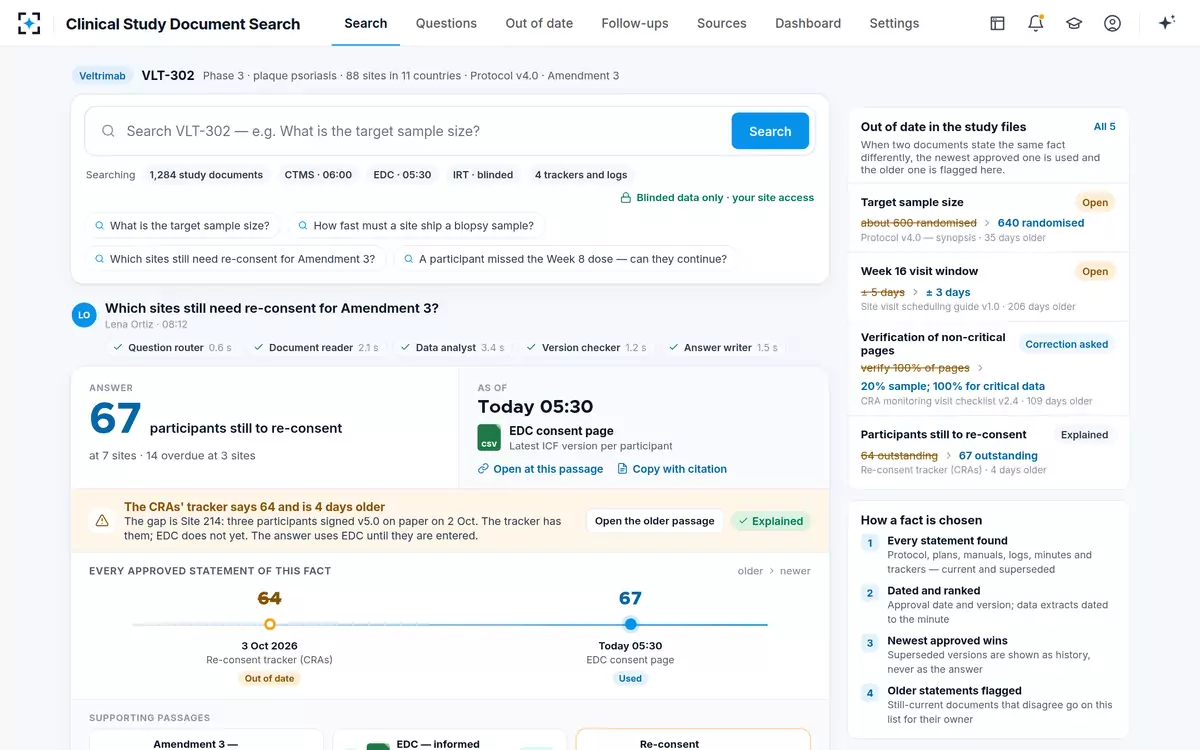
The full answer breaks the figure down site by site, because that is the level at which anyone can act on it. At the three sites with overdue participants the pattern is ordinary: a site approved on 2 September with 38 participants on study, 29 of whom have signed and six overdue; a site approved on 28 August with 31 on study, 24 signed and five overdue; a site approved on 5 September with 27 on study, 21 signed and three overdue. A fourth site, approved only on 22 September, has 14 participants still to sign and none overdue — its next visit falls the following day. That site looks worst on a raw count and is in fact fine.
Re-consent, site by site, with every source beside it
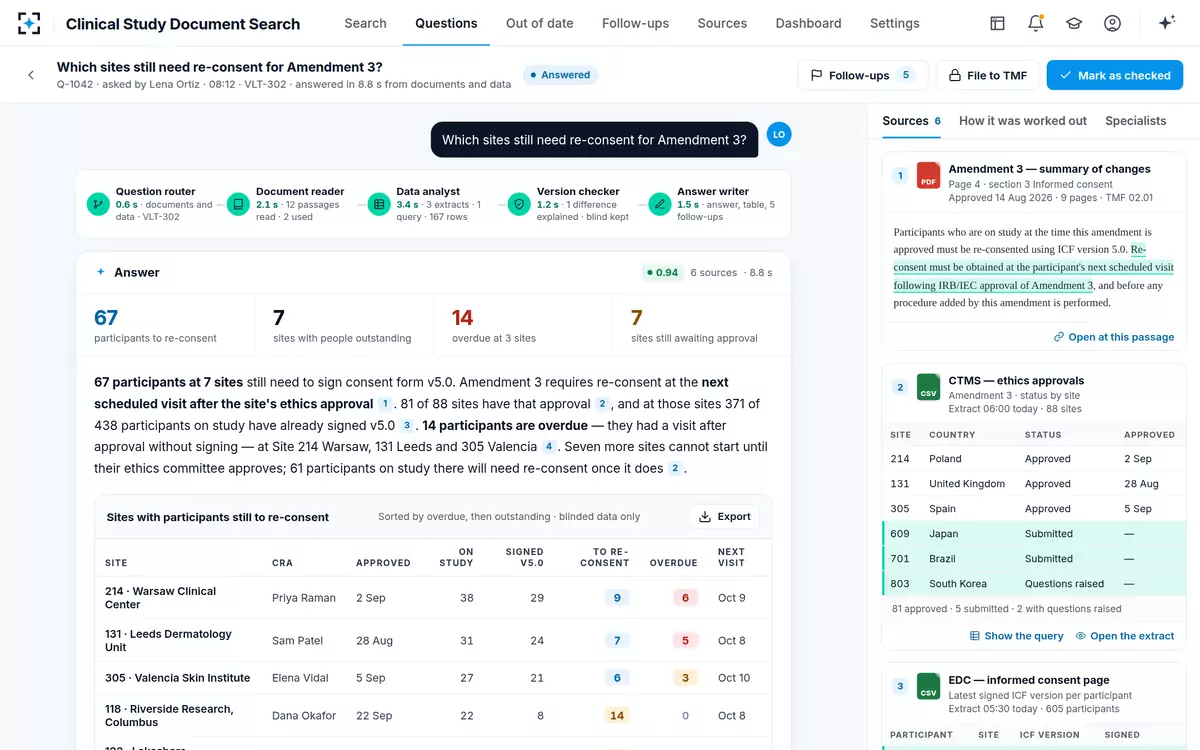
The same answer depends on knowing which system answers which part of the question — the rule from the amendment, the approval dates from one system, the signatures from another. Which system holds which answer sets that division out in full.
The gap that is not an error: paper signatures not yet entered
On the morning shown, the CRAs' tracker said 64 and the EDC said 67. Both were right. Three participants at one site signed the new form on paper on 2 October; the CRA added them to her sheet the next day, and the site had not yet entered them in the EDC. The tracker was ahead about those three people and, as a sheet dated 3 October, four days behind as a snapshot.
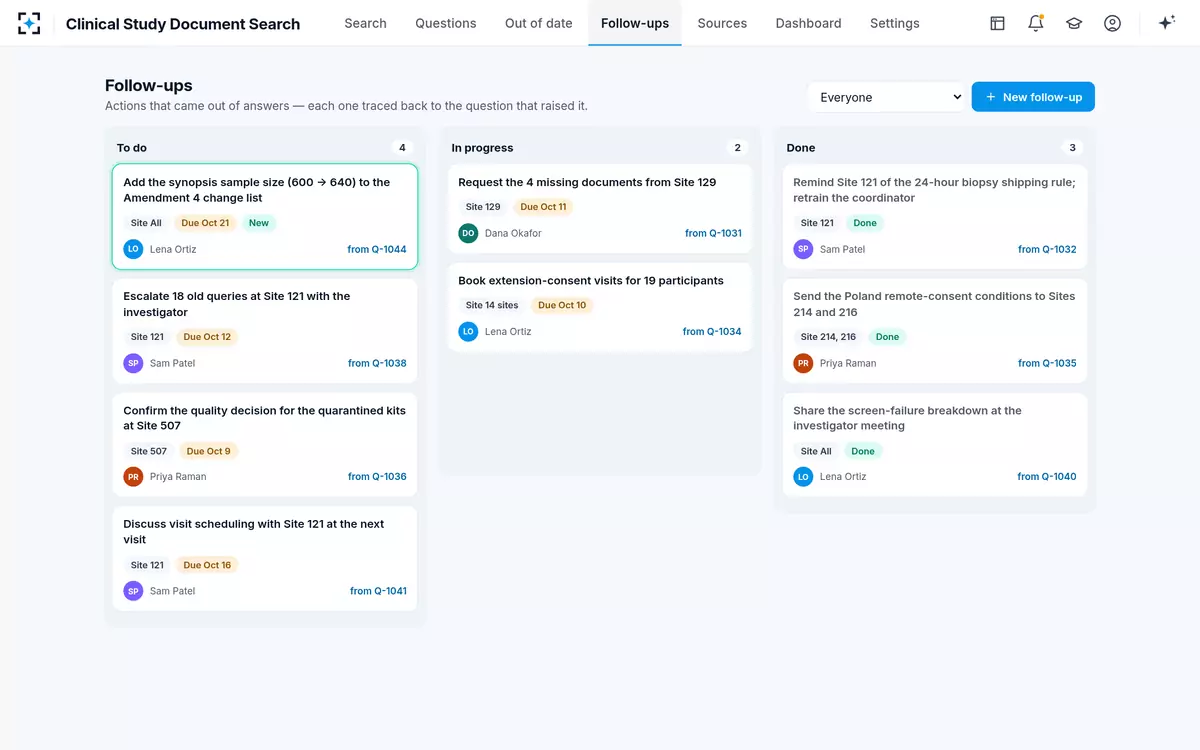
What a study does with that gap is a small test of its honesty. The tempting move is to report the lower number, because it looks better and is, on this occasion, closer to the truth on the ground. The defensible move is to report the documented figure, show the other one beside it with its date, and state the reason — then raise the action that closes it. In the sample study the gap becomes a follow-up for the CRA who owns that site: enter the three paper signatures from 2 October in the EDC, due 8 October, traced back to the question that found it.
The gap becomes somebody's task, with a date
A note on remote and electronic consent, which is where many of these gaps now live. Where a study allows participants to re-consent remotely, the conditions are usually country-specific and site-specific, and they are themselves written in a document that can go out of date. The sample study carries one such set of conditions for Poland, sent to two sites. The discipline is the same as for the form itself: approval before use, per site.
What a defensible re-consent record contains
Everything in the consent process is an essential record. The EMA guideline is explicit about the scope of that: "All documents of the informed consent procedure (including all accompanying information and all linked information) are considered to be essential documents and should be archived as such." "All linked information" is doing a lot of work there — it covers the participant information sheet, any accompanying leaflets, and the approved version history behind them.
Seven checks before you report a re-consent number
- Which version you are counting against
A count of "signed the latest form" is meaningless unless the latest form is named, with its date.
- Which sites are in scope today
Only sites whose own committee has approved the revised materials. Participants elsewhere are waiting, not late.
- Whose approval, and when
The approval date of each site, because it starts that site’s clock. A study-level date starts nothing.
- What is still on paper
Wet-ink signatures sitting in a folder are facts the EDC does not have. Name the known gap instead of letting it appear as a discrepancy.
- Which extract, taken at what time
A consent count is a snapshot. Quote the source and the moment, not "as of today".
- Who is overdue, separately from who is outstanding
A visit that happened after approval without a signature is a different problem, and usually a deviation.
- Who declined, and what was done
A decline is a decision about continuing in the trial, and it needs a documented discussion, not a row on a chasing list.
Behind each of those sits the same principle: a consent number should be reconstructable by someone else from the sources it names. Where it cannot be — where two sources disagree and nothing explains why — the honest output is not a number but a question for a person. In the sample study, an answer below 0.90 confidence, or one where sources disagree without an explanation, is held for the study manager's check rather than published.
When late re-consent becomes a deviation, and what to do about it
A participant who attends a visit after their site's approval, and takes part without having signed the revised form, has had a visit conducted outside the protocol as amended. That is a protocol deviation, and the obligation is unambiguous: "The investigator should document all protocol deviations." Whether it is an important one is a judgement against criteria the sponsor has to set for the trial in advance, and the factors that usually decide it are whether a procedure added by the amendment was performed before the signature, and whether the information withheld bore on safety.
The practical sequence after finding one is short. Document it as it is, including the date of the visit and the date of the eventual signature. Re-consent at the earliest opportunity rather than waiting for the next scheduled visit. Assess whether anything was done to the participant that the amendment introduced. And look for the cluster: fourteen overdue participants at three sites out of eighty-one is not fourteen individual oversights, it is a signal about three sites' visit scheduling or about how the amendment was communicated to them. The same clustering logic applies to windows and other protocol provisions, which a case study of one visit window follows to its source.
To see the count, its sources and the correction it raises in one place, start from Clinical Study Document Search.
Questions people ask
What is the difference between re-consent and a consent form update?
A consent form update is a change to the document; re-consent is a conversation with an enrolled participant, recorded. Updating the form is necessary whenever the information given to new participants changes, and it happens whether or not anyone already on study is affected. Re-consent happens only where the new information could bear on an existing participant's willingness to continue, and it produces two records: that the person was told, and that they confirmed they wish to carry on.
What happens if a participant refuses to re-consent?
They may withdraw from the trial, or in some cases continue under a reduced set of procedures if the protocol allows it, but they cannot continue under the amended protocol without consenting to it. The refusal itself is a decision to be documented with the discussion behind it, and the study then has to settle what happens to the data already collected, which the original consent usually addresses. Counting a refusal as an outstanding task to chase is the common mistake: it is a closed decision, not a gap.
Who can take re-consent at a site?
Whoever the investigator has delegated the consent task to on the site's delegation log, with the training and qualification the protocol requires, and able to answer the participant's questions about the change. ICH E6(R3) expects the form to be signed and dated by the participant and by the investigator or delegated site staff who conducted the consent discussion. Delegation is site-specific and dated, which is why a re-consent taken by someone not on the log at that date is itself a finding.
Does a participant get a copy of the updated consent form?
Yes. The US regulation requires that a copy be given to the person signing the form, and ICH E6(R3) says participants should receive a copy of consent form updates and any other updated informed consent materials provided during the trial. In a remote or electronic consent process this is easy to overlook, because nothing physical changes hands; the study should be able to show how and when the copy was delivered.
Does the ethics committee have to approve the new consent form first?
Yes, and approval is per site rather than per study. ICH E6(R3) asks for approval in advance of use, and the EMA guideline goes further for electronic systems: release of participant information and consent forms to sites before approval should be prevented outright. In practice this means the obligation to re-consent begins on different dates at different sites, and a site still awaiting its approval has no overdue participants, only waiting ones.
How do you track who still needs to re-consent?
By reconciling four things: the version each participant has signed, from the consent page in the EDC; the approval date of each site, from the study management system; whatever the site has told the CRA since; and the signatures still on paper. Where it is rebuilt by hand in a spreadsheet each week, the number is a few days old by the time it is read and rarely reconciles. The alternative is to produce it as an answer that names its sources and the time each was taken, and to show the gaps rather than smooth them.