Blinded sample size re-estimation is an interim look at a trial's accumulating data, taken with treatment assignment still hidden, that re-estimates an assumption the original sample size rested on — the variance of the outcome, the event rate, the share of participants who discontinue — and recalculates how many participants the trial now needs to keep its planned power. It never looks at the treatment effect, which is why the blind survives it and why it costs the trial almost nothing in statistical terms. What it does cost is documentation. The target sample size is not written down once: it sits in the protocol synopsis, in the protocol body, in the statistical analysis plan, in the decision log, in enrolment trackers and in site-level recruitment targets, and a revision reaches some of them months before the others. Clinical Study Document Search, Botminds' search over a study's own documents and data, is built for that interval: it finds every approved statement of a fact, uses the newest and dates it, and flags the still-current documents that disagree.
The worked example is the fictional sample study the solution ships with: VLT-302, a Phase 3 study of veltrimab in plaque psoriasis at 88 sites in 11 countries, with invented people and an invented sponsor. The statistical guidance quoted throughout is real and linked where it appears.
One target that moved, in a sample study
640
participants to randomise after the change, against 600 before it — 3:1, so 480 on veltrimab and 160 on placebo
Seen in the solution, on its fictional sample study
11.8%
pooled discontinuation found by the blinded review, against the 8% the design assumed
The sample study: 57 of 483 randomised by 31 August
35days
between the approved protocol and the analysis plan that contradicts its synopsis
Seen in the solution, on its fictional sample study
4
approved statements of the same target found in the study’s own files, three of them in documents still current
Seen in the solution, on its fictional sample study
What is blinded sample size re-estimation?
It is the adaptation that asks "were our assumptions right?" rather than "is the drug working?". A sample size is calculated before anyone is enrolled, from four inputs, and three of them are decisions. The fourth is a guess about the population, and a trial can check that guess as it goes without learning anything about the comparison it exists to make.
ICH E9 names the situation plainly in its section on sample size: "When event rates are lower than anticipated or variability is larger than expected, methods for sample size re-estimation are available without unblinding data or making treatment comparisons (see Section 4.4)." The FDA's final guidance on adaptive designs, issued in November 2019, describes it as the commonest of the designs that adapt on pooled, non-comparative data: "The most widely used category of adaptive design based on pooled outcome data involves sample size adaptations (sometimes called blinded sample size re-estimation)."
What a sample size is made of, and the one term a blinded look may re-estimate
Significance level
α — the false-positive rate the trial will accept, commonly 0.05 two-sided
A decision, fixed in the protocol before enrolment. Never re-estimated from accumulating data.
Set at design
Power
1 − β — the chance of detecting the effect if it is real, commonly 0.80 or 0.90
Also a decision. A re-estimation exists to protect this number, not to change it.
Set at design
The effect to be detected
the treatment difference the trial is designed to find
A decision about what would matter clinically. Reading it from the data as it accumulates is a different, unblinded kind of adaptation with different consequences.
Set at design
The nuisance parameter
the outcome’s variance, the event rate, or the discontinuation that shrinks the analysed group
Not a hypothesis but an assumption about the population, and estimable from all participants pooled together, with no treatment arm attached.
The only term a blinded look may re-estimate
Why the blind survives it: pooled data and nuisance parameters
"Pooled" means every randomised participant counted together, with no arm label attached to anyone. A pooled variance, a pooled event rate and a pooled dropout rate are properties of the trial population under whatever mix of treatments it received. They are exactly the quantities that entered the sample size calculation as assumptions, and none of them is the comparison the trial is testing.
The FDA guidance states the mechanism and the purpose in one sentence: "By using accumulating information about nuisance parameters, sample sizes can be adjusted according to prespecified algorithms to ensure the desired power is maintained." The word doing the work is "prespecified". A pooled figure plus a rule written in advance produces a new number without a judgement being made at the moment of the look, which is what keeps the people who make the judgement away from the data.
Blindness is not automatic, though, and ICH E9 says as much by demanding an account of it: "The steps taken to preserve blindness and the consequences, if any, for the type I error and the width of confidence intervals should be explained." Our reading of that sentence is operational rather than statistical: a trial has to be able to say who saw what, under which access, and why nothing in what they saw implied a treatment comparison. That is a question about systems and permissions as much as about statistics.
What it does to the type I error rate, and the one case where it does not
For most trials, nothing measurable. The FDA guidance is unusually direct, and it names the exception in the same breath: "These adaptations generally do not inflate the Type I error probability. However, there is the potential for limited Type I error probability inflation in trials incorporating hypothesis tests of non-inferiority or equivalence (Friede and Kieser 2003). Sponsors should evaluate the extent of inflation in these scenarios."
Two practical consequences follow. In a superiority trial, a blinded re-estimation is close to free and a statistician does not need to spend alpha on it. In a non-inferiority or equivalence trial it is not free, and the guidance asks the sponsor to measure the inflation rather than assert that there is none — which means a simulation, documented, before the look rather than after it.
Why prespecification is the whole game
An adaptation decided in advance and executed mechanically is a design feature. The same adaptation decided after seeing the data is a judgement, and nobody can later prove it was not influenced by the comparison. The FDA guidance sets out what "in advance" has to cover: "Prospective planning should include prespecification of the anticipated number and timing of interim analyses, the type of adaptation, the statistical inferential methods to be used, and the specific algorithm governing the adaptation decision."
ICH E9 asks the protocol to carry the arithmetic that the look will revisit: "The method by which the sample size is calculated should be given in the protocol, together with the estimates of any quantities used in the calculations (such as variances, mean values, response rates, event rates, difference to be detected)." This is the sentence that creates the documentation problem this page is really about. The protocol is required to state the assumed values. A blinded re-estimation exists to replace one of them. So the protocol is correct when it is approved and becomes an out-of-date statement of its own study by design — not through anybody's error.
Does changing the sample size need a protocol amendment?
Yes, in the sense that matters: the revised number has to be justified and written down in both the amendment and the final study report. ICH E9's sentence on this is the one to quote in a meeting.
"An interim check conducted on the blinded data may reveal that overall response variances, event rates or survival experience are not as anticipated. A revised sample size may then be calculated using suitably modified assumptions, and should be justified and documented in a protocol amendment and in the clinical study report."
ICH E9, Statistical Principles for Clinical Trials, section 4.4, Sample Size Adjustment
Whether that amendment is a substantial one is a separate question, answered by the effect tests each regulator applies. The UK's current guidance lists a significant change in the absolute number of trial participants as an example of a substantial modification, and 21 CFR 312.30 names any significant increase in the number of subjects under study among the changes that need a protocol amendment. What makes an amendment substantial, and what it drags along with it sets out those tests and the submission consequences. The point for a statistician is narrower: the recalculation is not finished when the number is agreed. It is finished when the number is in the document that governs the trial and the documents that restate it have been dealt with.
One number, from the blinded review to the signed answer
Here is the whole sequence on the sample study, with the part a person does and the part a system does kept apart. The review on 11 September counted discontinuations across all randomised participants together — 57 of 483 by 31 August, 11.8% against the 8% the design assumed. On 16 September the steering committee recorded decision D-024 raising the target to 640 and noting that the synopsis and section 9.2 would be updated in Amendment 4. Statistical analysis plan v3.0, approved 18 September, carries the new figure: 640 participants randomised 3:1 to veltrimab 300 mg or placebo, keeping at least 90% power for the key secondary endpoint, PASI 100 at Week 16, allowing for 12% early discontinuation.
From the blinded review to a cited answer, and who does each step
A person decides
Prespecify, before anyone is enrolledThe timing of the look, the quantity to be re-estimated, the algorithm that converts it into a new number, and the ceiling on how far the target may move.
A person decides
Take the blinded lookCount the nuisance parameter over all randomised participants pooled: in the sample study, 57 discontinuations of 483 randomised by 31 August, 11.8% against the 8% assumed.
Never: attach a treatment arm to anybody, or look at the comparison
A person decides
Recalculate, decide, approveRun the prespecified algorithm, take it to the steering committee — decision D-024 on 16 September — and approve the plan that carries the new figure, analysis plan v3.0 on 18 September.
Agent
Find every statement, and date itThe document reader returns each statement of the target with its document, version, page and section; the version checker dates them, uses the newest approved one and flags any current document that disagrees.
Never: answer from a superseded version, hide a disagreement, or edit a source document
A person decides
Check, correct, fileThe study manager turns the flagged synopsis into a correction for the Amendment 4 change list and signs the answer when it is filed as a study note.
The specialists at work on one question in Clinical Study Document Search
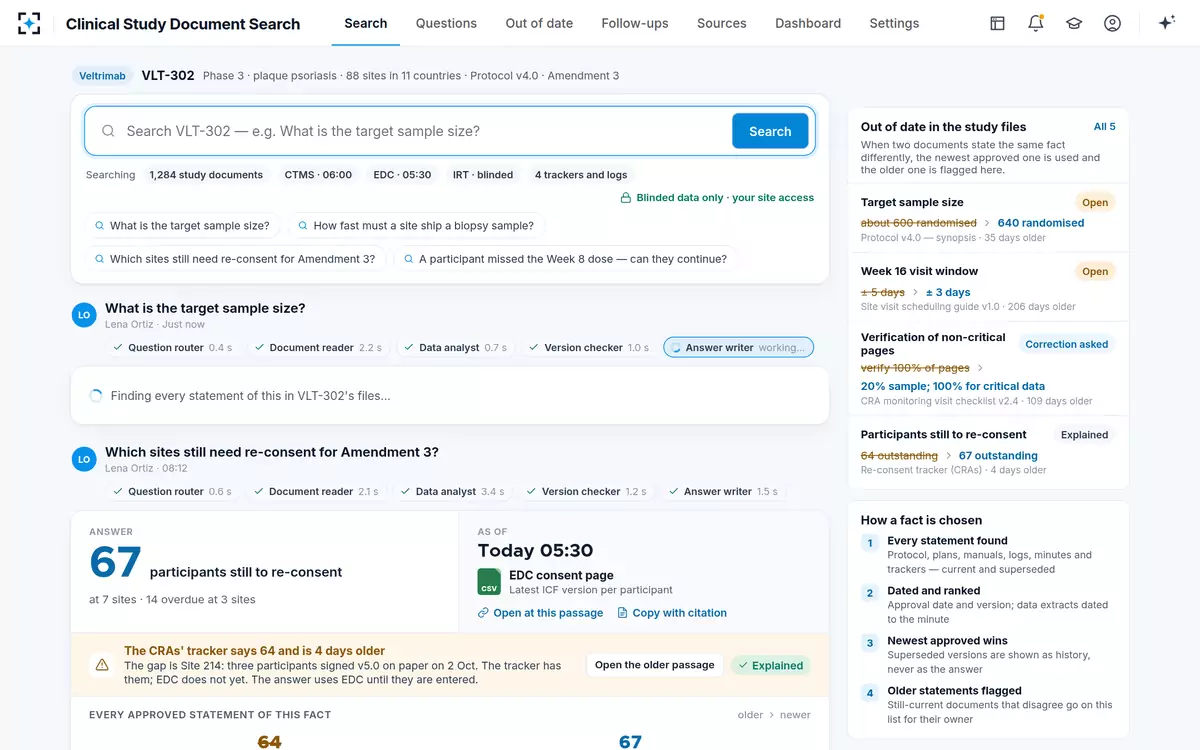
One thing the solution deliberately does not do is read the allocation. The blinded randomisation and supply extract gives kit counts, shipments, excursions and randomisation totals; the arm a participant is on is not among them. A search that could answer "how many discontinuations in each arm" would be a far more useful statistical tool and an unacceptable one in a running double-blind trial.
Everywhere the target sample size is written down
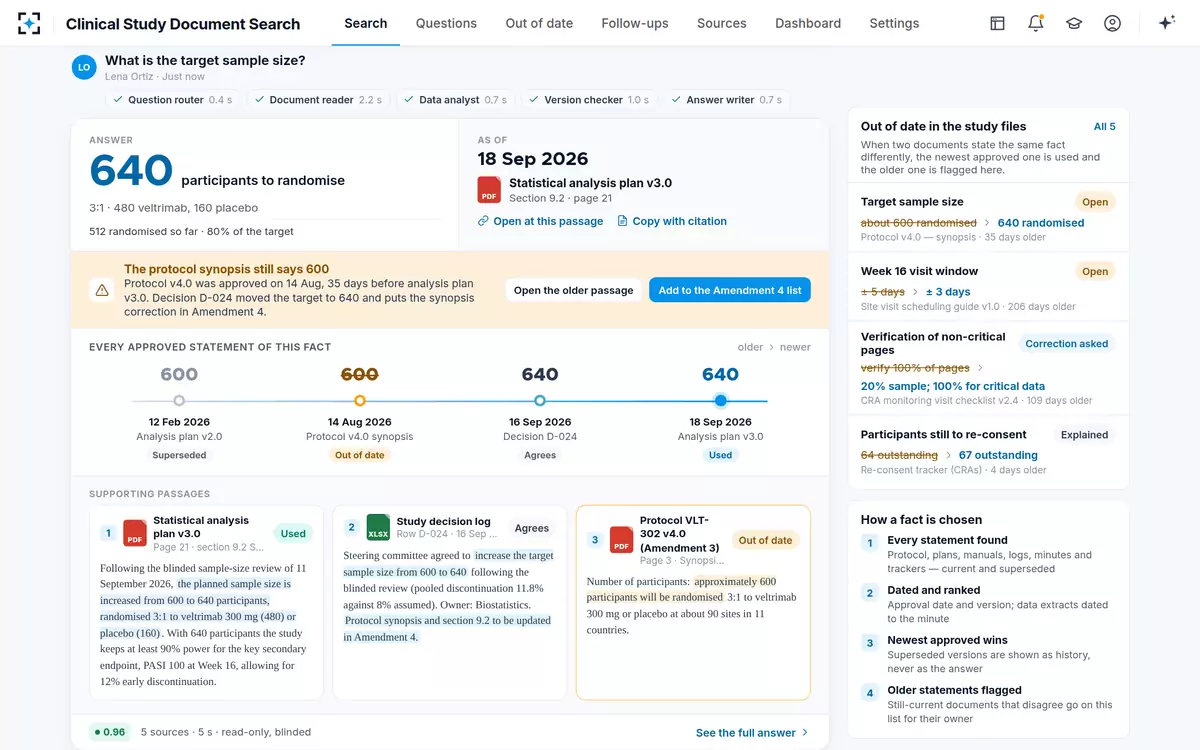
Ask a study team where the target sample size lives and the usual answer is "the protocol". Ask the study's files and you get four statements with four dates, three of them in documents that are still current — and they do not all agree.
The life of one number in a sample study's files
| Approved | States | Document | Where | Standing |
|---|---|---|---|---|
| 12 Feb 2026 | 600 | DocumentStatistical analysis plan v2.0 | WhereSection 9.2 | StandingSuperseded |
| 14 Aug 2026 | about 600 | DocumentProtocol v4.0, approved with Amendment 3 | WhereSynopsis, page 3 | StandingCurrent, and now wrong |
| 16 Sep 2026 | 640 | DocumentStudy decision log, row D-024 | WhereSteering committee | StandingAgrees |
| 18 Sep 2026 | 640 | DocumentStatistical analysis plan v3.0 | WhereSection 9.2, page 21 | StandingUsed in every answer |
That list is not the whole population of places the number appears, only the places it appears as an approved statement. Beyond them sit the enrolment tracker a study manager updates weekly, the per-site recruitment targets in the start-up documents, the slides shown at the last investigator meeting, and the public registry entry. None of those is a governing document; all of them are read by somebody who will then quote the number.
The answer: 640, as of 18 September, with the document, version and section it came from
The check nobody owns: which document still says the old number
Consider who, on a real study, is responsible for noticing that the protocol synopsis now contradicts the analysis plan. The statistician wrote the new plan and has moved on. The medical writer will fix the synopsis when Amendment 4 is drafted, which may be weeks away. The study manager answers the questions and does not re-read the protocol each time. The monitor checks sites against the protocol, not the protocol against the plans. The answer is that nobody owns it, which is why the gap is usually found by accident — in a slide review, in a deviation, or during an inspection.
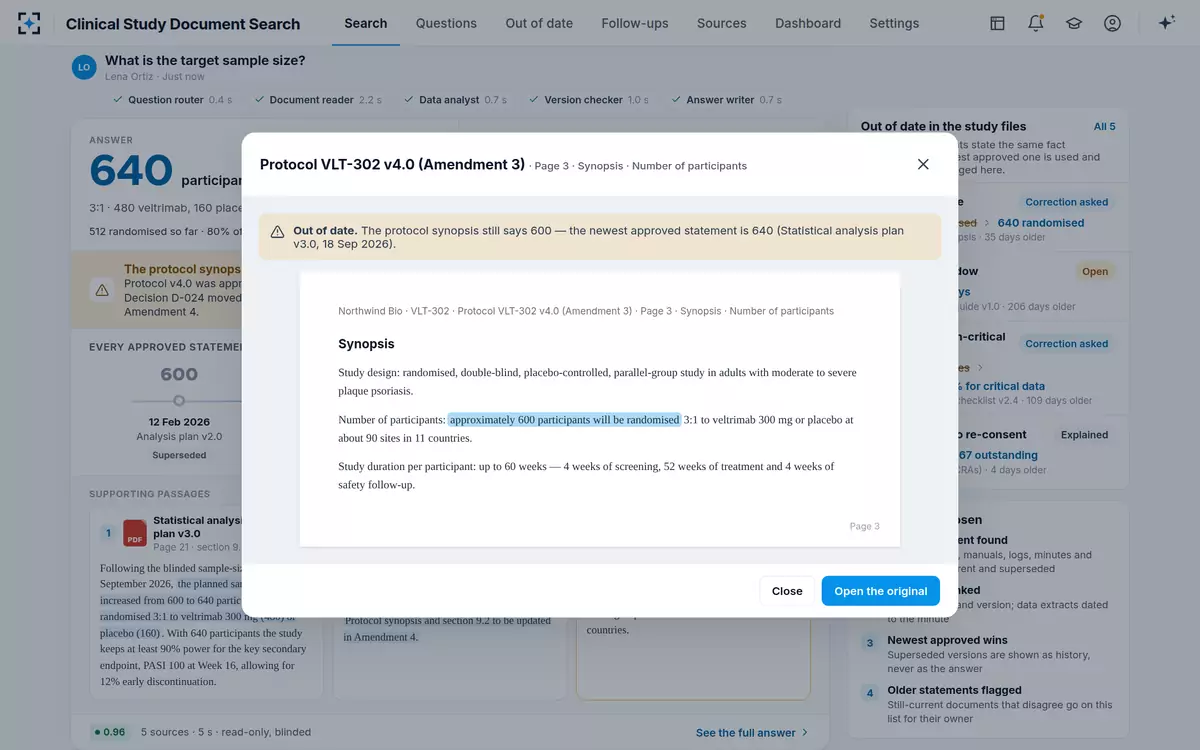
In the sample study the gap is 35 days old and entirely visible: protocol v4.0, page 3, synopsis, "approximately 600 participants will be randomised". It is not wrong in the sense of careless. It was true on 14 August. It is simply no longer the statement in force, and nothing about the document says so.
The out-of-date statement, opened where it is written
The same pattern recurs wherever a number is restated in an operational document, and the ages can be much larger than 35 days: a visit window that a scheduling guide states 206 days behind the protocol follows one to the deviations it caused.
What a defensible record of the change looks like
Put the statistics to one side and ask what an inspector, a reviewer or a new statistician joining in year two would need to reconstruct the change. The list is short, and most of it is produced anyway; what is usually missing is the last item.
Seven things to have on file after a blinded re-estimation
- The prespecification, with its date
The protocol or analysis plan text that set the timing, the quantity, the algorithm and any ceiling — approved before the look.
- What was looked at, and by whom
The pooled quantity, the cut-off date, the participants included, and the named people with access to the output.
- The evidence that no comparison was made
The guidance asks for the steps taken to preserve blindness to be explained; write them down at the time, not at the report stage.
- The recalculation itself
Inputs, method and result, with the assumptions that changed and the ones that did not.
- The decision, its owner and its reason
Who agreed the new number, on what date, and what they were shown. In the sample study this is one row of the study decision log.
- The amendment and the study report text
ICH E9 asks for the revised number to be justified and documented in both. The amendment is the one most often delayed.
- The list of every other document that states the old number
With an owner and a date for each. This is the item most often missing, and the one that turns into a deviation or a finding.
The first six are a statistician's job and the familiar part. The seventh is a document problem wearing statistical clothes, and it is the reason a study benefits from being able to ask its own files a question rather than remembering to. Every approved statement of the target in the sample study is dated and ranked automatically each morning, and the one that disagrees arrives on a list with the person who owns it. To see it run, start from Clinical Study Document Search; to follow the same mechanism on a consent obligation instead of a number, see how re-consent is counted across four sources.
Questions people ask
Can you change the sample size of a clinical trial after it starts?
Yes, and doing so is ordinary rather than exceptional, provided the change is justified and documented. ICH E9 contemplates a revised sample size calculated from a blinded interim check using suitably modified assumptions, documented in a protocol amendment and in the clinical study report. What changes the statistical position is not the timing but the information used: a change driven by pooled nuisance parameters is treated very differently from one driven by the observed treatment difference.
Does sample size re-estimation break the blind?
A blinded re-estimation does not, because it reads data with no treatment arm attached and makes no treatment comparison. It is not automatically safe, though: ICH E9 asks that the steps taken to preserve blindness be explained, which in practice means recording who had access to the interim output and under what permissions. An unblinded re-estimation, which uses the observed effect, is a different design altogether and carries statistical consequences a blinded one does not.
What is a nuisance parameter in a sample size calculation?
It is a quantity the calculation needs but the trial is not testing: the variance of a continuous outcome, the event rate of a binary or time-to-event outcome, or the discontinuation rate that reduces the number of participants actually analysed. Getting it wrong costs power rather than validity, which is why it can be corrected mid-trial. In the fictional sample study the parameter that moved was discontinuation, assumed at 8% and running at 11.8%.
Who decides to increase the enrolment target?
The sponsor decides, usually on a recommendation from biostatistics, through whatever body the protocol names — a steering or executive committee for the trial. Where the look involves comparative data the recommendation comes from an independent data monitoring committee instead, precisely so that the people running the trial never see the comparison. In the sample study it is a steering committee decision, recorded as one dated row in the study decision log with biostatistics named as the owner.
What has to be prespecified before an interim look?
The FDA's adaptive design guidance asks for the number and timing of interim analyses, the type of adaptation, the statistical inferential methods and the specific algorithm governing the adaptation decision. In other words, enough that the new sample size could be computed by someone else from the same pooled figure. Anything left to judgement at the moment of the look is a judgement made with data in the room.
What happens to the protocol synopsis when the sample size changes?
Usually nothing, for a while. The synopsis is part of the protocol, so correcting it means amending the protocol, and teams reasonably bundle that correction into the next planned amendment. The result is an interval — 35 days and counting in the fictional sample study — in which the protocol's own summary states a number the study has stopped using. The practical defence is to know the interval exists, list the documents affected, and make sure every answer given during it cites the plan rather than the synopsis.