A document management system for clinical trials is the system of record for a study's controlled documents: it holds each one, keeps its version history, records who approved it and when, controls who may open it, keeps an audit trail of every change, and makes sure the copy a person opens is the current approved one. That is a real job and a hard one, and the regulators ask for exactly it. What it does not do — what a filing system is not built to do — is notice that two current documents now state the same fact differently. The filing is correct and the study is wrong. Clinical Study Document Search is Botminds' search over a study's own documents and data, and it is built for that second problem; it reads what a trial master file already holds and does not file, archive or control anything.
Say that plainly before anything else on this page, because it is a buying decision and the boundary matters: this is not a document management system and it does not replace one. The worked example is sample data — VLT-302, an invented Phase 3 study of veltrimab in plaque psoriasis, with invented sites and invented people — and the regulatory expectations are attributed to the guidance that states them.
One Phase 3 study's document set, as the sample study holds it
1,284documents
indexed and read in place — protocol, plans, manuals, minutes, the trial master file
142
superseded versions kept, and quoted only when a question asks to compare
9extracts
daily read-only data feeds beside the documents, each with its own as-of time
5
facts two current documents state differently, on the morning in the example
What a document management system for clinical trials is for
Its job is identity. For any document a study runs on, a filing system answers four questions without argument: which file is this, which version is current, who approved it and when, and what has happened to it since. Everything else a vendor demonstrates — workflow, templates, dashboards, placeholders against a reference model — is a convenience built on top of those four answers.
The repository the rules care about has a name. ICH E6(R3), the Good Clinical Practice guideline adopted in January 2025, says essential records are kept in, or referred to from, repositories held by the sponsor and by the investigator or institution, and that those repositories may be called a trial master file (TMF). Note the second half of that sentence: records may be referred to from the repository rather than held in it. A trial master file is a defined set of records with a defined location, not necessarily one piece of software, which is why "do we have a document management system?" and "do we have a trial master file?" are different questions and a sponsor can answer yes to one and no to the other.
What the rules actually require of it
The requirements are unglamorous and short. Taken together, the GCP guideline, the European Medicines Agency's guideline on computerised systems and electronic data in clinical trials, and the United States regulation on electronic records and signatures ask a filing system to do a small number of specific things.
The jobs a regulated document system must do, and the rule that asks for each
| The job | What the rule asks | What it does not cover |
|---|---|---|
| Keep records retrievable for as long as they must be kept | Records protected so they can be retrieved accurately and readily for as long as they must be kept — 21 CFR 11.10(c) | Whether what is retrieved is still true. |
| Produce copies an inspector can read | Accurate and complete copies, human-readable and electronic, that the agency can inspect, review and copy — 21 CFR 11.10(b) | Whether two such copies agree with each other. |
| Limit who may open what | Access limited to authorised individuals — 21 CFR 11.10(d) | Whether the person with access opened the current version. |
| Keep an audit trail that cannot be overwritten | Secure, computer-generated, time-stamped audit trails, in which a change never obscures what was recorded before — 21 CFR 11.10(e) | Changes made in a different system to the same fact. |
| Make the audit trail usable | "FDA recommends that the audit trail be retained in a format that is searchable and sortable." — FDA, Electronic Systems, Electronic Records, and Electronic Signatures in Clinical Investigations, Q12, October 2024 | Searching the content of the documents themselves. |
| Keep essential records complete, readable and traceable | "… should retain the essential records in a way that ensures that they remain complete, readable and readily available and are directly accessible upon request by regulatory authorities, monitors and auditors. Alteration to the essential records should be traceable." — ICH E6(R3), C.2.6 | Statements inside the records that have been overtaken. |
| Stop obsolete versions being used | Obsolete versions of the participant information and consent documents prevented from use — EMA guideline on computerised systems, Annex 5, A5.3.8 | Obsolete statements inside documents that are not obsolete. |
| Be validated for the use it is put to | Validation showing the system meets its requirements for completeness, accuracy and reliability and performs consistently with its intended purpose — ICH E6(R3), 4.3.4(b) | Whether the requirements were the right ones. |
Read the right-hand column downwards. Every requirement is about the file: its identity, its integrity, its availability, its access. Not one of them is about whether the sentence inside the file is still the sentence the study is running on. That is not an oversight in the rules; it is the correct scope for a repository. It is also exactly the thing that costs a study money.
Version control, and the one thing it guarantees
Version control guarantees that a document's history is knowable: that version 3.0 exists, that it replaced 2.0 on a date, that a named person approved it, and that opening "the current version" gets you 3.0 rather than 2.0. It is the single most valuable property a filing system has, and buyers are right to interrogate it.
The GCP guideline's own example of how to do it well is worth borrowing for every controlled document, not just the one it is written about. On the investigator's brochure it suggests that "an edition number and a reference to the number and date of the edition it supersedes be provided along with the cut-off date for data inclusion in the version." Three elements: this version, the version it replaces, and the date up to which its content is true. The third is the one most studies omit, and the one that makes the difference. A document that says what it supersedes can be chained backwards; a document that says what it is true as of can be compared with another document's as-of date, and the newer one wins by arithmetic rather than by memory.
What version control does not guarantee is agreement. Analysis plan version 3.0 and protocol version 4.0 can both be the current approved version of their own document and state the target sample size differently, because they were approved five weeks apart and nobody re-opened the earlier one. The filing system is working perfectly. The study has two answers.
What does a document management system not do?
It does not read. A filing system treats a document as an object with properties — name, version, owner, approval date, location — and is indifferent to the sentences inside it. That is a deliberate design choice and it is why these systems are reliable. It also means that six things a study needs are outside the category:
It cannot tell you which other current document contradicts this one. It cannot tell you when a statement inside a current document went stale, as opposed to when the document was last touched. It cannot give a disagreement an owner or a due date. It cannot join a rule in a document to a number in the clinical trial management system or the database. It cannot date a fact — only a file. And it cannot tell you that the thing you asked for does not exist anywhere in the study, which is an answer a person often needs.
None of that is a criticism. A buyer gets into trouble by expecting the first list from a system built for the second, then blaming the implementation when deviations keep arriving from sites that printed something from a guide nobody retired.
The semantic gap: two current documents, two different numbers
Here is the gap, worked on the sample study. The target sample size has four approved statements. Analysis plan version 2.0 said 600. Protocol version 4.0, approved 14 August, carries 600 in its synopsis. Decision entry D-024, on 16 September, raised the target to 640 after a blinded review found pooled discontinuation running at 11.8%. Analysis plan version 3.0, approved 18 September, says 640.
Every one of those four documents is correctly filed. Two of them — the protocol and the current analysis plan — are current approved versions. They disagree by 40 participants, and the protocol is 35 days older. A filing system has no opinion about this, because from where it sits nothing has gone wrong.
The same fact, four times, dated — Clinical Study Document Search
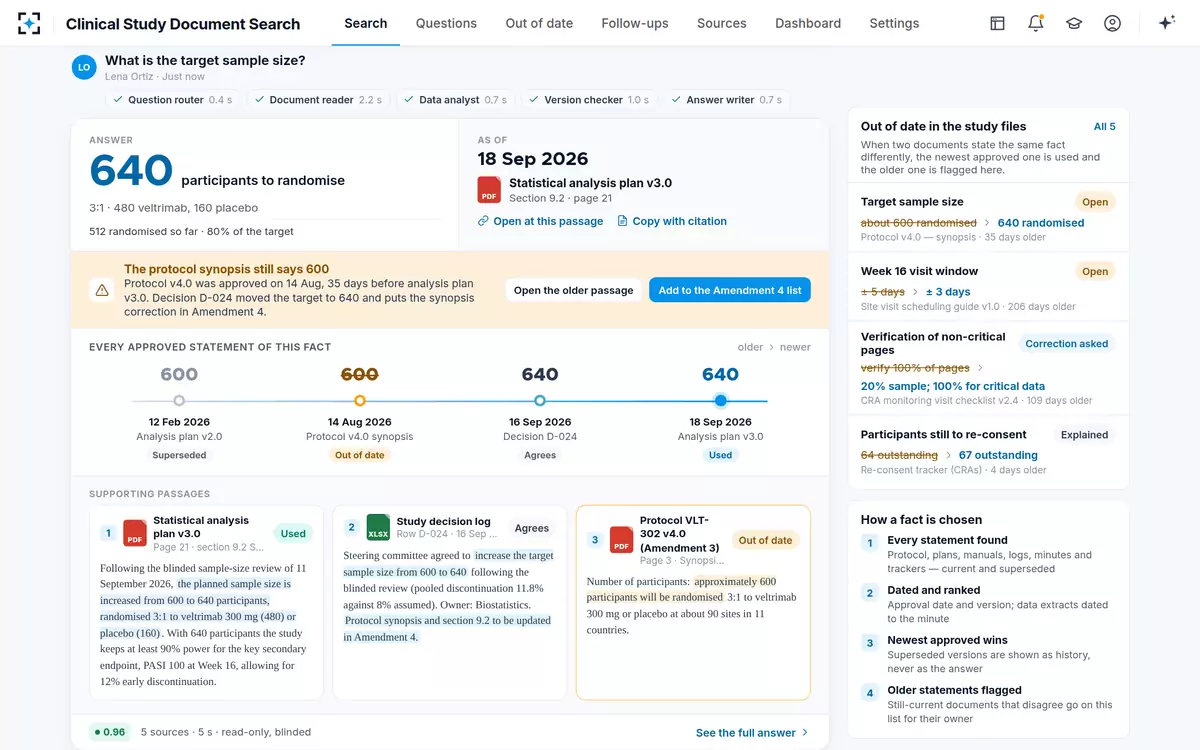
The European Medicines Agency guideline names the principle the gap offends, in its description of what makes data consistent: "Processes should be in place to ensure consistency of the definition, generation/capturing and management (including migration) of data throughout the data life cycle." Consistency of definition is the point. A study has one definition of the target sample size; it currently has two numbers for it; and the process that is supposed to detect that is, at many sponsors, a person remembering.
Search inside documents is not the same as an answer
Many filing systems offer full-text search, and some offer a question-answering layer on top of it. Both are genuinely useful and neither closes the gap, for a reason worth being precise about: search returns passages ranked by similarity to the question, and nothing in a similarity ranking prefers the newest approved statement over an older one that happens to be worded more like the question.
An answer needs three things search does not supply. It needs dating: every statement of the fact, with its approval date and version, so that newest-approved can win. It needs completeness: not the best match but all the matches, because the one that disagrees is the one worth knowing about. And it needs a figure as well as a rule: most real study questions are half document and half data — the window is in the protocol, the visits that fell outside it are in the database. Which system should supply which half is worked through in CTMS vs EDC: which system holds the answer you need.
A filing system and an answer, side by side
A document management system: For a document, by name, version, type or placeholder — or for text inside one.
Clinical Study Document Search: A question in plain words, about a rule, a figure, or both at once.
A document management system: The file, with its version, owner, approval date and audit trail.
Clinical Study Document Search: The value, the date it is true as of, and the document, version, section and page it came from.
A document management system: That this is the current approved version and that its history is intact.
Clinical Study Document Search: That the statement used is the newest approved one, and that every other statement of the same fact is listed beside it.
A document management system: That another current document states the same fact differently.
Clinical Study Document Search: A fact stated nowhere in the study — it says so rather than inferring one.
A document management system: Every access and change to the file.
Clinical Study Document Search: Every question, its sources, its confidence, and the e-signature when an answer is filed.
A document management system: The sponsor, for the completeness of the repository.
Clinical Study Document Search: The sponsor, for the answer — the product cites, flags and proposes; a person decides and signs.
Who is responsible for validating a clinical trial system?
The party that uses it, not the party that sold it. ICH E6(R3) is explicit that the responsible party owns the system's validation status throughout its life cycle, and the validation approach should rest on a risk assessment of the system's intended use and of the purpose and importance of the data and records it holds. A vendor can supply evidence, documentation and test results. It cannot supply the sponsor's determination that the system is fit for the use the sponsor is putting it to, and no contract moves that duty.
Two practical consequences for a buyer. First, "validated" on a vendor's web page is a category error: systems are validated by their users, for a stated intended use, against requirements the user wrote. Ask instead what the supplier provides to support your validation — requirement traceability, test evidence, release notes, change control, a documented configuration. Second, the guideline asks for validation to show that the system meets its established requirements for completeness, accuracy and reliability and performs consistently with its intended purpose. If your requirements never mentioned cross-document consistency, a successful validation will not have tested it. The requirements document is where this gap is either closed or built in.
The system should prevent the use of obsolete versions of the information and informed consent document.
EMA, Guideline on computerised systems and electronic data in clinical trials, Annex 5 (A5.3.8, Version control and availability to sites), in effect since September 2023
That sentence is written about electronic consent, where the stakes are highest and the rule is therefore sharpest. It is also the clearest statement in European guidance of the principle a buyer should generalise: preventing the use of an obsolete version is a system responsibility, not a training outcome. The awkward question is what "obsolete" means when the document is current and only the sentence inside it has been overtaken.
Twelve questions to ask before you sign
The list below runs from the capabilities any evaluation of this category covers to the ones that are easy to leave out — and the last few decide whether the system will help with the problem that actually hurts.
Twelve questions for a study document system, and what a good answer sounds like
- How is a version made current, and who may do it?
A good answer names roles and an approval step, and shows the audit trail entry it writes. A weak one describes a folder convention.
- What does the audit trail capture, and can an administrator alter it?
It should record creation, modification and deletion with date, time and operator, and no role should be able to obscure what it previously recorded.
- Is the audit trail searchable and sortable?
FDA recommends that it be retained in a format that is searchable and sortable. "Exportable to a spreadsheet on request" is a slower answer to a different question.
- How do you prove to an inspector which version was current on a given date?
Ask for the screen, not the assurance. A point-in-time view of the repository is the strongest answer.
- Can the system prevent an obsolete version being opened or distributed?
Required for consent documents under the EMA guideline. Ask how it works for site-facing material generally.
- What do you supply to support our validation, and what do you expect us to do?
Requirements traceability, test evidence, release notes, change control. A supplier that offers to "give you our validation" has misread who owns it.
- How are records retained, and what happens at the end of the trial?
Retention period, export format, readability without the vendor’s software, and who holds the copy.
- How do permissions work at site level, and how are changes to them logged?
Access is part of the record. Ask to see the log of role and permission changes, not just the current matrix.
- Can it search the content of documents, and what does it return?
Passages ranked by similarity are a useful tool and not an answer. Ask what happens when two documents match and disagree.
- Can it join a rule in a document to a figure in CTMS or EDC?
Many cannot, and should say so. If one claims it can, ask for the read-only query behind the number and the rows it used.
- Can it tell me which other current document disagrees with this one?
The question most easily left out. A system that cannot do it is not disqualified — but the job still exists, and somebody in your team is doing it by hand.
- Can that disagreement be given an owner and a due date?
A detected contradiction with no owner is a report. With an owner, a date and a status it becomes a correction that can be closed and shown to have been closed.
What to require instead: a statement-level comparison with an owner
The requirement to add is not better search. It is a standing comparison at the level of statements, running on a schedule, with an owner for every disagreement it finds. Written as a requirement it reads something like: for every fact the study relies on, identify every approved statement of it across all current documents and the daily data extracts; date each statement by approval and version, or by extract time; use the newest approved one in any answer; and raise every still-current document that disagrees as an item with a named owner, an age and a status.
That is what the sample study is configured to do each morning at 06:30, after the index and the extracts arrive. On the morning in the example it produced five items from 1,284 documents: a sample size, a visit window, a source data verification rule, a re-consent count where the tracker and the database differ, and a temperature limit on a pharmacy card that had already been corrected and reissued to all 88 sites. One was open, two had corrections asked, one was explained, one was done.
Every fact two documents state differently, with an owner and a status
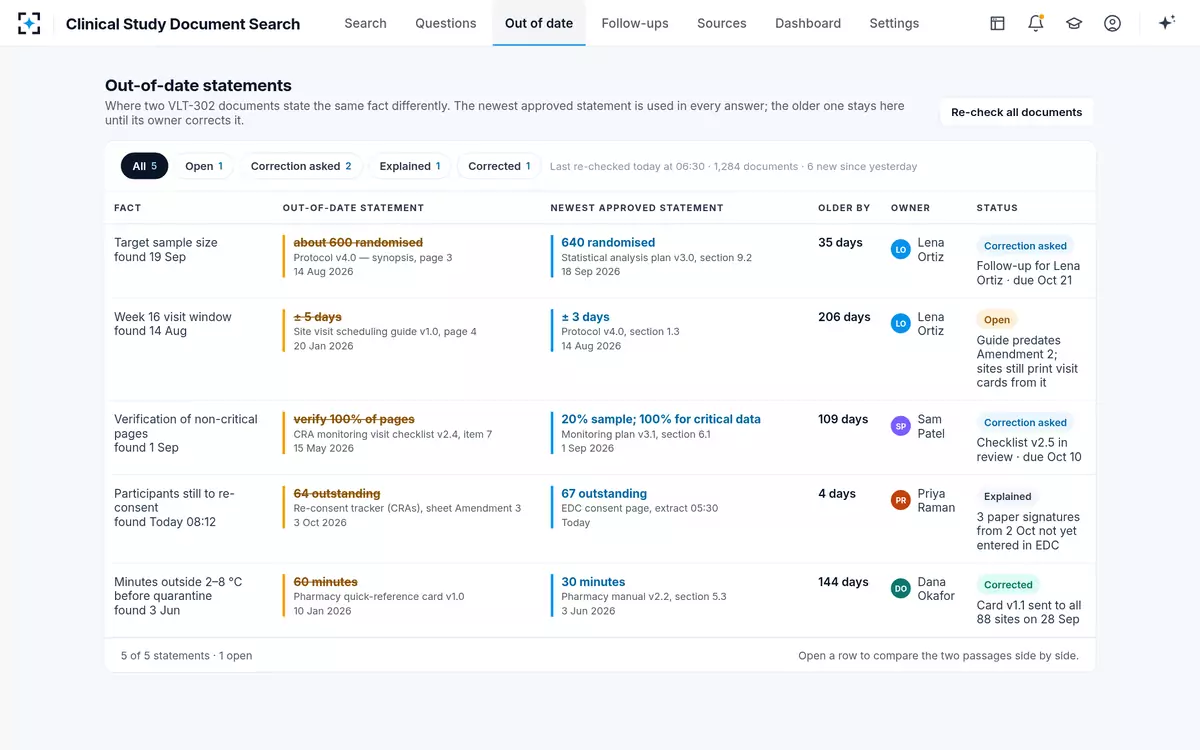
Three design points are worth stealing whether you buy anything or not. The comparison runs on every document every morning rather than on the ones somebody suspects, because the whole failure mode is not knowing where to look. The older statement is never edited by the system — it is flagged for the person who owns the document, which keeps the change-control path intact and the filing system authoritative. And the item carries a date, so an inspector can see not only that the disagreement was found but how long it stood and what was done about it. How a correction becomes a follow-up, and who signs an answer before it becomes a study record, is set out in what the agents do, and what you sign; which sources such a search may never read is in maintaining the blind while search reads it all.
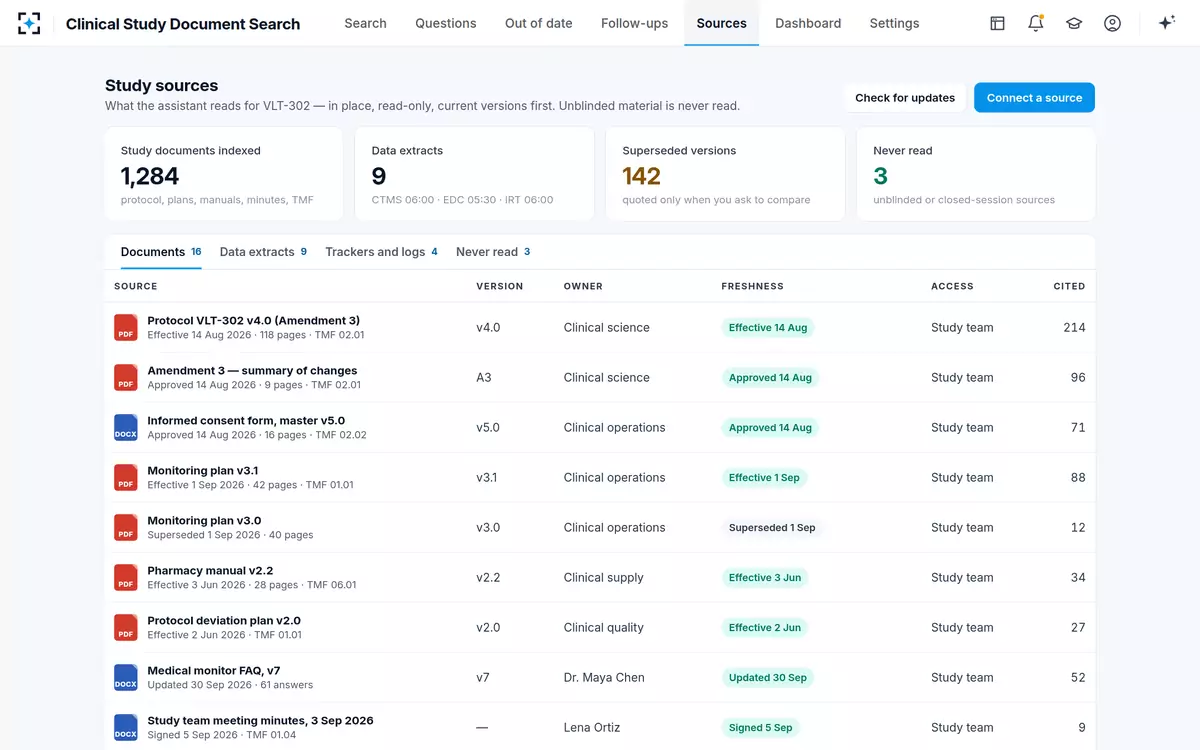
What is read, what is quoted only to compare, and what is never read
Questions people ask
What is the difference between a document management system and an eTMF?
A document management system is a general capability — identity, versioning, approval, access, audit trail. A trial master file is the defined set of essential records for one trial, usually organised against a reference model. An eTMF is a document management system configured to be that set. ICH E6(R3) says essential records should be maintained in, or referred to from, repositories held by the sponsor and by the investigator, and that those repositories may be called a trial master file — so the file is defined by what it contains, not by the software holding it.
Does a document management system have to be validated?
If it holds records that support a trial, yes, and the duty sits with the party using it. ICH E6(R3) puts the validation status of a system with the responsible party throughout its life cycle, on a risk basis that considers the intended use, the importance of the records held, and the potential effect on participants and on the reliability of results. 21 CFR 11.10(a) asks for validation to ensure accuracy, reliability, consistent intended performance and the ability to discern invalid or altered records.
What does 21 CFR Part 11 require of a document system?
For closed systems, section 11.10 lists controls including validation; the ability to generate accurate and complete copies in human-readable and electronic form for the agency; protection of records for accurate and ready retrieval throughout the retention period; limiting access to authorised individuals; and secure, computer-generated, time-stamped audit trails in which record changes do not obscure previously recorded information. It is a list about the integrity of records, not about their consistency with each other.
How does version control work in a regulated document system?
A new version is created, reviewed and approved by named people, the previous version becomes superseded but is retained, and the system presents the approved one as current while keeping the history reachable. The GCP guideline's own example, written for the investigator's brochure, is the pattern to copy for everything: give each edition a number, a reference to the edition it supersedes, and the cut-off date for the content in it — the third element being what lets two documents be compared by date rather than by recollection.
Can a document management system search inside documents?
Many can, and the result is a ranked list of passages. That is useful for finding a document and insufficient for answering a question, because ranking by similarity does not date the statements it returns, does not guarantee it has found all of them, and cannot join a rule to the figure that goes with it. The failure is quiet: the top hit is sometimes the superseded version, and nothing on the screen says so.
How do you prove to an inspector which version was current?
With the system, not with a memory. The strongest evidence is a point-in-time view: the repository as it stood on the date in question, with the approval record for the version that was current then and the audit trail showing when it was replaced. Ask for that in a demonstration rather than in a response to a requirements questionnaire — it is a good test of whether a system genuinely versions or merely stores versions.