Agentic AI in pharma is the market's term for software that does not just answer but acts — planning several steps, calling systems, and carrying a task towards completion without being told what to do at each turn. The interesting question about it in a regulated company is not mainly how autonomous it is. It is where the authority line sits: what the software may prepare, what it may propose, what it may never touch, and what the person at the end is putting their name to. The rules answer that precisely — ultimate responsibility does not transfer to whoever or whatever performs the work, and an electronic signature is only a signature if it records the meaning of signing. Clinical Study Document Search is Botminds' search over a study's own documents and data, and the line is drawn through the middle of it: six specialists read, query, date and draft; the study manager checks, corrects, files and signs.
The worked example is sample data — VLT-302, an invented Phase 3 study of veltrimab in plaque psoriasis, with invented sites and invented people. Nothing here says the product is compliant with any regulation, validated or qualified; it describes what the product does and what the signature it captures records, and leaves compliance where it belongs, as the sponsor's determination.
What does agentic AI mean in pharma?
In practice it means three things stacked on top of a language model: a plan, tools, and a loop. The plan breaks a request into steps; the tools let the software do something other than write — read a document, run a query, create an item in another system; the loop lets it check its own progress and take the next step. A chatbot answers from what it already has. Software of this kind goes and gets it, and then does something with it.
That is the whole of the technical difference, and it is smaller than the marketing suggests. What changes materially in a regulated setting is not capability but blast radius. A tool that can only answer is bounded by what the asker does next. A tool that can write to a system, create a task or file a document has reached into processes that have owners, approvals and audit trails of their own. The governance question therefore moves from "is the answer right?" to "what could this have changed, and who agreed?"
The authority line: prepare, propose, decide, sign
Four verbs, in order, and the line falls between the second and the third. Prepare is reading, querying, dating, comparing and drafting — work whose output stands in front of a person before it does anything. Propose is suggesting an action with everything needed to judge it: the owner, the due date, the question that raised it. Decide is choosing to take the action, which changes something in the world. Sign is attesting to a fact with your name against it, in a form that will be read years later by someone who was not there.
Software can do the first two well and should be allowed to. The third and fourth are not capability problems; they are accountability problems, and moving them does not make a company faster, it makes it unable to answer a question at an inspection.
One answer on the sample study, with the line drawn across it
Agent
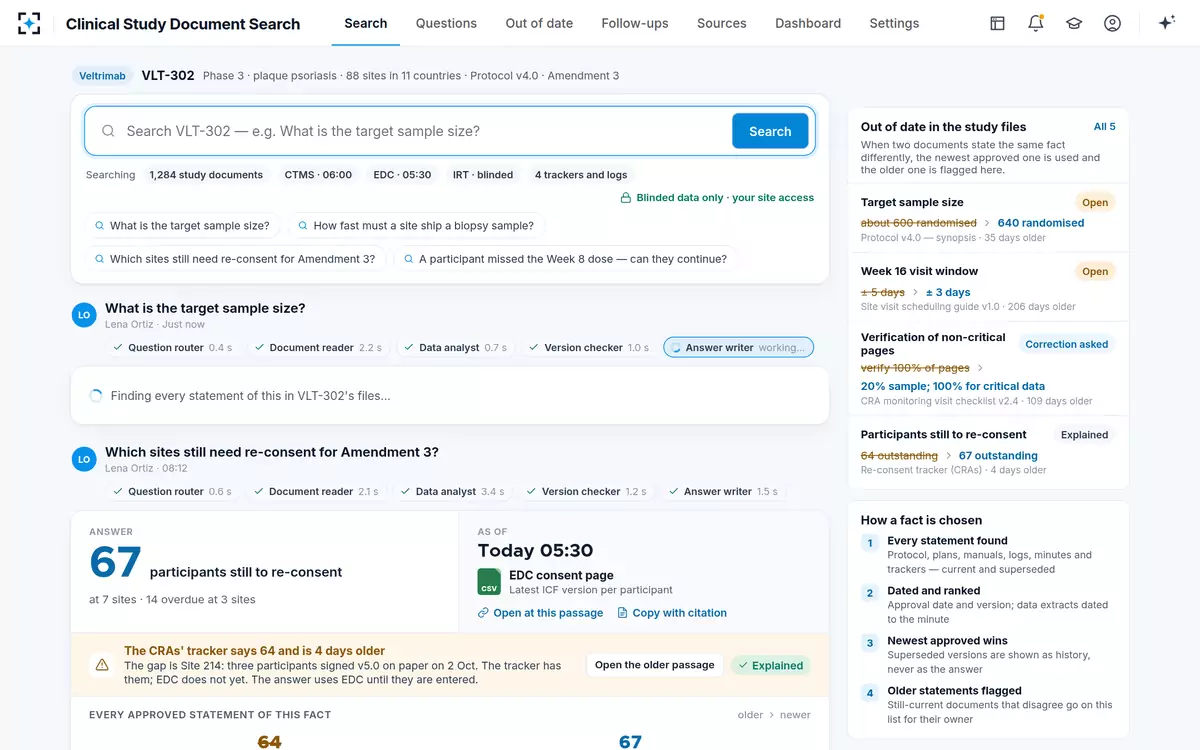
Prepare — route, read, query, dateThe question is routed to the right sources, every approved statement of the fact is found with its passage, one read-only query returns the rows, and every statement is dated by approval and version or by extract time.
Never: writes to a source system, edits a source document, or reads an unblinded source
Agent
Prepare — write the answerThe value first, with numbered citations to the document, version, section and page, or to the rows used, and a confidence score.
Never: makes a claim with no citation, or resolves a disagreement between documents quietly
Agent
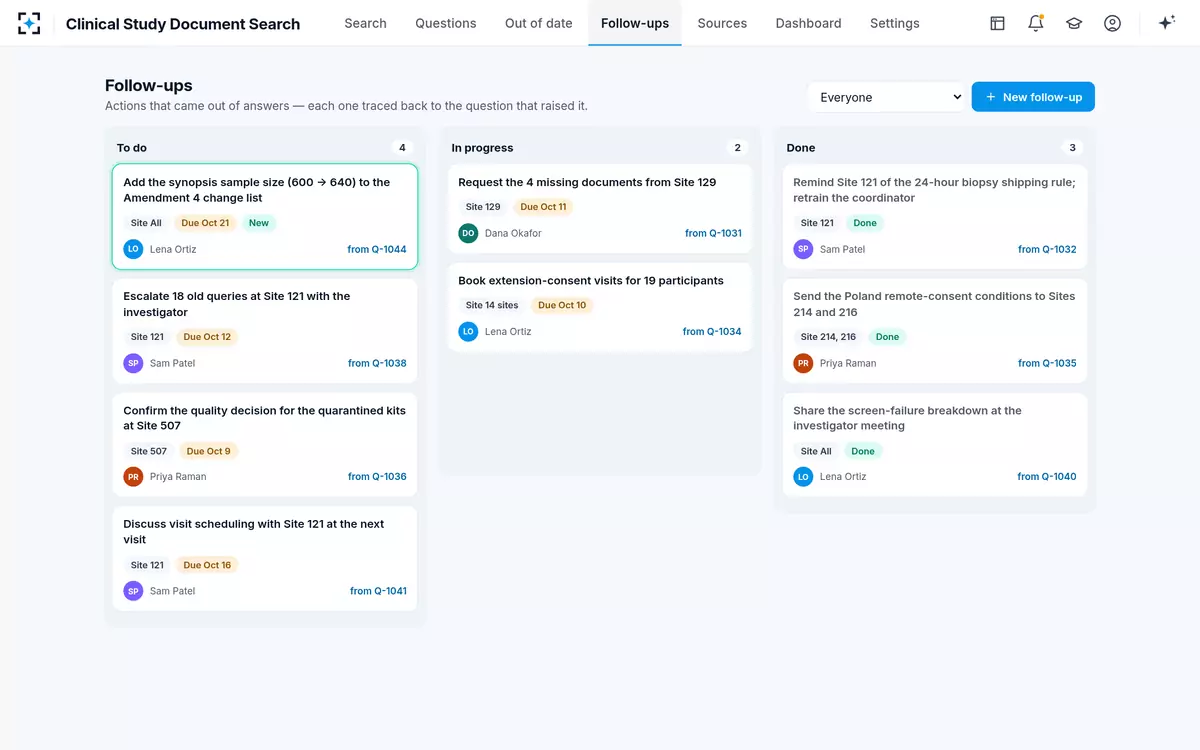
Propose — the follow-upTurns a gap in the answer into a proposed action for the owner it belongs to, with a due date from the next visit or the plan’s deadline, linked back to the question.
Never: creates the action itself — it proposes, and a person creates
A person decides
Decide — check, correct, createThe study manager reads the answer, checks anything below the confidence threshold or where sources disagree without an explanation, and decides whether a disagreement is corrected, explained or reopened.
Never: is skipped because the answer looked finished
A person decides
Sign — file it as a study recordFiles the answer to the trial master file with its sources, its query and its data as-of time, and signs with the meaning of the signature stated on the screen.
Never: delegates the attestation — the name on it is the name of the person who checked it
Who is responsible when an agent is wrong?
The sponsor. Not the supplier, not the model, not the person who configured it. ICH E6(R3), the Good Clinical Practice guideline adopted in January 2025, settles this for every form of delegation at once: "A sponsor may transfer any or all of the sponsor's trial-related activities to a service provider in accordance with applicable regulatory requirements; however, the ultimate responsibility for the sponsor's trial-related activities, including protection of participants' rights, safety and well-being and reliability of the trial data, resides with the sponsor."
The same structure applies on the investigator's side: ICH E6(R3) says the investigator keeps the ultimate responsibility and has to oversee the people and parties doing delegated work, to protect participants and the reliability of the data. Delegation moves the work and the oversight duty; it never moves the answer to "who is accountable".
The EMA reflection paper of September 2024 says the same thing about this technology specifically: it is the responsibility of the sponsor, applicant or manufacturer to make sure every algorithm, model, dataset and data-processing pipeline it uses is fit for purpose and meets legal, ethical, technical, scientific and regulatory standards. It is a reflection paper rather than a guideline, and on this point it restates settled law rather than proposing anything new.
So the useful procurement question is not "is your software reliable?" but "what will I be able to show about what it did?" A sponsor who cannot reconstruct a decision cannot discharge a responsibility it was never able to transfer.
What an electronic signature has to carry
Three things, and the third is the one most easily left out.
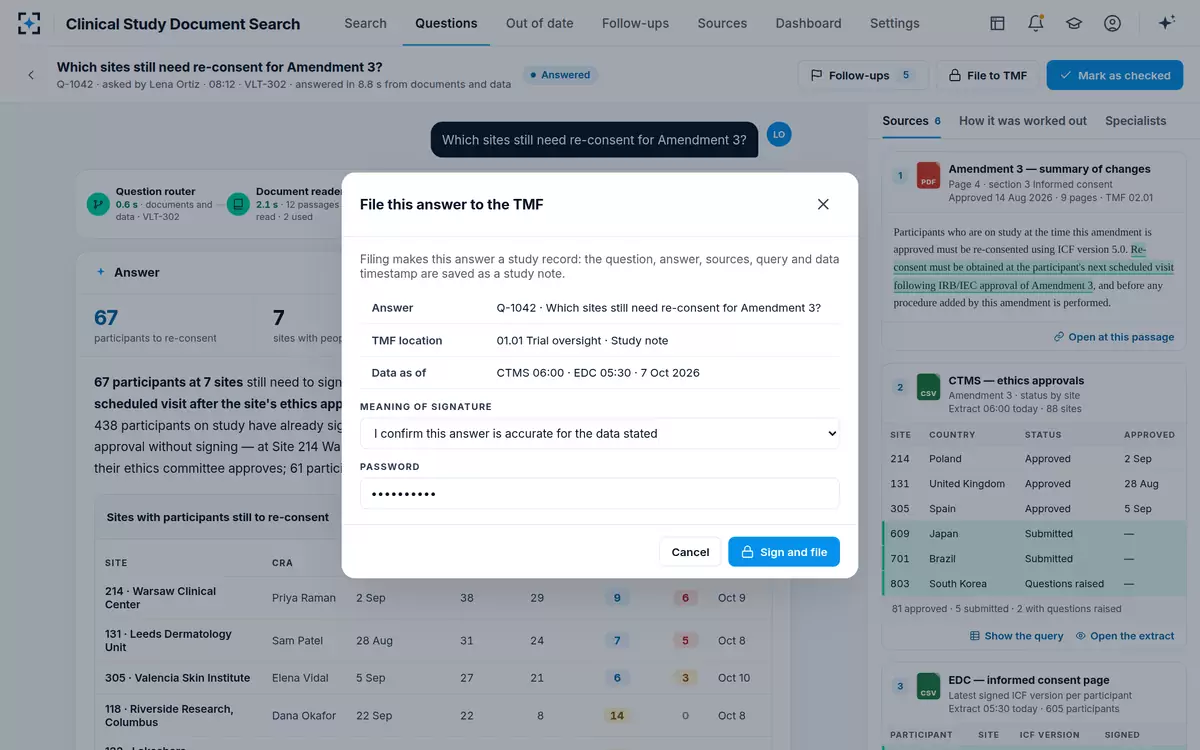
Signed electronic records shall contain information associated with the signing that clearly indicates all of the following: (1) The printed name of the signer; (2) The date and time when the signature was executed; and (3) The meaning (such as review, approval, responsibility, or authorship) associated with the signature.
21 CFR 11.50(a), Signature manifestations, on eCFR
Name, time, and meaning. A tick box labelled "confirm" satisfies the first two and fails the third, because it does not say what was confirmed. The meaning is what makes a signature readable by someone who arrives three years later with a question, and it is the difference between a signature and a click.
On the sample study the meaning is a sentence chosen at the moment of filing and stored with the answer: "I confirm this answer is accurate for the data stated". Note the qualifier. The signature is not an attestation that the enrolment figure is eternally correct; it is an attestation that the answer is accurate for the data stated — which is why the filing screen also carries the location it is being filed to and the as-of times of the extracts behind it. A signature that does not fix the data it refers to is attesting to something that changes every morning at 06:00.
A signature with its location, its data as-of time and its meaning
Limits written as limits: what an agent may never do
There is a difference between a system that happens not to do something and a system configured so that it cannot. The first is a demonstration; the second is a control. On the sample study each specialist carries its limits as configuration, and they are worth reading as a template because most of them generalise to any regulated process.
The six specialists, and the limit each one carries
| The specialist | What it does | What it may never do |
|---|---|---|
| Question router | Decides whether a question needs documents, data or both, and picks the smallest set of study sources that can answer it. | Route to an unblinded source. The asker’s own site access is applied to every question. |
| Study document reader | Searches the protocol, amendments, plans, manuals, minutes and decisions, current versions first, and returns every statement of the fact. | Return a statement without its passage; use a superseded version except when asked to compare, and then it says so. |
| Study data analyst | Writes one read-only query per question, explains each step in plain words, and returns the rows used so they can be cited. | Write to any system; read anything but blinded views, filtered to the asker’s sites. |
| Version checker | Dates every statement behind an answer, uses the newest approved one, and explains gaps between data sources. | Hide a disagreement; answer from a superseded version; edit a source document — it flags it for its owner. |
| Answer writer | Writes the value first, with numbered citations and a table when the answer runs long. | Make a claim without a citation; write in anything but plain words. |
| Follow-up planner | Turns a gap in an answer into a proposed action for the right owner, with a due date. | Create the action. It proposes only; a person creates, and every action links the question that raised it. |
Two of those limits deserve underlining because they are the easiest to trade away for convenience. Read-only is absolute: nothing writes back to the clinical trial management system, the database or the randomisation system, which means no answer can corrupt a source by correcting it. And a flagged document is never edited — the out-of-date statement goes to the person who owns that document, so change control stays where the sponsor's procedures put it. What a filing system guarantees, and what it cannot, is the subject of document management systems for clinical trials.
Why a low-confidence answer should go to a person, not through
Many systems of this kind produce a confidence figure. The question is what happens to it. If it is displayed and nothing else, it is decoration; the useful design is a threshold that routes, so that an answer below it does not reach the asker as a finished thing at all.
On the sample study the threshold is 0.90, and the rule has a second limb: an answer where sources disagree without an explanation also waits for a person, whatever its score. On the morning in the example that caught a consent-deviation count returning at 0.71 — seventeen in one log, two more in signed monitoring reports — which is precisely the sort of question where a confident-sounding single number would have been worse than no answer.
The FDA's draft guidance of January 2025 on using artificial intelligence to support regulatory decision-making, which carries the notice that it is not for implementation, makes the point that follows from this and is easy to miss: where the context of use involves a human in the loop, the evaluation should consider how the human-AI team performs, rather than the model in isolation. What matters is not how often the model is right but how often the pair is right — which depends on whether the person is given something checkable, whether the uncertain cases actually reach them, and whether they have time to look. A review point that everybody clicks through is a measured weakness of the team, not a feature of the model.
The EMA paper draws the same boundary around drafting: tools used to draft, compile, edit, translate, tailor or review product information documents should be used under close human supervision.
Proposed by the planner, created by a person, traced to the question
What has to be on the audit trail on both sides of the line
Above the line: what was asked, by whom, which sources were read, which query ran, what came back, and with what confidence. Below it: what the person changed, what they decided, what they created, and what they signed with what meaning. Both halves, or the trail has a hole exactly where the accountability is.
The requirement itself is old and blunt. ICH E6(R3) asks sponsors and investigators to ensure that audit trails, reports and logs stay switched on, and that audit trails are modified only in rare circumstances. The FDA's question-and-answer guidance of October 2024 explains why the trail is worth the storage: audit trails are how the quality, authenticity and integrity of data can be verified, and how significant details of a clinical investigation's conduct and its source data collection can be reconstructed.
Reconstruction is the test to apply when evaluating any software of this kind. Pick a decision from six months ago and ask whether the trail lets someone rebuild it: what the question was, what the system could reach at that moment, what it returned, who looked, what they changed, and what they attested to. If any of those is missing, the gap is not a logging preference — it is the part of the story a sponsor will not be able to tell.
What the specialists produce, and what the person signs
Prepared by the specialists: An answer: a value, an as-of date, the document, version and section, the supporting passages and the rows.
Signed by the study manager: A study note filed to the trial master file, holding the question, the answer, the sources, the query and the data timestamp.
Prepared by the specialists: "This is the newest approved statement of this fact, and here is every other one."
Signed by the study manager: "I confirm this answer is accurate for the data stated."
Prepared by the specialists: Citations to passages and rows, each openable at the exact place.
Signed by the study manager: The same citations, fixed at the moment of signing with the extract times they rest on.
Prepared by the specialists: Nobody yet — an answer is a working note until a person files it.
Signed by the study manager: The signer, by name, with the meaning of the signature recorded beside it.
Prepared by the specialists: The question, the sources read, the query, the confidence, and who asked.
Signed by the study manager: All of that, plus the location, the data as-of time, the meaning, and the time the signature was executed.
Transparency and accountability, as a standards body defines them
The clearest short statement of why the line has to be visible comes from the United States National Institute of Standards and Technology, in its AI Risk Management Framework: trustworthy AI depends on accountability, and accountability presupposes transparency.
Presupposes is the strong word. You cannot hold anyone to account for a decision nobody can see — which makes transparency a precondition of the governance rather than a nice property of the interface. In this setting it is concrete: the sources the system can reach, visible as a list; the steps it ran, visible as they run; the citation behind every claim, openable; the limits, written as configuration with an owner.
The framework also scales the expectation with the stakes: "When consequences are severe, such as when life and liberty are at stake, AI developers and deployers should consider proportionally and proactively adjusting their transparency and accountability practices." A clinical trial is squarely inside that sentence. It is also the reason a sponsor should be suspicious of any deployment whose governance story is mostly about the model and hardly at all about the configuration, the access and the trail.
How to write the line down before you buy anything
Ten clauses, drafted before the procurement rather than after it. They are short enough to fit on a page and specific enough that two vendors answering them will give visibly different answers.
Ten clauses to write before you buy
- The context of use, in one paragraph
What the software does, and where its output goes. Naming the destination is what makes the rest of the clauses writable.
- The never list
The sources it may never read, the systems it may never write to, and the actions it may never take. Specific sources and systems, by name.
- The confidence threshold, and its second limb
The score below which an answer goes to a person, and the rule that unexplained disagreement between sources routes there too, whatever the score.
- Who may approve, and who may not
By role, with the delegation path, and a statement of what happens when the named role is away — because that is when the control is actually tested.
- What the signature means
The exact words, and what they are true of: 21 CFR 11.50(a) requires the meaning to be recorded alongside the signer’s printed name and the date and time.
- The audit trail, on both sides of the line
What is kept above it and below it, for how long, in what format, and who can read it without asking the supplier.
- Access and blinding
That access is the asker’s own rather than a service account’s, that site filtering happens in the query, and that role and permission changes are logged.
- The escalation route when it is wrong
How an error is reported, who assesses its impact, what is told to whom, and how the route that allowed it is closed.
- Life cycle monitoring, with the sponsor’s numbers
What is measured after go-live — the share of answers corrected, the share routed for checking, the questions returned unanswered — and who sees it.
- Who answers at an inspection
Named roles on the sponsor side, and what the supplier contractually must provide and by when. Assume the model architecture, development logs, validation and testing and the data pipeline may be asked for.
Written this way, the question "how autonomous is it?" stops being interesting. What a buyer wants to know is which of these ten the software makes easy and which it makes awkward — and that is answerable in a demonstration. Which jobs are worth starting with at all, and the evidence each one owes, is the subject of the jobs AI can actually do in clinical trial operations, and the sources that must stay out of reach whatever the governance says are in maintaining the blind while search reads it all.
Each step, and how long it took, in view while it runs
Questions people ask
What is the difference between agentic AI and a chatbot?
A plan, tools and a loop. A chatbot answers from what it has been given; software described as agentic breaks a request into steps, calls tools to get what it needs — reading a document, running a query, creating an item somewhere — and keeps going until the task is done or it stops. The technical gap is smaller than the marketing suggests; the governance gap is not, because a tool that can act has reached into processes with their own owners and approvals.
Can an AI agent make a regulated decision in pharma?
It can produce everything the decision needs; it cannot be the one accountable for it. ICH E6(R3) puts ultimate responsibility for a sponsor's trial-related activities with the sponsor however the work is transferred, and gives the investigator the equivalent duty of oversight over delegated activities. In practice that makes "decide" and "sign" human verbs, and makes "prepare" and "propose" the two the software should be configured to stop at.
Can a sponsor delegate responsibility to a software vendor?
No. A sponsor may transfer any or all of its trial-related activities to a service provider, but the guideline says the ultimate responsibility — including participants' rights, safety and well-being and the reliability of the data — resides with the sponsor. The EMA reflection paper states the same for this technology: it is the sponsor's or applicant's responsibility to ensure the algorithms, models, datasets and pipelines used are fit for purpose. Contracts allocate work and liability; they do not move accountability.
What is a human-in-the-loop approval?
A named point at which a person must look before an output goes further, with a rule that routes the cases most likely to need it. The design that works has three parts: a threshold, a second rule for unexplained disagreement between sources, and something checkable in front of the reviewer — a citation they can open rather than a paragraph they must re-derive. The FDA draft guidance asks that evaluation consider the performance of the human-AI team rather than the model alone, which means a review point everybody clicks through should show up in that evaluation as a weakness.
What should an AI agent never be allowed to do in a clinical trial?
Four things, as a starting list: write to a source system, edit a source document, read an unblinded source, or file anything as a trial record without a person's signature. Each is a limit rather than an omission — written into the configuration, visible to a reviewer, and testable. On the sample study they are the limits the six specialists carry, and a flagged document is always sent to its owner rather than corrected in place, so change control stays where the sponsor's procedures put it.
How do you audit what an AI agent did in a clinical trial?
By reconstructing one decision end to end. Take a filed answer from months ago and ask the system for the question, who asked it, which sources were readable at that moment, which query ran, what came back and with what confidence, who reviewed it, what they changed, and the signature with its printed name, date, time and meaning. ICH E6(R3) asks that audit trails, reports and logs not be disabled and not be modified except in rare circumstances; FDA describes audit trails as the means of verifying quality, authenticity and integrity and of reconstructing significant details. If the reconstruction stops anywhere, that is where the governance stops too.