AI in clinical trial operations is used today for five quite different jobs — answering questions from a study's own files, pulling structured values out of documents, drafting text, forecasting enrolment and timelines, and supporting decisions about sites, risk and monitoring. They look alike in a demonstration and they are not alike at all: each puts a different weight on the model's output, and each therefore owes a different amount of evidence before anyone should rely on it. That is not a matter of taste. Both the United States Food and Drug Administration and the European Medicines Agency have published the framework, and it is simple enough to apply at a desk. Clinical Study Document Search is Botminds' search over a study's own documents and data, and it is deliberately the first of those five jobs — the one where the model's influence is lowest, because every claim is cited back to a passage or a row a person can open.
Two cautions before anything else, because this is a buying page. The FDA framework quoted throughout is a draft guidance of January 2025 and carries the usual notice that it is not for implementation; it states the agency's current thinking. The EMA document is a reflection paper, not a guideline. Nothing on this page should be read as saying any tool is approved, qualified or validated — those are determinations a sponsor makes, for a stated use. The worked example is sample data: VLT-302, an invented Phase 3 study of veltrimab in plaque psoriasis, with invented sites and invented people.
The framework, and the job this page argues you should start with
7steps
in the FDA risk-based credibility assessment framework — typical, draft guidance, January 2025
2factors
set model risk: model influence and decision consequence — typical, same source
6specialists
in the sample solution, and one person who decides what is filed — seen in the product
8.3s
design target, median to a cited answer, against an estimated 45 minutes by hand
What AI is actually used for in clinical trial operations
Strip away the slide decks and the uses in operations — as distinct from discovery, biomarkers or imaging — fall into five families. Cited retrieval: answering a question from the study's own documents and data, with the passage or the rows attached. Structured extraction: turning the content of documents into fields, such as pulling eligibility criteria or visit schedules into a table. Drafting: producing text a human will edit — a monitoring report narrative, a plain-language summary, a response to a query. Forecasting: predicting enrolment, screen failure, site performance or timelines. Decision support: recommending where to monitor, which site to visit, which signal to chase.
They differ on one axis that matters more than accuracy: how far the output travels before a person with the relevant knowledge sees it, and what that person can check it against. A cited answer arrives with its evidence attached, so checking it takes seconds. A forecast arrives as a number with a method behind it, and checking it means re-doing the work. That difference is not a nuance; it is the whole of the regulatory framework, written in a different vocabulary.
The five jobs, and what each one changes
Five jobs, and the evidence each one owes
| The job | Model influence on the decision | Consequence if it is wrong | Who checks it, and against what | What has to be kept |
|---|---|---|---|---|
| Cited retrieval over the study’s own files | Low — the output points at a passage or rows that stand on their own. | Moderate: a wrong answer acted on. Bounded by the citation being checkable in seconds. | The asker, against the cited passage or the rows behind the number. | The question, the sources, the query, the confidence, and who checked it. |
| Structured extraction into fields | Medium — downstream systems consume the field, not the sentence it came from. | High: a silent error propagates into every report built on the field. | A reviewer, against the source document, usually on a sample. | The extraction, the source location, the reviewer and the sampling plan. |
| Drafting text for a person to edit | Medium to high — the draft anchors what the reviewer writes. | High: generated text can be fluent when it is wrong, and a reviewer under time pressure may edit rather than verify. | The author who signs it, against the underlying facts — not against the draft. | The draft, the edits, and who approved the final text. |
| Forecasting enrolment, timelines, performance | High — the number is the input to the decision. | High: a wrong forecast moves money, sites and staffing months before it is falsified. | A statistician or operations lead, against held-out data and against what actually happened. | The model, the training data, the evaluation, and the performance over time. |
| Decision support on sites, risk and monitoring | High — the recommendation substitutes for the analysis. | Severe: under-monitoring a site affects participants and data reliability. | The accountable person, against the underlying evidence and the risk plan. | The recommendation, the evidence behind it, the decision taken and why. |
Read the first row against the last. Both are "AI in clinical trial operations" in a vendor's taxonomy. One hands a person a sentence with its evidence attached; the other hands them a conclusion whose evidence is the model. The first is checkable by the person who asked. The second is checkable only by someone who could have done the work anyway.
Is AI allowed in a clinical trial?
Yes, with conditions, and the conditions are the ordinary ones. The EMA reflection paper states the baseline plainly: AI used within a clinical trial has to meet the applicable requirements of ICH E6 good clinical practice, or of VICH GL9 in veterinary trials. No special permission regime, and no exemption either. Everything GCP asks of a computerised system applies: it is validated by the party using it, for its intended purpose; its records are attributable and traceable; its access is controlled; its audit trail is intact.
ICH E6(R3) adds the sentence that catches configured systems: standard functionality and protocol-specific configurations and customisations alike — automated data entry checks and calculations included — should be validated. A tool configured per study — a never-read list, a confidence threshold, a site-access rule — has a per-study configuration, and the configuration is inside the scope, not outside it.
Context of use: the question the framework makes you answer first
The FDA draft guidance does not ask whether a model is good. It asks what it is for, and makes everything else follow from the answer.
For the purposes of this guidance, credibility refers to trust, established through the collection of credibility evidence, in the performance of an AI model for a particular COU. Credibility evidence is any evidence that could support the credibility of an AI model output for a specific COU. The COU defines the specific role and scope of the AI model used to address a question of interest.
FDA, Considerations for the Use of Artificial Intelligence to Support Regulatory Decision-Making for Drug and Biological Products, draft guidance, January 2025 — not for implementation
Context of use is the discipline hiding inside the acronym. The guidance asks that "The description of the COU should describe in detail what will be modeled and how model outputs will be used." Both halves are required, and the second is the one teams skip. "A search assistant for study documents" is not a context of use. "Answers a study team's questions about the protocol and plans by returning the newest approved statement of a fact with its citation, for a person to check and, where it is to become a study record, to sign" is one — because it says where the output goes and who acts on it.
Writing it properly has an immediate effect on a procurement. Two tools that demonstrate identically will have different contexts of use the moment you ask where their output travels, and the one whose answers go straight into a report owes more evidence than the one whose answers land in front of the person who asked, next to the passage they came from.
How do you assess AI model risk?
With two factors, multiplied by judgement. The guidance defines model risk as a combination of two factors: model influence — how much the evidence from the AI model contributes relative to the other evidence used to answer the question of interest — and decision consequence, the significance of an adverse outcome if a decision based on it turns out to be wrong.
Model influence is the quietly radical idea. It is not a property of the model — it is a property of the surrounding evidence. The same model has high influence when its output is the only thing in the room and low influence when the thing it produces is a pointer to evidence that exists independently of it. This is why citation is not a user-interface nicety but a risk control: an answer that carries its passage and its rows has other contributing evidence by construction, and the model's share of the decision falls accordingly.
The EMA reflection paper reaches the same place by a different route: it says the degree of risk turns not only on the technology and the quality of the data but on the context of use and on how much influence the AI exerts. Two regulators, one test. A sponsor that writes a context of use and scores these two factors for each proposed use has done most of the work of deciding what to buy first.
What EMA expects of a sponsor that deploys one
It expects the sponsor to own the tool's fitness, and it expects the paperwork to be available later. The reflection paper warns that a model's full architecture, its development, validation and testing logs, its training data and a description of its data-processing pipeline would likely count as part of the clinical trial data or the protocol dossier, and so may be requested for assessment at a marketing authorisation, a clinical trial application or a GCP inspection.
Read that as a procurement requirement rather than as a warning. Whatever a sponsor cannot obtain from a supplier is a thing a sponsor cannot produce at an inspection. That is a reason to prefer uses where the evidence an inspector would want is mostly about configuration and logs — what the system could reach, what it was asked, what it answered, who checked it — rather than about the internals of a model.
On generated text the paper is sharper still: because generative language models tend to produce plausible but erroneous or incomplete output, it asks for quality review mechanisms that make sure all model-generated text is factually and syntactically correct before it goes for regulatory review. Plausible but erroneous is the failure mode of the drafting job, and it is why drafting is the wrong place to start even though it demonstrates best.
Why cited retrieval is the low-risk place to start
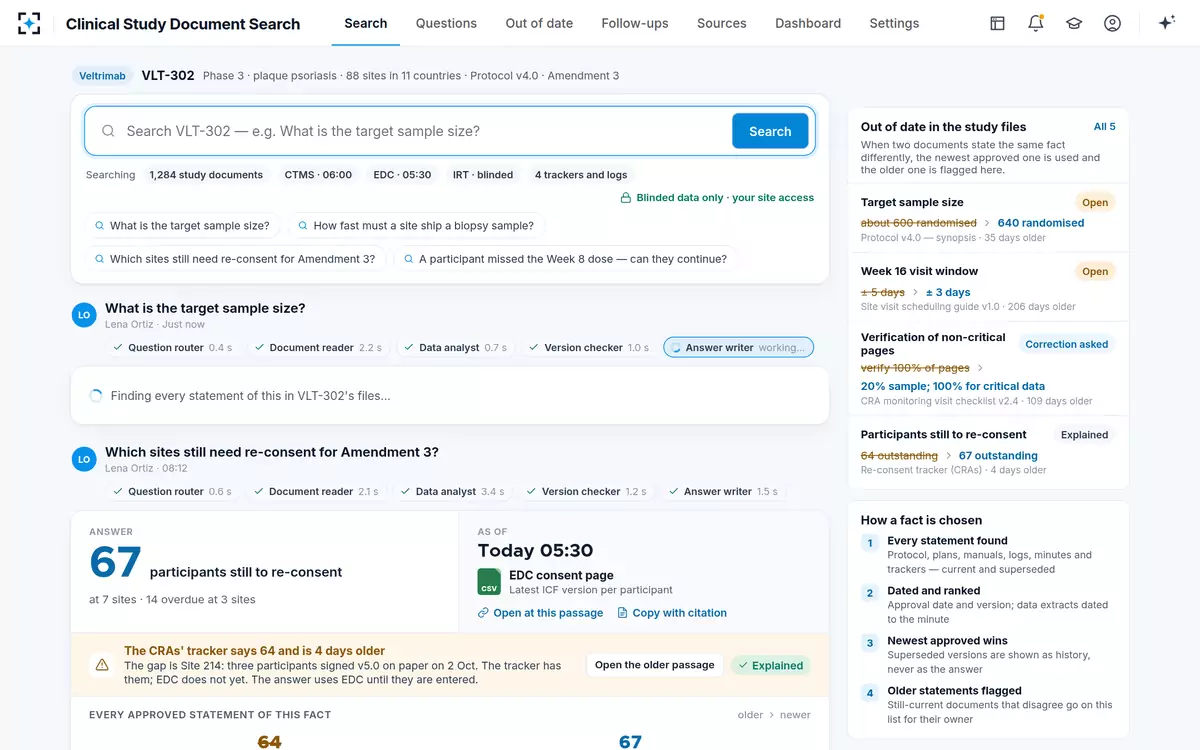
Because it is the job of the five where checking the output is cheapest relative to producing it. That is the whole argument, and it is worth being concrete about what it looks like inside the product on the sample study.
One cited answer, and the limit each specialist is configured with
Agent
Question routerReads the question, decides whether it needs documents, data or both, and picks the smallest set of study sources that can answer it, within the asker’s site access.
Never: routes to an unblinded source; the asker’s site access is always applied
Agent
Study document readerSearches the protocol, amendments, plans, manuals, minutes and decisions, current versions first, and returns every statement of the fact with document, version, page and section.
Never: returns a statement without its passage; uses a superseded version except to compare, and says so
Agent
Study data analystWrites one read-only query per question over this morning’s extracts, explains each step in plain words, and returns the rows used so they can be cited.
Never: writes to any system; reads anything but blinded views, filtered to the asker’s sites
Agent
Version checkerDates every statement behind the answer — documents by approval and version, data by extract time — uses the newest approved one and explains gaps between data sources.
Never: hides a disagreement; answers from a superseded version; edits a source document — it flags it for its owner
Agent
Answer writerWrites the fact card and the plain-words answer: the number first, numbered citations, and a table when the answer runs to more than three rows.
Never: makes a claim without a citation; writes in anything but plain words
Agent
Follow-up plannerTurns a gap in an answer into proposed actions for the right owner, with due dates from the next visit or the plan’s deadline.
Never: creates an action — it proposes, and a person creates; every action links its question
A person decides
The study managerChecks anything below the confidence threshold or where sources disagree without an explanation, decides what is corrected, explained or reopened, and signs what is filed.
Never: is bypassed — an answer is a working note until a person files it
Each step visible as it runs — Clinical Study Document Search
Generated text and cited retrieval, as two different purchases
A tool that generates text: Prose, in the register the reader expects, whether or not the underlying facts support it.
A tool that retrieves and cites: A value, an as-of date, and the document, version, section and page — or the rows — it came from.
A tool that generates text: Re-derive the facts from the sources to verify a paragraph that already reads as finished.
A tool that retrieves and cites: Open the citation. Agreeing or disagreeing takes seconds and needs no re-derivation.
A tool that generates text: A plausible sentence with no source behind it, in a document that is then approved.
A tool that retrieves and cites: Little: a claim with no citation is not written, and a disagreement between sources is shown rather than smoothed.
A tool that generates text: High — the text is the evidence the reader has.
A tool that retrieves and cites: Low — the evidence exists independently of the model and is attached to the answer.
A tool that generates text: A prompt and a response, usually outside the trial’s records.
A tool that retrieves and cites: The question, the sources, the read-only query, the confidence, the person who checked, and the signature when it is filed.
The evidence file: what an inspection can ask for
Assemble it before you need it, and keep it small. For a cited-retrieval tool it is mostly configuration and logs, which is the reason to start here.
Nine questions for a vendor, each tied to the framework that makes it a question
- What is the context of use, written in one paragraph?
What the model does and how its outputs are used. The FDA draft guidance asks for both halves; a supplier who can only supply the first has not thought about where the output goes.
- How much of each decision rests on the model?
Model influence is relative to the other evidence in front of the person. Ask what evidence accompanies every output, and whether a claim can be produced without one.
- What happens if an output is wrong, and who finds out?
Decision consequence. Map one wrong answer forward: who acts on it, what it changes, and at which point somebody would notice.
- What credibility evidence can you give us for our use?
Evaluation results on realistic tasks, with the test set described. NIST asks that accuracy measurements be paired with clearly defined and realistic test sets and details about the test methodology.
- What do you monitor after deployment, and what do we see?
The guidance treats life cycle maintenance as planned activity to monitor the model’s performance and suitability for the context of use over time, not as a release note.
- Where exactly does a person review the output?
A named point, a named role, and a rule that routes uncertain output there. "A human can always review" is not a review point.
- What is on the audit trail, on both sides of that point?
What was asked, what was read, what was returned, what the person did, and when. Ask to see it, not to be told about it.
- How is access controlled, and is it the asker’s own?
A tool with a privileged service account holds the union of everyone’s access. In a blinded trial that is a design fault, not a configuration detail.
- What happens when the model is wrong — what is the route?
How an error is reported, corrected, and prevented from recurring, and what the sponsor is shown. A supplier with no answer has not had the conversation before.
The NIST framework is worth having open beside the two medicines regulators, because it is blunt where they are careful. On measurement it asks that accuracy figures always come with clearly defined, realistic test sets that represent the conditions of expected use, with the test methodology documented alongside. A supplier quoting a percentage with no test set described has given you a number, not evidence.
A first ninety days, and what to bring to it
A workable first programme has four parts and does not need a budget cycle. Weeks one to three: pick one study and one question class — the cross-document questions that take 30 to 60 minutes by hand are the obvious candidate — and write the context of use in a paragraph. Weeks four to six: score model influence and decision consequence for that use, and write down the never-list: the sources the tool may not read, the actions it may not take, and the point at which a person must look. Weeks seven to ten: run it against questions whose answers you already know, including ones where two documents disagree, and keep every result. Weeks eleven to thirteen: review what a person actually checked, tune the confidence threshold, and decide whether to widen the question class or the study.
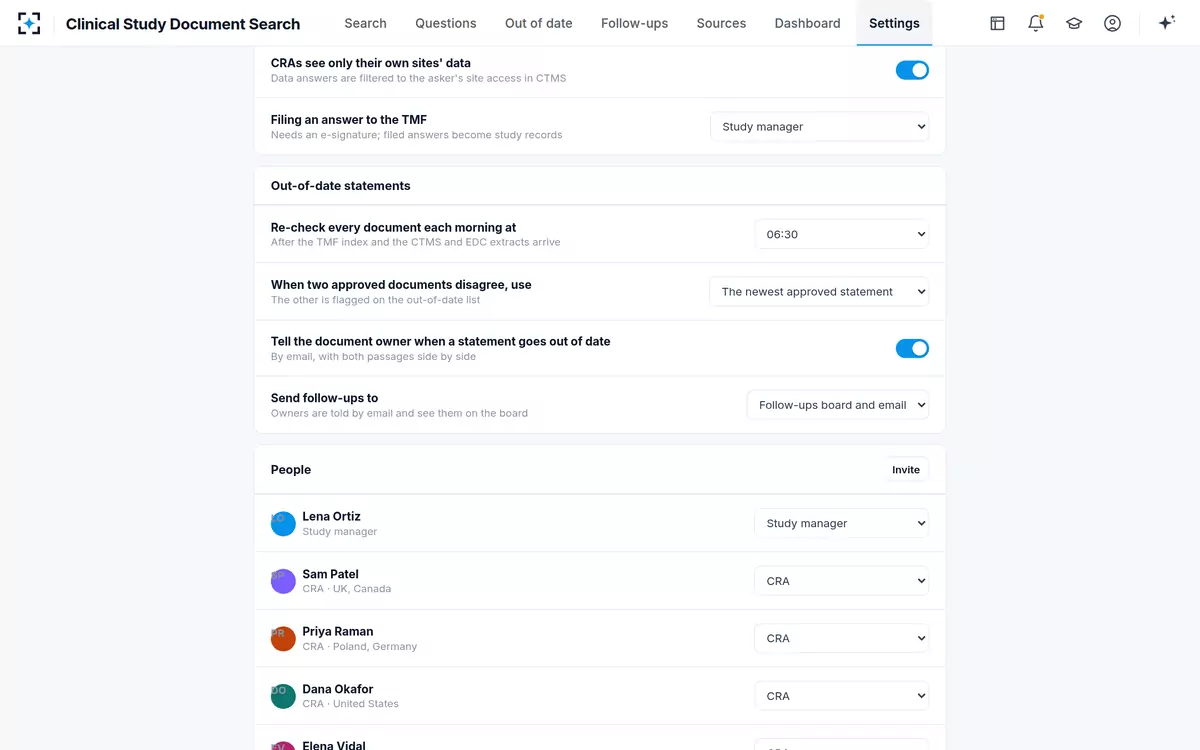
Two settings carry most of the governance on the sample study, and both are worth insisting on wherever you start: the confidence below which an answer goes to a person rather than through — 0.90 there — and who may turn an answer into a study record. Neither is a feature; they are where the risk assessment becomes configuration.
Where the risk assessment becomes configuration
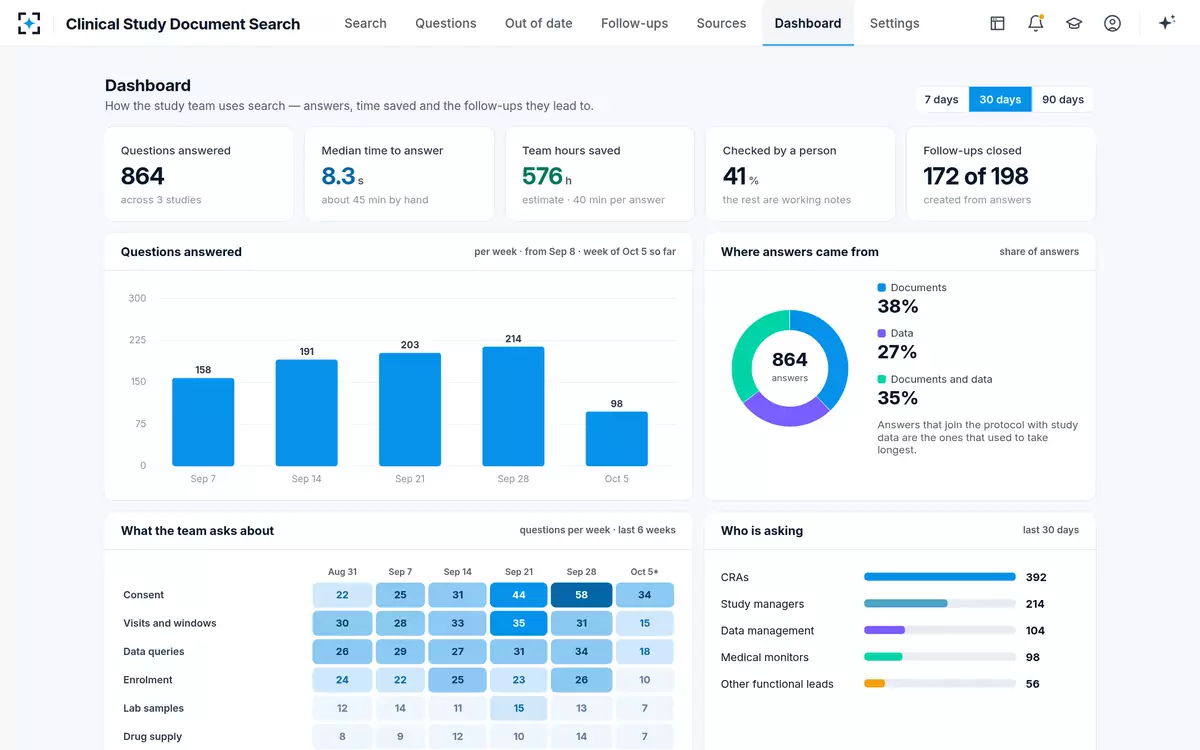
The guidance is explicit that the work does not stop at go-live: "Life cycle maintenance of AI models is a set of planned activities to monitor and ensure the model's performance and its suitability throughout its life cycle for the COU." On a retrieval tool that monitoring is unusually concrete — the share of answers a person had to correct, the share routed for checking, the questions that came back without an answer at all. All three are visible to the sponsor rather than to the supplier.
What the team asks, and what a person checked
Where this fits with the rest of the decision: what a filing system already does, and what it cannot, is set out in document management systems for clinical trials; which sources such a tool must never read, and how to prove it, is in maintaining the blind while search reads it all; and where the authority line sits between what is prepared and what is signed is in what the agents do, and what you sign.
Questions people ask
What does the FDA require to use AI in drug development?
There is no standing approval regime for an operations tool. The January 2025 draft guidance — which carries the notice that it is not for implementation — proposes a seven-step risk-based credibility assessment framework: define the question of interest, define the context of use, assess the model risk, plan how credibility will be established within that context of use, execute the plan, document the results and any deviations, and determine whether the model is adequate for the context of use. It is a way of deciding how much evidence a use owes, not a licence.
What is a context of use for an AI model?
A written statement of the specific role and scope of the model in addressing a question of interest. The draft guidance asks that it describe in detail what will be modeled and how the model outputs will be used — so it has to name where the output goes and who acts on it, not just what the tool does. Two products that look identical in a demonstration can have different contexts of use, and therefore different evidence obligations.
Does AI in a clinical trial have to be validated?
If it is a computerised system used in the trial, the ordinary GCP expectations apply: the responsible party owns the validation status throughout the life cycle, on a risk basis, and both standard functionality and protocol-specific configurations and customisations should be validated. The EMA reflection paper says the use of AI in clinical trials should meet the applicable requirements of ICH E6. A supplier can do validation work and supply evidence, but the responsibility for the validation status stays with the party using the system.
What does the EMA reflection paper say about AI in clinical trials?
Its reflection paper of September 2024 places AI inside existing GCP rather than beside it, makes risk depend on the context of use and the degree of influence the technology exerts, and asks sponsors to assume that model architecture, development and validation logs, training data and the data processing pipeline may be requested at a clinical trial application, at market authorisation or at a GCP inspection. On generated text it asks for quality review mechanisms, because such models are prone to plausible but erroneous or incomplete output. It is a reflection paper, not a guideline.
Can an AI tool answer questions from the protocol?
Yes, and on the framework above it is among the uses with the most favourable risk profile — provided the answer carries its evidence. The property that matters is that every statement comes back with the document, version, section and page it was taken from, that the newest approved statement is the one used, and that any still-current document disagreeing with it is shown rather than quietly dropped. An answer without a citation is a different product with a different risk assessment.
Where should a clinical operations team start with AI?
With the job where the model's influence is lowest and the checking is cheapest: answering questions from the study's own files, with citations. Start on one study and one class of question, write the context of use down in a paragraph, score influence and consequence, set the point at which an answer goes to a person, and keep the logs from day one. The worst place to start is anything whose output is generated text that goes forward unread.