CTMS and EDC are not two copies of one study record. An EDC, an electronic data capture system, holds what was observed about a participant at a visit, entered by the site from its own source documents. A CTMS, a clinical trial management system, holds what the study team did about a site: contracts, ethics approvals, monitoring visits, payments, enrolment counts, deviations. Ask either one a question it was never built for and it answers badly; ask both the same question on the same morning and you will often get two numbers. That is the hard part of the job, because almost every real question crosses them — the rule is in a document, the number is in the EDC, the status is in a tracker. Clinical Study Document Search is Botminds' search over a study's own files and this morning's extracts, and it is built for exactly that question: it answers with the rule from the document and the number from the system, each carrying the version or the extract time it came from.
The study on the screens below is fictional: VLT-302, a Phase 3 study of veltrimab in plaque psoriasis run by an invented sponsor at 88 sites in 11 countries, with invented people. It is the sample study the solution ships with. The regulatory material is real, and linked where it appears.
A CTMS against an EDC, row by row
CTMS: A site, and the study team’s work on it: start-up, approvals, monitoring visits, payments, issues, deviations.
EDC: A participant: eligibility, visits, assessments, doses, events, the consent version signed.
CTMS: The study team — start-up, CRAs, finance — usually after the event it describes.
EDC: The site, from its own source documents, usually during or soon after the visit.
CTMS: Rarely the system itself. The signed contract, the ethics letter and the monitoring report are the source; the field is a summary of them.
EDC: The system can be source, where the protocol says a datum is recorded directly into it.
CTMS: In the sample study, a read-only extract taken at 06:00 each morning.
EDC: A read-only extract at 05:30 each morning; entry by sites runs all day.
CTMS: Clinical operations.
EDC: Data management.
CTMS: What happened to a participant.
EDC: Whether a site has approval for the amendment, or what the protocol requires.
CTMS vs EDC: the one-sentence difference
If the answer is about a person in the trial, it is in the EDC or in the source behind it. If the answer is about the running of the trial, it is in the CTMS. If the answer is a rule, a threshold or a definition, it is in neither: it is in a document, and the systems only tell you what happened under it.
That division is why "which system is correct" is usually the wrong question. The two systems are not competing accounts of one event. They are accounts of different events, kept by different people, on different clocks, and the regulators treat them that way. The European Medicines Agency's guideline on computerised systems asks sponsors to be able to say, for each datum, where it came from: "The location of source documents and the associated source data they contain, should be clearly identified at all points within the data capture process." Not for the study; for each datum, at each point.
What a CTMS is actually for
A CTMS is the study team's own operational memory. It carries the site list and each site's start-up milestones, the ethics submission and approval dates, contracts and payment schedules, the monitoring visit calendar and whether each visit happened, action items, issues, protocol deviations as they are logged, and a running enrolment count by site and country. In the sample study the morning extract from the CTMS carries sites, ethics approvals, enrolment and deviations, and it is taken at 06:00.
Two things follow from who types into it. First, a CTMS entry is almost always a summary of a document that lives somewhere else: the approval date is a summary of the ethics letter, the deviation row is a summary of a monitoring finding. Ask a CTMS what a deviation actually was and it gives you a category and a free-text line. Second, the entry happens when someone gets round to it. A CTMS is rarely wrong about what it holds and frequently late.
What it does hold well, and what an EDC does not hold at all, is the trail of the study team's own actions. ICH E6(R3) expects that of a trial system: "Systems record and maintain workflow actions in addition to direct data entry/changes into the system." When a question is really "who did what about this site, and when", the CTMS is the first place to look.
What an EDC is actually for
An EDC holds the trial's observations, one participant at a time: eligibility, visit dates, assessments, doses given, adverse events, the consent version on file, and the queries data management has raised against any of it. In the sample study the EDC extract carries the consent page, visits and queries, and it is taken at 05:30 — half an hour before the CTMS extract, which is enough to matter on a morning when both are quoted in the same sentence.
Whether an EDC field is source data is not a property of the software. It is a decision recorded in the protocol. The EMA guideline is explicit on both halves: "The protocol should identify any data to be recorded directly in the data acquisition tools and identify them as source data", and, on where source begins, "From a practical point of view, the first obtainable permanent data from an electronic data generation/capture should be considered and defined as the electronic source data." A blood pressure typed into the EDC from a paper worksheet is a transcription; the same blood pressure entered directly at the visit, where the protocol says so, is the source itself.
This is the reason a study team cannot settle a disagreement by naming a system. It has to name a datum and then name that datum's source, which may be a device, a worksheet, a signed paper form in a folder at the site, or the EDC screen itself.
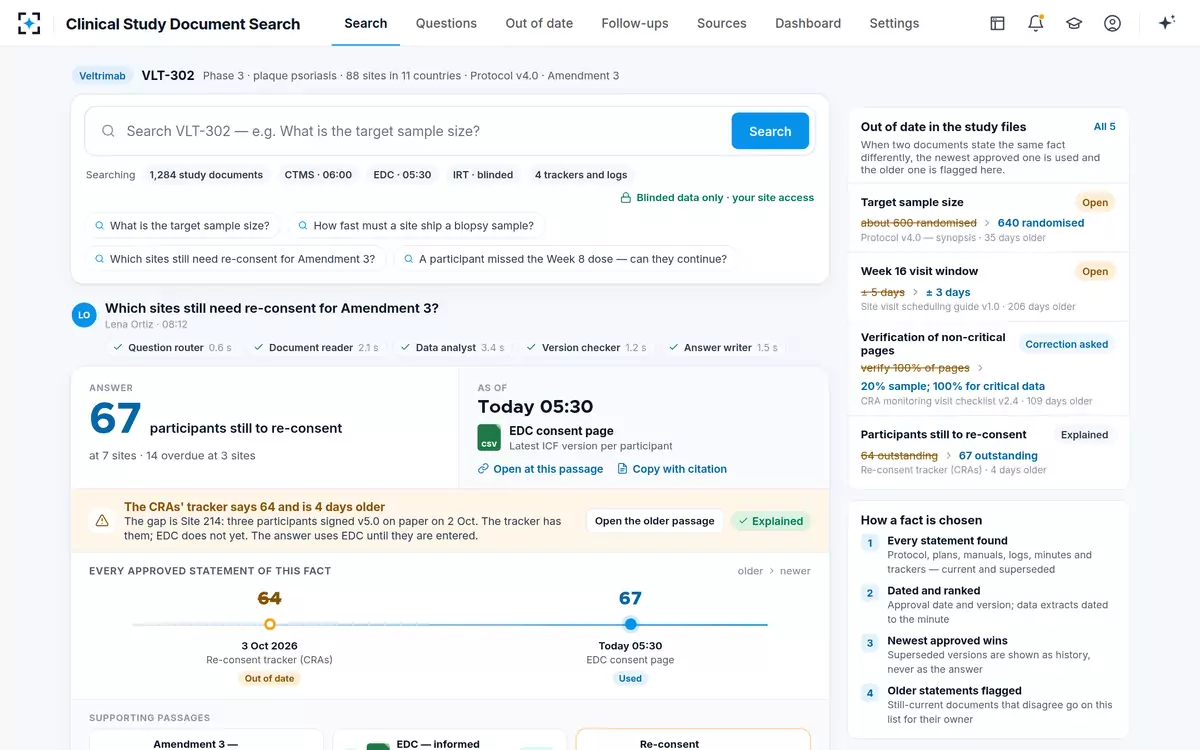
One search bar over the documents and both systems, in Clinical Study Document Search
Why do CTMS and EDC numbers disagree?
They disagree for four reasons, and only the last one is an error. They are about different subjects, so the same word counts different things. They are entered by different people, so one can know a fact days before the other. They are read at different times, so two extracts are two snapshots. And occasionally somebody typed the wrong thing.
The first reason is the one that produces the most argument in the most polite language. "Enrolled" in a CTMS often means randomised and counted by the study team; "enrolled" in an EDC means a participant with a randomisation record on a visit page. "On study" in a CTMS enrolment tile counts randomisations to date; in the EDC it counts people who have not yet discontinued. Neither number is wrong. They are answers to different questions that share a word.
The second and third reasons showed up on one morning in the sample study. Asked which participants still needed to sign the new consent form, the answer came back as 67, from the EDC consent page as of 05:30. The CRAs' own tracker said 64. The gap is three participants at one site who signed the new form on paper on 2 October: the CRA wrote them into the tracker the next day, and the site has not yet entered them in the EDC. The tracker is ahead of the EDC about those three people, and the tracker sheet itself is four days older than this morning's extract. Both statements are true, about different things, at different times.
One fact, three sources, three different days it became true
- Three participants sign the new consent form2 Oct
- One day behind the pen1 day
- Sheet dated 3 Oct — still the sheet quoted on 7 Oct4 days old by Wednesday
- Not entered: the answer still counts all three as outstanding6 days
- Entered 8 Oct8 Oct
Which raises the uncomfortable half of this example. On the three people in question, the tracker is the more current document — and the answer still uses the EDC, because the consent page is where the obligation is documented and the tracker is a working note about it. What makes that defensible is not the choice; it is that the other number, its date and the reason for the gap are printed next to it instead of being quietly dropped. Counting who still has to re-consent works through the same number source by source.
The two clocks: extract time, entry time and the paper in between
Every cross-system number carries two clocks, and teams routinely quote the first while meaning the second.
The extract clock is when the copy was taken. In the sample study that is 05:30 for the EDC, 06:00 for the CTMS and 06:00 for the blinded randomisation and supply system. A figure quoted at four in the afternoon from a copy taken at half past five in the morning is ten and a half hours old, however fresh the page it is printed on looks.
The entry clock is when a human put the fact into the system. It is the one that explains gaps, and it is recoverable, because an audit trail has to hold it. The FDA's questions and answers on electronic systems in clinical investigations set out what an audit trail must contain: "Audit trail components must include (1) the date and time the data element or information was entered or modified (see Q14), (2) the individual making the change (e.g., user ID and user role), and (3) the old value and the new value." The EMA guideline asks for the same pairing under its "Contemporaneous" principle: "The time point of the observation and the time point of the storage should be kept as part of the metadata, including the audit trail."
Between the two clocks sits the paper. Wet-ink consent forms, worksheets, pharmacy logs and a site coordinator's notebook are all facts that exist before any system knows them. In a study running across eleven countries the gap also has a time-zone problem, which ICH E6(R3) handles by asking for one unambiguous stamp: "Ensuring that the automatic capture of date and time of data entries or transfer are unambiguous (e.g., coordinated universal time (UTC));"
"Processes should be implemented to detect and/or avoid contradictions, e.g. by the use of standardisation, data validation and appropriate training."
EMA guideline on computerised systems and electronic data in clinical trials, ALCOA++ principle “Consistent”
Read in an operational light, that sentence is not a warning about sloppy data entry. It is an instruction to have a process whose job is to find contradictions — which is a different thing from having two good systems.
Which system is the source of truth in a clinical trial?
Neither, and a study that answers this question with a system name has answered the wrong question. Source is defined per datum. The protocol or a related document says, for each kind of data, where it is first captured and how it travels; the EMA guideline asks for that to be written down and drawn: "A detailed diagram and description of the transmission of electronic data (data flow) should be available in the protocol or a protocol-related document."
So the practical answer to "which one do I trust" is: look up the datum in the data flow description, and then quote the system that description names as its source, with the time your copy was taken. Where the study's own files have drifted, that lookup is also how a disagreement gets resolved rather than argued. ICH E6(R3) expects a study to be able to do the lookup at all: "The sponsor and investigator/institution should maintain a record of where essential records are located, including source records."
One caution about the phrase itself. "Source of truth" is borrowed from software architecture, where it means the one store that may be written to. A clinical trial has no such store, by design: the participant's own notes, the device, the site's paper and the sponsor's databases each hold part of the account, and the regulations describe how they relate rather than ranking them.
Where the eTMF, the IRT and the trackers fit
Three other things hold study answers, and each has a different relationship with the two systems.
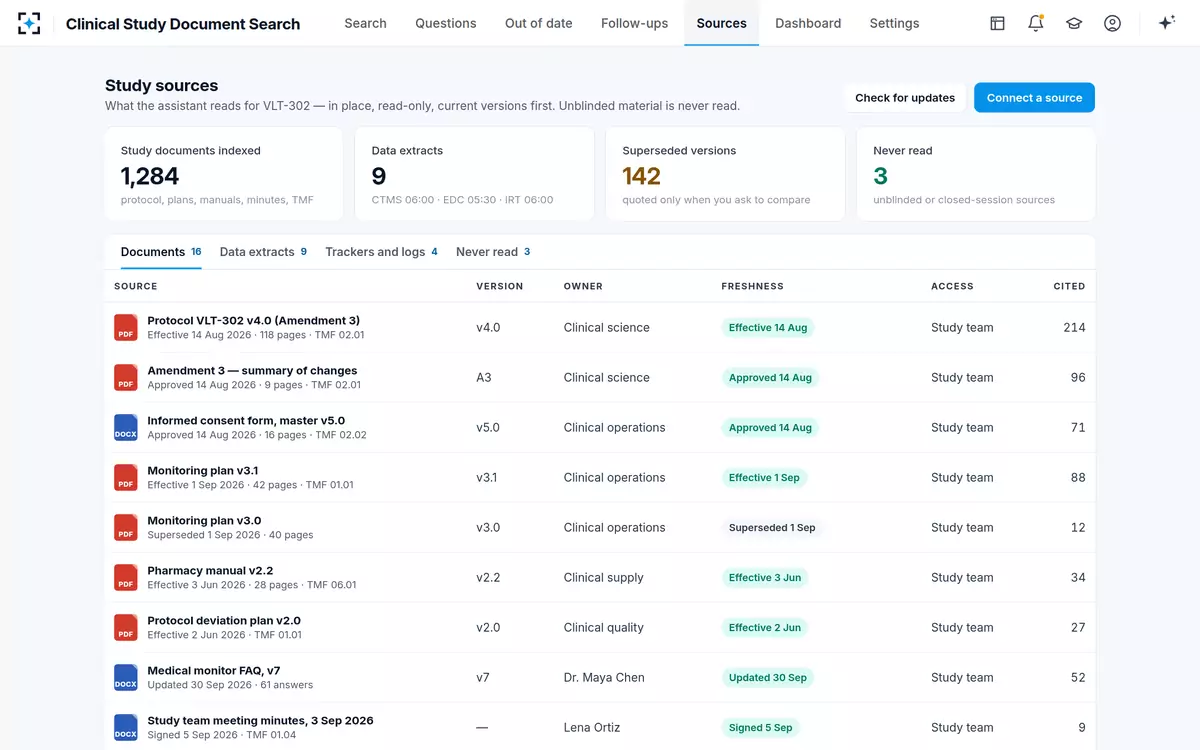
The eTMF is the study's filing — the protocol and its amendments, plans, manuals, contracts, approvals, minutes and decisions. Almost every rule a question needs is here, and almost no numbers are. Its weakness is version drift: a filed document is only correct until something supersedes it, and nothing in a filing system notices that a site guide now contradicts the protocol. What a document management system does and does not do for a trial takes that gap apart.
The randomisation and supply system holds kit allocation, shipments, temperature excursions and randomisation counts. Read in a blinded view it answers supply questions without touching treatment assignment; read carelessly it is the fastest way to unblind a study team. In the sample study only blinded views are read, and the treatment allocation list, unblinded dispensing logs and closed committee reports are excluded outright.
Then there are the trackers: the spreadsheets a CRA keeps because neither system answers the question she is asked every Monday. They are usually the most current statement of a fact and the least governed. A study that pretends they do not exist answers questions from the systems and then finds the team quoting the tracker in the meeting.
Every source an answer may use, with its version, owner and freshness
Questions neither system can answer, and where the answer lives
The questions that take a study manager longest are the ones with a rule on one side and a number on the other. How many visits fell outside their window last month needs the window from the protocol and the visit dates from the EDC. Whether a participant who missed a dose may continue needs the protocol's rule and that participant's dosing history. How far behind the enrolment plan the study is needs the plan's target, which lives in a document and may have moved since the protocol was written.
The table below is a lookup for twenty of them. It is worth reading as a map of where a study's knowledge actually sits: a third of these questions never touch a transactional system at all.
Twenty study questions, and the smallest set of sources that can answer each
| The question | Where the answer is | What you actually read |
|---|---|---|
| How many participants are randomised today? | Where the answer isEDC | What you actually readThe consent and visit pages, as of this morning’s extract. A randomisation count also sits in the blinded IRT. |
| What is the target sample size? | Where the answer isA document | What you actually readThe statistical analysis plan, and the protocol synopsis that may still state the earlier figure. |
| Which sites have ethics approval for the amendment? | Where the answer isCTMS | What you actually readApproval status and date by site, entered by start-up when the letter arrives. |
| Has this participant signed the newest consent version? | Where the answer isEDC | What you actually readThe informed consent page, one row per participant with the version signed. |
| What is the Week 16 visit window? | Where the answer isA document | What you actually readThe protocol’s schedule of activities — and often a site guide that restates it. |
| How many visits fell outside their window last month? | Where the answer isEDC + a document | What you actually readVisit dates from the EDC, the window from the protocol; neither answers alone. |
| Which sites have queries older than 30 days? | Where the answer isEDC | What you actually readQuery ageing is an EDC report; the CTMS may carry a stale summary of it. |
| When was this site last monitored, and by whom? | Where the answer isCTMS | What you actually readVisit scheduling and completion; the findings are in the signed monitoring report. |
| How much source verification does the plan require? | Where the answer isA document | What you actually readThe monitoring plan — and the visit checklist sites work from, which may disagree. |
| How many kits are left at this site? | Where the answer isBlinded IRT | What you actually readKit counts and shipments, read without the kit-to-arm list. |
| Which kits had a temperature excursion? | Where the answer isBlinded IRT + a document | What you actually readThe excursion from the IRT, the quarantine rule from the pharmacy manual. |
| A participant missed the Week 8 dose — can they continue? | Where the answer isA document | What you actually readThe protocol’s dosing and discontinuation rules, and the medical monitor’s own answers. |
| Which participants still need to re-consent? | Where the answer isEDC + a document | What you actually readThe consent page gives the versions signed; the amendment states who is in scope and by when. |
| How many protocol deviations were recorded this quarter? | Where the answer isCTMS + documents | What you actually readThe deviation log, plus deviations written up in signed monitoring reports and not yet logged. |
| Why was the enrolment target raised? | Where the answer isA document | What you actually readThe study decision log and the minutes behind it; no system holds a reason. |
| Has this site’s contract been signed? | Where the answer isCTMS | What you actually readStart-up milestones by site; the signed contract itself is filed in the TMF. |
| What is the screen-failure rate by country? | Where the answer isEDC | What you actually readScreening and randomisation pages; the CTMS enrolment summary will be a day or more behind. |
| What temperature must the drug be stored at? | Where the answer isA document | What you actually readThe pharmacy manual — and any quick-reference card printed from an earlier version of it. |
| Which participants are still on study at this site? | Where the answer isEDC | What you actually readDisposition pages; the CTMS enrolment figure counts randomisations, not people still on study. |
| Who owns the monitoring plan, and which version is current? | Where the answer isA document | What you actually readThe plan’s own approval page; the TMF index says which version is filed as current. |
Two rows deserve a warning. "Which document states this rule" is a question with more than one right answer, because a number written in the protocol is usually restated in a site guide, a checklist or a printed card — and those copies do not move when the protocol does. In the sample study the Week 16 visit window is stated as three days in the current protocol and five days in a scheduling guide issued before the amendment that narrowed it, and sites print visit cards from the guide. That one number, followed from the amendment to the deviations is a case study of its own. And "how many deviations were there" is a question whose answer is split across a log and a set of signed reports, which is why the sample study's answer to it comes back at low confidence and waits for a person.
What a cross-system answer has to show before you can use it
An answer that crosses a document and two systems is a small piece of evidence, and it should travel with the things that make it checkable. Six of them are worth insisting on, whether the answer was assembled by hand in forty minutes or by software in eight seconds.
Six things to settle before you trust a cross-system number
- Which extract, and taken when
Not "from the EDC" but "from the EDC extract of 05:30 today". Two systems quoted together need both times.
- Whose access the number was read under
A CRA filtered to her own sites and a study manager with all of them will get different totals from the same query, correctly.
- What is still on paper
Signatures, worksheets and pharmacy logs exist before any system holds them. Name the known gap rather than letting it surface as a discrepancy later.
- Which document states the rule
With its version, section and page — and whether another current document states it differently.
- The query, in words a person can check
What was counted, what was excluded and on which rows. A number nobody can reproduce is an opinion.
- Who signs it, and what the signature means
A working answer and a filed one are different objects. Say which this is before it is pasted into a slide.
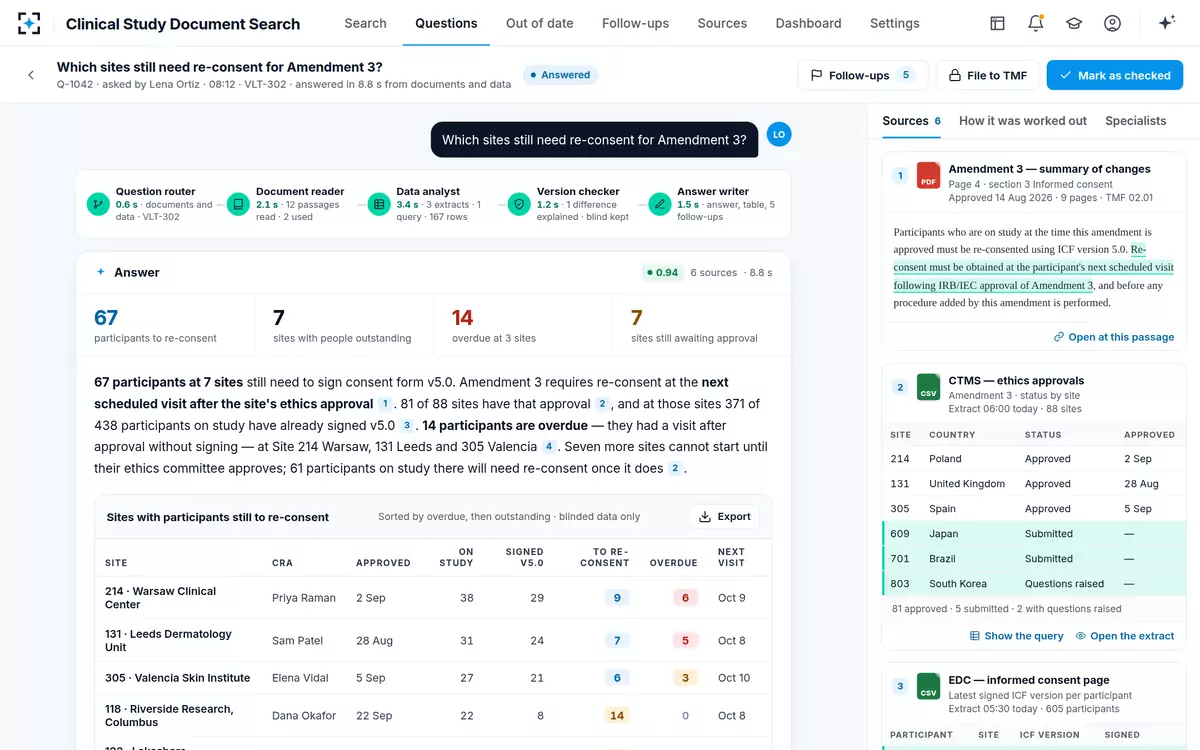
This is what Clinical Study Document Search puts around each answer. The question is routed to the smallest set of sources that can answer it, within the asker's site access; the document reader returns every statement of the fact with its document, version, page and section; the data analyst writes one read-only query over this morning's extracts and returns the rows it used; a version checker dates every statement and flags any still-current document that disagrees; and the answer leads with the number and the date it is true as of. Nothing is written back to the CTMS or the EDC, and no source document is edited — a disagreement is flagged for its owner.
A cross-system answer in Clinical Study Document Search: the rule, the number and every source
Where the number moved because the study itself changed, the document trail matters as much as the systems do: what a substantial amendment changes, and what it leaves behind covers the documents that quietly keep stating the old figure. To see a cross-system answer assembled end to end, start from Clinical Study Document Search.
Questions people ask
Do you need both a CTMS and an EDC?
For an interventional trial of any size, yes, because they hold different things: an EDC cannot tell you whether a site has ethics approval, and a CTMS cannot tell you a participant's visit date. Very small single-site studies sometimes run the operational side on spreadsheets instead of a CTMS, which works until the study has to show who did what and when. What should not be skipped is the written description of how data travels between whatever you use, which the EMA guideline expects in the protocol or a protocol-related document.
What does a CTMS do that an EDC does not?
It holds the study team's own work: site selection and start-up milestones, ethics submissions and approval dates by site, contracts and payments, the monitoring visit calendar and completion, action items, issues and the protocol deviation log. It also holds the trail of who did each of those things, which ICH E6(R3) expects a trial system to keep alongside direct data entry. None of that is participant data, and none of it belongs in an EDC.
Who owns the CTMS and who owns the EDC?
In many sponsors and contract research organisations, clinical operations owns the CTMS and data management owns the EDC, with a biostatistics stake in the EDC's design. The split matters when numbers disagree, because the two owners answer to different quality processes and often meet the discrepancy for the first time in a meeting. Naming an owner per question, rather than per system, is what stops that.
How often are CTMS and EDC extracts refreshed?
It is a study decision, not a product limit. In the fictional sample study the EDC extract is taken at 05:30 and the CTMS extract at 06:00 each morning, and every answer states which extract it used and when. The important discipline is not the frequency but the labelling: a daily extract is perfectly usable for most operational questions as long as nobody quotes it as "today's" at five in the afternoon.
Can a CTMS answer questions about the protocol?
Only indirectly. A CTMS usually carries the protocol version a site is approved for and links to the filed document, but it does not hold the protocol's content, so it cannot tell you the visit window, the dosing rule or the target sample size. Those are read from the protocol, the schedule of activities and the plans — and from the amendments that changed them.
What is source data in a clinical trial?
Source data is the first permanent capture of an observation, wherever that happens: a device output, a worksheet, a hospital note, or an EDC field where the protocol says the datum is recorded directly. The EMA guideline puts it as the first obtainable permanent data from an electronic data generation or capture, and asks that the protocol identify any data recorded directly into the data acquisition tools as source. The practical test is not which system holds the newest copy, but which place holds the first permanent one.