Maintaining the blind in clinical trials means keeping the treatment assignment out of reach of everyone whose judgement could be bent by knowing it — the participant, the site, the monitor, the sponsor's own study team — until every opportunity for that knowledge to bias the trial has passed. The hard part is no longer the sealed envelope. It is the access list: a modern study runs on a dozen systems, and anything that can read across them inherits whatever that list allows. Clinical Study Document Search is Botminds' search over one study's own documents and data, and it is built from the other end — the sources it may never read are named before it reads anything, and the access it applies on every question is the asker's own.
The study used as an example throughout is sample data, not a customer's: VLT-302, an invented Phase 3 trial of veltrimab in plaque psoriasis, with invented sites and invented people. The regulatory expectations are not ours. Each is attributed to the guidance that states it and linked where it appears.
What does maintaining the blind actually mean?
It means preventing identification of the treatments for as long as knowing them could change anything. ICH E9, the international guideline on statistical principles for clinical trials, puts the purpose in one line: "The essential aim is to prevent identification of the treatments until all such opportunities for bias have passed." The word to read twice is opportunities. The blind is not protecting a secret for its own sake; it is protecting every decision still to be made — whether this adverse event is treatment-related, whether this participant is evaluable, whether this protocol deviation is important, whether the analysis population should be defined one way or another.
That framing is what makes blinding an operational problem rather than a design one. A double-blind design is settled on paper once. Keeping it for years across 88 sites in 11 countries means that every person, every system and every export has to be reasoned about once, and then again each time one of them changes. ICH E6(R3), the Good Clinical Practice guideline adopted in January 2025, puts blinding into data governance for exactly that reason, and lists where the risk lives: "Maintaining the integrity of the blinding is important in particular in the design of systems, management of users' accounts, delegation of responsibilities with respect to data handling and provision of data access at sites, data transfers, database review prior to planned unblinding and statistical analysis across all appropriate stages of the trial."
Most of those are questions of access and handling; only the last is statistics. A sponsor that treats blinding as something the biostatisticians own has already lost the part of it that actually breaks.
When does data count as unblinded?
Earlier than most teams assume. The United States Food and Drug Administration draws the line not at the point where a treatment is named but at the point where results are looked at by arm, whatever those arms are called.
Of note, FDA considers the data to be unblinded when they are reviewed by treatment group (e.g., A versus B), whether or not the groups are identifiable.
FDA, Use of Data Monitoring Committees in Clinical Trials, draft guidance, February 2024 — not for implementation
Read that against the way study teams actually work and the consequences are immediate. A table of discontinuations with two unlabelled columns is unblinded data. A chart that splits any endpoint by a randomisation-derived variable is unblinded data. A search tool that is willing to group by a field it does not understand — "cohort", "group", "stratum A" — can unblind a trial without anyone involved intending to, and without the word "treatment" appearing anywhere on the screen.
The same draft guidance is equally plain about who may hold comparative interim results: "As emphasized, access to the accumulating comparative effectiveness data should be limited to the DMC and any statistical personnel involved in generating the interim analysis results for DMC review. Broader access unblinds the trial and could lead to bias." Broader access is the unblinding — not the use someone later makes of it. That is why a line drawn at intent ("nobody would look") is worthless and a line drawn at capability ("nobody can open it") is the only one an inspector can test. The guidance is a draft and carries the usual note that it is not for implementation; it states the agency's current thinking, and it is the clearest published statement of where the line sits.
The sources that must never be read, and who holds each
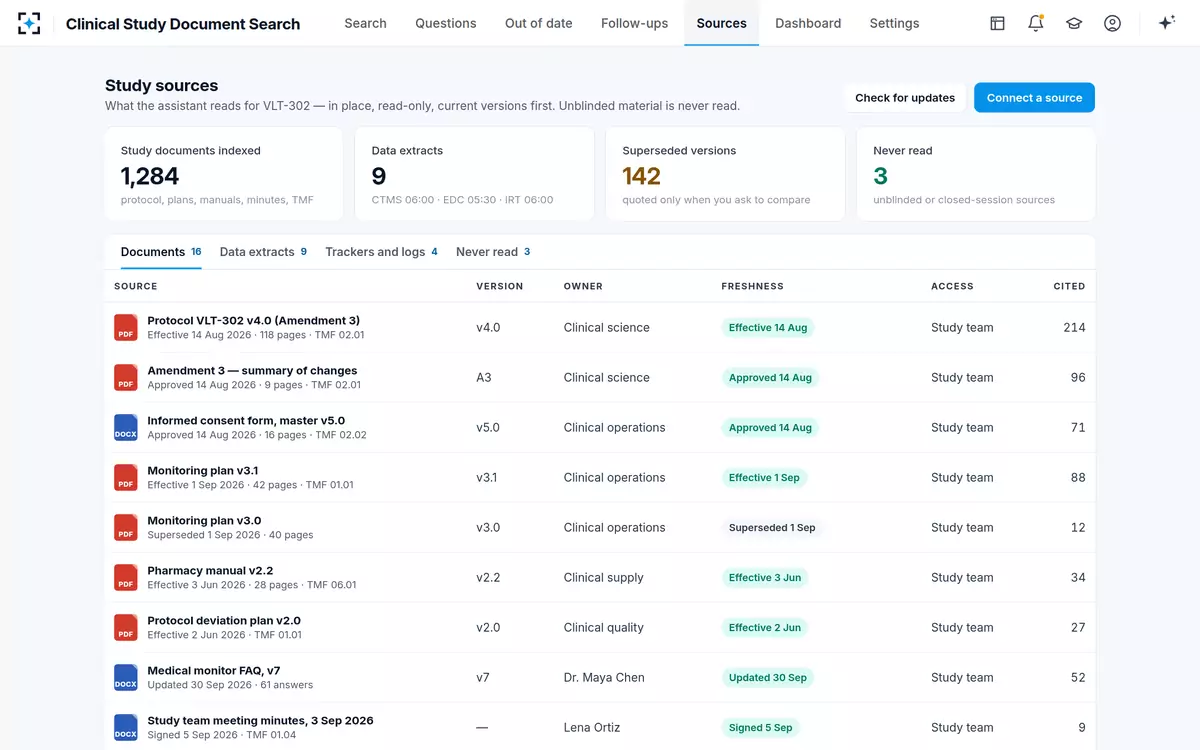
The practical form of that line is a list of sources, written down before anything is connected. On the sample study it has three entries, and they are visible in the product as their own panel rather than buried in a procedure: the interactive response technology treatment allocation list, the unblinded pharmacist dispensing logs held at the sites, and the closed-session reports of the data monitoring committee. Nothing in Clinical Study Document Search reads them, under any account, in answer to any question.
What it does read from the same randomisation system is the blinded part: kit numbers, temperature excursions, randomisation counts. The distinction is worth stating precisely, because it is where most of the engineering sits. "How many participants have been randomised at Site 214?" is a blinded question with a blinded answer. "How many were randomised to each arm?" is the allocation list wearing a different hat, and it is refused.
One study's sources against who may read them — the matrix behind Clinical Study Document Search
| Source | Study manager | CRA | Medical monitor | Independent statistician | The search |
|---|---|---|---|---|---|
| Protocol, amendments, plans and manuals | Read | Read | Read | Read | Read |
| Decision logs, minutes, trackers | Read | Read | Read | Read | Read |
| CTMS: sites, approvals, enrolment, deviations | Read | Own sites only | Read | Read | Read, filtered to the asker |
| EDC, blinded views: consent, visits, queries | Read | Own sites only | Read | Read | Read, filtered to the asker |
| IRT, blinded: kits, excursions, randomisation counts | Read | Own sites only | Read | Read | Read, filtered to the asker |
| IRT treatment allocation list | Never | Never | Never | Read | Never |
| Unblinded pharmacist dispensing logs | Never | Never | Never | Read | Never |
| Closed data monitoring committee reports | Never | Never | Never | Read | Never |
Writing the matrix down has a second effect, which is the one teams notice later: it forces someone to say who holds each unblinded source. On many studies that question has no single owner until it is asked. The allocation list sits with the randomisation vendor, the dispensing logs with the site pharmacies, the closed reports with the committee's own statistician — three different custodians, three different retention arrangements, and no one page that says so.
Firewalls: the people who may see unblinded data, and what they may not also do
Some people have to be unblinded. The independent statistician who prepares the committee's tables, the pharmacist who dispenses, the bioanalytical scientist running assays where the compound is obvious, the safety physician expediting a suspected unexpected serious adverse reaction. The rule is not that nobody sees; it is that whoever sees is kept away from the decisions their knowledge could bend.
FDA's draft guidance on data monitoring committees names the mechanism: "One helpful approach that could be considered is maintaining appropriate firewalls between such safety review entities and those directly involved in the conduct of the trial". ICH E9 had asked for the same thing in 1998, in the language of its time: "If any of the sponsor staff who are not involved in the treatment or clinical evaluation of the subjects are required to be unblinded to the treatment code (e.g. bioanalytical scientists, auditors, those involved in serious adverse event reporting), the sponsor should have adequate standard operating procedures to guard against inappropriate dissemination of treatment codes."
E6(R3) turns it into a documentation duty: "Roles, responsibilities and procedures for access to unblinded information should be defined and documented by all relevant parties according to the protocol". Three points follow for anyone writing that document. Name the roles, not the individuals, so the arrangement survives staff turnover. Say what each unblinded role may not also do — the unblinded monitor who may verify drug accountability at a site but may not discuss a participant's response with the investigator is the standard example. And put the same list into every system's access configuration, because a firewall that exists only in a procedure is a sentence, not a control.
Site access as part of the blind: why a CRA sees only their own sites
Site-level access is not blinding in the textbook sense, but it belongs in the same access design. A clinical research associate who can see every site's enrolment, query ageing and deviation rate can compare sites in ways the monitoring role does not need. More immediately, it is a confidentiality problem between investigators who are, in a commercial study, each other's competitors for recruitment.
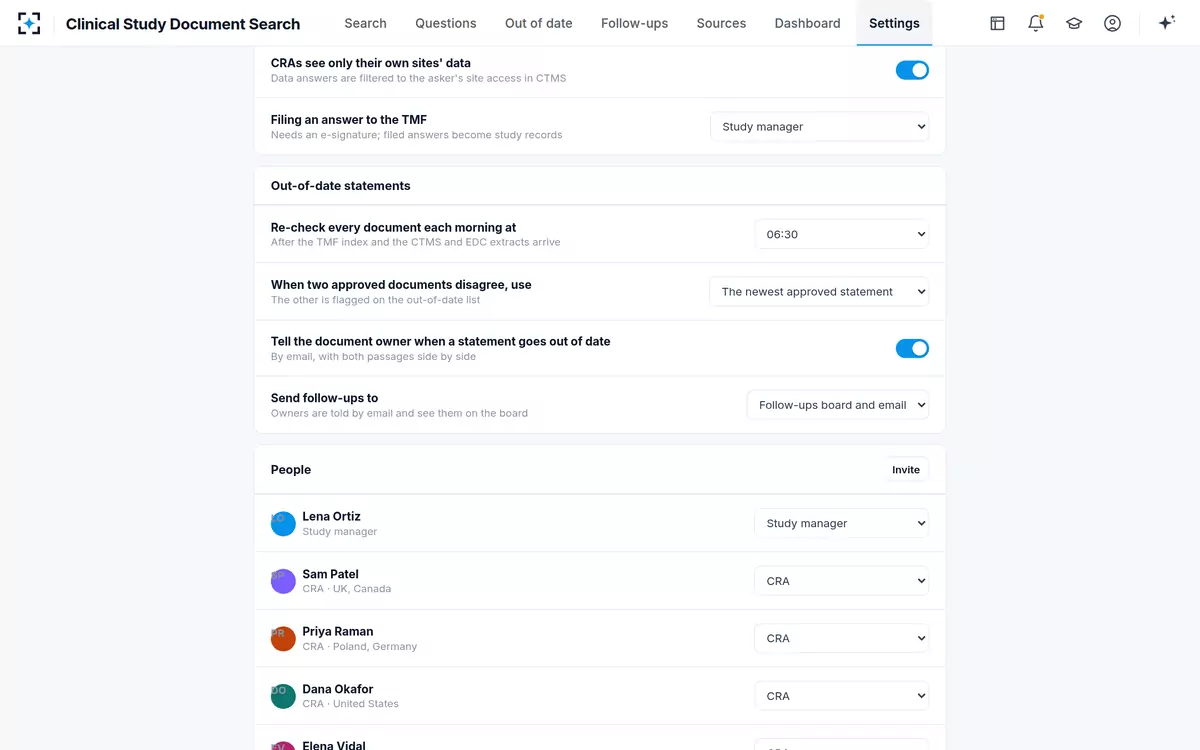
E6(R3) lists "provision of data access at sites" among the places blinding integrity is won or lost, and the sample study's settings take it literally. Data answers are filtered to the asker's site access as held in the clinical trial management system, so Sam Patel, the fictional CRA for the United Kingdom and Canada, gets United Kingdom and Canadian rows to the same question that returns all 88 sites to the study manager. The filter is applied to the query, not to the answer after it is written, which matters: a number computed over everything and then trimmed has already leaked into the sentence above it.
Access and blinding as settings, not as a promise — Clinical Study Document Search
What has to be documented when unblinding happens anyway
It will happen. A participant presents at an emergency department and the treating physician needs the code; a pharmacist breaks a kit seal in the wrong order; an export is built with one column too many. E6(R3) treats all of it the same way: "Any planned or unplanned unblinding, including inadvertent or emergency unblinding, should be documented. Any unplanned unblinding should be assessed for its impact on the trial results, and actions should be taken as appropriate."
Two obligations sit inside that sentence and they are often confused. The first is a factual one: who was unblinded, for which participant, when, by what route, and on whose authority. Randomisation systems typically record that automatically. The second is a judgement: what this does to the trial's results. That one needs a person — usually the medical monitor and the trial statistician together — and it needs writing down even when the answer is "nothing", because an inspector reading a list of eleven emergency unblindings with no impact assessments beside them cannot tell the difference between a sponsor that considered each one and a sponsor that did not.
An inadvertent unblinding has a third obligation the other two do not: find out how it became possible, and close that route. An export that could be built once can be built again.
Designing for it: user accounts, roles and access as a blinding control
Every requirement above lands in the same place — the configuration of the systems a study runs on. The checklist below is the form that takes for anything that reads across a study. It is written for the solution on this page, and it applies equally to a data warehouse, a reporting layer or an assistant bought from anyone.
Eight checks before a search is allowed to read a blinded study
- The never-read list exists, by name, before anything is connected
Allocation lists, unblinded dispensing logs, closed committee reports and any export derived from them — named as sources, with their custodian, not described as a category.
- Access is the asker’s own, not the service’s
Questions run with the permissions of the person asking. A tool with its own privileged account has the union of everyone’s access and keeps it after they leave.
- Site filtering is applied in the query, not to the answer
A figure computed across all sites and then hidden has already been computed. The filter belongs where the rows are selected.
- Every query is read-only
Nothing writes back to the randomisation system, the clinical trial management system or the electronic data capture system. A read-only path cannot corrupt a blind by correcting it.
- No treatment-arm field is reachable, under any phrasing
Including derived and renamed ones. Test it adversarially: ask for the split by cohort, by group, by stratum, by kit series, and confirm each is refused.
- Access and role changes are logged and reviewable
Account creation, role changes, permission changes and who read what — kept for the trial’s retention period, searchable by person and by date.
- The documented unblinding route runs outside the tool
Emergency unblinding stays in the randomisation system where it is authorised and recorded. A search is not an unblinding channel and should not be a convenient alternative to one.
- Who holds what is reviewed on a schedule
At every amendment, at every staff change, and at least at each periodic quality review. Access lists decay quietly; nothing fails until the day it matters.
The evidence an inspector asks for
A blind that cannot be shown is hard to defend. The useful question at an inspection is not "were you careful" but "show me what this account could reach, and when that changed". E6(R3) puts the expectation on the system rather than on the team, in its list of what computerised systems should do: "Computerised systems maintain logs of user account creation, changes to user roles and permissions and user access;"
Expect four things to be asked for, and have them ready. One: the list of sources the system can reach, with the never-read ones named and dated. Two: the roles, and what each may open — the matrix above, as configured, not as designed. Three: the log of who held which role when, so a question about last March can be answered about last March. Four: the unblinding record, with an impact assessment against each unplanned entry.
The first of those is a screen in the product rather than a document somebody maintains, which removes the commonest failure: a procedure that described the configuration accurately on the day it was approved.
The sources a study is read from — and the three that are never read
What a read-only, blinded answer looks like in practice
Take a real-shaped question from the sample study. Dana Okafor, a fictional CRA, asks which sites had investigational product temperature excursions in the last 30 days. It needs a rule from the pharmacy manual and counts from the randomisation system — exactly the kind of question that tempts a team to open something it should not.
One question through Clinical Study Document Search, and what no step may do
Agent
Question routerDecides the question needs the pharmacy manual and the blinded kit data, and picks the smallest set of sources that can answer it.
Never: routes to an unblinded source, or past the asker’s site access
Agent
Study document readerFinds the excursion rule in the current manual and returns the passage with its version, section and page.
Never: answers from a superseded version without saying so
Agent
Study data analystWrites one read-only query over this morning’s blinded extracts and returns the rows behind the count.
Never: writes to any system, or reads outside the asker’s sites
Agent
Version checkerDates every statement behind the answer and flags any still-current document that disagrees with it.
Never: edits a source document — it flags it for its owner
Agent
Answer writerWrites the number first, with numbered citations to the passage and the rows used.
Never: makes a claim without a citation
A person decides
The CRA, then the study managerReads the answer, checks anything the product marks uncertain, and decides what to do about it.
Never: is replaced — the answer is a working note until a person files it
The shape of the answer matters as much as the path to it. A blinded answer names the rule, gives the count, cites both, and stops. An unblinded one would have offered the comparison nobody asked for.
The same study question, handled two ways
A general-purpose assistant on the same systems: Whatever its service account can reach, which can be everything the integration was given.
Clinical Study Document Search: A named list of sources, minus three that are never read, minus anything outside the asker’s site access.
A general-purpose assistant on the same systems: A fluent paragraph, often with a helpful breakdown by whichever grouping column it found.
Clinical Study Document Search: The value, the date it is true as of, the document version and section, and the rows behind it.
A general-purpose assistant on the same systems: Anyone with a login; the answer is the same for everyone.
Clinical Study Document Search: Anyone on the study; the answer is computed with that person’s own access.
A general-purpose assistant on the same systems: A renamed treatment field read as an ordinary category.
Clinical Study Document Search: Nothing silently: a refused source is refused by name, and a disagreement between documents is shown rather than resolved quietly.
A general-purpose assistant on the same systems: A chat history, usually outside the trial’s records.
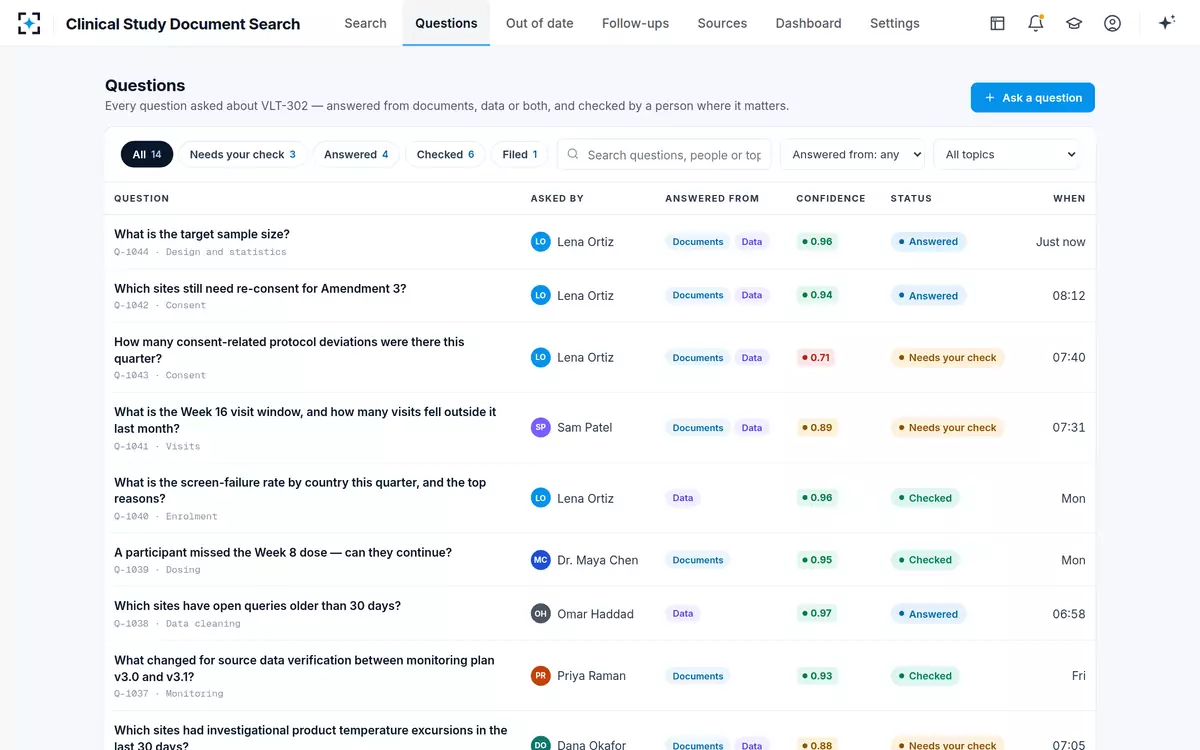
Clinical Study Document Search: Who asked what, from which sources, with what confidence — and an e-signature when an answer is filed.
Two sibling questions sit either side of this one. Whether a number should come from the clinical trial management system or the electronic data capture system is settled in CTMS vs EDC: which system holds the answer you need. The one blinded analysis that deliberately looks at pooled data, and the care it takes to stay blinded, is worked through in blinded sample size re-estimation. And where the authority line sits between what specialists prepare and what a person signs is the subject of what the agents do, and what you sign.
Every question asked, with its sources and its confidence
Questions people ask
Who is allowed to see unblinded data in a clinical trial?
Only the roles the protocol and the trial's procedures name, and only for the purpose they are named for. The data monitoring committee and the statistical personnel preparing its tables are the central case; FDA's draft guidance says access to accumulating comparative data should be limited to them, because broader access unblinds the trial. Around that sit roles that must be unblinded for operational reasons — the dispensing pharmacist, an unblinded monitor, bioanalytical staff, sometimes safety reporting — each kept behind a firewall from the people conducting the trial.
What is an unblinded monitor?
A monitor who is deliberately given access to treatment assignment so they can do work that requires it, most often drug accountability and dispensing checks at the site pharmacy. The role exists so the blinded monitor never has to open the pharmacy's records. Its defining feature is what it may not also do: an unblinded monitor does not assess participant response, does not discuss efficacy with the investigator, and usually reports along a different line, because the whole point is to keep the knowledge inside one person's remit.
Can sponsor staff see interim results by treatment group?
As a rule, no. FDA considers data unblinded the moment they are reviewed by treatment group, whether or not the groups are identifiable — so "A versus B" with no labels is still unblinded, and sponsor staff holding it have been unblinded. The exceptions are the firewalled roles the trial has documented in advance, and ICH E9 asks for standard operating procedures that guard against the treatment codes spreading further once someone has them.
What is the risk of inadvertent unblinding?
Bias that cannot be undone and cannot be measured. Once someone involved in evaluating participants knows the assignment, their later judgements — relatedness of an adverse event, whether a deviation matters, whether a participant is evaluable — are no longer independent of it, and no analysis can separate the effect out afterwards. That is why E6(R3) asks for every unplanned unblinding to be assessed for its impact on the trial results, and why the engineering effort goes into making the route impossible rather than discouraged.
Can a CRA see data from other sites?
That is the sponsor's decision, and many studies say no. A common configuration restricts each monitor to the sites they are assigned, both for the participating investigators' confidentiality and to keep cross-site comparison out of the monitoring relationship. On the sample study it is a setting, applied inside the query so that figures for other sites are never computed, and a study manager or medical monitor sees the whole trial.
How do you prove the blind was kept?
With configuration and logs, not assurances. An inspector can be shown the list of sources each system can reach with the never-read ones named, the roles and what each may open, the log of user account creation and of changes to roles, permissions and access that E6(R3) asks computerised systems to keep, and the unblinding record with an impact assessment against every unplanned entry. Anything that rests on what people remember about an access change three years ago is not evidence.