A substantial amendment in a clinical trial is a change to an authorised trial — its protocol or its supporting documents — that is likely to have a significant effect on participants' safety or rights, or on the reliability of the data the trial produces. The phrase comes from the older European and UK rules; the EU Clinical Trials Regulation and, since 28 April 2026, the UK call the same thing a substantial modification, and the US asks for a protocol amendment. Nothing in any of these tests is about length: a single altered number can be substantial and a rewritten appendix need not be. The hard part comes after approval. One approved change can leave a dozen documents that restate the old figure — a synopsis, a site scheduling guide, a monitoring visit checklist, a pharmacy card, three trackers — and no role on a study team owns the question of which ones they are. Clinical Study Document Search, Botminds' search over a study's own documents and data, exists partly to answer that question: it finds every statement of a fact across the study's files, uses the newest approved one, and lists the still-current documents that now disagree, each with an owner and a date.
The screens here come from the fictional sample study the solution ships with: VLT-302, a Phase 3 study of veltrimab in plaque psoriasis at 88 sites in 11 countries, now on Protocol v4.0 after Amendment 3. The people and the sponsor are invented. The regulatory material and the published research are real, and linked where they appear.
What the published research measures about protocol amendments
72.1%
of non-oncology protocols had at least one amendment — and 91.1% of oncology protocols
Published figures: 950 protocols from 16 companies (Botto, Smith and Getz, 2024)
3.0and 4.0
amendments per protocol, non-oncology and oncology
Published figures, same study
$141,000
median direct cost of implementing one substantial amendment in a phase II protocol; $535,000 in phase III
Published figures: 52 protocols (Getz et al., Tufts CSDD, 2016)
5
facts on one morning’s out-of-date list in a sample study, each stated two ways
Seen in the solution, on its fictional sample study
What counts as a substantial amendment in a clinical trial?
The European Union's Clinical Trials Regulation needs one sentence: it defines a substantial modification as any change to any aspect of an authorised trial that is likely to have a substantial impact on the safety or rights of the participants, or on the reliability and robustness of the data the trial generates. The United Kingdom's guidance for changes made from 28 April 2026 uses nearly the same words for its main category: "Route A substantial modifications are likely to have a substantial impact on the safety or rights of the participants or on the reliability or robustness of the data generated in the trial". Under both, a study team has to make a judgement about effect before it knows which process applies — and in the UK the guidance puts that judgement squarely on the sponsor: "It is the sponsor's responsibility to assess, using a risk-based approach, whether a modification is substantial, minor or a modification of an important detail."
Two features of that test trip teams up. The first is that it is prospective and probabilistic: "likely to have a substantial impact" is a forecast, not a measurement, so two reasonable people can disagree and the file has to show which view was taken and why. The second is that it attaches to the change, not to the document: a change to a laboratory manual or an investigator's brochure can be substantial, and a change to the protocol body can be minor.
ICH E6(R3)'s glossary defines a protocol amendment as nothing more than a written description of what changed in a protocol. That definition is deliberately thin, and it carries an obligation that study teams under-use. ICH E6(R3) asks that the protocol carry its own identity on its face — "Protocol title, unique protocol identifying number and date. Any amendment(s) should also bear the amendment number(s) and date(s)." A number and a date on every version are what make the question "is this the statement in force?" answerable at all. A document that states a rule without saying which amendment it belongs to cannot be checked, only trusted.
The older four tests, and the wording that replaced them
Teams trained under the older rules learned a four-part test. The MHRA's earlier guidance put it this way — "You only need to submit substantial amendments to the MHRA. Changes count as a substantial amendment to your clinical trial authorisation if the amendment is likely to affect to a significant degree:" — followed by the four limbs below. That page now carries its own warning that it applies only before 28 April 2026. The four limbs remain a useful checklist for the kinds of change that usually meet the newer, shorter test.
The four limbs of the older UK test, still a useful checklist
1
“the safety or physical or mental integrity of the subjects of the trial”
A new exclusion, a changed dose, an added procedure, a new safety monitoring rule.
2
“the scientific value of the trial”
A changed endpoint, a changed analysis population, a changed sample size or power assumption.
3
“the conduct or management of the trial”
A new country, a changed visit schedule or window, a change of sponsor or of a key provider.
4
“the quality or safety of any investigational medicinal product used in the trial”
A new manufacturing site, a changed formulation, a changed storage or stability condition.
One procedural rule surprises teams in the middle of a transition. The UK's current guidance lists a change of sponsor as a modification of an important detail rather than a substantial one, and warns that "certain modifications of an important detail cannot be submitted at the same time as any other modification." Before bundling a sponsor change with anything else — a safety-driven change in particular — check which of the two can wait.
Non-substantial amendments: still recorded, still consequential
A change that is not substantial does not go to the regulator for review, and that is where study teams quietly lose control of their own documents. The UK's current guidance is explicit that a minor change is still a recorded one: "The sponsor must keep records of any modifications implemented and, if requested, make them available to the licensing authority or ethics committee." Nothing about the operational cascade depends on the label. A non-substantial correction to a schedule of activities still changes what a coordinator books. A clarified laboratory handling instruction still changes what a site does with a sample. The ethics committee may still need to be told, the sites certainly do, and the documents that restate the changed text still need re-issuing.
The asymmetry is worth naming plainly: substantial amendments get a process, a tracking number, a date and a file; non-substantial ones often get an email. Six months later the email is the only evidence that a site was ever told, and the printed card on the pharmacy wall still says the old number.
What the United States asks instead: the protocol amendment under 21 CFR 312.30
The US regulations for studies under an investigational new drug application do not use the word "substantial". They describe when a sponsor must file a protocol amendment, and the trigger is written in terms of safety, scope and scientific quality: a sponsor must submit a protocol amendment for any change that significantly affects the safety of subjects in a Phase 1 protocol — and, in a Phase 2 or 3 protocol, for any change that significantly affects subjects' safety, the scope of the investigation or the scientific quality of the study.
Two timing rules follow, and they pull in opposite directions. The default is that the paperwork comes first: "A sponsor shall submit a protocol amendment for a new protocol or a change in protocol before its implementation." The exception is for danger: a change meant to eliminate an apparent immediate hazard to subjects may be made at once, provided FDA is told afterwards by protocol amendment and the reviewing IRB is notified under § 56.104(c).
A sponsor running the same study in several regions therefore has one scientific change, several regulatory characterisations of it, and several approval clocks that do not start or finish together. That is the structural reason an amendment's effective date differs by site, and why a study with 88 sites in 11 countries has, for a period, two correct answers to "which protocol version is in force" depending on which site is asking.
What does a substantial amendment cost, and how many does a protocol get?
Two peer-reviewed studies from the Tufts Center for the Study of Drug Development give usable figures, and they measure different populations, so they should be quoted separately rather than averaged.
The earlier study pooled data from 836 phase I to IV protocols and reported that 57% of protocols had at least one substantial amendment, and that close to half of those amendments (45%) were judged avoidable. From a subset of 52 protocols it derived the cost: a median direct cost of US$141,000 to implement a substantial amendment in a phase II protocol, and $535,000 in a phase III protocol. Those are direct implementation costs — the work of writing, approving, submitting, re-training and re-papering — not the cost of the delay.
What one substantial amendment cost to implement, at the median
The later benchmark used data from 950 protocols contributed by 16 companies and split them by therapeutic area. Its headline comparison is the one to quote when someone asks how many amendments are normal: oncology protocols were amended significantly more often — 91.1% had at least one amendment, against 72.1% of non-oncology protocols — and more times, 4.0 amendments on average against 3.0. Its conclusion is blunt: industry efforts to prevent avoidable amendments have failed in oncology.
What each study counted, and for which protocols
| Study and population | Protocols | Share with an amendment | Amendments per protocol |
|---|---|---|---|
| Tufts CSDD amendment study, phase I–IV protocols (2016) | 836 | 57% had at least one substantial amendment | 2.2 in phase II, 2.3 in phase III (global amendments) |
| Non-oncology protocols, 2024 benchmark | 701 | 72.1% had at least one amendment | 3.0 |
| Oncology protocols, 2024 benchmark | 249 | 91.1% had at least one amendment | 4.0 |
A fair reading of both: most protocols are amended at least once, oncology protocols almost always, and the direct cost of a substantial amendment runs into six figures before anybody counts the delay. What neither study measures is the cost of the documents an amendment fails to update. That one has to be read from a study's own deviation log.
The cascade: one approved change, and every document that restates it
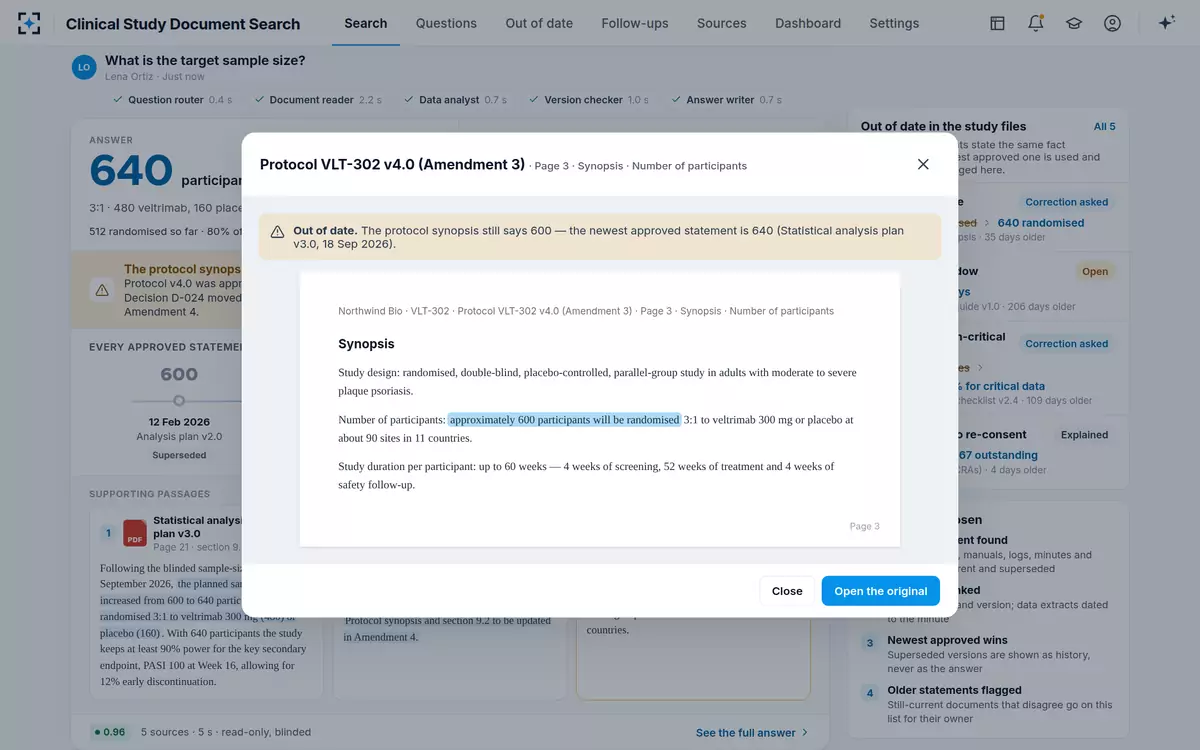
Here is how it happens on a study that is doing everything properly. In the sample study the protocol was approved as v4.0 on 14 August, with a synopsis stating that approximately 600 participants will be randomised. A blinded review on 11 September found pooled discontinuation running at 11.8% against the 8% assumed. On 16 September the steering committee recorded decision D-024 to raise the target to 640, noting that the synopsis and section 9.2 would be updated in Amendment 4. The statistical analysis plan v3.0 was approved on 18 September with the new figure. Why a blinded review can move the target at all is a separate story; what matters here is what happened to the paperwork.
One number, from protocol approval to the correction’s due date: 68 days
- Synopsis says 60014 Aug · 35 d
- Analysis plan says 64018 Sep · 19 d
- Correction raised7 Oct → 21 Oct
Note what did not go wrong. No document was approved carelessly; no rule was broken; the correction was consciously deferred to the next amendment, which is ordinary practice. The gap is structural. Between 18 September and whenever Amendment 4 is approved, the study holds two current approved documents that state the same fact differently, and a reader who opens the protocol first gets the old number with every appearance of authority.
The older statement, opened at its page and marked out of date
Which documents must change, which must be told, and which nobody remembers
An amendment's document list is longer than its submission package, and the last two groups below are where the deviations come from. The categories are stable across studies; the owners and the lead times are not.
What an amendment touches: six groups of documents, and the one nobody lists
- Submitted: the amendment package itself
Protocol with the amendment number and date, summary of changes, revised consent materials, investigator brochure if affected, and the regional forms. These are tracked because a regulator is waiting for them.
- Approved in step: the plans that depend on the protocol
Statistical analysis plan, monitoring plan, pharmacy and laboratory manuals, deviation plan, data management plan. Each has its own approval route, and each can land weeks after the protocol it follows.
- Derived: what sites actually work from
The protocol synopsis, the schedule of activities, site scheduling guides, printed visit cards, monitoring visit checklists, pharmacy quick-reference cards, training slides, the trackers each function keeps. Nobody submits these, so nobody chases them.
- Configured: the systems built from the protocol
EDC forms and edit checks, randomisation and supply settings, visit windows in scheduling tools. These change on their own release calendar, per site, and only after that site’s approvals are in place.
- Told, not changed: the people and the parties
Sites and investigators, the ethics committees of record, central laboratories and other providers, and — where the study is registered publicly — the registry entry.
- The one nobody lists: documents that merely restate a changed number
A figure copied into a checklist two versions ago is not on anyone’s amendment plan, because the amendment plan was written from the protocol, not from the study’s own files.
In the sample study, the last group is not hypothetical. A monitoring visit checklist issued on 15 May still instructs CRAs to verify 100% of pages, while the monitoring plan approved on 1 September calls for a 20% sample with 100% verification only for critical data — a 109-day gap, now with a revised checklist in review. A pharmacy quick-reference card printed in January stated a 60-minute limit outside the 2 to 8 °C range, against the 30 minutes in the pharmacy manual approved in June — a card 144 days older than the manual that replaced it — and a corrected card has since gone to all 88 sites. A visit window that sites kept booking from the wrong document follows a third one all the way to the deviations it produced.
What the public record shows — and how far behind it is
It is reasonable to ask whether any of this can be seen from outside. It mostly cannot. The largest public registry holds a record for every registered study, but a protocol document for fewer than one in ten, and a version history for almost none.
Protocol versions in the public registry, counted on 28 October 2026
Studies registered
608,904
Every study with a record in the registry, of any phase, sponsor or country.
Studies with a protocol document posted
52,729
Our arithmetic: 8.7% of registered studies. Posting a protocol is required only for certain applicable trials with results.
Studies that posted more than one protocol document
550
Our arithmetic: one in a hundred of the studies that posted a protocol at all, and under one in a thousand of all registered studies.
Median days from a posted protocol’s own version date to the day it was posted
679
About 72% of posted protocols reached the public more than a year after the date printed on their own cover.
Two conclusions follow for anybody trying to answer a protocol question from the public record. A registry entry is a summary, not a document: it carries the current recruitment status and outcome measures, not the visit window or the analysis population. And where a protocol is posted, it is usually posted long after the version it describes was in force — a median of 679 days in our count — so it answers what the study used to say, not what it says now. The study's own files are the only current record, which is precisely why their internal consistency matters so much.
The one list an amendment should produce before it closes
Every amendment produces a change list. Almost none produces its inverse: the list of every other document that now says something false. That second list is cheap to describe and expensive to build by hand, because it requires reading the study's whole file set against one changed fact, and then doing it again for the next fact.
Made mechanical, it is a short daily job. In the sample study every document is re-checked each morning after the file index and the extracts arrive — 1,284 documents on the day shown, six of them new since the previous day — and every fact that two current documents state differently appears on one list with the older wording, the newest approved wording, how much older the first is, its owner and its status.
The out-of-date list in Clinical Study Document Search: what an amendment left behind
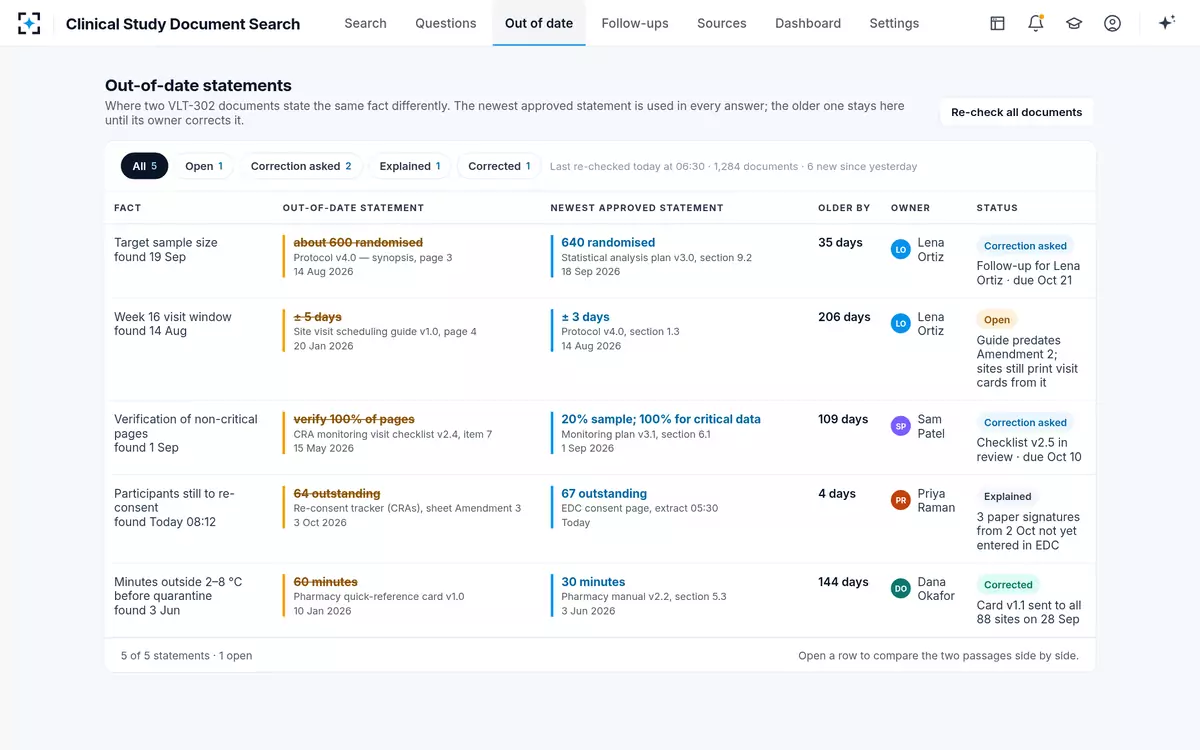
What turns a list into a closed loop is an owner and a date. In the sample study each row can be turned into a follow-up for the person who owns the document — the synopsis correction goes to the study manager, due 21 October, to be carried in the Amendment 4 change list — and the solution never edits a source document itself. Where the difference turns out to be explained rather than wrong, it is marked as explained and stays visible, which is the honest outcome for a case like the four-day consent lag that counting outstanding re-consents works through.
One row, one owner, one due date
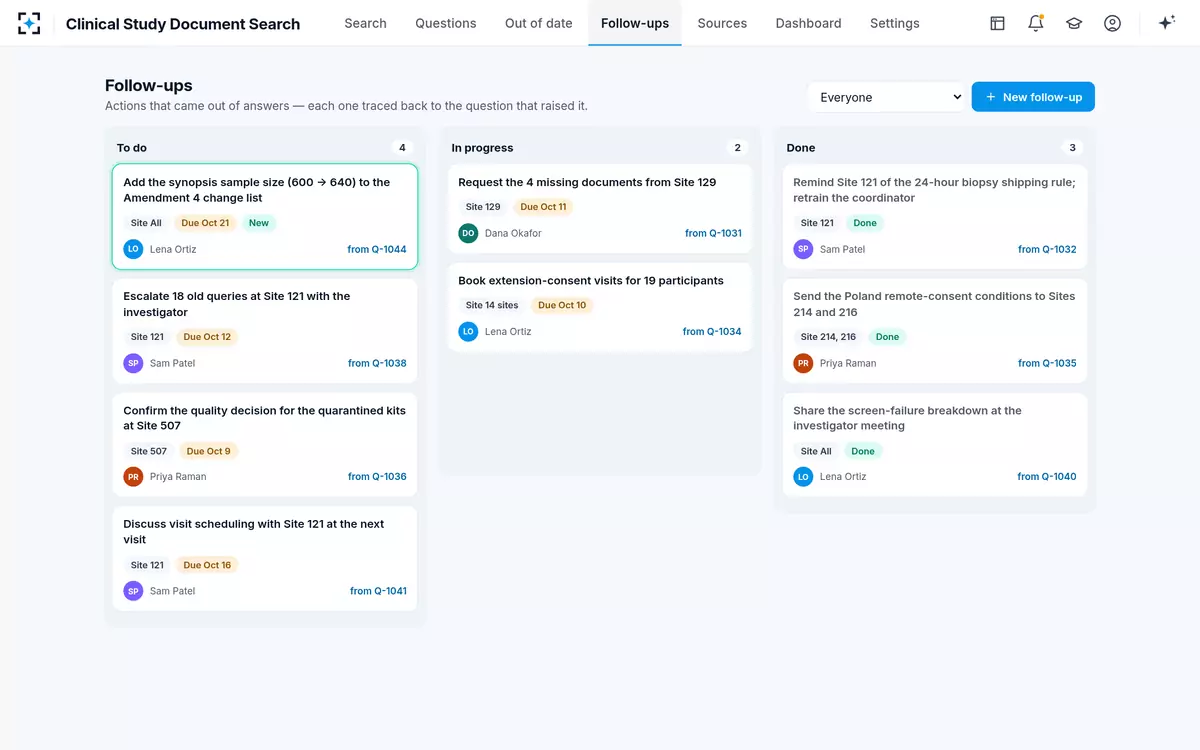
The discipline this adds to an amendment is small and specific: before the amendment is closed, ask the study's own files which other documents now state the changed fact, fix or explain each one, and record which. To see that run on a study, start from Clinical Study Document Search.
Questions people ask
Who approves a protocol amendment?
Three parties, in sequence, and all three must be satisfied before the change takes effect at a given site: the sponsor approves the amended document internally, the regulator of each country accepts the submission where the amendment is substantial, and each site's ethics committee or institutional review board gives its own approval. Because the three clocks run at different speeds, the effective date of an amendment is a per-site fact, not a study-level one.
Does a protocol amendment need FDA review before it is implemented?
For studies under an investigational new drug application, the regulation requires a protocol amendment to be submitted before the change is implemented. Submission is not the same as waiting for a decision — the sponsor may generally proceed once the amendment has been submitted and the reviewing board has approved it, unless the study is on clinical hold.
When can a protocol change be made immediately?
When it removes an immediate danger. The regulation allows a change intended to eliminate an apparent immediate hazard to subjects to be implemented at once, provided the FDA is notified afterwards by protocol amendment and the reviewing board is notified as well. This is the one route that reverses the usual order, and it is narrow: it covers eliminating a hazard, not a convenient operational fix made under time pressure.
Do you have to update the informed consent form for every amendment?
No. The consent materials change when the amendment changes something a participant was told or should now be told — a new risk, a new procedure, a changed duration. An amendment that alters only an analysis method or an internal monitoring approach may leave the consent form untouched. Where the materials do change, they must be approved before they are used, and the separate question of which already-enrolled participants must sign again is decided by whether the new information could affect their willingness to continue.
Are clinical trial protocols publicly available?
Usually not, and almost never as a version history. Of 608,904 studies in the largest public registry on 28 October 2026, 52,729 had posted a protocol document and 550 had posted more than one version of it, by our count of the registry's public interface. Posted protocols also arrive late: the median gap between the version date printed on the document and the day it was posted was 679 days.
What is the difference between a substantial and a non-substantial amendment?
Only the forecast effect. A substantial change is one likely to have a substantial impact on participants' safety or rights, or on the reliability and robustness of the trial's data; the EU regulation and the UK now call it a substantial modification. Everything else is non-substantial — in the UK, either a minor modification or a modification of an important detail. The difference governs whether the regulator and ethics committee must approve it first, not whether the change matters operationally: a minor change still has to reach every site and every document that repeats it, and still has to be recorded.