Litigation lifecycle management, for a casualty insurer defending its policyholders, is running every sued claim as a sequence of stages, from service of the complaint to payment or verdict, each with a known length, a clock that sets it, an owner at the carrier and a measure of how long it actually took. The court data set the frame: federal civil cases that ended in the year to September 2025 took a median 15.6 months from filing, and those that ended during trial 30.7 months. Inside that frame the carrier decides how fast a suit reaches counsel, when the claim is valued, when authority is set and whether a moved trial date is seen the day it is ordered. The hard part is that those dates sit in reports from dozens of panel firms. Botminds' Claims Litigation Management puts every suit's deadlines on one calendar, each with its source, so the stages can be measured rather than remembered.
A litigated claim against the official medians, in months
- Crash to complaint filed5.5 mo
- Filing to fact discovery close16 mo
- Experts and pretrial, 1.5 mo
- Filing to verdict22.3 mo
- Filing to end during trial30.7 mo
- Filing to disposition15.6 mo
What is litigation lifecycle management for an insurer?
It is the discipline of managing a sued claim by stage rather than by file: knowing which stage each suit is in, which clock governs it, who at the carrier must act next and how long the stage has run against a benchmark. A law firm manages the case; the carrier manages a portfolio of cases run by many firms, and owns the decisions that set the pace between the court's deadlines.
The stages are the same in almost every jurisdiction, though the rules that time them differ. A claim becomes a suit; the policyholder is served and the answer clock starts; the court issues a scheduling order; discovery and expert work take most of the calendar; motions, mediation and settlement talks run alongside; a small share reach trial; and every resolution ends in a release and a payment. The table sets out who controls each.
Each stage of a litigated claim has a clock, and a decision the carrier owns
| Stage | What sets the clock | The carrier decides |
|---|---|---|
| Claim before suit | The statute of limitations; state versions of NAIC 902 require written notice of the limit to an unrepresented third-party claimant at least 60 days before it expires | Whether to resolve the claim before suit, and at what value |
| Service and answer | Federal rule: 21 days after service, or 60 days after a waiver request was sent; state rules differ | How fast the papers reach the litigation unit and panel counsel |
| Scheduling order | Federal judge must issue it within the earlier of 90 days after service or 60 days after appearance | The initial evaluation and first budget it asks counsel for |
| Discovery | Set by the scheduling order; changed only for good cause | When records, an examination and the valuation are requested |
| Experts | Absent an order, disclosures 90 days before trial; rebuttal 30 days after | Whether to retain, and the spend it approves |
| Mediation and settlement | A court order, or the parties | When settlement authority is set, and before which deadline |
| Trial | The court's calendar, which differs widely by venue | Trial plan, roundtable and readiness weeks ahead |
| Payment | State versions of NAIC 902: tender within 30 days of affirming liability where the amount is settled and undisputed | Release terms and the payment run |
Three people at the carrier carry most of those decisions: the litigation manager or director who runs the portfolio and the firms, the claim supervisor who sets reserves and approves budgets, and claims legal counsel, who holds settlement authority above a threshold. Panel counsel runs the case. Litigation lifecycle management is the agreement among those four about what each stage should take and who moves it.
How long does each stage of a litigated claim take?
Most of a litigated claim's life is spent in discovery, and the median federal civil case ends 15.6 months after filing. The Administrative Office of the U.S. Courts publishes the cleanest figures. Of 355,243 federal civil cases terminated in the year to 30 September 2025, those closed with no court action took a median 5.1 months; those ended with court action before the pretrial stage 18.8; during or after pretrial 15.9; and the 1,462 that ended during trial 30.7.
Four federal figures that frame a carrier's litigated portfolio
15.6months
filing to disposition, all federal civil cases ended in the year to Sept 2025
30.7months
filing to disposition, cases that ended during trial
33.7months
filing to trial, federal civil cases, year to June 2026
26.2%
of pending federal civil cases more than three years old, 30 June 2026
State courts, where many injury suits against policyholders are filed, publish no comparable national series today. The last national picture is the Bureau of Justice Statistics' 2005 survey: tort cases tried to a verdict took a median 22.3 months from filing, automobile accident cases 20.1, premises liability 24.5 and medical malpractice 30.0, and trials made up an estimated 4% of tort dispositions. A carrier with a large state-court book should benchmark against its own closed files by venue; national medians only bracket the answer.
National medians also move with a few very large dockets. In the same federal year, one category, "other personal injury" cases under diversity jurisdiction, accounted for 162,125 terminations, and the federal median from filing to disposition swung from 22.5 months in the year to June 2025 to 6.9 in the year to June 2026. A portfolio benchmark that leans on one national number will drift for reasons that have nothing to do with the carrier's own handling.
Before the complaint: the claim months that decide which files become suits
The cheapest litigated claim is the one that never becomes a suit, and the share of claims that do is rising. In the Insurance Research Council's study of more than 7.4 million auto injury claims closed between mid-2017 and mid-2022, contributed by nine insurers with about 43% of the private passenger market, litigation rates "nearly doubled over the same period, from 10% to 18% of claimants". Represented bodily injury claimants waited a median of nearly 440 days for claim closure, more than double the time for unrepresented claimants.
The pre-suit months carry obligations of their own. The NAIC's model claims regulation bars an insurer from continuing to negotiate directly with an unrepresented claimant whose rights may be affected by a statute of limitations unless it has given written notice of the limit, at least 60 days before expiry for a third-party claimant. For lifecycle purposes the pre-suit stage is also where the carrier's file is built: the liability facts, the medical specials and the demand history that counsel will need in its first 30 days. In the sample suit the crash was on 3 March 2025 and the complaint was filed on 19 August, five and a half months later.
Service to scheduling order: the first 90 days belong to the carrier
The opening stage is short, fixed by rule and easy to lose. A federal defendant must answer "within 21 days after being served with the summons and complaint", and the clock runs from service on the policyholder, not from the day the papers reach the claim desk. The judge then issues the scheduling order within the earlier of 90 days after any defendant is served or 60 days after any defendant appears. Every later date flows from that order.
The carrier's levers in this window are internal. How many days pass between service and assignment to panel counsel; whether the answer date is docketed by the venue's own rule; when the initial report and first budget fall due under the litigation guidelines (30 and 60 days after assignment in the sample settings); and whether the claim supervisor revisits the reserve when that first evaluation lands. In the sample suit, filed on 19 August 2025, the file was assigned to Ardwick Voss LLP ten days later. How the answer and scheduling clocks are computed, and where a calculator's result yields to the court's order, is set out in court deadline calculator vs the court's order.
The first weeks of a suit in Claims Litigation Management, and who acts
Agent
Suit intake readerReads the complaint and summons, finds the court, the parties and the date of service, and dockets the answer date by the venue's rule.
Never: Never chooses counsel or files anything with a court
A person decides
Litigation managerAssigns panel counsel and confirms the answer date shown with the rule it was computed from.
Agent
Docket watcherReads the court's e-filing notices and the scheduling order, and adds, moves or confirms each deadline.
Never: Never marks a deadline met without the filing that meets it
Agent
Counsel report readerReads counsel's initial report and first budget, adds the dates they contain with the line quoted, and checks each against the guideline clock.
Never: Never changes a reserve or writes to counsel
A person decides
Claim supervisorSets the reserve and approves the budget, with counsel's evaluation attached.
Discovery and experts: the stage that holds most suits, and most of the spend
Discovery is the longest stage in almost every litigated claim, and the one where the carrier's requests most change the pace. Its length is set by the court: the federal scheduling order "must limit the time to join other parties, amend the pleadings, complete discovery, and file motions", and it may be changed only for good cause and with the judge's consent. Expert disclosures follow, absent an order at least 90 days before trial, with rebuttal experts 30 days after the other side's disclosure.
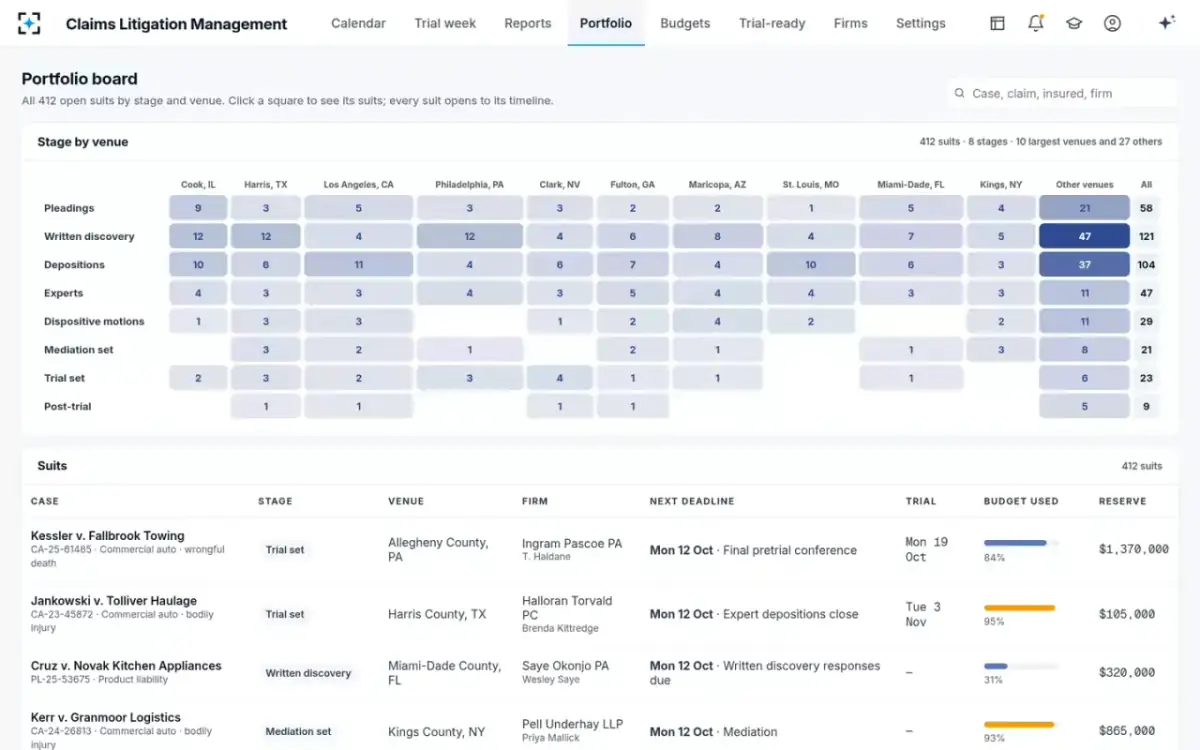
Where a sample portfolio's 412 open suits sit by stage
In injury suits the medical picture sets the pace. A defense cannot value a claim without the records and often an independent medical examination, and the claimant's valuation waits on treatment ending. The carrier's levers are when those requests are made and when it asks counsel for a valuation it can act on. In the sample suit, discovery runs from the August 2025 filing to a fact discovery cutoff on 18 December 2026, about sixteen months.
Discovery is also where a schedule changes under the carrier's feet. On 8 October 2026 the court in the sample suit entered an amended case management order: fact discovery moved from 29 January to 18 December, six weeks earlier, and the trial from 5 April to 1 February 2027, nine weeks earlier. The order was quoted on page 2 of a pre-trial report sent four days later. A carrier that reads such reports at file review, not on arrival, learns of the new trial date weeks after the court set it.
When do litigated claims resolve, and what moves the date?
Almost all of them resolve before trial, and the timing tracks information and deadlines. The federal courts' Table C-4 shows the pattern for the two categories a casualty carrier sees most in federal court. Of 5,333 motor vehicle injury suits under diversity jurisdiction that ended in the year to September 2025, 37 ended during or after trial; of 13,016 insurance suits, 60 did.
How federal diversity suits ended, year to September 2025
Motor vehicle personal injury: 5,333 suits
- No court action: 1,079 · 20.2%
- Court action, ended before trial: 4,217 · 79.1%
- During or after trial: 37 · 0.7%
Insurance: 13,016 suits
- No court action: 2,595 · 19.9%
- Court action, ended before trial: 10,361 · 79.6%
- During or after trial: 60 · 0.5%
What moves a resolution date is a decision forced by a deadline. Cases end early when liability is clear and the injuries are fully treated, and late when one side waits for an expert, a ruling or a trial date. For the carrier, the controllable question is whether settlement authority and mediation come before the expensive stages or after them. In the sample portfolio, 7 of 23 trials set in the next 26 weeks had no mediation held or set, and in the sample suit the top of counsel's verdict range, $2.6 million, sat above the $1.35 million indemnity reserve with trial less than four months off.
Time to trial by venue: the same case runs 19 months or 73
Venue is the largest single driver of a litigated portfolio's cycle time that the carrier does not control. Federal civil cases tried in the year to June 2026 took a median 33.7 months from filing to trial, according to the courts' caseload profiles, a figure that has ranged from 28.3 to 35.7 months over six years. By district the spread is close to four to one.
Median months from filing to trial, federal civil cases, by district, year to June 2026
Two consequences follow for anyone setting cycle-time goals. A firm's months to close must be read against its venue mix, or the firm in the slow district looks worst for reasons outside its control. And a portfolio's average duration can lengthen with no change in handling if new suits shift toward slower venues. The trial itself is the short part: tort jury trials in the 2005 state survey lasted nearly four days on average, and federal judges completed 15 trials per judgeship in the year to June 2026. How a carrier checks each trial set months ahead is covered in trial readiness: eight items to check 26 weeks before trial.
Which months does the insurer control?
The carrier controls the time between the court's deadlines: how fast it acts on what the court and counsel tell it. It cannot shorten a venue's trial queue or a judge's discovery period, but it sets the lag on every handoff that feeds them.
The court sets the deadlines; the carrier sets the lag between them
Set by the court and the rules: Service fixes the answer date
Set by the carrier: Days from service to the litigation unit and to counsel
Set by the court and the rules: Scheduling order and every amendment
Set by the carrier: Days from an order to the carrier's own calendar
Set by the court and the rules: Discovery and expert deadlines
Set by the carrier: When records, examinations and a valuation are asked for
Set by the court and the rules: Any ordered mediation date
Set by the carrier: When authority is set, and whether before discovery closes
Set by the court and the rules: The trial slot in that venue
Set by the carrier: Readiness checked weeks ahead, not in trial week
Set by the court and the rules: Release terms agreed by the parties
Set by the carrier: Tender within the state's payment clock once liability is affirmed
Each lag is set by the carrier's guidelines and how they are run. The guideline clocks (initial report, first budget, status report, pre-trial report) define when counsel tells the carrier something; the carrier's own response clocks, often unwritten, define when it acts. Writing both down, with a trigger and a proof for each, is the subject of litigation management guidelines counsel can meet.
Why a litigated claim's duration is a cost line
Duration costs money in two ways: defense fees accrue by phase for as long as a suit is open, and the indemnity exposure keeps developing while it waits. Defense spend is billed against budget phases, from case assessment (UTBMS L100) through trial (L400), and a suit that reaches trial week without a settlement plan incurs the most expensive phase of all. In the sample suit the firm had billed $162,400 of an approved $185,000 with trial less than four months off, and counsel's own estimate for trial preparation and trial added about $96,000, for a projected $258,400.
The indemnity side has its own evidence. The Casualty Actuarial Society and the Insurance Information Institute report that across personal auto, commercial auto, other liability and product liability, "claim severity, not claim frequency, is driving loss increases", and that loss development factors, the actuarial measure of how claim costs evolve over time, "have generally increased since 2008". For commercial auto liability they put the effect of legal trends and inflation at 22.6% to 30.8% of booked losses. The IRC study found average bodily injury payments rose from about $14,000 in 2017 to more than $20,000 in 2022. How defense spend is classified and where it sits against policy limits is in the defense and cost containment definition.
Measuring litigation cycle time across a panel of firms
Measure the stages, not just the total. A single "months to close" figure tells a director which firms are slow but not why; stage durations and handoff lags show where the time went and whose step it was. Each measure below needs only dates the carrier already receives, provided each date is captured with its source on the day it arrives.
Six measures of a litigated claim's lifecycle, and who owns each
Filing to resolution
resolution date − filing date, median by venue and line
The headline duration, read against the venue benchmark
Litigation director
Assignment lag
date counsel assigned − date of service on the insured
Eats into a 21- or 30-day answer clock
Litigation manager
Evaluation lag
date initial evaluation received − date assigned
Against the guideline clock, 30 days in the sample settings
Panel counsel
Authority lag
date authority set − date of counsel's valuation
The carrier's own decision time before mediation
Claims legal counsel
Order-to-calendar lag
date the carrier's calendar shows a date − date of the court's order
How late a moved trial or cutoff is seen
Litigation manager
Stage dwell
days in current stage − venue median for that stage
Which suits have stalled, and where
Litigation director
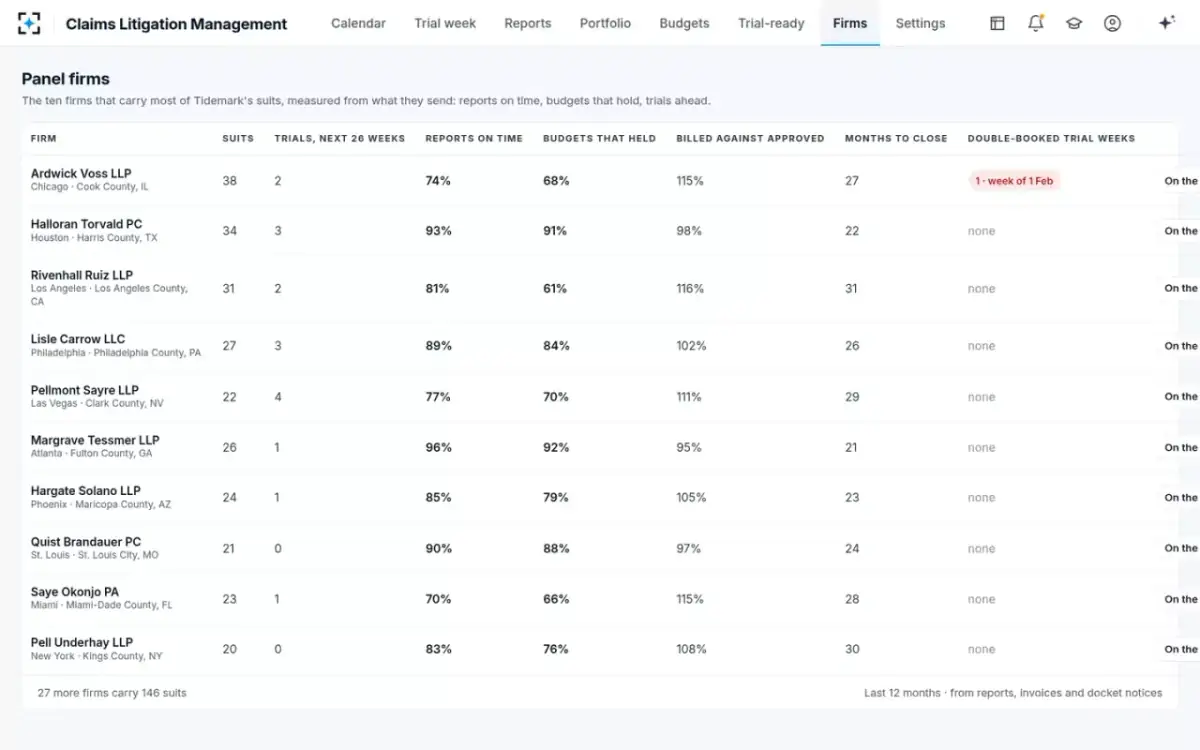
On the sample panel, the ten largest firms' average months to close over twelve months ranged from 21 to 31. That spread is where a director starts asking questions, firm by firm and venue by venue, before drawing any conclusion about the firms.
Ten panel firms measured from what they send, months to close included
Where Claims Litigation Management fits in the litigation lifecycle
Claims Litigation Management reads what arrives during the lifecycle (complaints and summons, court e-filing notices, counsel's status, budget and pre-trial reports, LEDES invoices) and puts each date on one litigation calendar with the court order or report line it came from. That is what makes the stage and lag measures above possible across hundreds of suits: the date each order was entered and the date the carrier's calendar reflected it are both kept.
When the sample suit's pre-trial report arrived at 09:02, the counsel report reader found the amended order on page 2, added five dates, retired the two they replaced and flagged that the new trial week now held six of the carrier's trials, three with no mediation and one partner first chair in two. Each morning the trial readiness checker tests every trial in the next 26 weeks against the eight items the guidelines ask for.
Every open suit by stage and venue, in Claims Litigation Management
The boundaries matter as much as the reading. The agents do not file with a court, write to counsel, change a reserve or pay a bill; requests to firms are drafted and sent only when the litigation manager clicks Send; settlement authority stays with claims legal counsel and reserves with the claim supervisor. The solution shortens the carrier's own lags. It does not shorten the court's.
Questions people ask
What are the stages of the litigation lifecycle?
Pre-suit claim, service and answer, the scheduling order, discovery, experts, motions and mediation, trial for the few cases that reach it, and resolution with payment. In federal court the answer is due 21 days after service, and the scheduling order follows within the earlier of 90 days after service or 60 days after appearance.
How long does discovery take in a civil lawsuit?
The court sets it in the scheduling order, so it varies by judge and venue; in injury suits it is usually the longest stage. In the fictional sample suit used in these guides, discovery ran about sixteen months from filing. Federal cases that ended with court action before the pretrial stage took a median 18.8 months from filing in the year to September 2025.
What is the average time to trial for civil cases?
In federal court, a median 33.7 months from filing for civil cases tried in the year to June 2026, ranging from 18.8 months in the Eastern District of Virginia to 73.3 in the Eastern District of California. The last national state-court figure, from 2005, was a median 22.3 months from filing to verdict for tort trials.
What percentage of lawsuits go to trial?
Very few. Of 5,333 federal motor vehicle injury suits under diversity jurisdiction that ended in the year to September 2025, 37 ended during or after trial, 0.7%. In the 2005 state survey, bench and jury trials accounted for an estimated 4% of tort dispositions.
When do most civil cases settle?
Most end with some court action but before trial, often when a deadline forces a decision: the close of discovery, an expert disclosure, a mediation date or the trial date itself. In the federal data, about four in five motor vehicle and insurance diversity suits ended with court action short of trial; the tables do not separate settlements from dismissals.
How do insurers reduce litigation cycle time?
By shortening their own lags rather than the court's: faster assignment after service, an early evaluation on a guideline clock, settlement authority set before discovery closes, and every moved court date seen the day it is ordered. The Insurance Research Council found represented injury claimants waited a median of nearly 440 days for claim closure, so the pre-suit months count too.