Florida's claims handling statute is section 627.70131 of the Florida Statutes, the rule every residential property insurer, surplus lines carriers included, must meet on each claim: acknowledge any claim communication within 7 calendar days, begin the investigation within 7 days of proof-of-loss statements, inspect within 30, send the adjuster's detailed estimate within 7 days of writing it, and pay or deny within 60 days of notice, with interest from the date of notice if late. It also tells the insurer what to keep, a dated entry for each communication, request, inspection, estimate, tolling period and decision, and it defines narrowly what may stop a clock. Around it sit the Homeowner Claims Bill of Rights in section 627.7142, the unfair claim settlement practices in section 626.9541 and the fines in section 624.4211. The work is hard because the clocks start at different events and run on every message, not only the first notice. Botminds' Claim Status Self-Service is a policyholder self-service solution that answers status questions from the live claim file and counts the clocks a carrier sets for each claim, so a Florida desk sees the next deadline before it is missed.
The statute text quoted here is the 2026 Florida Statutes as the Legislature publishes them. Examples from the solution come from a fictional sample carrier, Halverton Mutual, and its sample claims; those figures are sample data, not a customer's result, and this guide is not legal advice.
Five clocks a Florida residential claim runs against
7days
to review and acknowledge each claim communication
7days
after proof of loss, to begin the investigation
30days
after proof of loss, to complete any physical inspection
60days
after notice of the claim, to pay or deny it, in whole or in part
What is the Florida claims handling statute?
It is section 627.70131, titled "Insurer's duty to acknowledge communications regarding claims; investigation", and it is the operational core of Florida claims law: the section that turns "prompt" into numbers. It applies to "any residential property insurer" and, by its subsection (9), to surplus lines insurers writing residential coverage. Its 60-day payment rule reaches further, to commercial property claims on structures or contents of 10,000 square feet or less and to commercial tenants' contents on premises of that size.
Five neighbouring provisions complete the picture a claims leader works to. Section 627.7142 requires the Homeowner Claims Bill of Rights within 14 days of the first claim communication. Section 626.9541(1)(i) lists the unfair claim settlement practices, several of which restate the same duties as conduct the Office of Insurance Regulation can punish. Section 627.70132 bars a new or reopened claim not noticed within 1 year of the loss and a supplemental claim not noticed within 18 months. Section 627.7011 sets how a replacement cost dwelling claim is paid. And section 624.4211 sets the fines.
The Florida claims handling statute and the five provisions around it
| Provision | What it requires of the insurer | What it means for the desk |
|---|---|---|
| §627.70131 | The clocks: 7-day acknowledgment, 7-day start, 30-day inspection, 7-day estimate copy, 60-day pay or deny; the dated entries; tolling | Every claim carries several running deadlines at once |
| §627.7142 | Deliver the Homeowner Claims Bill of Rights within 14 days of the first communication | One more dated step on every personal residential claim |
| §626.9541(1)(i) | Unfair claim settlement practices, including failing to acknowledge and act promptly and failing to answer a written request within 30 days of proof of loss | A missed clock repeated often enough is a business practice |
| §627.70132 | Notice within 1 year of the loss for a new or reopened claim; 18 months for a supplemental one | The claim type decides which clock restarts |
| §627.7011(3) | Pay at least actual cash value less the deductible first; the rest of a dwelling claim as work is performed | The payment schedule itself is regulated |
| §624.4211 | Administrative fines per violation, with restitution and 12% interest | The price of a pattern |
The 7-day clock runs on every communication, not only the first notice
The statute's first duty is the broadest: "Upon an insurer's receiving a communication with respect to a claim, the insurer shall, within 7 calendar days, review and acknowledge receipt of such communication unless payment is made within that period of time or unless the failure to acknowledge is caused by factors beyond the control of the insurer." A first notice of loss is one communication. So is a policyholder's email on day 20, an upload on day 31 and a question to the independent adjuster on day 44. Each starts its own 7 days.
Three details widen it further. A communication to or by the insurer's "representative", anyone the insurer has authorised to receive or make claim communications, counts as one to or by the insurer, so messages to a vendor, a third-party administrator or an independent adjusting firm run the insurer's clock. An acknowledgment not made in writing must be noted, with its date, in the claim file. And the acknowledgment "must be responsive to the communication": a first-notice acknowledgment must carry the claim forms, instructions and a telephone number unless it tells the claimant the claim appears not to be covered.
The rule stops short of one group: claimants represented by counsel, beyond the communications needed to provide forms and instructions. That exception needs its own dated evidence, because the clock runs until the file shows the representation.
Proof of loss starts three more clocks
Within 7 days after receiving proof-of-loss statements, the insurer must begin the investigation reasonably necessary, and if that investigation involves a physical inspection, it must happen within 30 days of those statements. The licensed adjuster who inspects must give the policyholder a printed or electronic document with their name and state adjuster license number, and "Any subsequent communication with the policyholder regarding the claim must also include the name and license number of the adjuster communicating about the claim."
The licence rule is easy to miss in a status message, a text reminder or an automated email, and it applies to every one of them after the inspection. The statute also lets the insurer investigate by electronic means, photographs, video calls with recorded video, drones, and lets the policyholder help that way, without removing the right to send an adjuster.
The estimate rule follows: "The insurer must send the policyholder a copy of any detailed estimate of the amount of the loss within 7 days after the estimate is generated by an insurer's adjuster." No detailed estimate is required where one is not reasonably necessary. Where a preliminary or partial estimate goes out, subsection (6)(a) requires a fixed statement in at least 12-point bold uppercase type that the estimate is a current evaluation and may be revised; any payment that is not full and final carries a second fixed statement under (6)(b).
One Florida residential claim, three starting events, five clocks
- Acknowledgeby day 7
- Bill of rightsby day 14
- Investigate, estimate, decidepay or deny by day 60
- Begin investigationby day 7
- Physical inspectionby day 30
- Acknowledge, responsivelyby day 7
- Copy to the policyholderby day 7
How long does a Florida insurer have to pay or deny a claim?
Sixty days from notice of the claim. The statute reads: "Within 60 days after an insurer receives notice of an initial, reopened, or supplemental property insurance claim from a policyholder, the insurer shall pay or deny such claim or a portion of the claim unless the failure to pay is caused by factors beyond the control of the insurer." A reopened or supplemental claim starts a fresh 60 days, which is why the claim type on the file matters as much as the date.
The decision must be explained. The insurer owes a reasonable written explanation of the basis in the policy, in relation to the facts or the law, for the payment, denial or partial denial, and if the payment is less than any of its own adjusters' detailed estimates, a reasonable written explanation of the difference. Late payment bears interest at the rate in section 55.03, accruing from the date the insurer received notice, paid with the claim. The subsection "may not be waived, voided, or nullified by the terms of the insurance policy."
Its enforcement is regulatory. Failing to comply "constitutes a violation of this code. However, failure to comply with this subsection does not form the sole basis for a private cause of action." The unfair-practice list adds a payment duty of its own: failing to pay undisputed amounts within 60 days after notice of a residential claim, once the insurer has determined the amounts and agreed to coverage. The shorter clocks Florida now uses replaced longer ones in 2023, and the Office of Insurance Regulation's hurricane reports tested each claim against the version in force on the day, as the guide to Florida OIR market conduct exam findings sets out.
What stops the clock, and what does not?
Only the grounds the statute names. Subsection (8) tolls the requirements during a mediation under section 627.7015 or an alternative dispute resolution proceeding in the policy, and when the policyholder or their representative fails to provide requested material claims information within 10 days of receiving the request, until the insurer receives it. That second pause has a condition carriers miss: it applies only to requests sent at least 15 days before the pay-or-deny deadline.
Separately, "factors beyond the control of the insurer" excuse a delay in two cases: an Office of Insurance Regulation order after a declared state of emergency, a reportable data breach or an information technology issue, which "may not extend the period for payment or denial of a claim for more than 30 additional days"; and fraud, lack of cooperation or intentional misrepresentation by the policyholder or their representative that reasonably prevents compliance. Everything else, staffing, a backlog, a slow vendor, an adjuster on leave, runs the clock.
What tolls a Florida claim clock, beside what only feels like it should
Tolls or extends, if documented: Mediation under §627.7015, or an alternative dispute resolution process in the policy, until it ends.
Does not stop the clock: An open disagreement over scope with no mediation or appraisal under way.
Tolls or extends, if documented: Material information requested at least 15 days before the deadline and not provided within 10 days, until received.
Does not stop the clock: A request sent in the last two weeks before day 60, or a request for something immaterial.
Tolls or extends, if documented: An Office of Insurance Regulation order after a declared emergency, breach or IT issue; at most 30 extra days to pay or deny.
Does not stop the clock: The insurer’s own volume, staffing or vendor capacity without an order.
Tolls or extends, if documented: Fraud, lack of cooperation or intentional misrepresentation that reasonably prevents compliance.
Does not stop the clock: A policyholder who is slow but cooperating.
The bill of rights is a 14-day duty in the insurer's own name
For personal lines residential policies, section 627.7142 adds a delivery deadline: the Homeowner Claims Bill of Rights within 14 days after receiving an initial communication about a claim. Its text is fixed by the statute, and it makes eight promises the insurer then has to keep, among them an acknowledgment within 7 days, a copy of the detailed estimate within 7 days of its creation, and payment or denial within 60 days, with interest if late.
The second right is the one claims operations most often fail to plan for: "Upon written request, receive from your insurance company within 30 days after you have submitted a complete proof-of-loss statement to your insurance company, confirmation that your claim is covered in full, partially covered, or denied, or receive a written statement that your claim is being investigated." The same duty appears in the unfair-practice list at section 626.9541(1)(i)3.e, so a written request has to be recognised as one when it arrives, by email, upload or portal message, and routed with its 30-day date.
The statute limits the notice's legal weight: it creates no private cause of action, and a failure to deliver it is subject to administrative enforcement but not admissible in a civil action. It also says the bill of rights does not enlarge or modify sections 626.9541 or 627.70131, which keep their own force.
What must the claim file show to prove the clocks were met?
Dated entries for seven kinds of events, kept for each claim. Subsection (4) requires the insurer to maintain a log of every adjuster who communicates with the policyholder, to be listed for the insured or the regulator on request, and claim files with the dates of: each claim-related communication with the policyholder or their representative; receipt of the proof of loss; each request for information; each inspection, physical or electronic; each detailed estimate; the beginning and end of any tolling period; and the payment or denial.
That list is the examiner's checklist, and it is also the minimum a claims leader needs to manage the clocks before they are missed rather than after. A seventh-day acknowledgment that exists only in an adjuster's sent mail, or a tolling period that began with a phone call nobody dated, is a compliant step the insurer cannot prove.
One more control sits in the unfair-practice list. Altering an adjuster's report is an unfair practice unless the insurer gives a detailed explanation of any change that reduces the estimate, lists every change and who ordered it, and retains every version with the name of whoever made or ordered each change (§626.9541(1)(i)3.j). Estimate versions are evidence, not drafts.
The dated entries a Florida residential claim file needs
- Every claim communication, both directions
Including those to and from vendors and independent adjusters acting for the insurer, with the date received and the date acknowledged.
- The adjusters who spoke to the policyholder
A list the insurer can hand over on request, with each one’s name and licence number.
- Proof-of-loss receipt
The start of the 7-day investigation and 30-day inspection clocks, and of the 30-day on-request answer.
- Each information request
With the date sent, so a tolling claim can show it went out at least 15 days before day 60.
- Each inspection and each detailed estimate
Physical or electronic; every estimate version with who changed what.
- Tolling start and end
Mediation, late information, an Office of Insurance Regulation order: each with its basis.
- The payment or denial
With the written explanation, and the difference from any detailed estimate explained.
What does a missed clock cost a Florida insurer?
Interest on the claim, then fines when it becomes a pattern. Interest under section 627.70131(7) runs from notice on any payment made after day 60. Unfair claim settlement practices under section 626.9541(1)(i)3 are defined by frequency, committed "with such frequency as to indicate a general business practice", which is why a desk that misses the 7-day acknowledgment on one claim in twenty has a compliance problem, not twenty small ones.
Section 624.4211 lets the Office of Insurance Regulation fine an insurer instead of suspending or revoking its certificate. A nonwillful violation can cost up to $12,500 per violation, capped at $50,000 for the same action, or $25,000 per violation and $100,000 in aggregate where the claim arose from a declared emergency. A knowing and willful violation can cost up to $100,000 per violation and $500,000 in aggregate, or $200,000 and $1 million for emergency claims. Restitution is owed on top, with interest at 12 percent a year.
Florida's fine ceilings rise steeply for willful and catastrophe violations
Where Florida desks miss the clocks
Rarely on the first notice, which every claim system dates. The misses cluster where the statute is broader than the process. Messages that arrive through a channel the claim system does not watch, a contractor's email to the independent adjuster, a reply to a text reminder, an upload with a question in its file name, start a 7-day clock nobody sees. A supplemental claim filed as a note on the old claim never gets its own 60 days. A request for information sent on day 50 is treated as tolling the clock when it cannot.
The others are content, not timing: a status email after the inspection without the adjuster's licence number, a partial payment without the (6)(b) statement, a payment below the insurer's own estimate with no written reason for the difference. Each is a sentence a template can carry, and each is cited when it is missing. The 30-day on-request answer fails a different way: a written request arrives inside a general message and nobody recognises it as the request the bill of rights describes.
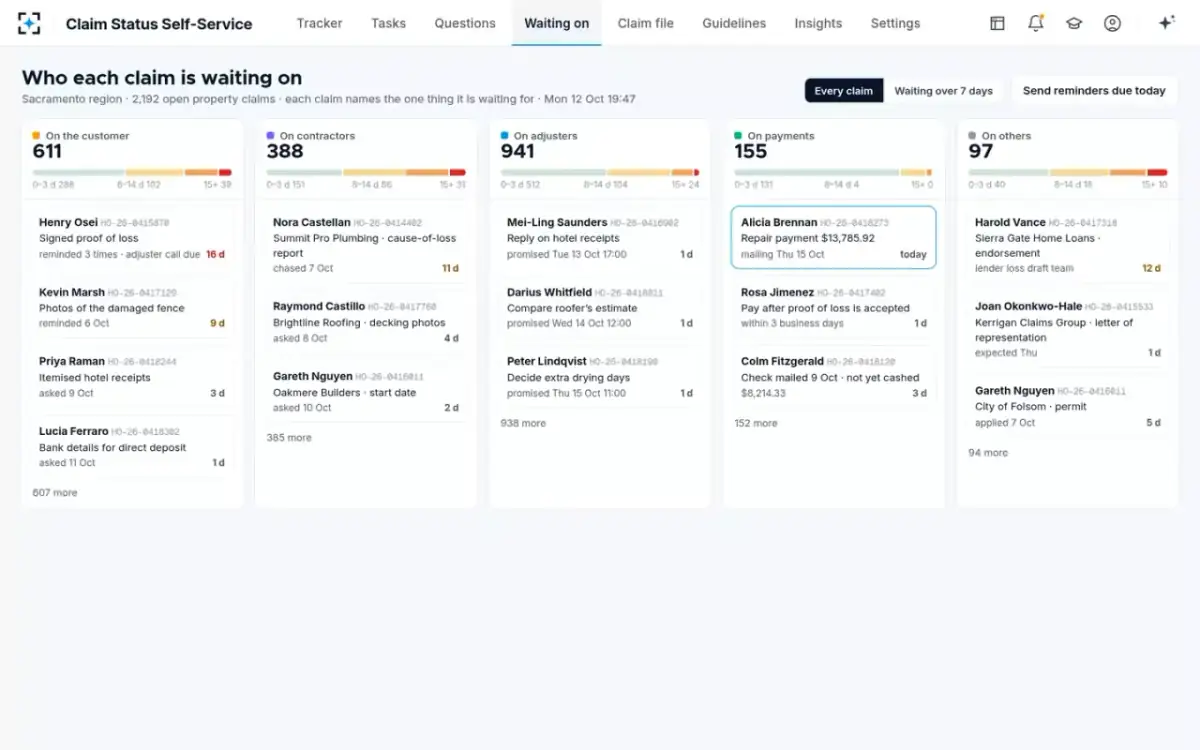
Claim Status Self-Service shows who each claim is waiting on, and for how many days
Counting Florida's clocks in Claim Status Self-Service
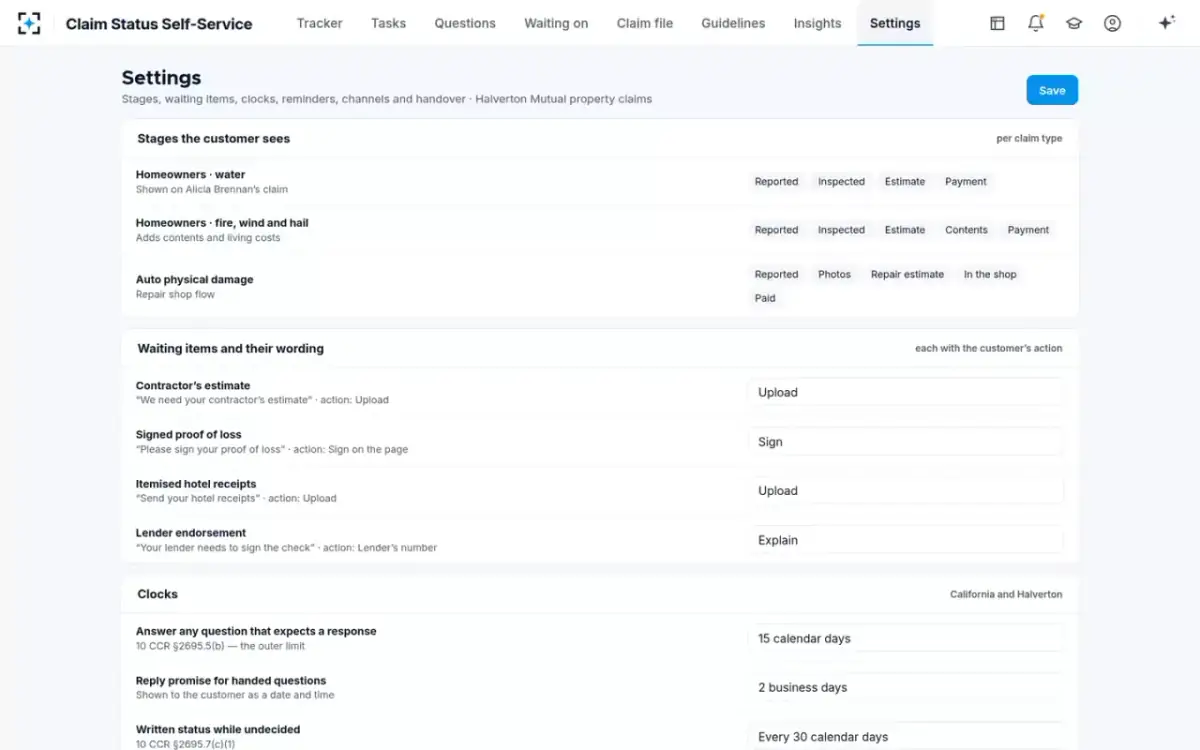
The solution counts whatever clocks a carrier sets, per message and per claim, and logs each step against the claim with the rule it comes from. The sample carrier is in California, so its settings carry California's clocks: a complete response to any communication that expects one within 15 calendar days, written status every 30 days while a claim is undecided, and a 2-business-day reply promise for questions handed to the adjuster. A Florida carrier would set 7 days for every acknowledgment, 7 and 30 days from proof of loss, 7 days for the estimate copy, 30 days for the on-request answer and 60 days to pay or deny, and the adjuster's task list and the supervisor's board would count those instead.
Clocks are settings, each naming its rule
Three parts of the solution map onto the statute's hardest duties. The contact logger writes each question, answer, upload and reminder to the claim's contact log as it happens, so every communication through the policyholder page, two-way text or the phone status line has a received date and an answered date without anyone typing them. The question answerer replies from the claim file and the policy with a source on each fact; a question that needs judgment, such as a coverage question, goes to the adjuster with the policyholder's own words and a reply-by time. And a supervisor's board sorts every open claim by who has the next move and how long it has waited.
In the sample week the carrier's three clocks stood at 100 percent: 3,358 questions answered or replied to within 15 days, 209 of 212 handed questions answered by the promised time with the other 3 still inside it, and 118 undecided claims sent their 30-day written status on time. Those are sample figures. What the written status itself must say is the subject of the guide to the California 30 day status letter, and the payment rules that follow a decision, including Florida's replacement cost schedule, are in the guide to depreciation of labor by state.
The solution does not decide coverage, set reserves or choose whether a delay qualifies as tolling; those stay with the adjuster and the claims leader. It also does not reach messages outside its channels, so a carrier still needs a way to bring an independent adjuster's or vendor's correspondence into the claim's log. To see the sample claim screen by screen, start from Claim Status Self-Service.
Questions people ask
Does section 627.70131 apply to commercial property claims?
Mostly not. The acknowledgment, investigation and estimate duties apply to residential property insurers, but the 60-day pay-or-deny rule also covers commercial structures or contents of 10,000 square feet or less and commercial tenants' contents on premises of that size. It does not apply to commercial policies covering structures or contents in more than one state.
Do the Florida claim clocks count business days or calendar days?
The acknowledgment duty says "within 7 calendar days" in terms, and the other periods in the section are written as plain days with no business-day wording anywhere. A desk that counts every one of them as calendar days, weekends and holidays included, cannot be caught short by the reading it chose.
Can an insurer extend the 60 days after a hurricane?
Only by order of the Office of Insurance Regulation after a declared state of emergency, a reportable breach or an information technology issue, and never by more than 30 additional days to pay or deny. Interest then runs on payments made after the later of day 60 and the end of the extension.
Does a supplemental claim restart the Florida 60-day clock?
Yes. The 60 days run from notice of an initial, reopened or supplemental claim, so each supplement needs its own notice date on the file. A supplemental claim must itself be noticed within 18 months of the date of loss under section 627.70132.
Can a policyholder sue an insurer for violating section 627.70131?
Not on that violation alone: the statute says failing to meet the 60-day rule is a code violation but not the sole basis for a private cause of action. The Office of Insurance Regulation enforces it, and the bill of rights likewise creates no civil cause of action.
Do status texts and emails need the adjuster's licence number?
After a physical inspection, yes: any later communication with the policyholder about the claim must include the name and licence number of the adjuster communicating. A status text sent in an adjuster's name falls inside that wording, so the template should carry both.