Depreciation of labor is the practice of deducting depreciation from the labor part of a repair estimate, not only from the materials, when an insurer calculates actual cash value. By state, the answer differs. California's claims regulations forbid it outright, apart from labor already built into manufactured goods. High courts in Arkansas and Tennessee, and the federal Sixth Circuit applying Kentucky and Ohio law, have held that a policy which does not clearly allow it cannot use it. High courts in Oklahoma, Minnesota and Nebraska have allowed it. On a replacement cost policy the choice sets how much of the first payment is held back until repairs are done; on an actual cash value policy it sets the payment itself. Botminds' Claim Status Self-Service is a policyholder self-service solution that answers claim questions from the live claim file and the policy, and on the payment stage it explains the deductible and the held-back depreciation line by line, in the carrier's approved words, on every claim.
The state map below comes from court opinions and regulations as published, chiefly the Sixth Circuit's 2020 opinion in Perry v. Allstate Indemnity Co., which surveys the split. State law has kept moving since, so treat the map as the start of a state-by-state review with counsel, not the end of one. Examples from the solution come from a fictional sample claim with an invented carrier, Halverton Mutual; those figures are sample data, not a customer's result.
On a roof that is half labor, the choice halves or keeps its value
$10,000
to install the example roof, split evenly between materials and labor
$5,000
its value at the end of a 10-year life if labor is not depreciated
$0
its value at the end of the same life if labor is depreciated too
What is depreciation of labor in a property claim?
It is the deduction of wear-and-tear depreciation from the cost of the work needed to repair or replace damaged property, on top of the deduction from the materials. Actual cash value is usually defined as replacement cost less depreciation; Ohio's regulation, for example, tells the insurer to determine it "by determining the replacement cost of property at the time of loss, including sales tax, less any depreciation." The dispute is over what "depreciation" covers when the policy does not say.
The stakes are large because labor is a large share of most building repairs. The Sixth Circuit's separate opinion in Perry put it in one example: a roof that cost $10,000 to install, half materials and half labor, with a ten-year life. If labor is not depreciable, the roof loses $500 a year and is worth $5,000 in year eleven, and in year one hundred. If labor depreciates with the materials, it loses $1,000 a year and is worth nothing at the end of its life. On an old roof, the reading can be the difference between paying half the replacement cost up front and paying close to none of it.
Actual cash value on one estimate: the labor line is the state-by-state question
Replacement cost
Materials + labor, at today’s prices
The agreed estimate, before the deductible.
The adjuster agrees it
Materials depreciation
Materials × share of useful life used
Taken item by item on property that wears out.
Set from age and condition
Labor depreciation
Labor × share of useful life used
Taken only where the state and the policy allow it; never in California.
The state-by-state question
Deductible
Once per claim
Comes off the payment and is never paid back.
The declarations page
Depreciation of labor by state: where the courts and regulators stand
The states fall into three groups: those that forbid labor depreciation by rule, those whose courts read an ambiguous policy against it, and those whose courts allow it. The Sixth Circuit summarised the split in 2020 by observing that "a slim majority of courts may have gone the other way" from the policyholder's reading, while holding that the slimness did not matter under Ohio's rule for ambiguous policies.
Depreciation of labor by state, as the courts and regulators have decided it
| State | Who decided | Labor may be depreciated? | The reasoning |
|---|---|---|---|
| California | Regulation, 10 CCR 2695.9(f)(1) | No | Labor to repair, rebuild or replace is not a component of physical depreciation, except labor built into manufactured goods |
| Arkansas | Supreme Court, Adams v. Cameron Mutual (2013) | No, where the policy does not define actual cash value | Labor is not something that can be depreciated |
| Tennessee | Supreme Court, Lammert v. Auto-Owners (2019) | No, under the policies before it | “Depreciation” was ambiguous and is read against the insurer |
| Kentucky | Sixth Circuit, Hicks v. State Farm (2018) | No, under the policy before it | Ambiguous term read against the insurer |
| Ohio | Sixth Circuit, Perry v. Allstate (2020) | No, under the policy before it | Ambiguous term read against the insurer |
| Oklahoma | Supreme Court, Redcorn v. State Farm (2002) | Yes | Materials and labor fuse into the finished structure and depreciate together |
| Minnesota | Supreme Court, Wilcox v. State Farm (2016) | Yes, as one factor | Embedded labor is a factor that may be weighed in actual cash value |
| Nebraska | Supreme Court, Henn v. American Family (2017) | Yes | Follows the Redcorn reasoning |
The rows that say "under the policy before it" matter most for a carrier. Those decisions turn on wording that did not define depreciation; they leave room for a policy that says plainly that labor is depreciated. California's row is different in kind: it is a regulation about the measure of recovery, and policy wording does not change it.
Why do courts split on labor depreciation?
Because two reasonable readings of "depreciation" meet a rule that resolves ambiguity against the insurer. One reading, adopted by the Oklahoma Supreme Court in Redcorn, holds that materials and labor fuse into a finished roof or wall, and that when the finished thing ages, both parts lose value together. The other holds that depreciation means physical wear and tear, and that the labor needed to install a new roof is a fresh service, as costly on a fifty-year-old house as on a new one.
The Tennessee Supreme Court's version of the second reading, as quoted by the Sixth Circuit, is the one most carriers meet in litigation: "it is reasonable that a homeowner would understand that depreciation would only be applicable to material goods that can age and experience wear and tear." Once a court finds both readings reasonable, the contract rule decides, and in Tennessee, Kentucky and Ohio that rule favours the insured.
“Therefore, construing the policy language in favor of the insured, depreciation can only be applied to the cost of materials, not to labor costs.”
The Tennessee Supreme Court in Lammert v. Auto-Owners, as quoted by the Sixth Circuit in Perry v. Allstate (2020)
The courts allowing it often rely on the "broad evidence rule", which lets the fact-finder weigh many factors in actual cash value. The Minnesota Supreme Court, quoted in the same opinion, said embedded labor depreciation is "one factor that the trier of fact may consider and weigh among other factors to determine the actual cash value of the damaged property." States that, like Ohio, fix actual cash value by formula as replacement cost less depreciation leave less room for that argument.
California's rule: labor is not physical depreciation
California settles the question by regulation for policies subject to its standard fire policy. Section 2695.9(f)(1) of the Fair Claims Settlement Practices Regulations reads: "Except for the intrinsic labor costs that are included in the cost of manufactured materials or goods, the expense of labor necessary to repair, rebuild or replace covered property is not a component of physical depreciation and shall not be subject to depreciation or betterment."
The same subsection sets how any depreciation is taken. Adjustments must be "discernable, measurable, itemized, and specified as to dollar amount", must reflect a measurable difference in market value attributable to the property's condition and age, must apply only to property normally subject to repair and replacement during its useful life, and their basis "shall be fully explained to the claimant in writing." The Insurance Code says the same about structures: depreciation applies only to components normally subject to repair and replacement during the structure's useful life, as the Department of Insurance's 2026 annual notice summarises section 2051.
In practice this means a California estimate has to keep labor and materials on separate lines, depreciate only the materials that wear out, and carry an explanation the claimant can read. A cabinet run's materials can carry depreciation; the carpenter's hours to hang new cabinets cannot.
Does policy wording settle labor depreciation?
In most states that have left it to the courts, clear wording goes a long way; in California it cannot. The Sixth Circuit put the drafting point directly, quoting its earlier Kentucky decision: the insurer "could have removed any ambiguity by simply writing its policies to expressly include labor depreciation when calculating ACV." Courts that found ambiguity did so because the policy defined actual cash value as cost less depreciation and stopped there.
Policy wording against the two lines of cases
Policy that does not define depreciation: Read against the insurer: materials only.
Policy that says labor is depreciated: The reasoning that found ambiguity no longer applies; state statutes and later cases still govern.
Policy that does not define depreciation: Labor may be depreciated, or weighed as a factor.
Policy that says labor is depreciated: Labor may be depreciated.
Policy that does not define depreciation: Labor may not be depreciated.
Policy that says labor is depreciated: Labor may not be depreciated: the regulation sets the measure of recovery.
Policy that does not define depreciation: A dispute over every actual cash value check on that form.
Policy that says labor is depreciated: A line the claimant can see and the regulator can test.
Wording also has to match practice. Estimating software applies labor depreciation by default or not according to its settings, and a carrier whose form forbids it in one state and allows it in the next needs those settings by state and by policy form, tested, with the result visible on every estimate.
From actual cash value to the held-back depreciation
On a replacement cost policy, depreciation is not lost: it is held back and paid when the repair is done. The NAIC describes the two steps: "the insurer at first may pay only the ACV for the damage to your home or personal property", and pays the difference, up to replacement cost, on evidence of the repair. "Recoverable depreciation is calculated as the difference between an item’s replacement cost and ACV." So labor depreciation, where it is allowed, enlarges the holdback rather than the final payment, and moves money from the first check to the second.
That timing is regulated too. California gives the insured at least 12 months from the first actual cash value payment to collect full replacement cost, and at least 36 months for a loss related to a declared state of emergency, with six-month extensions for good cause (CDI 2026 notice). The NAIC tells consumers the time limit "can range from 6 months to up to one year, depending on your state’s laws and your policy."
How long the insured has to collect held-back depreciation
Florida changes the schedule. For a dwelling insured at replacement cost, "the insurer must initially pay at least the actual cash value of the insured loss, less any applicable deductible. The insurer shall pay any remaining amounts necessary to perform such repairs as work is performed and expenses are incurred." A total loss of a dwelling is paid at replacement cost with no holdback at all, and for personal property the insurer must offer a form that pays replacement cost with no holdback whether or not the item is replaced. And if a Florida payment is less than the insurer's own detailed estimate, the difference must be explained in writing (§627.70131(7)). Florida's other clocks are set out in the guide to the Florida claims handling statute.
What does a labor depreciation error cost an insurer?
It is rarely one claim. Perry itself was brought as a putative class action, and the shape is a natural one for this dispute, because an estimating default applies to every actual cash value payment on a form, in a state, for years. A finding that labor should not have been depreciated turns into a recalculation of each of those payments, the difference paid back, and interest where the state imposes it.
Two quieter costs follow. In a state like California, an itemized, measurable, written explanation is required for every depreciation adjustment, so an estimate that depreciates labor fails twice: once on the amount, once on the explanation. And the held-back amount becomes a promise with a deadline. A carrier that does not track which claims still have depreciation to release, and by when, leaves money owed and complaints waiting.
Controls for labor depreciation across a multi-state book
- A per-state rule for labor depreciation
Forbidden, allowed only with express wording, or allowed; reviewed with counsel as cases and statutes change.
- Estimating settings that match the rule
By state and by policy form, tested on sample estimates, with labor and materials on separate lines.
- Depreciation explained in writing on every payment
Itemized and in dollars, so the claimant and the regulator see what was taken and why.
- The holdback and its deadline on every open claim
The amount to be released, what must be sent, and the last date, including longer emergency periods.
- One explanation, whoever answers
The same approved words for deductible, depreciation and holdback on the phone, in writing and on the claim page.
- An audit sample each quarter
Closed actual cash value payments re-tested against the state rule, before a plaintiff or an examiner does it.
How should a claims team explain the actual cash value payment?
Line by line, from the agreed estimate to the check, in the same words every time. Take a fictional sample claim as it runs through the solution: a burst supply line in a California kitchen, insured at replacement cost by Halverton Mutual. The adjuster agreed the estimate at $17,500.52. Depreciation of $2,214.60 is held back until the repairs are finished. The $1,500 deductible comes off once. The check is $13,785.92, to the policyholder and the mortgage lender, and the $2,214.60 follows when the contractor's final invoice arrives. Because the claim is in California, none of the held-back amount can be depreciation of labor.
Claim Status Self-Service shows the payment, the holdback and when the rest is paid
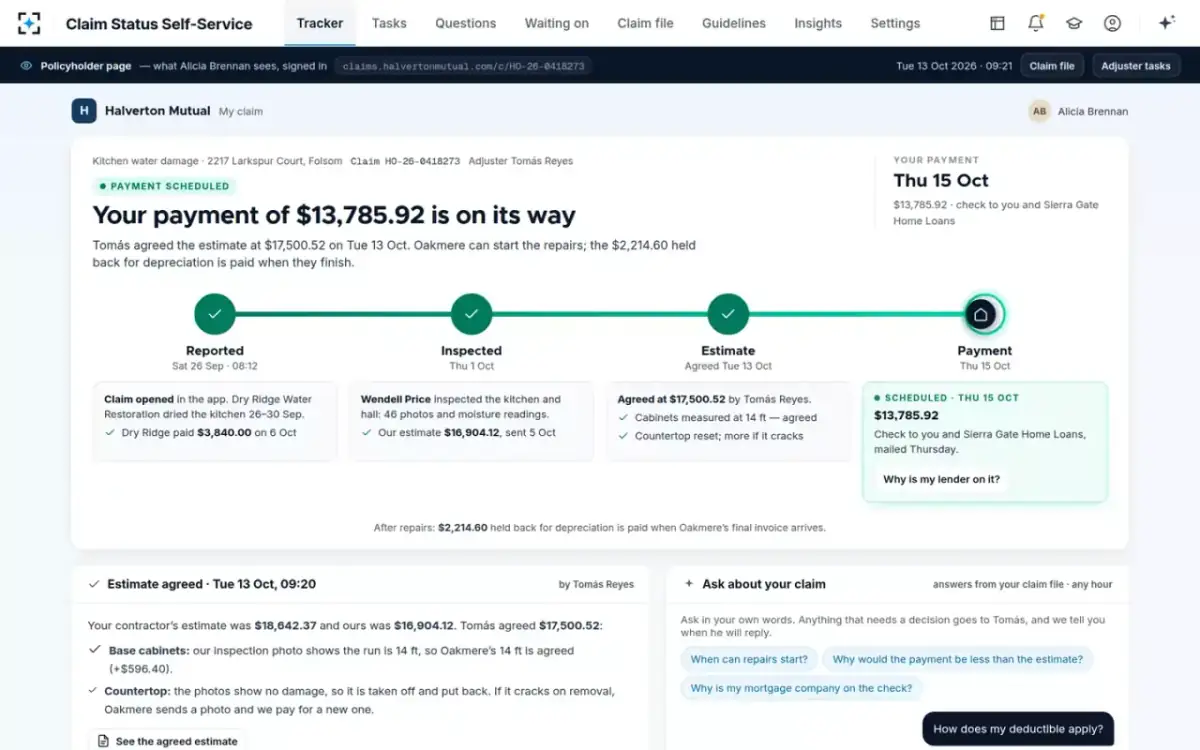
The explanation matters because the questions are many. In the sample carrier's week of 5 to 11 October, policyholders asked 3,358 questions about their claims; 412 were about the deductible and 226 asked why the payment was less than expected or about depreciation, together about 19 percent (our arithmetic on sample data). Those are the conversations where the answer used to depend on who picked up.
Two policyholders, one approved explanation of the smaller check
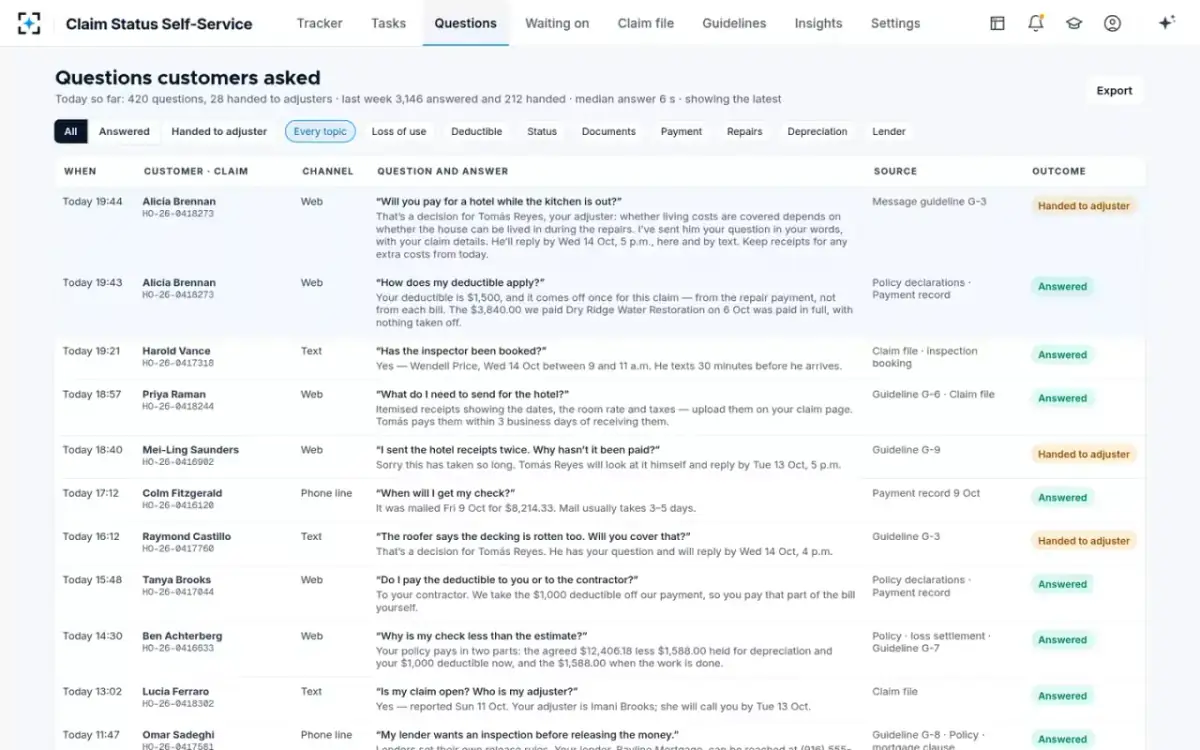
Where Claim Status Self-Service fits, and where it does not
The solution explains the payment; it does not set depreciation. The adjuster agrees the estimate, and the carrier's estimating rules decide whether labor is depreciated. What the solution adds is that the explanation follows the file and the approved wording. Its question answerer answers from the claim file, the policy and the carrier's message guidelines with a source on each fact, and under the sample guideline G-7 it explains how replacement cost is paid in two parts but quotes amounts only once they are agreed. A question beyond the file, such as whether an upgrade will be paid for, goes to the adjuster with the policyholder's own words and a reply-by time.
For the claims leader, that turns the controls above into something checkable: every depreciation answer cites its source, the held-back amount and its release event sit on the claim page, and the questions customers ask about depreciation are counted each week. The written status owed while a claim is still undecided, before any payment, is covered in the guide to the California 30 day status letter. To see the sample claim screen by screen, start from Claim Status Self-Service.
Questions people ask
Which states prohibit depreciation of labor?
California does so by regulation: 10 CCR §2695.9(f)(1) says labor to repair, rebuild or replace covered property is not a component of physical depreciation. Elsewhere it is mostly a matter of case law and policy wording; the high courts of Arkansas and Tennessee, and the Sixth Circuit applying Kentucky and Ohio law, have refused it under policies that did not clearly allow it.
Which states allow depreciation of labor?
The Oklahoma Supreme Court allowed it in Redcorn v. State Farm (2002), and the high courts of Minnesota (2016) and Nebraska (2017) followed similar reasoning, Minnesota as one factor in actual cash value. A carrier should confirm each state's current position, because statutes and later decisions have moved since those cases.
Is labor depreciation allowed if the policy says so?
In states that left the question to contract interpretation, express wording removes the ambiguity the policyholder-friendly decisions relied on; the Sixth Circuit said an insurer could have done so "by simply writing its policies to expressly include labor depreciation." It cannot override a regulation that defines the measure of recovery, such as California's.
Does labor depreciation reduce what a replacement cost policyholder gets in the end?
Not if the repair is completed in time: on a replacement cost policy the depreciation, including any on labor, is held back and paid when the work is done, up to the agreed replacement cost. It reduces the first payment, and the insured can lose the held-back amount by not repairing or by missing the deadline, which in California is at least 12 months from the first payment.
What does "intrinsic labor" mean in California's rule?
It is the labor already built into the price of a manufactured item, such as a factory-made cabinet or window. California lets that be depreciated as part of the item's cost, while the labor to install it on site may not be.
Was the Perry v. Allstate case a class action?
It was brought as a putative class action, and the Sixth Circuit's 2020 decision reversed the trial court's dismissal and sent it back for further proceedings. That is the pattern of labor depreciation litigation: one estimating practice, applied to every actual cash value payment on a form, tested at once.