The California 30 day status letter is the written notice an insurer must send under 10 CCR §2695.7(c)(1), part of California's Fair Claims Settlement Practices Regulations, when it needs more than the 40 days the regulations allow to accept or deny a claim. The first letter is due within those 40 days of proof of claim; it must specify any additional information the insurer needs and state the continuing reasons it cannot decide; and it must be sent again every 30 calendar days until the insurer decides or notice of legal action is served. It is a small letter with a large failure rate, because it must be written from the state of one claim on one day, and a claim desk with hundreds of open files has to know which are due this week. Botminds' Claim Status Self-Service is a claim status solution that keeps each claim's stage and the one item it waits on current from the claim file, and counts the 30-day written-status clock on every undecided claim.
Rules are quoted as published on the date of writing, from the Legal Information Institute's copies of the California, Pennsylvania and Ohio regulations and from the regulators' own sites. Examples from the solution come from a fictional sample carrier, Halverton Mutual, and are sample data, not a customer's result. This is not legal advice.
The California clocks around a claim that cannot be decided yet
15days
to acknowledge a notice of claim and give forms and instructions
15days
to send a complete response to any communication that expects one
40days
from proof of claim to accept or deny, or send the first status letter
30days
between status letters until a decision or notice of legal action
What is the California 30 day status letter?
It is the continuing written notice required by subsection (c)(1) of section 2695.7. The regulation reads in full: "If more time is required than is allotted in subsection 2695.7(b) to determine whether a claim should be accepted and/or denied in whole or in part, every insurer shall provide the claimant, within the time frame specified in subsection 2695.7(b), with written notice of the need for additional time. This written notice shall specify any additional information the insurer requires in order to make a determination and state any continuing reasons for the insurer's inability to make a determination."
“Thereafter, the written notice shall be provided every thirty (30) calendar days until a determination is made or notice of legal action is served.”
10 CCR §2695.7(c)(1)
Subsection (b) sets the 40 days: upon receiving proof of claim, the insurer must "immediately, but in no event more than forty (40) calendar days later, accept or deny the claim, in whole or in part." The letter is the lawful alternative to deciding inside that window, and it has to be repeated for as long as the claim stays undecided. Claims teams call it the 30-day letter, the status letter or the delay letter; the regulation calls it written notice of the need for additional time.
When is the first status letter due, and when do the next ones fall?
The first is due by day 40 after proof of claim, and each later one 30 calendar days after the one before: day 70, day 100, day 130, until the claim is decided or notice of legal action is served. The hard part is day zero. "Proof of claim" is defined broadly, as "any evidence or documentation in the possession of the insurer, whether as a result of its having been submitted by the claimant or obtained by the insurer in the course of its investigation, that provides any evidence of the claim and that reasonably supports the magnitude or the amount of the claimed loss."
That definition means the 40 days can start before any formal proof-of-loss form is signed: an inspection report or a set of photos that supports the size of the loss may be enough. A desk that starts the count from the signed sworn statement may be counting from the wrong day. The conservative practice is to date the first evidence of the amount and count from there.
A claim undecided for four months generates four status letters
- Acknowledge, forms, begin investigatingby day 15
- Decide, or first letterday 40
- Second letterday 70
- Third letterday 100
- Fourth letterday 130
- Complete responseby day 15
The status letter does not replace the 15-day response rule. A claimant who writes on day 52 asking what is happening is owed "a complete response based on the facts as then known" within 15 calendar days of that message, whatever the letter schedule says. On a long claim the two clocks interleave, and a desk needs both on the same view.
What must a 30-day status letter say?
Three things, on the facts of that claim on that day: the additional information the insurer still needs, the continuing reasons it cannot decide, and, where the decision waits on a future event, the situation and an estimate of when it can decide. The regulation's last sentence covers that third case: "If the determination cannot be made until some future event occurs, then the insurer shall comply with this continuing notice requirement by advising the claimant of the situation and providing an estimate as to when the determination can be made."
A template that says "your claim remains under investigation" meets none of the three. It names no information, gives no reason and offers no estimate, and on the fourth identical letter it is evidence that nobody looked at the file. The useful test is whether a claims examiner could read the letter alone and know what the claim is waiting on, who has it and when it will move.
The same status letter, written to the regulation and not
Letter that fails the test: “We are continuing to review your claim.”
Letter written from the file: We still need the cause-of-loss report from your plumber, requested on 7 October, to decide whether the leak was sudden.
Letter that fails the test: None given.
Letter written from the file: Your policy covers sudden water discharge and excludes long-term seepage; the report decides which this is.
Letter that fails the test: None given.
Letter written from the file: We expect to decide within 10 days of receiving the report, and will write by 9 November in any case.
Letter that fails the test: “The claims department.”
Letter written from the file: Tomás Reyes, your adjuster, at the number on this letter.
One thing the letter may leave out. Subsection (c)(2) says nothing in (c)(1) requires disclosing "any information that could reasonably be expected to alert a claimant to the fact that the claim is being investigated as a possible suspected fraudulent claim." The letter still goes out on schedule; it is the reason that may stay general. That exception is narrow and claim-specific, and it is not a basis for generic letters on the ordinary claims that make up nearly all of the book.
Who is owed the letter, and when does the series end?
The claimant, a term California defines to include first-party and third-party claimants, attorneys and anyone properly designated by the claimant, such as a public adjuster or a family member. A designation must be in writing, signed and dated, and once it is on file the letters go to the designated person. The series ends when the claim is accepted or denied in whole, or when notice of legal action is served; the definition of legal action includes arbitration.
Partial decisions are where series end too early. A claim accepted in part and still open on the rest is not decided: the 40-day rule covers acceptance or denial "in whole or in part", and the status letter continues for the part that is still waiting. A dwelling paid while contents or additional living expenses are still being adjusted is the common case.
How do other states' status letter rules compare?
California's 30 days is a shorter interval than the National Association of Insurance Commissioners' model regulation, the template many state rules are written from, which uses 45 days. The NAIC model asks the insurer to notify the claimant within 21 days of proofs of loss that it needs more time, giving reasons, and "forty-five (45) days from the initial notification and every forty-five (45) days thereafter, send to the claimant a letter setting forth the reasons additional time is needed for investigation."
Status letter rules for an undecided claim, state by state
| Rulebook | First notice | Then | What the letter must say |
|---|---|---|---|
| California, 10 CCR 2695.7(c)(1) | Within 40 days of proof of claim | Every 30 calendar days | Information still needed; continuing reasons; if waiting on a future event, the situation and an estimate of when |
| Pennsylvania, 31 Pa. Code 146.6 | At 30 days from notification of claim | Every 45 days | A reasonable written explanation for the delay, and when a decision may be expected |
| Ohio, Adm. Code 3901-1-54 | Within 21 days of proof of loss | At least every 45 days | The status of the investigation and the continued time it needs |
| NAIC Model 902, §7B | Within 21 days of proofs of loss | 45 days from notification, then every 45 days | The reasons additional time is needed |
| Florida, Fla. Stat. 627.7142 | On written request, 30 days after a complete proof of loss | No fixed interval | Covered in full, in part, or denied, or that the claim is being investigated |
Pennsylvania's wording sets the highest bar on content: the insurer must give a reasonable written explanation and "state when a decision on the claim may be expected." Ohio's asks for "the status of the investigation and the continued time for the investigation". A carrier writing in several states can meet all of them with one letter that names the information needed, the reason, the owner and an expected decision date, sent on the shortest interval that applies. Florida's own clocks, which run from every communication rather than at fixed intervals, are set out in the guide to the Florida claims handling statute.
Why do status letters fail?
Mostly because they are produced by a calendar and not by the claim. Five patterns recur. The count starts from the wrong day, the signed proof of loss rather than the first evidence of the amount. The letter is a template that never changes, so the fourth one says what the first did. The series stops at a partial payment while part of the claim is still undecided. A designated public adjuster or attorney is not the one who receives it. And the letter is sent but not provably: no copy, no date, or a date in a mail log that is not in the claim file.
The last one matters because California examines the file, not the adjuster's memory. Claim files must contain the documents and notes "in such detail that pertinent events and the dates of the events can be reconstructed", and the insurer must record the date it received, processed and transmitted or mailed every material document. Those files must be kept for the current year and the four preceding years. A status letter whose mailing date cannot be shown is, for an examiner, a letter that was not sent.
The regulations also put the duty on the organisation, not only the adjuster. Every insurer must adopt written standards for the prompt investigation and processing of claims, train its claims agents on the regulations, and certify that training every year under penalty of perjury (10 CCR §2695.6). A status letter process is one of the standards that certification stands behind.
A status letter process a California examiner can test
- Day zero dated from the first proof of claim
The first evidence that supports the amount, not only the signed form.
- A due list for the week
Every undecided claim with its next letter date, including claims accepted in part.
- Content from the live file
The item still needed, the reason, the owner and an expected decision date, or the future event and an estimate.
- The right addressee
The claimant, or the attorney, public adjuster or family member properly designated in writing.
- A copy and a date in the claim file
The letter itself and the date it was sent, retrievable for five years.
- A clean stop
The decision, or the date notice of legal action was served, ends the series and is dated too.
The status letter is the status page, written down every 30 days
The content the regulation asks for, what the claim needs, why it cannot be decided, when it will be, is exactly what a policyholder asks on the phone. A carrier that keeps that answer current on every claim, every day, has the letter written before it is due; one that composes the letter from scratch every 30 days repeats the investigation of its own file twelve times a year. The two should never disagree, because the letter and the status a claimant sees online are examined against the same file.
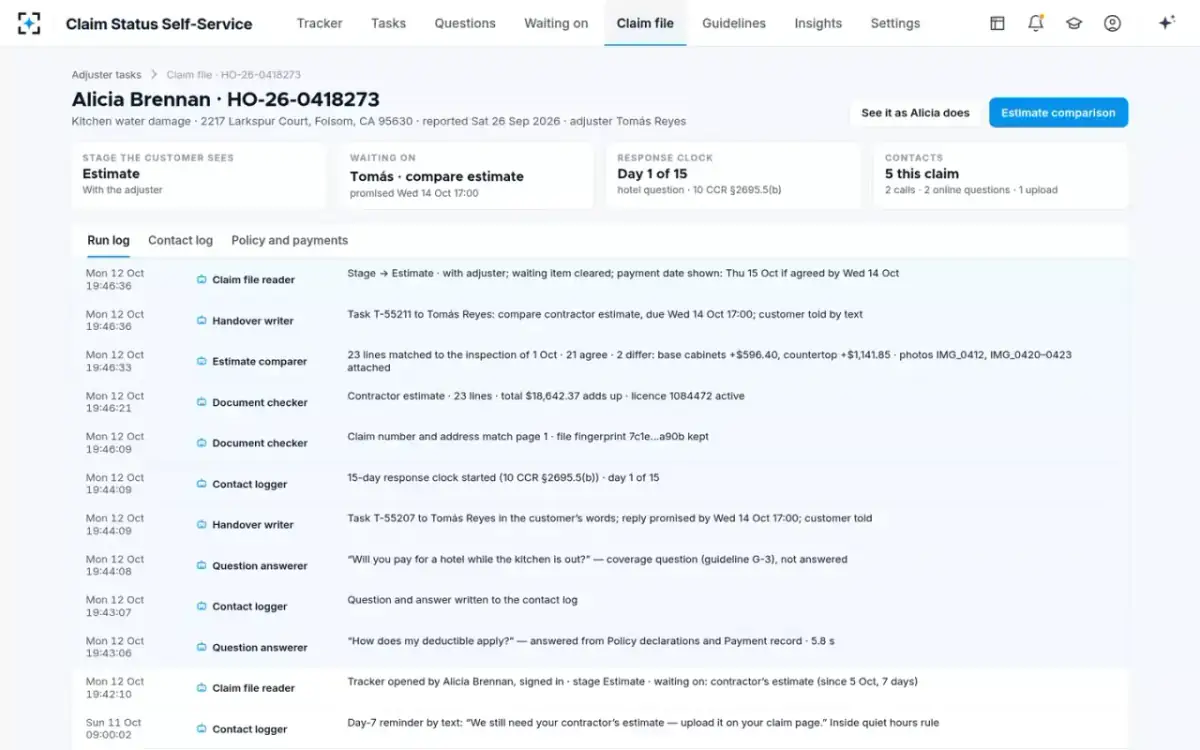
That is the design behind Claim Status Self-Service. Its claim file reader keeps each claim's stage, dates and the one item it is waiting on current from the claim system, in plain words; the waiting item comes from a list the carrier writes once, such as "We need your contractor's estimate" or "Please sign your proof of loss", each with the customer's action. The contact logger counts the 30-day written-status clock on each undecided claim alongside the 15-day response clock on each question.
In Claim Status Self-Service, each clock is counted on the claim and names its regulation
On the sample carrier's board, the 2,192 open property claims in one region sort by who has the next move: 611 waiting on the policyholder, 388 on a contractor, 941 on an adjuster, 155 on payments and 97 on others such as a lender or a city permit office. A status letter written from that view names a real owner and a real item. A letter written without it tends to say "under review", which the guide to going live with a claim status portal treats as a status that has not yet been written.
Running the 30-day clock in Claim Status Self-Service
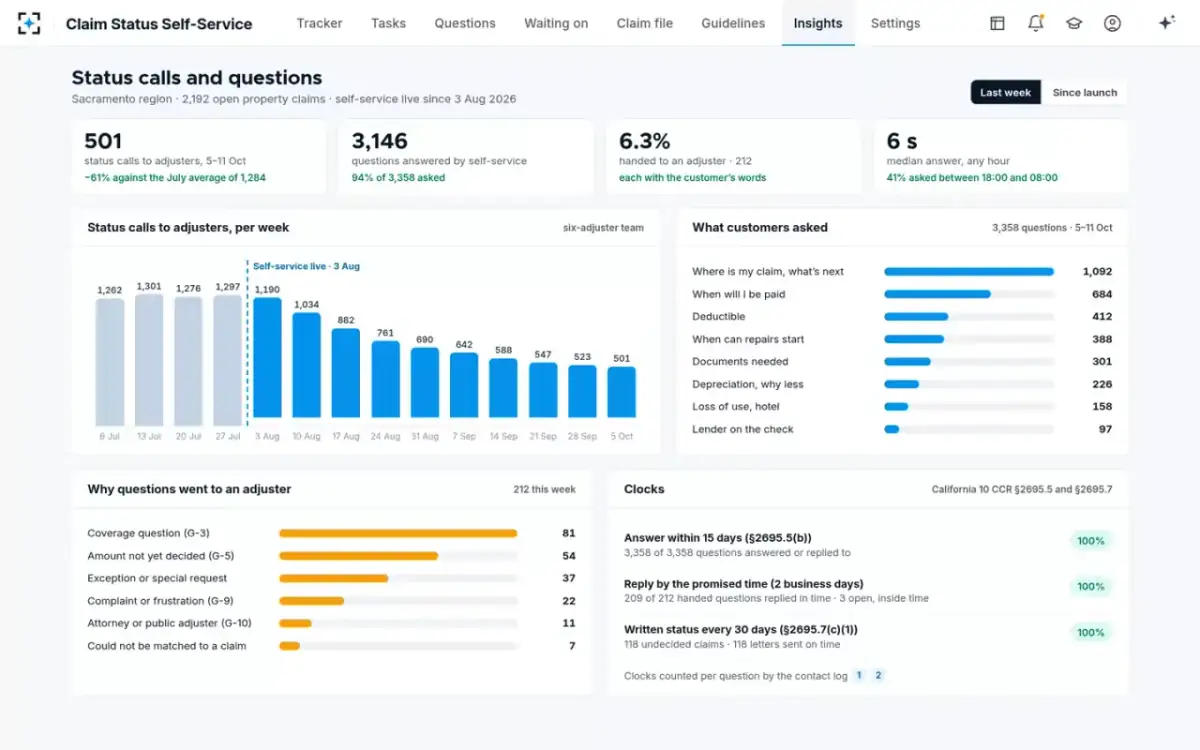
The 30-day written status is a setting, citing §2695.7(c)(1), and the contact logger counts it per claim from the dates the carrier configures. The supervisor's insight view shows it beside the other clocks. In the sample week of 5 to 11 October, 118 undecided claims were sent their 30-day written status on time, 3,358 of 3,358 questions were answered or replied to within 15 days, and 209 of 212 questions handed to adjusters were answered by the promised time, with 3 still inside it. Those figures are sample data.
Three clocks, one view: the 30-day written status beside the 15-day response
The solution does not decide whether a claim is accepted or denied, and it does not decide what a letter may say about a claim under fraud investigation: its message guidelines keep reserves, internal notes and fraud or subrogation activity off anything the claimant sees, and coverage questions go to the adjuster with a reply-by time. A carrier still owns its letter wording and its approval. The payment side of the same claims, including the depreciation held back on a replacement cost claim, is covered in the guide to depreciation of labor by state. To see the sample claim screen by screen, start from Claim Status Self-Service.
Questions people ask
Is the California 30 day status letter required for third-party claims?
Yes. Section 2695.7(c)(1) runs to "the claimant", and California's definitions include both first-party and third-party claimants, as well as attorneys and properly designated representatives. Some lines are carved out of the 40-day decision window in subsection (b)(4), such as disability and mortgage guaranty claims and auto repair bills under Insurance Code section 560.
Does a phone call or an email satisfy the 30-day status requirement?
The regulation requires "written notice", so a call alone does not. An email or a message on a claimant portal is written, provided the insurer can show what was sent, to whom and when, because the claim file must let an examiner reconstruct the date of every material document.
When does the 40-day clock start under 2695.7(b)?
On receipt of proof of claim, which California defines as any evidence or documentation in the insurer's possession that reasonably supports the magnitude or amount of the loss. That can be earlier than a signed sworn proof of loss, so a conservative desk dates it from the first estimate, inspection or invoice that supports the amount.
Does the status letter stop after a partial payment?
Not if part of the claim is still undecided. The 40-day duty is to accept or deny "in whole or in part", and the continuing notice runs until a determination is made, so a paid dwelling with contents still under adjustment still needs its letters for the open part.
What if the claim is waiting on an engineer's report or a lawsuit?
The letter must advise the claimant of the situation and give an estimate of when a decision can be made. Once notice of legal action is served, which California defines to include arbitration, the 30-day series ends.
Can a claimant ask for the claim file instead of a status letter?
In Washington, since 18 October 2026, insureds may request any portion of their first-party claim file, including claim notes, estimates and photographs, with limited redactions (WSR 26-17-089). Elsewhere the right varies by state, which is one more reason the status letter itself should name what the insurer still needs and why.