A bank's check fraud investigation process starts when a customer reports a stolen, washed or forged check and ends when the loss has either been recovered from another bank or written off with a second person's approval. In between, the claims team has to open the claim and its clocks, obtain the customer's affidavit, decide whether the customer is owed a recredit, decide what kind of fraud the check shows, send a breach of warranty claim to the depositary bank within 30 days, and route anything suspicious to the financial crimes team, which has 30 days of its own to file a suspicious activity report. Each step is simple; the difficulty is running them in parallel, on deadlines set by different rules, for thousands of claims a year. Botminds' Check Fraud Claims gives the claims team agents that read the paid image, decide the type and draft the packet, while a specialist and a manager approve every dollar and every letter.
The rules come from UCC Articles 3 and 4 as the states adopted them, Regulations E and CC, and FinCEN's rules and alerts, linked where they apply. The worked claim comes from the solution's fictional sample bank; its customers and figures are sample data.
Why the check fraud investigation process is a volume problem
680,000+
SARs on potential check fraud filed with FinCEN in 2022, nearly double 2021
15,417
reports on mail theft-related check fraud in six months of 2023
$688M
in actual and attempted transactions those reports covered
30days
to give warranty notice after the bank has reason to know of the breach
What is the check fraud investigation process at a bank?
It is two investigations sharing one file. The first faces the customer: was the check, as paid, one the customer authorized, and did the customer meet their own duties? The answer decides the recredit. The second faces the other banks: what kind of fraud is this, and which bank in the chain bears the loss? The answer decides whether the money comes back. A third thread, the suspicious activity review, runs alongside and must never leak into anything the customer sees.
The two main investigations ask different questions on different clocks, which is why banks that treat them as one queue lose money. A specialist who waits for the depositary bank's answer before recrediting the customer has made the customer pay for the bank's recovery. A specialist who recredits but sends the warranty claim on day 35 has made the bank pay for its own delay. The process below keeps them apart.
Check Fraud Claims: the check fraud investigation process, step by step
Agent
Open the claimFinds the paid item from the customer's report, opens the claim and starts the affidavit, recredit and warranty clocks.
Never: decide whether the customer is owed a recredit
Agent
Send the affidavitFills the affidavit from the call note and sends it for e-signature; checks it against the paid item when it returns.
Agent
Compare and typeReads the paid image against the customer's copy and earlier checks, and proposes a type with its evidence.
Never: settle a type below its confidence floor
A person decides
Specialist approvesConfirms the type and who bears the loss, and approves the recredit and the warranty claim as the maker.
A person decides
Manager approvesGives the second approval, which posts the recredit and sends the claim to the depositary bank.
Agent
RecoverTracks the reply date, chases, reads the answer and drafts a rebuttal to a denial.
Never: accept a part payment as settlement
A person decides
Refer or write offFinancial crimes decides on a SAR; loss accounting proposes any write-off and a manager or the head of claims approves it.
Intake: opening the claim and starting its clocks
Intake has one job: turn a phone call into a claim with dates. The claims team needs the paid item, the date the customer reported, the date of the statement that showed the payment, and the date the bank first had reason to know of the fraud. Each of those dates drives a different rule, and the last one starts the 30-day warranty clock against the depositary bank whether or not the affidavit has come back.
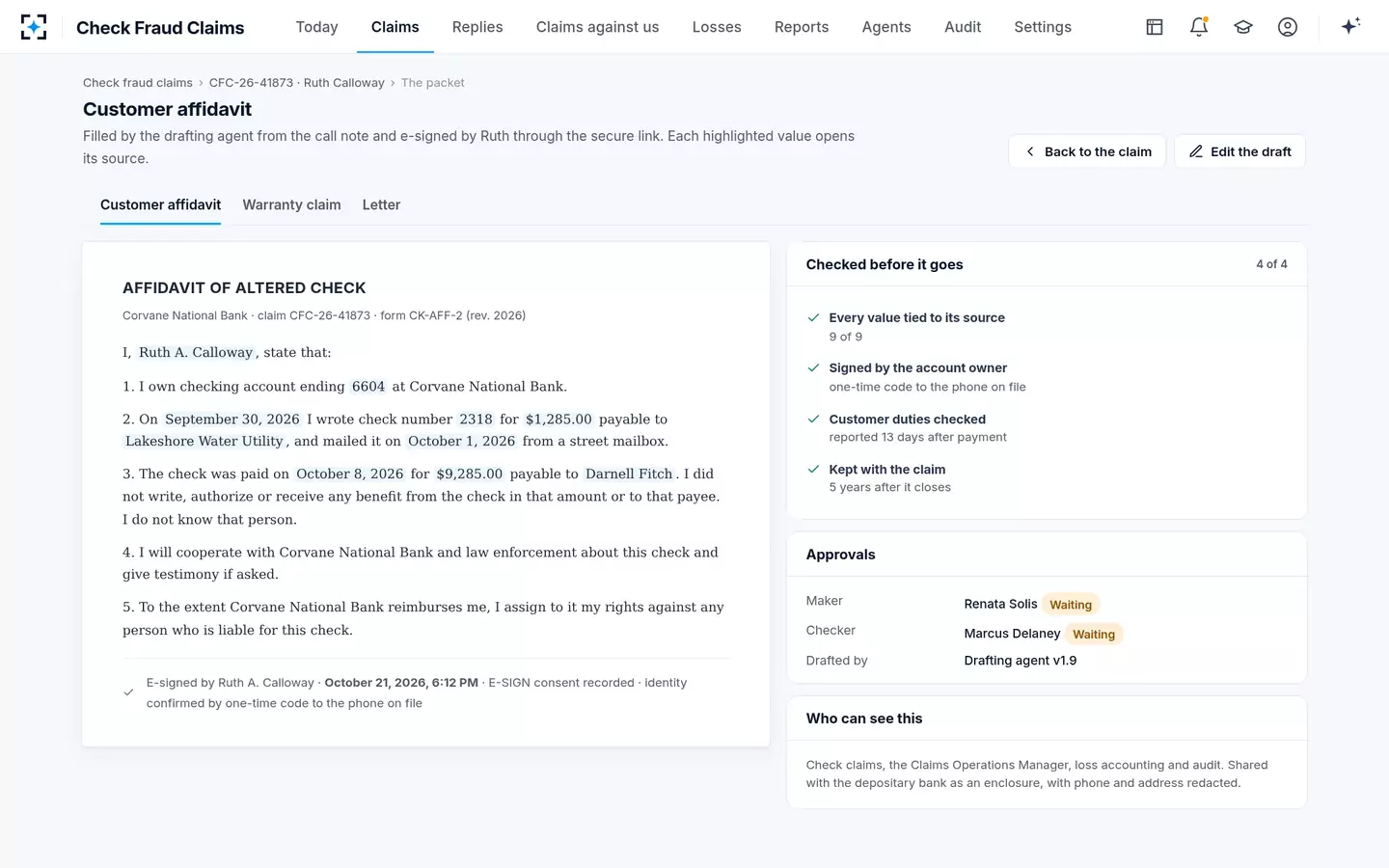
Take a sample customer as her claim runs through Check Fraud Claims. She mailed a $1,285.00 check to her water utility from a street mailbox; it was washed and paid for $9,285.00 to a stranger, deposited by mobile deposit at another bank. She called at 4:40 PM. The intake agent found the paid item, opened the claim and started three clocks; the affidavit went out for e-signature at 4:52 PM, and she signed it at 6:12 PM, uploading her duplicate copy and the utility bill.
Speed at intake is not courtesy; it is evidence. A same-day affidavit, a copy of what the customer wrote and the bill the check was meant to pay are the three documents that make the later typing decision easy. A claim that waits a week for its affidavit loses that week from the 30-day notice period.
What does the bank owe the customer, and when may it refuse?
Generally a recredit, because a bank may charge an account only for an item that is "properly payable," which UCC 4-401 defines as one "authorized by the customer and in accordance with any agreement between the customer and bank" (UCC 4-401). A check washed and rewritten to a new payee, or paid on a forged signature, is not the item the customer authorized. The OCC's consumer answer states the result plainly: "Banks are generally required to reimburse customers for forged checks. However, based on individual circumstances, a bank can investigate to determine if the customer is entitled to a reimbursement" (OCC, HelpWithMyBank).
The investigation into the customer turns on two defences, and the bank carries the burden on both. Under UCC 4-406, a customer who fails to examine statements with reasonable promptness can be precluded, but only if the bank proves the failure and that it suffered a loss from it; and for later items by the same wrongdoer, the customer has "a reasonable period of time, not exceeding 30 days" to examine the statement and report (UCC 4-406(d)). Separately, a customer whose own lack of ordinary care substantially contributed to the forgery may bear some or all of the loss. The outer limit is absolute: a customer who does not report an unauthorized signature or alteration within one year after the statement is precluded, "without regard to care or lack of care of either the customer or the bank" (UCC 4-406(f)).
The recredit decision and the recovery decision are different questions
| What the check shows | Recredit owed to the customer? | Who usually bears the loss in the end |
|---|---|---|
| Altered: payee or amount washed and rewritten | Yes, unless a 4-406 or ordinary-care defence is proved | The depositary bank, which warranted the check was not altered |
| Forged indorsement: payee's signature on the back faked | Yes, on the same terms | Usually the depositary bank, which warranted it was entitled to enforce |
| Forged drawer's signature on the customer's stolen stock | Yes, unless the customer's care contributed | Usually the paying bank; the warrantor knew of no forgery |
| Counterfeit: a check printed on stock that is not the customer's | Yes | Usually the paying bank |
| Signed blank check, payee or amount left open | Often not | Often the customer |
Two federal rules are often assumed to apply and mostly do not. Regulation E, which sets investigation deadlines for electronic transfer errors, excludes "any transfer of funds originated by check, draft, or similar paper instrument" (12 CFR 1005.3(c)(1)), so there is no federal deadline for an ordinary check recredit; the timing is the bank's own policy. The exception is a consumer who received a substitute check: Regulation CC's expedited recredit requires a bank that has not decided a valid claim by the end of the 10th business day to recredit up to $2,500, and the rest by the 45th calendar day (12 CFR 229.54).
The affidavit: what it must establish, and why the recovery needs it
The affidavit is the customer's sworn statement that the check as paid was not the check they authorized, and it serves two readers. For the paying bank it is the basis of the recredit. For the depositary bank it is usually the only document in which the account holder says what the check said when it was written, which makes it the core enclosure of the warranty claim.
What a check fraud affidavit should capture, field by field
- The variant
Altered check, forged drawer's signature, or forged indorsement. The wording differs, and the wrong form invites a denial.
- The check as written
Number, date, payee and amount the customer wrote, ideally with a duplicate copy or register entry.
- The check as paid
Payee, amount and date of payment from the paid image, so the differences are stated, not implied.
- No authority, no benefit
That the customer did not authorize the item as paid and did not receive its proceeds.
- How it left the customer's hands
Mailed, from where and when; or stock stolen, and when it was noticed. This feeds the ordinary-care review and the pattern search.
- Assignment of rights
Where the bank's form provides it, the customer assigns rights against those liable to the extent the bank reimburses.
- Signature and date
An e-signature with recorded consent is faster and dates itself; the date matters to the 4-406 review.
The affidavit, filled from the call note and e-signed the same evening
Why the type of fraud decides who pays
Because the warranties that move the loss cover some frauds and not others. A bank that obtains payment of a check warrants to the paying bank that "the draft has not been altered" and that it was entitled to enforce it, so an altered check or a forged indorsement can be charged back to the depositary bank; it warrants only that it "has no knowledge" that the drawer's signature is unauthorized, so a forged drawer's signature or a counterfeit usually stays with the paying bank (UCC 4-208(a)). The right to recover "is not affected by any failure of the drawee to exercise ordinary care in making payment."
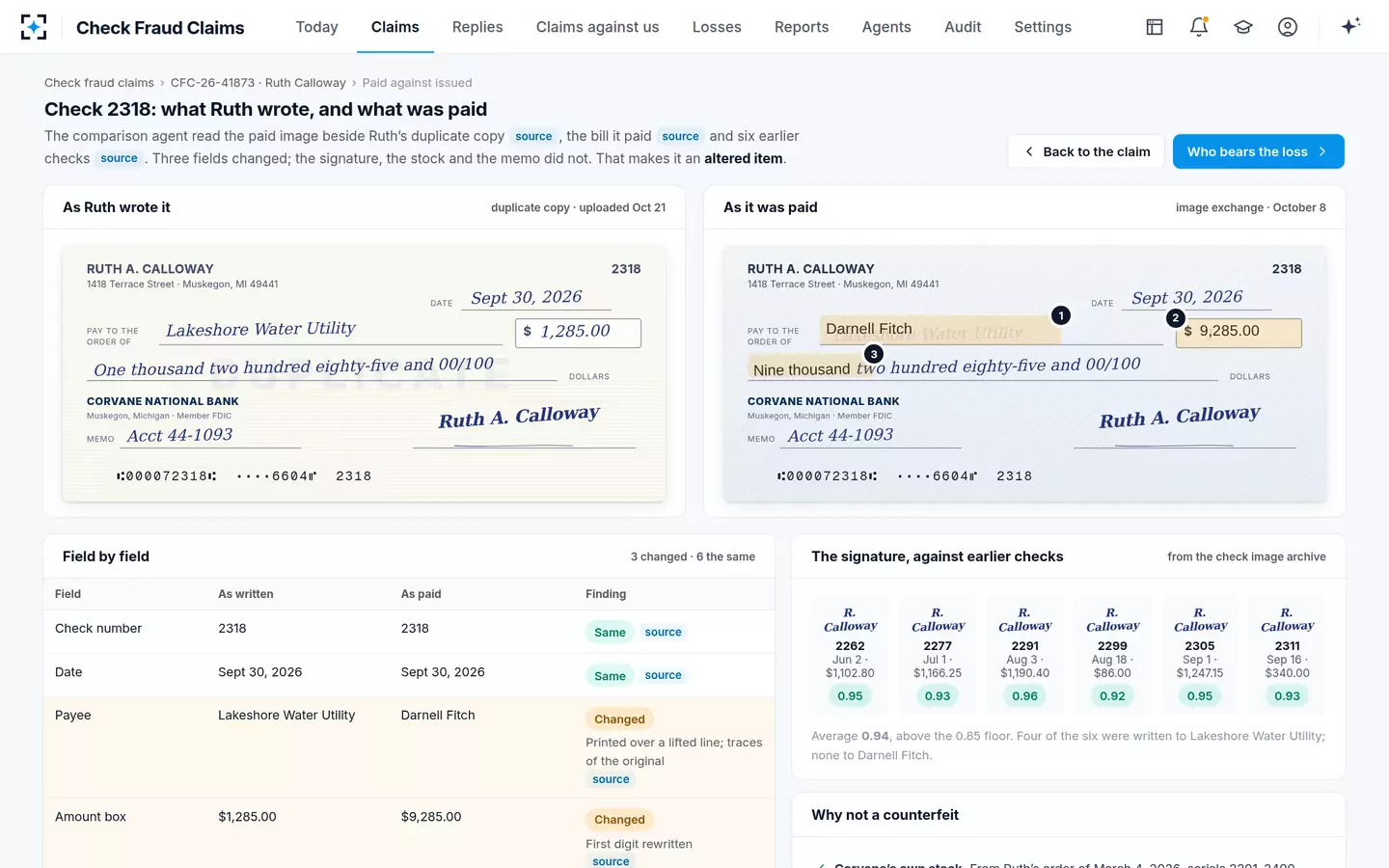
That is why typing is the most expensive decision in the process. A specialist comparing the paid image with what the customer says they wrote has to decide whether the check is the customer's own stock with the payee and amount changed, or a counterfeit printed elsewhere. Called altered, the loss can be recovered; called counterfeit, it stays home. Depositary banks know this, which is why "counterfeit, not altered" is one of the most common denials. Who is liable for altered checks works through each type and the evidence that settles it.
The paid check beside what the customer wrote: three fields changed, six the same
How fast must the warranty claim reach the depositary bank?
Within 30 days of knowing. UCC 4-208(e) provides that unless notice of a warranty claim "is given to the warrantor within 30 days after the claimant has reason to know of the breach and the identity of the warrantor, the warrantor is discharged to the extent of any loss caused by the delay in giving notice of the claim" (UCC 4-208(e)). The warranties cannot be disclaimed for checks. The clock starts when the bank has reason to know, usually the customer's report, not when the affidavit returns or when the specialist gets to the file.
Three bank-side clocks start with the customer's report
- Affidavit due, then recredit one business day after it is signed10 + 1 days
- Sample bank target25 days
- Margin to the legal limit5 days
- From initial detection to filing30 days
In practice the claim is rarely late because someone forgot; it is late because the specialist could not find the depositary bank's claims contact, or waited for an affidavit before drafting. The sample bank sets its own target at 25 days to keep a margin, and in the worked claim the notice went the morning after the call: day 1 of 30. The check fraud claim time limit sets out all four clocks and what each one costs when missed.
When a check fraud claim is also a suspicious activity report
Often, and the decision belongs to financial crimes, not to the claims specialist. A bank must file a SAR "no later than 30 calendar days after the date of initial detection by the bank of facts that may constitute a basis for filing" (31 CFR 1020.320), and must keep the SAR and its supporting documentation for five years. FinCEN's 2023 alert on mail theft-related check fraud asks banks to include the key term "FIN-2023-MAILTHEFT" in the SAR and to select check fraud as the activity type (FinCEN Alert FIN-2023-Alert003).
The claims file is where patterns first show. In the sample bank, the pattern agent linked the water-bill claim to six others: seven checks mailed from street mailboxes in one ZIP code over ten days, washed the same way, deposited at three banks, with $31,644.00 paid on checks written for $1,712.00. It drafted a referral for the financial crimes team, which decides whether to file.
Seven washed checks from one ZIP code, linked for the bank's investigators
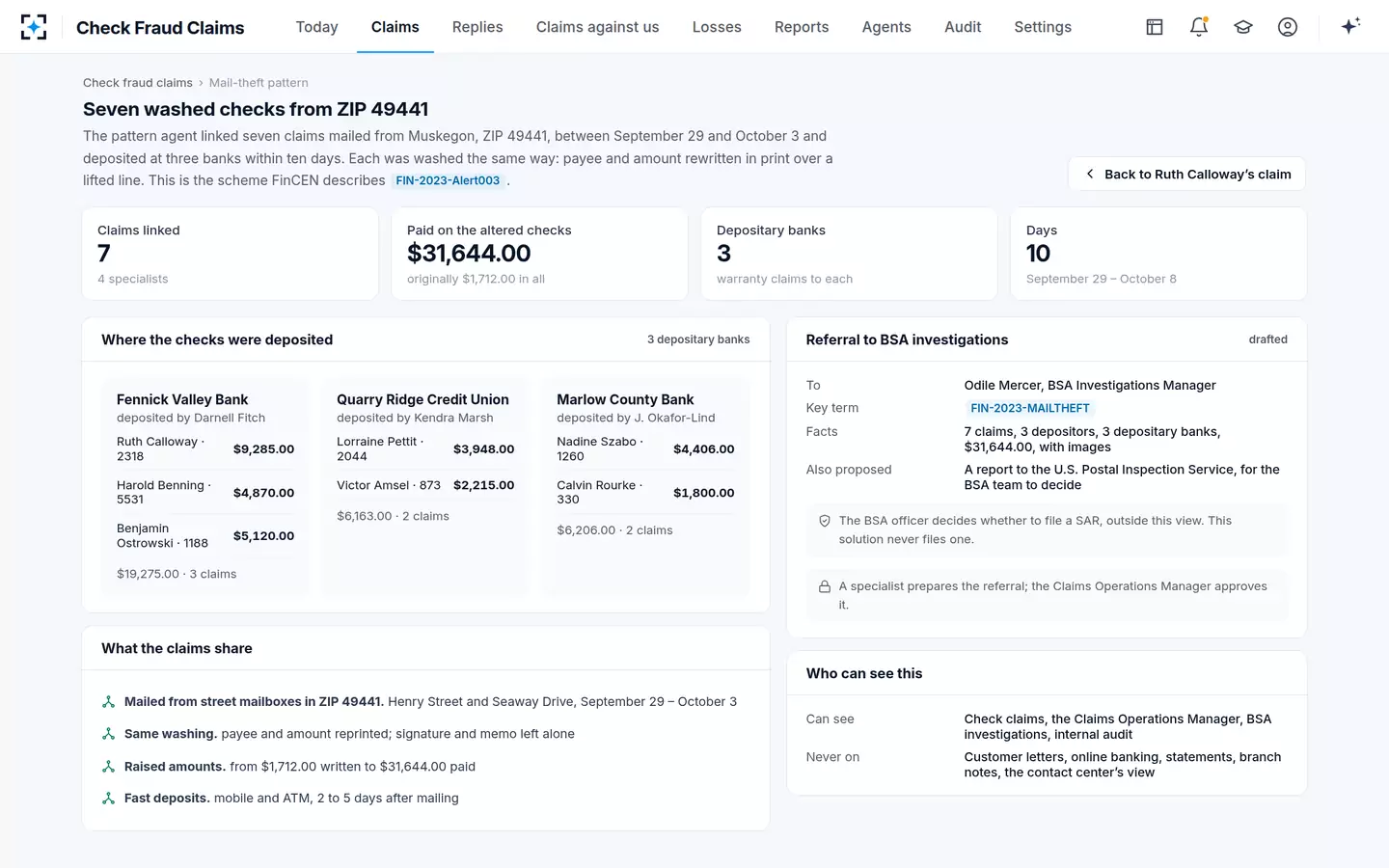
The confidentiality rule is why referrals live outside the customer file. Customer letters, denial reasons and recredit notices are written by the claims team; any mention of a referral in them is a disclosure problem. A process that keeps the two threads in separate views, with a check on every outgoing letter, is easier to defend than one that relies on each specialist remembering.
Controls: who approves what in a check fraud claim
Every action that moves money or speaks for the bank needs two people. That is the standard most claims procedures already state; the gap is usually in proving it, because approvals live in email and recredits post from a shared queue. The sample bank's settings show one way to divide the work.
Roles and approvals in the sample bank's check fraud claims procedure
| Action | Proposes | Approves |
|---|---|---|
| Recredit and warranty claim (the packet) | Check claims specialist, as maker | Claims operations manager, as checker |
| Rebuttal or second demand to a depositary bank | Specialist | Claims operations manager |
| Denial to a customer | Specialist, with a reason | Claims operations manager |
| Hold or payment on a claim against the bank | Deposit operations | Claims operations manager |
| Write-off up to $25,000 | Loss accounting | Claims operations manager |
| Write-off over $25,000, and any change to settings | Loss accounting; claims administrator | Head of fraud and claims operations |
| Referral for a SAR | Specialist or pattern review | Financial crimes, who decide whether to file |
Two more controls matter to an examiner. Each type decision can be changed only with one of seven reason codes, and the change waits for the checker, so a type flipped to make a claim go away leaves a trail. And claim files are kept five years after closing, matching the BSA's five-year recordkeeping period, so a referral made from a claim can always be traced back to its evidence.
Where the specialist's minutes go, and what to measure
Most of a specialist's time on an altered-check claim goes on work that is not judgement: finding the paid item, chasing the affidavit, finding the other bank's contact, writing the letter and chasing the reply. By Botminds' estimate, a claim that takes about 115 minutes by hand takes about 17 with the agents preparing the packet and the specialist reviewing it.
Check Fraud Claims: estimated specialist minutes per altered-check claim
Minutes are not the only measure. A claims leader should track the share of warranty notices sent inside the bank's own target, the share of claims typed altered or forged indorsement that are recovered in full, the denials received by reason, and the write-offs by type. The last two show whether losses come from fraud the bank cannot recover or from claims it could have recovered but typed, timed or argued badly.
Where Check Fraud Claims fits
Check Fraud Claims sits in the claims team's queue. Eight agents open the claim, fill and send the affidavit, compare the paid image with what the customer wrote, reason through who bears the loss in the order the law asks, draft the warranty claim with its enclosures, track and read the replies, and look for patterns across claims. Each works to a confidence floor; below it, the agent offers its readings and the specialist picks one.
People keep every decision that matters. The specialist approves as the maker and the manager as the checker; deposit operations, loss accounting and financial crimes act in their own lanes. In the worked claim, the second approval at 9:31 AM posted the $9,285.00 recredit and sent the warranty claim at the same moment, the day after the call. For the bank-to-bank half of the process in more depth, see the breach of warranty claim, bank to bank; to see the queue with your own closed claims, start from Check Fraud Claims.
Questions people ask
Does Regulation E apply to a stolen and cashed check?
No. Regulation E excludes any transfer of funds originated by check, draft or similar paper instrument, so an ordinary check claim has no federal investigation deadline. The bank's deposit agreement and procedure set the timing, under state law based on UCC Articles 3 and 4.
Must the bank wait for the depositary bank before recrediting?
No. The customer's right to a recredit rests on whether the item was properly payable, not on whether the bank recovers. Banks that link the two make the customer wait on a claim the customer is not a party to.
What happens if the warranty notice goes out after 30 days?
The depositary bank is discharged to the extent of any loss caused by the delay, under UCC 4-208(e). In practice, a depositary bank that has already released the funds to the fraudster will argue the delay caused the whole loss.
How long must check fraud claim files be kept?
No single rule covers the claim file, but a SAR and its supporting documentation must be kept five years from filing. Many banks keep claim files five years after closing so that any referral can be traced to its evidence.
Can a bank deny a claim because the customer reported late?
Only on the terms of UCC 4-406 and the deposit agreement. The bank must prove the customer failed to examine statements with reasonable promptness and that it suffered a loss as a result; after one year from the statement, the customer is precluded regardless of either side's care.
Who decides whether a check fraud claim becomes a SAR?
The bank's financial crimes or BSA team, not the claims specialist. The claims team refers what it sees; the SAR must be filed within 30 calendar days of initial detection, and FinCEN asks for the key term "FIN-2023-MAILTHEFT" where mail theft is involved.