Time-barred debt is debt the applicable statute of limitations has run out on, so that nobody can bring a legal action on it any more — and finding it inside a portfolio before the portfolio is sold is a different job from the one every consumer-help page answers. It is hard because time-barred is not a property of an account; it is the result of a calculation needing two facts, a date the clock runs from and the state whose law it runs under, and charged-off credit card files are missing one or both far more often than anyone expects. Botminds’ Charge-Off Media Management computes the limitation period for every account from the date of default and the borrower’s state, holds back anything inside the bank’s own buffer with the evidence behind it, and runs the whole screen again in the days before cut-off, because an account that was clear in week one may not be clear in week four.
The sample figures on this page come from a fictional sample tranche of 1,284 charged-off card accounts being sold at a cut-off of Friday 16 October. The people, the bank and the buyer are invented. The limitation periods in it are that bank’s settings, not legal advice: periods and their start dates are matters of state law, and they differ.
“A debt collector must not bring or threaten to bring a legal action against a consumer to collect a time-barred debt. This paragraph (b) does not apply to proofs of claim filed in connection with a bankruptcy proceeding.”
Regulation F, 12 CFR § 1006.26(b)
What is time-barred debt?
Regulation F defines the two terms in the plainest possible way. “Statute of limitations means the period prescribed by applicable law for bringing a legal action against the consumer to collect a debt,” and “time-barred debt means a debt for which the applicable statute of limitations has expired” (12 CFR § 1006.26(a)).
Two words there carry everything. “Applicable” means the period is not a federal number: it comes from a state’s law, and which state’s law applies is itself a question that can be argued. “Expired” means the obligation is still owed — the borrower’s liability does not vanish — but one remedy for it, suing, has closed. A time-barred debt can usually still be asked for, can still be paid, and may still sit on a credit report under the rules that govern reporting. What has run out is the courtroom.
From a seller’s chair, that distinction is the practical one. Nothing about a near-expired account makes the balance wrong or the borrower’s liability doubtful. What changes is what the buyer will be able to do with it, and whether the buyer’s likely next steps are ones the seller wants attached to its name.
Can a debt collector sue on time-barred debt?
No. Paragraph (b) of the rule quoted above is unconditional: a debt collector must not bring, or threaten to bring, a legal action to collect a time-barred debt. The rule carries no knowledge requirement — a mistaken belief about the date is not a defence under it — and threatening counts.
The word that matters for a bank is “collector”. The prohibition is in the Bureau’s debt collection rule and attaches to debt collectors as the FDCPA defines them, which is not everyone who collects. The OCC’s own guidance notes the point in a footnote: “An institution is not considered a debt collector under the FDCPA if the institution collects its own debts under its own name, or for debts that it originated and then sold but continues to service” (OCC Bulletin 2014-37, footnote 8).
So the rule is not something a selling bank breaks by holding an old account on its own books. It is what travels with the account the moment it is sold. The buyer is a debt collector; the buyer will be bound; and a seller that puts an account past, or nearly past, its limitation period on the schedule has handed a buyer paper whose only remaining collection route is one the buyer may not take. The question for the seller is therefore not “are we allowed to hold this?” but “what are we selling, and what will the person who buys it be able to do?”
The two facts the calculation needs: a date and a state
Every limitation calculation is the same shape, whichever state it runs in. Something starts the clock, a period runs, and a date arrives. What varies is the length of the period, what counts as the starting event, and whether anything restarts it — all of them state-law questions.
The limitation calculation, and the fourth term most portfolios forget
The date the clock starts
date of default
Commonly the default or the last payment, depending on the state. Not the charge-off date, which is the bank’s accounting event rather than the borrower’s breach.
A fact about the account
The period
+ the state’s limitation period
Set by the law of the applicable state for this kind of contract. It is not one number nationally, and which state applies can itself be contested.
A fact about the law
Today
− the date it is measured on
Which, in a sale, means the cut-off date rather than the day the screen happened to run.
A fact about the sale
The buffer
− the months you hold back
The margin the seller keeps between the bar and the sale, to absorb a wrong start date, a different state or a slow close.
A policy, set by the bank
Put the first three together and you get an expiry date. Put the fourth in and you get something a seller can actually operate, because it admits that the first two terms are estimates. The start date in a card file is often inferred. The state is taken from the last known address, which may be years old. A calculation built from two soft inputs should not be read against zero.
Where the date comes from, and why so many files lack it
The start date is the weakest link, and the industry has measured it. In the FTC’s study of debt buying, the data files buyers received carried the account-opening date for 97% of accounts and the last-payment date for 90%, but the date of first default — the fact most limitation periods actually turn on — for only 35%.
The dates buyers actually received, and what each one can start a clock from
| Date in the data file | Present for | What it can and cannot do |
|---|---|---|
| Date the account was opened | 97% of accounts | Establishes the contract and often the governing terms. Starts no limitation clock on a revolving account. |
| Date of the last payment | 90% of accounts | In several states the clock runs from here, and in several others a payment can restart it. Needs the remittance detail behind it to be relied on. |
| Date the creditor charged off the debt | 83% of accounts | An accounting event on a fixed timetable after delinquency. Useful as a sanity check on the default date, not as a substitute for it. |
| Date of first default | 35% of accounts | The fact most limitation calculations need — and the one nearly two-thirds of accounts arrived without. |
A file without a default date is not a file that cannot be screened; it is a file that will be screened from a proxy, usually the last payment or the charge-off date, and a proxy is exactly the kind of input a buffer exists to absorb. The seller’s own records are the only place a real default date can come from, which is another way of saying this is work that cannot be moved downstream.
It is worth being clear about what the industry’s contracts did with this. The FTC found that sellers were not setting out to sell expired paper — “the FTC did not receive any contracts that were written specifically to sell debts that were beyond the statute of limitations” — but also that “although some contracts permitted debt buyers to put back out-of-statute debts, most were either silent about out-of-statute debts or expressly stated that sellers’ inclusion of out-of-statute debts was not a breach of the contract.” Nobody meant to sell it, and in most agreements nobody had promised not to.
Why a buffer beats an expiry date
An expiry date says an account is fine until a Tuesday and not fine on the Wednesday. Nothing about the underlying facts is that sharp. The start date may be a proxy; the state may be wrong; the sale may close three weeks later than planned; and the account may sit on a buyer’s desk for months before anyone looks at it. A buffer measured in months answers all four at once, which no amount of precision in the date can do.
Eleven months from the bar, against thirteen
Held back — inside a 12-month buffer: Nothing. The account stays on the bank’s books whatever the start date turns out to be.
Sold — just outside it: The default date and the state in the file both being right.
Held back — inside a 12-month buffer: Immaterial — the margin absorbs it.
Sold — just outside it: A three-month error can put the account past the bar in the buyer’s hands.
Held back — inside a 12-month buffer: Immaterial.
Sold — just outside it: The margin is now twelve months and shrinking against a date nobody re-checked.
Held back — inside a 12-month buffer: Nothing — it was never sold.
Sold — just outside it: Collect, and possibly sue, on an account near enough to the limit that the decision is delicate.
Held back — inside a 12-month buffer: The recovery on one account.
Sold — just outside it: A put-back at best; at worst, the bank’s name on a suit nobody should have brought.
That is the argument for a buffer rather than a date. The buffer is also the honest way to describe what is going on: the bank is not asserting that it knows the expiry date to the day, it is declining to sell anything close to one.
Does making a payment restart the statute of limitations?
In some states, on some kinds of debt, yes — and that is precisely why a payment date is not interchangeable with a default date in the calculation. A partial payment, or a written acknowledgement of the debt, can begin a fresh limitation period in a number of jurisdictions. In others it does nothing at all once the period has already run.
The seller’s handling of this should be mechanical rather than clever. Hold the facts: the date, source and amount of the last payment, with the remittance detail behind it, because a payment that may have restarted a clock is a fact the buyer and any court will want evidenced rather than asserted. Do not attempt to apply a restart rule across a portfolio from a single national assumption; the rule differs, and getting it wrong in the generous direction is how an expired account ends up on a schedule.
The same caution applies to the borrower’s side of this, which is why consumer guidance warns people that paying a small amount on a very old debt can have consequences they did not intend. The two concerns meet at the same evidence: what was paid, when, and under which state’s law.
What the OCC says about selling accounts near the limit
The OCC’s debt-sale guidance draws two lists, and the distinction between them matters. The first is debt “clearly not appropriate for sale, because it likely fails to meet the basic requirements to be an ongoing legal debt”. The second is different in kind: “banks should refrain from the sale of certain additional types of debt because the sales of these types of accounts may pose greater potential compliance and reputational risk” — and that is where accounts close to the statute of limitations appear.
The OCC’s two lists, and which one the limitation period is on
- Debt that has been otherwise settled or is in process of settlement
Clearly not appropriate for sale
- Debt of deceased account holders
Clearly not appropriate for sale
- Debt of borrowers that have sought or are seeking bankruptcy protection
Clearly not appropriate for sale
- Debt of account holders currently in litigation with the institution
Clearly not appropriate for sale
- Debt incurred as a result of fraudulent activity
Clearly not appropriate for sale
- Accounts lacking clear evidence of ownership
Clearly not appropriate for sale
- Accounts eligible for Servicemembers Civil Relief Act protections
Banks should refrain — compliance and reputational risk
- Accounts of minors
Banks should refrain — compliance and reputational risk
- Accounts in disaster areas
Banks should refrain — compliance and reputational risk
- Accounts close to the statute of limitations
Banks should refrain — compliance and reputational risk
Read it carefully and the bulletin has already made the argument of this page. It does not say “do not sell expired debt”, which would be a rule about a date. It says do not sell accounts close to the limit, which is a rule about a margin — and leaves the margin to the bank. That is a buffer, named as such by the regulator, with the number left blank.
What happens to the accounts a bank declines to sell is visible in the market data. The Bureau’s credit card market report describes warehoused balances as “generally those that issuers do not actively seek to collect and generally include accounts issuers considered to be uncollectible or unlikely to be repaid, including older accounts that may be past the statute of limitations” (CFPB, The Consumer Credit Card Market). Held-back paper does not disappear; it sits.
Bankruptcy: the exception the Supreme Court drew
There is one explicit carve-out in the rule, and it is in the same sentence as the prohibition: paragraph (b) “does not apply to proofs of claim filed in connection with a bankruptcy proceeding.” That exception is not an oversight. It follows the Supreme Court’s decision in Midland Funding, LLC v. Johnson, which held that “the filing of a proof of claim that is obviously time barred is not a false, deceptive, misleading, unfair, or unconscionable debt collection practice within the meaning of the Fair Debt Collection Practices Act” (No. 16-348, decided 15 May 2017).
The reasoning turned on the setting: a bankruptcy claims process has a trustee whose job is to examine claims, and an expired claim is disallowed rather than paid. It is not a licence to sue, and it does not touch paragraph (b)’s prohibition anywhere else. For a seller, its practical effect is narrow and worth knowing: a portfolio’s oldest paper has a route in bankruptcy that it does not have in a county court, which is part of why specialist buyers exist for segments a general buyer will not take.
That market is real. The same Bureau report notes that issuers may sell special segments — accounts with a bankruptcy notice or a deceased borrower, for example — to buyers with the specialised expertise those accounts need. A bank that holds an account back from the general tranche has not necessarily decided never to sell it; it has decided not to sell it to this buyer, in this sale, on these terms.
The disclosure a notice may carry, and what it does not fix
Regulation F allows a collector of time-barred debt to put a time-barred disclosure on the front of the validation notice, below the current amount — but only “any time-barred debt disclosure that is specifically required by, or that provides a safe harbor under, applicable law, provided that applicable law specifies the content of the disclosure” (12 CFR § 1006.34(d)(3)(iv)(B)). In other words, the federal rule makes room for a state’s warning; it does not write one.
It is worth being blunt about what such a disclosure does and does not do. It tells a consumer that the debt is old and that the collector will not sue on it. It does not make an expired account a better thing to have bought, it does not revive the remedy, and it does nothing whatever for the seller whose name is on the account’s history. A disclosure is a late repair on a sale decision that could have been made correctly months earlier, for nothing.
Examiners treat the subject as a question about process rather than about any one account. The CFPB’s debt collection examination procedures direct examiners to “determine whether the entity has policies and procedures related to debt for which the applicable statute of limitations has expired (‘time-barred debt’), including how the entity identifies such debt and how it collects on such debt (if at all)” (CFPB, Examination Procedures: Debt Collection). How you identify it is half the question being asked.
Running the clock again before cut-off
The last mistake is the one that is hardest to see, because the screen passed. Most do-not-sell screening happens once, early, when the portfolio is first assembled — and then weeks pass, during which a borrower files a Chapter 13, a dispute is raised, a death is recorded, and every account in the file gets a few weeks older against its limitation date. A clean screen in week one is a statement about week one.
Seven checks in Charge-Off Media Management, each with its source and the date it ran
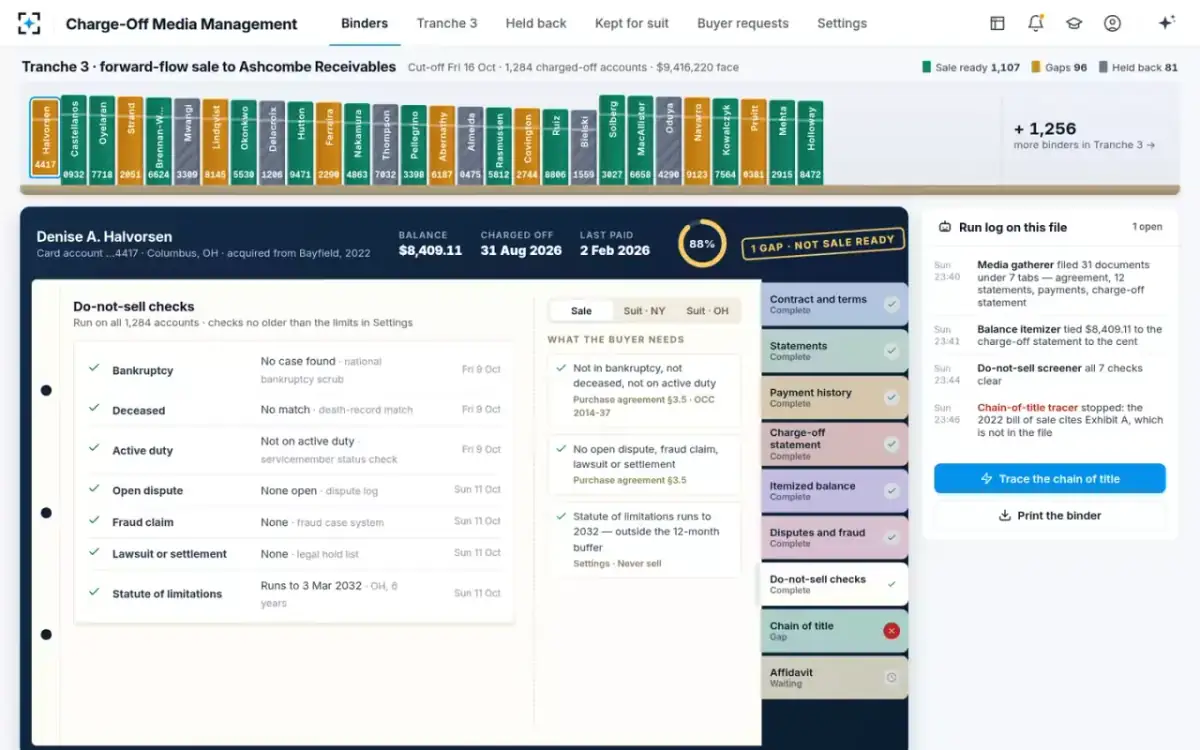
On the sample account, the limitation check reads Ohio, six years, running to 3 March 2032, outside the twelve-month buffer, all clear — which implies a clock starting on 3 March 2026 and leaves more than four years before the account would even enter the buffer. Six other checks run beside it, each stamped with the source it consulted and the date it ran, because a check without a date is not a check.
One account’s clock, read against the buffer rather than against zero — and the cut-off the verdict is taken at
- Run so far7 months
- Clearto 3 Mar 2031
- The buffer12 months
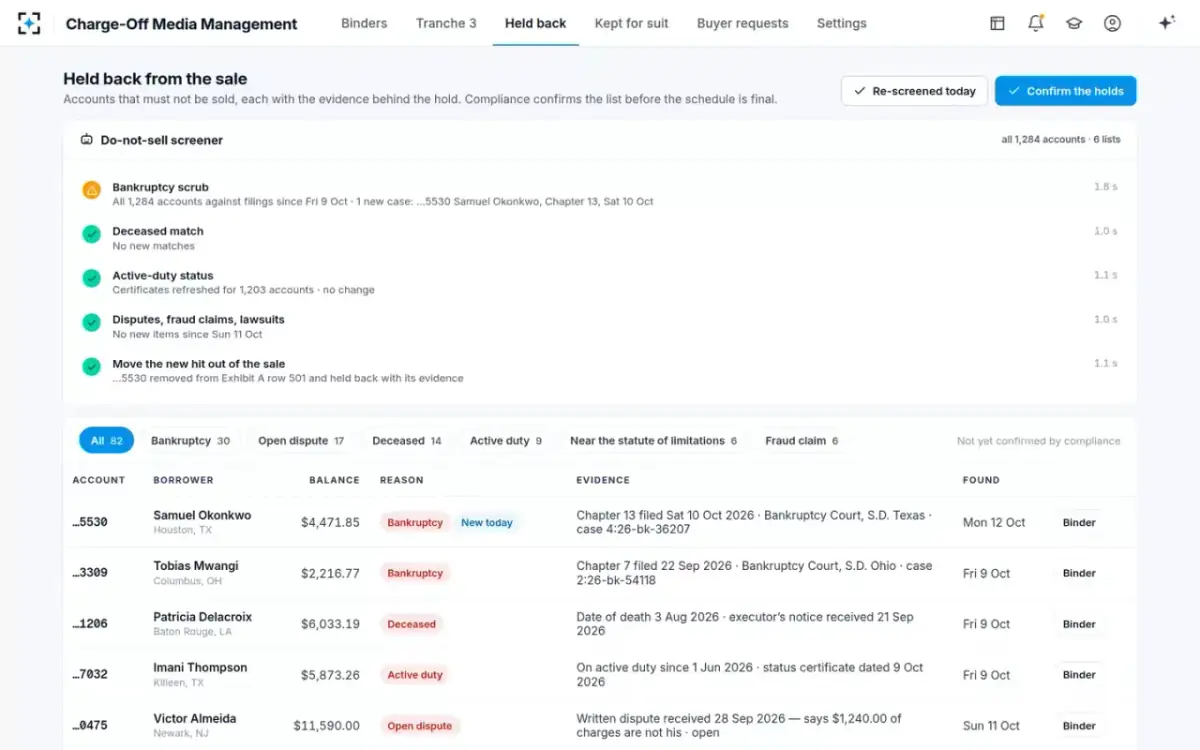
In the sample tranche, 81 of 1,284 accounts were held back, and the limitation check accounted for six of them: bankruptcy 29, open dispute 17, deceased 14, on active duty 9, near the statute of limitations 6, fraud claim 6. Six is a small number, and it is the one most easily got wrong, because it is the only reason on that list that is computed rather than looked up. The other six reasons are events — a filing, a death, a claim. This one is arithmetic over two uncertain inputs, which is why it is expressed as a margin and why the screener is barred from clearing a hit on its own.
Then the whole screen runs again. Before the cut-off, all 1,284 accounts are re-checked rather than only the ones that previously failed, and in the sample week that caught a Chapter 13 filed on the Saturday: the account came off the schedule and the hold count went to 82. A hold can be lifted, but only with a reason and a second person — which is the right asymmetry, because adding a hold protects the sale and removing one exposes it.
Held back in Charge-Off Media Management, with the evidence that put each account there
The settings behind all of this are the bank’s: the limitation buffer in months, the freshness windows for each scrub, which reasons are on at all, and who confirms. They sit beside the sale checklist and the state suit checklists, because they are the same kind of decision — the one date a charged-off balance is built on is set in the same place, and what may be sold when the borrower has died is the hold on the same list with the clearest law behind it. To see the screen run against your own charged-off accounts, start from Charge-Off Media Management.
Questions people ask
What is the statute of limitations on debt?
It is the period your state’s law gives a creditor to bring a legal action to collect, and there is no single national figure: periods differ by state and by the kind of agreement, and what starts the clock differs too. Because the period and its starting event are both state-law questions, the only reliable answer for a particular account is the one that comes from the law of the state that governs it.
Can time-barred debt be sold?
Nothing in federal law forbids selling it, and the FTC found that most purchase agreements it reviewed were silent on the point or said expressly that including out-of-statute debt was not a breach. Supervisory guidance pushes the other way: the OCC tells banks to refrain from selling accounts close to the limit because of the compliance and reputational risk. In practice a seller’s own buffer, not a prohibition, is what keeps that paper out of a tranche.
What date does the statute of limitations run from?
It depends on the state, and commonly on the default or the last payment rather than on the charge-off date, which is the bank’s accounting event. That is why the date of first default matters so much and why its absence is a problem: in the FTC’s data it was present for only 35% of accounts, against 90% for the last-payment date.
What happens if a collector sues on an expired debt?
Bringing or threatening a legal action on a time-barred debt is prohibited for debt collectors by Regulation F, whether or not the collector knew the period had run; the rule itself has no knowledge requirement. The one carve-out in the rule is for proofs of claim in a bankruptcy proceeding, following the Supreme Court’s decision in Midland Funding, LLC v. Johnson.
How close to the statute of limitations is too close to sell?
There is no published figure, and the OCC deliberately does not give one — it says “close to” and leaves the margin to the bank. A buffer expressed in months is the usual answer because it absorbs the two weak inputs in the calculation, an inferred start date and a stale address. The sample portfolio on this page uses twelve months; the number is a setting, and the right one depends on how good the bank’s default dates are.
Does time-barred debt still show on a credit report?
Expiry of a limitation period and the separate rules on how long information may be reported are different clocks, and one does not end the other. An account can be beyond the period for suing and still be reportable, or reportable no longer and still legally owed. Treat them as two questions with two different answers rather than as one event.