A forward flow agreement is a contract to sell charged-off accounts to the same buyer on a repeating schedule — monthly or quarterly — at an agreed price, with the accounts in each pool defined by criteria the parties fixed in advance rather than chosen deal by deal. It replaces the one-off portfolio auction with a standing deadline, and that is what makes it hard: the diligence a seller used to do once, slowly, now has to be finished by every cut-off, and each clause of the agreement is a promise about an account's file that has to be true on the day. Charge-Off Media Management is Botminds' software for that file work: it fills each account's binder from the bank's own systems, screens out what must not be sold, traces ownership account by account, and builds the schedule and the seller's affidavit for a named person to release.
The worked example on this page is a fictional sample tranche inside the solution: Tranche 3 of a forward-flow sale by Kestrel Point Bank to Ashcombe Receivables, 1,284 charged-off card accounts, $9,416,220 of face value, cut-off on a Friday in October. The bank, the buyer, the people and the agreement are invented. The research figures come from the FTC, the CFPB and the OCC, linked under each figure.
What is a forward flow agreement?
The structure is common enough that both prudential and consumer regulators describe it in passing. The OCC notes that "some banks and debt buyers agree to contractual 'forward-flow' arrangements, in which the banks continue to sell accounts to the debt buyers on an ongoing basis" (OCC Bulletin 2014-37). The CFPB's market report puts the criteria at the centre of the definition: card issuers sell charged-off debt "to pre-selected debt buyers, receiving a fraction of the outstanding account balances sold", and "typically, these sales are structured as 'forward-flow' contracts, where a pool of accounts that meet pre-determined criteria is sold on an ongoing (e.g., monthly, quarterly) basis" (CFPB, 2025).
Read that definition as an operating instruction and two things follow. First, the buyer is not bidding on what the seller happens to have; it has already agreed to take whatever meets the criteria, which means the criteria do the work a bid process used to do. Second, "ongoing" means there is no quiet quarter. A spot sale can slip a month while an analyst finishes the file. A forward flow cannot: the price is fixed, the pool is defined, and the only variable left is how much of the eligible population the seller can actually make deliverable by the date.
That is why the economics of these agreements are decided in clauses most people skip. The price per dollar is one line. Eligibility, put-back rights, the media obligation, resale and the service level are five, and each of them converts a documentation gap into money.
The six clauses that decide a forward flow's economics, and the question each one really asks
| Clause | What it says | The question behind it |
|---|---|---|
| Eligibility criteria | Which accounts may be in the pool: age since charge-off, balance band, state, segment, and the exclusions. | Can we prove, per account, that it meets every criterion on the cut-off date — not last month? |
| Put-back rights | When the buyer may return an account and get its money back, and what proof it must show. | Which of our own screens runs late enough to catch what the buyer will catch? |
| Media allowance | How many of the sold accounts the buyer may ask documents for free, and for how long. | Will the free allowance absorb the gaps we already know about? |
| Media fee | What the buyer pays per document once the free allowance or the window is used up. | What does one missing statement cost us at the next renewal, not this one? |
| Resale | Whether the buyer may sell the accounts on, and what it must pass to the next buyer. | Who will answer a consumer, or a court, about this account in three years? |
| Service level | How long the seller has to answer a media request after the sale. | Can we answer from the file we already built, or do we start the hunt again? |
The cut-off: the date everything is measured against
The cut-off date is the moment the pool is fixed. Balances are struck as at the cut-off, eligibility is tested as at the cut-off, and the schedule the seller signs says these accounts, with these balances, were eligible then. Everything a bank does in the days before it is therefore work against a clock that does not move, and the work has an awkward shape: the accounts that need the most document chasing are exactly the ones whose eligibility is least certain, so the file work and the screening cannot be run in sequence without one of them finishing after the deadline.
In the sample tranche the week runs like this. Overnight on the Sunday, agents fill every account's binder from the bank's own systems and list the gaps: 1,107 accounts sale ready, 96 with gaps, 81 held back. Through the week each missing document is asked of the system that should hold it, and the gaps close in batches rather than one at a time — one found acquisition schedule closed 41 files at once. Before cut-off the do-not-sell screens run again over all 1,284 accounts, not just the ones that changed. Compliance confirms the holds. Then the schedule is built from complete, unheld binders only, and the debt sale manager releases it under his own name.
Cut-off week, one tranche, drawn across the five days it has
- Mon · binders filledgaps listed by tab
- Tue–Wed · the media chaseeach gap asked of its own system
- Thu · re-screenholds confirmed
- Fri · schedule builtreleased at cut-off
That estimate is the reason forward flow is operationally different from a spot sale, and not only commercially. Twenty working days of preparation is survivable once a year. Repeated monthly it guarantees a backlog, and a backlog in this work does not look like a late report — it looks like accounts rolling from one tranche to the next, which is precisely the population whose eligibility is drifting towards the exclusions.
What the deadline looks like at release
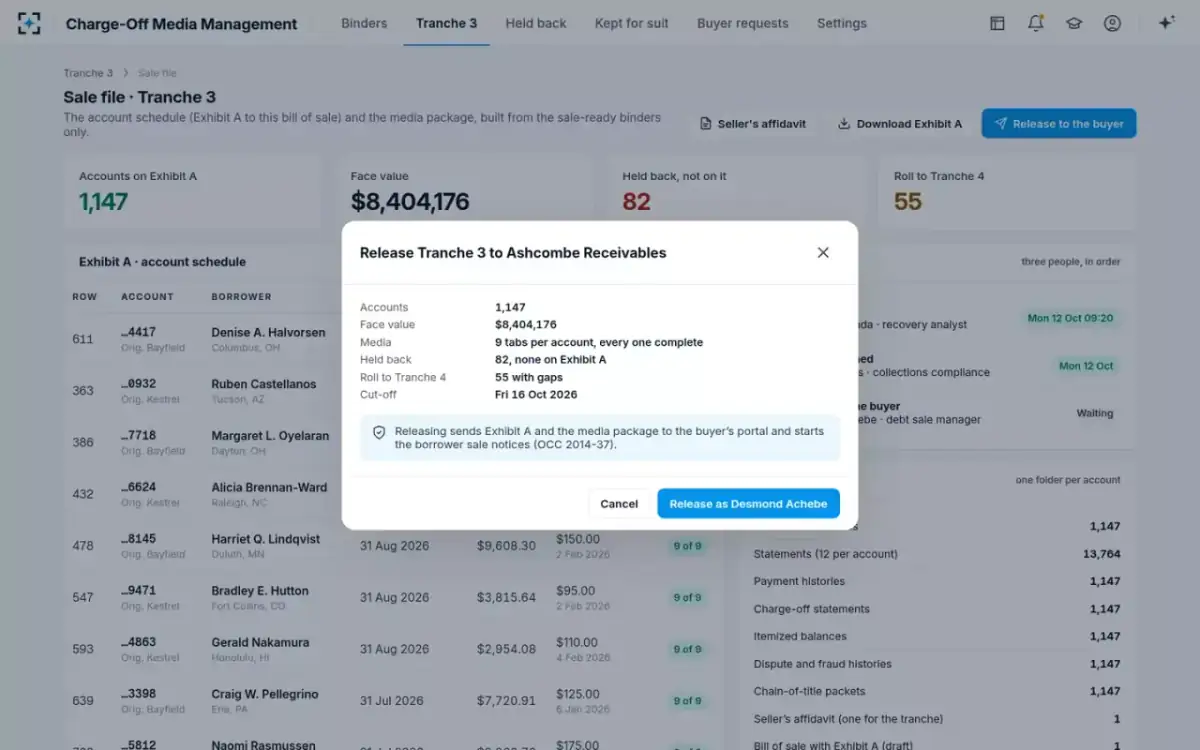
Eligible and ineligible accounts, and who carries the mistake
Eligibility in these agreements is written as a list of positive criteria and a longer list of exclusions, and the exclusions are where the money is. The FTC's study of the industry found that the accounts buyers could most easily return were the ones with a clean documentary test: "debt buyers typically could put back 'ineligible accounts' to debt sellers that included debts owed by consumers who had died or who had declared bankruptcy on or before a specific date prior to the transfer of ownership to the debt buyer", and the agreements "tended to provide debt buyers with a relatively easy and low cost means of providing proof" of either (FTC, 2013).
That asymmetry should shape a seller's screening calendar. Death and bankruptcy are matched against public and commercial records that the buyer can also search, cheaply, after the sale. A seller whose scrub ran three weeks before cut-off is not making a judgement call about residual risk; it is choosing to let the buyer find the hits first, and to pay for them. The same logic applies to the clock on the limitation period, which moves on its own: an account eleven months inside a six-year bar at the scrub can be outside the seller's own policy buffer by the cut-off.
In the solution the screens re-run over the whole tranche within five days of cut-off, which is a setting rather than a rule, and the re-screen in the sample week finds exactly the kind of hit a single early scrub misses: a Chapter 13 filed on the Saturday, two days before confirmation. The account comes off the schedule with the court, the case number and the date behind it, and the hold count goes from 81 to 82. What should never be sold at all, and why the limitation period deserves its own buffer, are set out in the guide to time-barred debt and in what may be sold after a borrower dies.
Eligibility read tab by tab, across a whole tranche
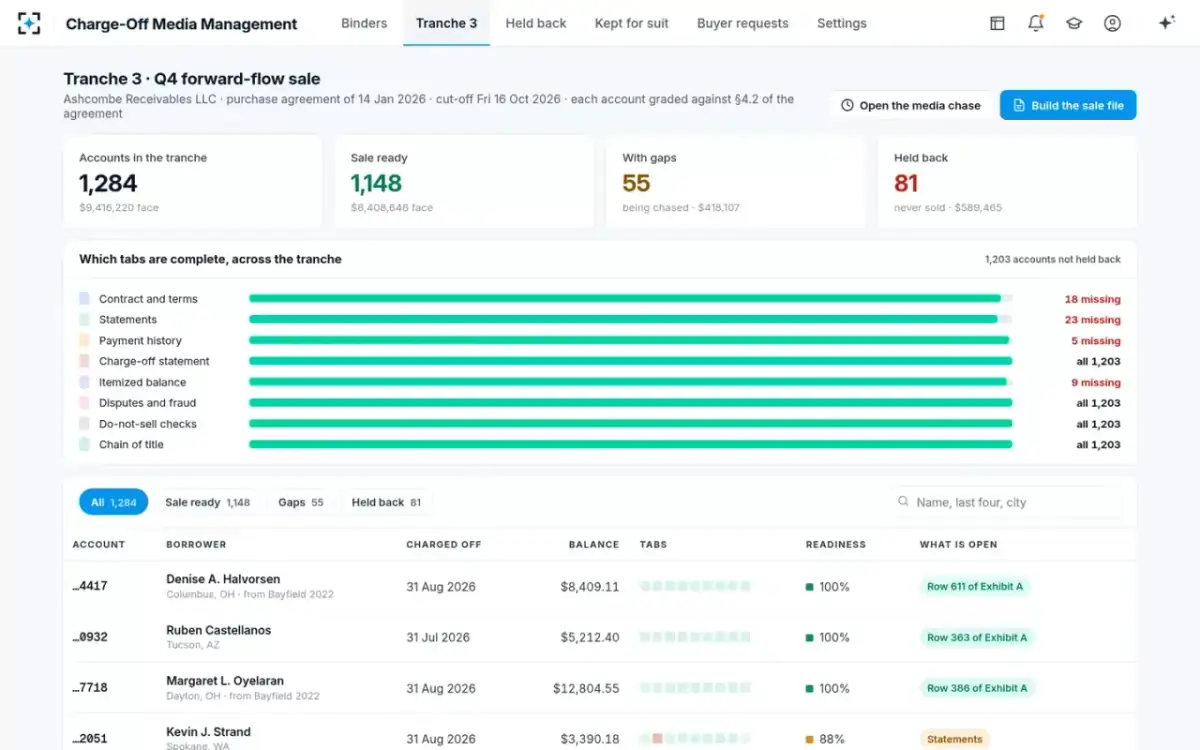
What is a put-back in a debt sale?
A put-back is the buyer's right to hand an account back and be repaid, usually by credit against the next tranche, because the account did not have the attributes the agreement said it would. It exists because the rest of the contract gives the buyer almost nothing else. The FTC found that "in many purchase and sale agreements, sellers disclaimed all warranties and representations regarding the accuracy of the information they provided at the time of sale about individual debts, essentially selling the debts, with some limited exceptions, 'as is'", and that contracts "typically gave debt buyers some refund, or 'put-back,' rights when purchased debts did not have the attributes necessary to be included in the portfolio of debts sold" (FTC, 2013).
So the put-back is narrow by design: it is a remedy for ineligibility, not for a thin file. The same study found that "most purchase and sale agreements provided very limited, if any, right for debt buyers to put back debts to debt sellers on the grounds that information from debt sellers about individual debts was missing or inaccurate". A seller reading its own agreement should therefore know which of its failures come back as a put-back and which come back as a media fee, because the two have different sizes and different timing.
A put-back, from the buyer's request to the credit note
Agent
Request receivedThe buyer names the account and the ground — deceased, in bankruptcy, settled, in litigation or outside the criteria — and attaches its proof.
Never: Never accepts a ground the agreement does not list
Agent
Evidence matchedThe claim is tested against the bank’s own records and the screen results as they stood at cut-off, with the date each check ran.
Never: Never re-dates a check to make a claim fail
A person decides
Compliance confirmsWhere the hit is real, compliance confirms that the account should not have been sold and records what the early screen missed.
A person decides
Credit and correctionThe debt sale manager credits the account against the next tranche, and the screening rule that let it through is changed, not just the account.
The OCC states the discipline plainly: "if banks are required to repurchase accounts from debt buyers after sales are completed, the banks' quality control personnel should evaluate why the accounts were returned and determine whether additional quality controls need to be implemented" (OCC Bulletin 2014-37). The bulletin also asks a bank's own policy to require "ongoing monitoring and analysis of repurchase requests from debt buyers to improve the bank's account review process before each debt sale". A put-back rate is not an accident rate; in a forward flow it is a measurement of last month's screening, available in time to fix this month's.
Media obligations: how many documents, for how long, at what price
The media clause is the part of a forward flow agreement that is most often negotiated by people who will never have to meet it. It has three numbers: the share of sold accounts for which the seller will produce documents at no charge, the window in which the buyer may ask, and the price per document afterwards. The FTC read the agreements themselves and found all three clustered tightly.
What the purchase and sale agreements themselves said about media
10–25%
of the debts purchased, the share for which sellers typically agreed to provide documents free of charge
6 mo–3 yr
the window in which a buyer could ask for those free documents, measured from the date of sale
$5–$10
per document after the free allowance or the window ran out, and sometimes higher
Those three numbers interact in a way that rewards preparation and punishes delay. A free allowance of 10% is generous if the seller's files are complete, because the buyer will use it for the handful of accounts it actually litigates. It is nothing at all if a fifth of the tranche went out with a missing statement, because the allowance is consumed by the seller's own gaps and everything after it is billed. And the window cuts both ways: a buyer that waits two years to ask will be asking a bank whose statement archive has moved once since the sale.
One regulator has set a floor by consent. The CFPB required a card issuer, for debt sale contracts entered into after the order, to "make available to a Debt Buyer, for a minimum of three years following the Debt Sale, upon request at no or nominal cost to the Debt Buyer" the credit agreement, any recorded dispute from the eighteen months before sale, an itemization of any judgment, the last eighteen monthly statements, and the name and address of the original creditor (CFPB consent order, 2015). That order binds its respondents, not the market, but it is the clearest published statement of what a supervisor thinks a seller should still be able to produce three years on — and a seller that cannot produce it from a file built once will be producing it from a hunt.
Examiners read the clause as written. The CFPB's examination procedures tell an examiner to "review sale contracts, in particular: i. Provisions that describe the nature of the account-level information provided to the debt buyer; ii. Any representations or disclaimers made relating to the accuracy of the account-level information provided to the debt buyer; and iii. Whether the entity agreed to provide additional account-level information upon the buyer's request, including how long the additional account-level information will be available and how much it will cost" (CFPB examination procedures). The third item is the media clause by another name.
Representations, warranties and "as is"
Most forward flow agreements give the buyer a short list of representations about the seller itself — that it owns the accounts, that it may sell them, that the data file was produced from its own systems — and then disclaim nearly everything about the individual debts. That is what "as is" means here, and the FTC was careful about what follows from it: the fact that debts were generally sold as is "does not necessarily mean that errors or inaccuracies were or were not prevalent", because the study did not test accuracy at all (FTC, 2013).
For the seller, the disclaimer is less protective than it looks. It limits the buyer's contractual remedy; it does not limit a regulator's interest in whether the seller knew. The examination procedures ask directly whether the seller "had reason to doubt the accuracy of the account-level information it provided to the buyer (for example, if there were patterns of disputes, unusual gaps of information, or known problems with account maintenance)", and whether, where a consumer has disputed a debt, the seller tries to verify it before selling and passes the dispute on. An "as is" clause and a known pattern of unusual gaps are not a comfortable pair.
The practical answer is to make the representations the seller can give narrow, true and cheap to prove. In the solution each document in a binder carries the system it came from and its identifier, each balance is rebuilt into principal, interest and fees and tied to the charge-off statement, and the itemization date is used the same way everywhere — the discipline that the itemization date guide works through in detail. A seller with that behind it can warrant process without warranting every figure.
Resale: the clause that decides who answers in three years
Resale is the clause with the longest tail and the least attention. The OCC's position is that it must be addressed explicitly: "banks should ensure that the debt-sale arrangements address the extent to which the debt buyers can resell debt", and "in drafting debt-sale arrangements, banks should address whether subsequent resales of former bank debt would be permitted" (OCC Bulletin 2014-37). Where resale is permitted, the bulletin expects the agreement to carry the file forward with the debt rather than leaving the next buyer to reconstruct it.
A seller who permits unrestricted resale has given away the only thing that keeps the account's story intact. The documents the first buyer did not ask for are the documents the third buyer cannot get, and by then the bank's own retention clock may have run. A seller who prohibits resale outright has a cleaner tail but a smaller bid. The middle position — resale permitted to buyers that meet named standards, with the whole file passed on — is the one the guidance implies, and it is worth more at the table than a tenth of a cent on the price. How ownership is actually proved, link by link, is the subject of the chain of title guide.
What the OCC expects the contract itself to say
The bulletin applies to national banks and federal savings associations, so it is supervisory expectation for them and the clearest published checklist for everyone else. Read as a contract review, it asks for nine things.
The OCC's expectations of a debt-sale contract, written as clauses to look for
- Clear, consistent terminology, standard across business lines
The bulletin asks that contracts "reflect clear, consistent terminology" and that a bank selling from more than one business line use standard language where appropriate.
- Duties and obligations delineated, including confidentiality and information security
These "should be clearly delineated in the contracts, as should responsibility for compliance with applicable consumer protection laws."
- A termination plan for customer information
The contract should "ensure that customer information is returned to the bank or destroyed in accordance with the debt-sale arrangement."
- Minimum service levels for the treatment of customers
Banks "should include minimum-service-level agreements in debt-sale arrangements to promote fair and consistent treatment of customers", whether the buyer collects itself or uses agents.
- An explicit position on resale
Whether resale is permitted at all, and if it is, an obligation on the first buyer to diligence the next and to pass on every document it holds.
- Volume addressed in dollars, share and account numbers
Contracts should "address the volume of accounts (both in terms of the total dollar amount and percentage of debt sold, as well as aggregate numbers of accounts)".
- The reasons the buyer may litigate
The same sentence asks contracts to address "the reasons why the debt buyer can litigate" — a clause most sellers leave silent.
- The buyer’s duty to keep the information accurate
Arrangements "should address the debt buyers’ obligations to engage in ongoing efforts to maintain the accuracy of the information provided by banks."
- No compensation that rewards aggression
Banks "should ensure that contracts do not include compensation provisions that incent debt buyers to act aggressively or improperly."
Running a tranche to the deadline
Everything above reduces to one operational question: on the Friday, is the schedule a statement of fact or a hope? The difference between the two tranches below is not effort. It is whether the gaps were found on the Monday, at the level of the tab, or discovered at the end while the schedule was being typed.
Two tranches at the same cut-off: complete, and short
Released short: Every account the criteria allow, including the ones whose statements never arrived.
Released complete: Only accounts whose every tab is complete and that are not held back; the rest roll to the next tranche.
Released short: Known in aggregate — "statements are weak" — and account by account only when the buyer asks.
Released complete: Known by tab and by account before the chase starts: 23 short on statements, 18 on contract and terms, 9 on the balance, 5 on payment history.
Released short: One scrub, run early, because re-running it after the schedule is drafted means redrafting.
Released complete: Re-screened over the whole tranche inside five days of cut-off; one new bankruptcy caught and removed.
Released short: Each one starts a hunt across the systems the documents should have come from.
Released complete: Answered from the binder that was built for the sale.
Released short: Put-backs for the ineligible, per-item fees for the missing, and a buyer with a reason to re-price.
Released complete: A smaller tranche than the pool allowed, and no credit notes.
Released short: Whatever was not noticed, mixed with what was.
Released complete: 55 accounts with a named reason each, already in the chase for the next cut-off.
The sale file: the schedule, the media package and three sign-offs
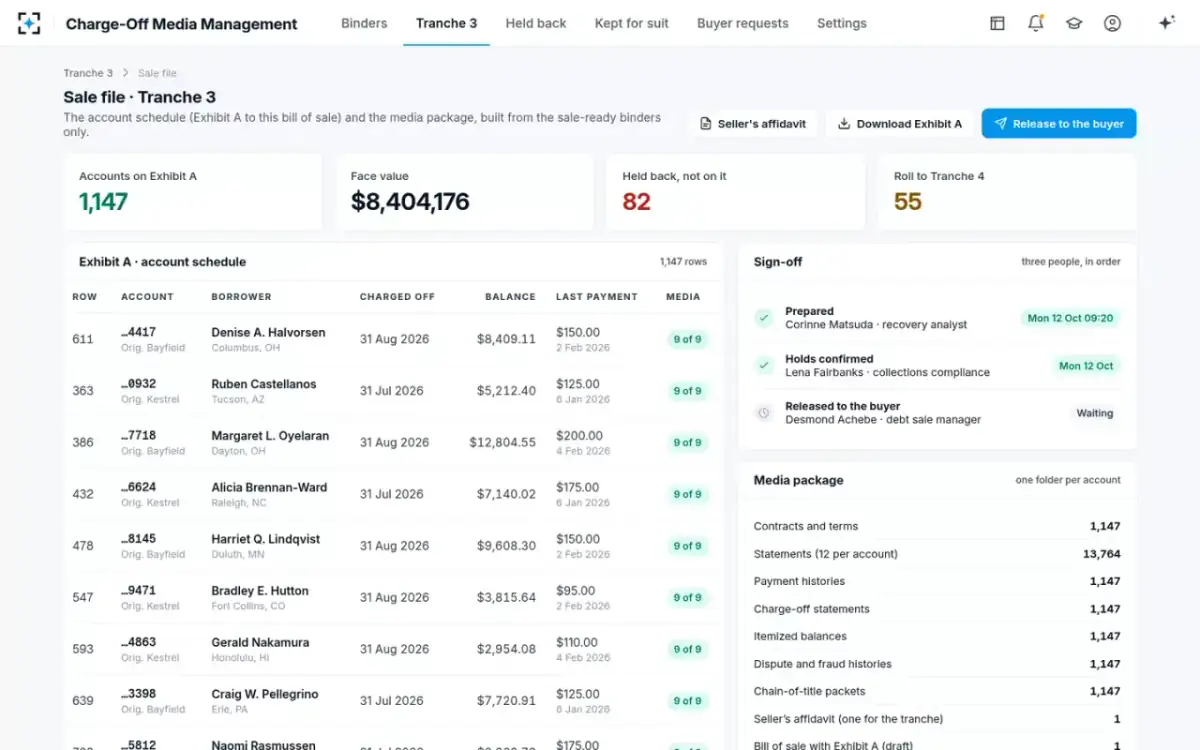
The last clause worth measuring is the service level. In the sample agreement the seller has thirty days to answer a buyer's media request; on the solution’s sample data the median answer takes four minutes, because the request is answered from the binder the sale was built from rather than from the systems it was built out of. That is the whole argument for treating the file as the deliverable: the same work that makes the schedule true on the Friday is the work that answers the buyer two years later. What a complete file is worth in the price itself is the subject of what debt buyers pay for debt. To see the binders, the re-screen and the release together, start from Charge-Off Media Management.
Questions people ask
How does a forward flow debt sale work?
The seller and buyer agree a price, the criteria an account must meet, and a repeating cut-off. At each cut-off the seller strikes balances, tests every candidate account against the criteria, removes what must not be sold, and delivers an account schedule plus a media package; the buyer pays the agreed fraction of the balances on the schedule. Accounts that are eligible but not yet deliverable usually roll to the next cut-off rather than being dropped.
What is an eligible account in a debt sale agreement?
One that satisfies every criterion the agreement lists on the cut-off date — typically a charge-off age band, a balance range, permitted states and segments — and none of the exclusions. The exclusions are the operative half: deceased borrowers, accounts in or near bankruptcy, settled or paid accounts, accounts in litigation with the seller, fraud, and accounts close to the end of the limitation period. The FTC found that death and bankruptcy were the grounds buyers could prove most cheaply after the sale.
How long does a seller have to provide documents after a sale?
It is a negotiated window, not a rule. The FTC found sellers typically agreed to provide documents free of charge for between 10% and 25% of the debts purchased, with requests limited to between six months and three years after the sale. One CFPB consent order required its respondents to keep a defined list available for at least three years at no or nominal cost. Separately, the agreement sets a service level for answering each request; thirty days is common, and it is the number worth measuring yourself against.
Can a debt buyer resell the accounts?
Only if the agreement allows it. The OCC expects a bank's debt-sale arrangements to address the extent to which a buyer may resell, and, where resale is permitted, to oblige the first buyer to diligence the next purchaser and pass on all the account information and documentation it holds. Unrestricted resale is how a file degrades: each hand-off is a chance for the documents, and the ownership trail, to be left behind.
What happens if an ineligible account is on the schedule?
The buyer puts it back and is credited, usually against the next tranche, on proof of the ground it claims. The seller's own cost is larger than the credit: the account was collected on by someone who should never have been given it, the reason it slipped through is a control failure the OCC expects quality control staff to investigate, and a pattern of put-backs is the first thing a buyer raises when the price is renegotiated.
Is a forward flow agreement the same as a spot sale?
No. A spot sale is one portfolio, marketed and bid once, with diligence done before the deal. A forward flow fixes price and criteria in advance and repeats on a schedule, which moves all the diligence into the operating rhythm — the same checks, every month, against a date that does not move. The commercial terms are easier; the file work is relentless.