Deceased debt collection is allowed, but it is narrow: the debts of someone who has died are generally claims against that person’s estate, and the people a collector may discuss them with are set by federal law and by probate rather than by who picked up the telephone. It is hard in practice for two reasons — the family on one end rarely knows which of them, if any, has authority to pay anything, and the bank on the other end often does not yet know the borrower has died. Botminds’ Charge-Off Media Management matches every account in a charged-off portfolio against a death record before the portfolio is sold, holds back the ones that match with the evidence that put them there, and runs the match again in the days before cut-off, because a death recorded in week three does not show up in a screen run in week one.
This page is written for the people who decide what the bank does next: the compliance analyst deciding which accounts in a tranche cannot leave the bank, and the servicing team that takes the call from a relative holding a letter addressed to someone who died in March. The sample figures come from a fictional sample tranche of 1,284 charged-off card accounts; the people, bank and buyer in it are invented. Nothing here is legal advice, and the one question it deliberately does not answer — whether any particular relative owes anything — is a matter of state law.
Deceased accounts in one tranche of 1,284
14
accounts held back because the borrower had died
81
holds in all before cut-off, across seven reasons
82
after the re-screen in the days before the schedule was final
Can debt collectors collect from a deceased person?
They can seek payment from the estate, and under federal law they may discuss the debt with a short list of people connected to it. They cannot collect from the person who has died, for the obvious reason, and they cannot treat a relative as a substitute for the borrower.
The starting point is that the obligation survives. As the FTC put it when it set out its policy on collecting decedents’ debts, “most debts incurred in life do not simply vanish upon death”; instead “the decedent’s estate (comprised of the assets held by the decedent at the time of death) is responsible for paying them” (76 FR 44915). Whether there is anything in the estate to pay with is a separate question, and often the answer is no.
What changes is the conversation. Before the death, the collector was talking to the borrower. After it, the collector is talking to someone who may have authority over the estate, may have no authority at all, and in either case is a third party whose privacy the FDCPA protects. Getting the list of permitted people right is the whole of the compliance problem.
Who is responsible for a deceased borrower’s debt?
The estate, in the first instance — and beyond that, no single answer holds, because it depends on the state, on whether the account was joint, and on marital property rules that differ sharply across the country. Both of the easy answers circulating are wrong. “Relatives always inherit the debt” is wrong. “No relative is ever liable for anything” is also wrong, and a collector that said it to a surviving joint account holder would be making a misstatement of a different kind.
What the federal material does say, and say firmly, is that a collector must not blur the line. The FTC noted that collectors contact relatives who “may have no authority to pay the debts from the decedent’s estate and no legal obligation to pay the debts from their own assets,” and warned that even without an explicit claim, a collector’s communication “might convey the misimpression that the individual is personally liable for the decedent’s debts, or that the collector could seek certain assets to satisfy the debt.” To avoid that impression, the Commission said it may be necessary to disclose clearly and prominently that payment is sought from the estate’s assets, and that the individual could not be required to use their own assets, or assets owned jointly with the person who died, to pay it.
So the two questions to keep separate are: who may be spoken to, which federal law answers; and what the estate owes and who else, if anyone, is on the account, which state law and the credit agreement answer. A seller preparing a portfolio only has to get the first one right — and then decline to sell the account at all.
Who counts as the consumer once the borrower has died
Regulation F gives a short, closed list. For the purposes of the section that governs who a debt collector may communicate with, the word consumer is widened to take in five more people — and, once the borrower has died, the one that matters most is the executor or administrator of the estate (12 CFR § 1006.6(a)).
The five people Regulation F treats as the consumer — and who is not on the list
- The consumer’s spouse
On the list by status, whether or not they are on the account.
- The consumer’s parent, if the consumer is a minor
Rarely relevant on charged-off card paper.
- The consumer’s legal guardian
A court-conferred role, evidenced by an order.
- The executor or administrator of the estate, if the consumer is deceased
The role probate creates. Evidenced by letters or a certificate, not by self-description.
- A confirmed successor in interest
Confirmed — the status has to have been established, not asserted on a call.
- Not on the list: adult children, siblings, partners, the person who answered
Being closest to the person who died confers nothing. They may be the right person to locate — that is a different kind of call.
Two words in that list do most of the work, and both are about evidence. “Executor or administrator” is a role conferred in a probate process, not a description someone adopts. “Confirmed” successor in interest means exactly what it says. A collector that treats the person who answered the phone as the consumer because they said they were handling things has stepped outside the list.
The FTC’s forbearance, and exactly what it permits
There is one more category, and it comes from an enforcement policy rather than from a rule — a distinction worth holding on to, because it is often reported as though the law had been changed.
“this Statement announces that the FTC will forebear from enforcing Section 805(b) of the FDCPA … against a debt collector for communicating about a decedent’s debts with persons specifically identified as appropriate to contact under Section 805 of the FDCPA (e.g., spouse, parent, guardian, executor, or administrator) or any other person who has the authority to pay the decedent’s debts from the assets of the decedent’s estate.”
Federal Trade Commission, Statement of Policy, 76 FR 44915 (27 July 2011)
Read precisely, that is a statement about what the Commission will not enforce, in respect of one section, against a collector communicating with one additional class of person: someone who has authority to pay the debts from the estate’s assets, whatever title probate gave them. It does not create a right, it does not bind a private litigant, and it does not extend to anybody outside that description.
The Commission gave its reason, and it is a practical one. Restricting a collector to the strict list can push collections into the probate process even on small estates, “imposing substantial costs on the estate and delaying the distribution of assets to heirs and beneficiaries.” The forbearance is a balance, not an invitation.
Locating the right person without naming the debt
Before any of that can happen, the collector usually has to find out who the right person is — and the rules for that call are stricter than the rules for the conversation it leads to, because the people being called have no connection to the debt at all. The FTC’s statement is explicit that these are location communications under Section 804 of the FDCPA, which requires a collector to “identify himself, state that he is confirming or correcting location information concerning the consumer, and, only if expressly requested, identify his employer,” and “not state that such consumer owes any debt”.
One call to find the person who can pay from the estate
What the caller may do
- Identify himself or herself.
- State that the call is to confirm or correct location information about the consumer.
- Identify the employer, but only if expressly asked.
- Ask clarifying questions to find the person with authority to pay the debts from the estate’s assets.
What the caller may not do
- State that the consumer owes any debt.
- State or imply that the person who died was behind on those bills.
- Use leading questions that invite the person answering to claim an authority they do not have.
- Leave the person contacted with the impression that they are personally liable, or that their own assets can be reached.
Where it has to stop
- As soon as the person with authority over the estate’s assets is identified, the location call has done its job.
- A discussion of the balance belongs with that person, not with whoever answered.
- Questions such as whether someone is “handling the final affairs” or paid for the funeral are not, on their own, evidence of authority.
The Commission also considered, and rejected, prescribing a script: it concluded that it was impractical to limit collectors to a fixed list of questions, and said instead that a collector “may ask a person clarifying questions when seeking to identify and locate the person with the authority to pay the decedent’s debts from the estate’s assets, but a collector should not use inappropriate leading questions” or do anything else likely to make the person contacted claim an authority they do not have.
One small point of language from the same discussion shows how fine the line is. A collector may refer to the “outstanding bills” of the person who has died, because that balances the need to find the right person against the privacy of the person who died — but the Commission cautioned that stating or implying that those bills were in arrears would breach Section 804. The permitted phrase and the prohibited one are a few words apart.
Can a deceased person’s debt be sold?
In a general portfolio sale, supervisory guidance says it should not be. The OCC lists debt “of deceased account holders” among the debt that should plainly not be sold, because it probably fails the basic test of an ongoing legal debt, alongside debt already settled or in settlement and debt of borrowers who have sought bankruptcy protection (OCC Bulletin 2014-37).
The reason is not that the obligation has evaporated. It is that the collection process which follows a sale cannot be run correctly by a buyer who knows nothing about the estate. The buyer has a balance, a name and an address. The work that is actually needed — identifying an executor, establishing whether probate has been opened, judging whether there are assets at all — requires facts the sale file does not carry and the buyer has no way to obtain.
That is why a deceased account is the plainest entry on the whole do-not-sell list. Unlike a near-expired limitation period, there is no calculation and no margin: either the account matched a death record or it did not, and if it did, it stays with the bank.
Why the death screen runs twice, not once
Most portfolios are screened once, early, when the accounts are first pulled together. Then three or four weeks pass before cut-off. In that window, people die, bankruptcies are filed, disputes are raised — and a screen run in week one has nothing to say about any of it.
The gap a second screen closes
- Covered by the first screenweeks 1–2
- Not covered — anything recorded after itweeks 2–5, up to cut-off
- First screenweeks 1–2
- Re-screened over all 1,284 accountswithin 5 days of cut-off
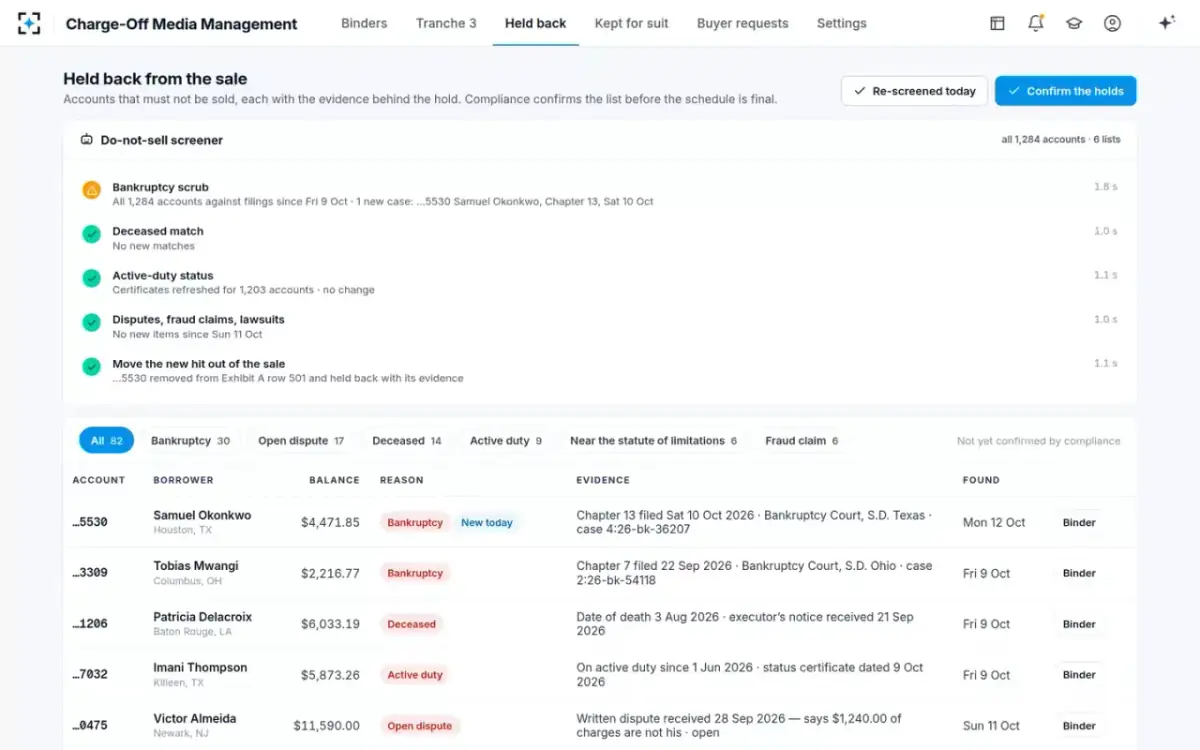
In the sample tranche, the second screen ran over all 1,284 accounts rather than only the ones that had previously failed, which is the part that matters: re-checking the hits tells you nothing new, and the account you need to find is one that was clean the first time. It found a Chapter 13 filed on the Saturday, took that account off the schedule, and moved the hold count from 81 to 82.
The freshness of each source is itself a setting — the bankruptcy scrub no older than five days at cut-off, the servicemember status certificate no older than thirty days — and a check older than the setting allows is simply re-run. The death-record match sits in the same list, next to the dispute log, the fraud case system and the legal hold list.
The death-record match, beside the six other checks Charge-Off Media Management runs

The evidence a hold has to carry
A hold that says “deceased” and nothing else is a rumour in a schedule. In the sample tranche every hold carries the thing that put it there: the court and case number for a bankruptcy, the date of death for a deceased account, the status certificate for a servicemember, the reference for a dispute. That evidence does three jobs — it lets compliance confirm the list rather than take it on trust, it survives the person who ran the screen leaving, and it is what makes the hold reversible on terms rather than reversible on a whim.
From a match to a released tranche: who does what, and what none of them may do
Agent
Do-not-sell screenerMatches every account against the death record and the six other sources, and holds back each hit with the evidence and the date behind it.
Never: clears a hit by itself
Agent
Sale file assemblerBuilds the schedule and the media package from binders that are complete and not held back.
Never: includes a held-back account, and never signs
A person decides
Collections complianceConfirms that every held-back account must not be sold, before the schedule is final. A hold is lifted only with a reason and a second person.
A person decides
Debt sale managerReleases the tranche under their own name, after compliance has confirmed the holds, and signs the seller’s affidavit.
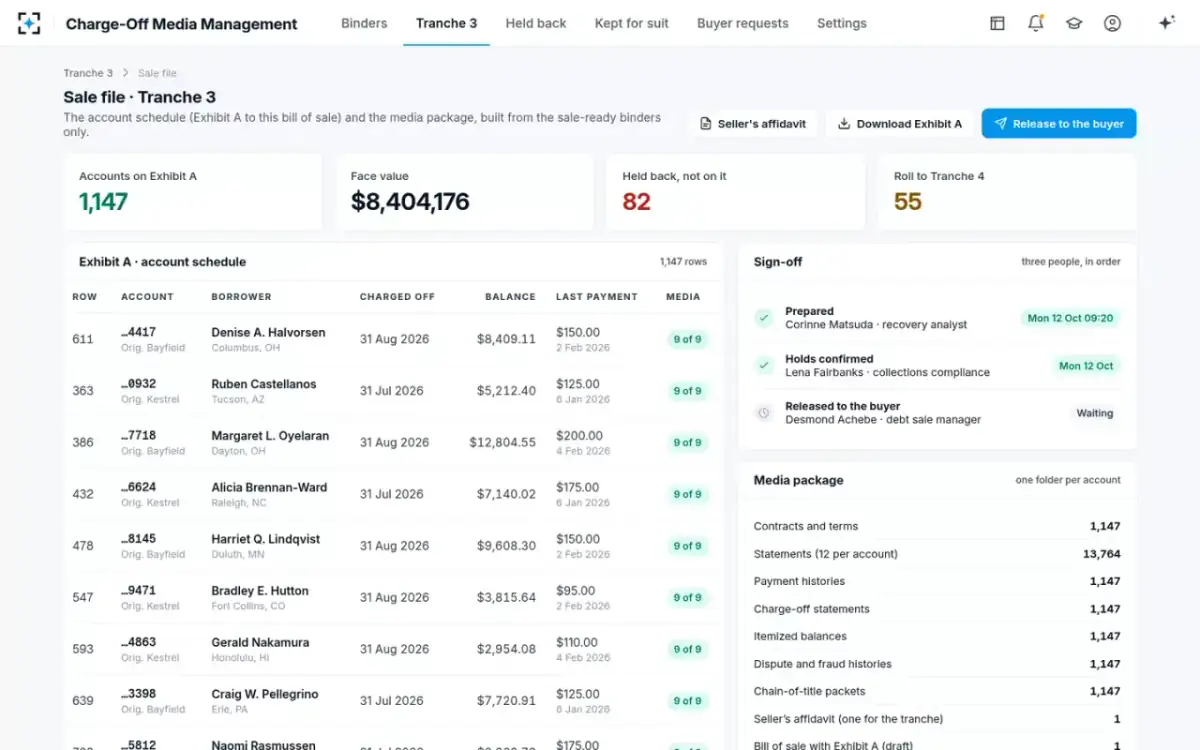
The asymmetry in that sequence is deliberate. Adding a hold is cheap and protective, so an agent may do it alone. Removing one exposes the sale and the borrower’s family, so it takes a reason and a second person. And because the schedule is built only from binders that are complete and not held back, a held-back account never reaches the schedule in the first place rather than being struck off it later — which is a meaningfully different control, because nothing has to be remembered.
Every hold with its reason and the record behind it
The one case where deceased accounts are sold on purpose
Having said all that, there is a market in exactly this paper, and a page that left it out would be telling half the story. The Bureau’s credit card market report records that “issuers may sell other special segmented accounts, such as where the issuer has received a notice of bankruptcy or the consumer is deceased, where specialized expertise may be required to service the amount owed” (CFPB, The Consumer Credit Card Market).
Both things are true, and they are not in conflict once you see what each is describing. The OCC is giving supervisory guidance about general portfolio sales, where a buyer takes thousands of accounts on a standard contract and collects them in a standard way; in that setting a deceased account is one the buyer cannot handle properly. The Bureau is describing a different transaction: a segmented sale to a buyer whose whole business is probate work, with its own contract and its own expertise. Neither is the whole picture, and a seller should not quote one at the other.
Held back with the death record behind it, against sold with the death unknown
Held back, with the record: Nobody — the account never left the bank.
Sold into a general tranche, death unknown: The last known address and telephone number, which may now be a bereaved household.
Held back, with the record: Not applicable.
Sold into a general tranche, death unknown: A balance and a name. Nothing about probate, an executor, or whether there is an estate.
Held back, with the record: The bank’s own process, with the death already on the account.
Sold into a general tranche, death unknown: A letter addressed to someone who died, from a company they have never heard of.
Held back, with the record: Nothing.
Sold into a general tranche, death unknown: A put-back when the death surfaces, and a seller explaining why its scrub was four weeks old.
Held back, with the record: Sell the segment to a specialist buyer, on a contract written for it.
Sold into a general tranche, death unknown: Not that — this is the same account in the wrong sale.
Examiners ask about the same boundary from the collector’s side: the CFPB’s examination procedures direct an examiner to “determine whether the debt collector entity sells debt that it knows or should know has been paid or settled or discharged in bankruptcy” and, if it does, whether it qualifies for an exception (CFPB, Examination Procedures: Debt Collection). The knows-or-should-know standard is why the age of the scrub matters as much as its existence.
What Charge-Off Media Management puts on the schedule, and what stays behind
For the servicing team taking a relative's call, the practical steps are narrower than they look: give in writing the information the collector is required to give, ask who, if anyone, has been appointed to deal with the estate, and say nothing that suggests the caller must pay from their own money. For the compliance analyst, the practical step is to make the screen a dated, evidenced thing that runs twice — the other hold on the same list that is computed rather than looked up works the same way, and Charge-Off Media Management runs both against your own accounts.
Questions people ask
May a debt collector call a deceased borrower’s family?
A collector may call people to find out who has authority to deal with the estate, and that call is tightly limited: the caller must say they are confirming or correcting location information, must not say that any debt is owed, and may name their employer only if expressly asked. A conversation about the balance itself is permitted only with the people federal law lists, plus — under the FTC’s enforcement policy — anyone who has authority to pay the debts from the estate’s assets.
What happens to a deceased borrower’s credit card balance?
It becomes a claim against the estate, to be dealt with in whatever probate or small-estate procedure the state provides. If the estate has assets, creditors may be paid from them in the order that state law sets. If it has none, the claim usually goes unpaid. Nothing about the death makes the balance larger or smaller.
Does being on the communications list make a surviving spouse liable?
Not by itself. Liability depends on the state, on whether the account was joint, and on marital property rules, and this page does not answer it for any particular case. Being named as the consumer for the purposes of who a collector may speak to is not the same as being liable — Regulation F puts a spouse on the communications list regardless of whether they owe anything.
Who is the executor or administrator in debt collection?
The person a probate court has appointed to administer the estate: an executor where there is a will naming them, an administrator where there is not. It is a role evidenced by a court document, not a description someone adopts on a call, and it is the role Regulation F names when it treats a representative of the estate as the consumer.
How do banks find out that a borrower has died?
Usually by matching their accounts against a death record, sometimes by being told by a family member, a funeral director or a joint account holder. The matching is the only route that works at portfolio scale, and its value depends entirely on when it was last run: a match performed when a tranche was assembled says nothing about a death recorded the following month.
What should a bank do when a borrower dies mid-portfolio?
Take the account off the sale, record the evidence of the death against it, and have a second person confirm the hold before the schedule is final. If the bank wants to sell that paper at all, sell it as a segment to a buyer equipped for probate work, on a contract written for it — not inside a general tranche where the buyer will have neither the facts nor the expertise.