An affidavit of debt is a sworn written statement, signed before a notary or other authorised officer, in which someone with access to a creditor’s records sets out what those records show about an account: who owes it, how much, since when, and how the figure was arrived at. It is not evidence of the debt itself — it is testimony about records — and that distinction is the reason everything which makes an affidavit survive sits upstream of the signature, in a file that is complete before anyone is asked to swear to anything. Assembling that file is the hard part, because the statements, the contract, the payment history and the ownership documents a custodian has to vouch for are typically spread across four systems and two previous owners. Botminds’ Charge-Off Media Management builds each account’s file first, checks every tab against the agreement or the court’s rules, and only then drafts the affidavit from what the file actually holds, for a named person to read and sign.
The sample figures on this page come from a fictional sample tranche of 1,284 charged-off card accounts; the bank, the buyer, the people and the law firm in it are invented. Nothing here is legal advice. Evidence rules differ between the federal courts and each state’s courts, and between states, so the test below is described as a shape rather than as the test any particular judge will apply.
How much of this work is signatures, and how little is documents
150,000+
sworn statements and documents one card issuer provided to support debt buyers’ collection lawsuits
8
distinct practices the Bureau set out in its findings on how those statements were produced
<1%
of accounts for which debt buyers obtained an affidavit after purchase
What is an affidavit of debt?
It is a statement of facts about an account, sworn to by a person, and offered so that a court can rely on documents without the author of each document coming to testify. In a default-judgment application it may be the only thing a judge sees. In a defended case it is the vehicle that gets the records themselves admitted.
That purpose sets its limits. An affidavit can say what the records show and how the person knows; it cannot manufacture a record that does not exist, and it cannot cure a gap by asserting a conclusion. If the account’s chain of ownership is missing a schedule, an affidavit saying the bank owns the account is a statement about a belief rather than a proof — which is why proving who owns a charged-off account is a separate exercise done before anyone drafts a word.
There are several affidavits in the life of one charged-off account, and conflating them causes a lot of confusion. The seller’s affidavit in a debt sale certifies, to the buyer, what the seller is handing over. An affidavit of facts in litigation sets out the account for the court. A custodian-of-records affidavit or certification lays the foundation for the business records attached. The same person may sign more than one, and each has a different audience.
Who signs it, and what personal knowledge means
The signer is usually described as a custodian of records: someone who can speak to how the creditor’s records are made and kept, not someone who remembers the borrower. On a charged-off portfolio that is typically an operations head, a debt sale manager or a litigation referral coordinator — a person whose job puts them close to the systems the records come from.
Personal knowledge, in this setting, almost never means knowledge of the underlying transaction. Nobody at a card issuer personally remembers a purchase made six years ago. What the signer must actually know is the process: that records of this kind are made at or near the time by someone with knowledge, that keeping them is a regular practice, and that the specific exhibits attached are what they purport to be — because the signer has looked at them.
That last clause is where affidavits fail. A signature attests to a review, and a review that did not happen is the defect, regardless of whether the figures were right.
“Swearing to having reviewed the contents of records when in fact they had not. For example, Respondents’ employees or agents swore to the accuracy, authenticity, and veracity of attached exhibits without reviewing those exhibits or without having the personal knowledge needed to verify the contents of the exhibits”
CFPB consent order, 2015-CFPB-0013, findings
The business-records foundation a court is really testing
Behind every custodian’s affidavit is a hearsay problem: the records are out-of-court statements, and they need an exception to come in. The federal exception for records of a regularly conducted activity sets out conditions that are worth reading as questions the signer should be able to answer aloud, because that is exactly how they get tested.
Rule 803(6), turned into five questions a signer should be able to answer
- Was the record made at or near the time, by — or from information transmitted by — someone with knowledge?
Not reconstructed later for this purpose.
- Was it kept in the course of a regularly conducted activity of a business?
A routine of the business, not a one-off file assembled for a lawsuit.
- Was making the record a regular practice of that activity?
The difference between a system’s output and somebody’s notes.
- Are these conditions shown by the custodian, another qualified witness, or a certification?
This is the signer’s own role in the exception — and the reason the affidavit exists at all.
- Is there anything about the source, method or circumstances that indicates a lack of trustworthiness?
The opponent’s opening, and the reason a reconstructed or inconsistent file is worse than a thin one.
Condition (D) is the one to dwell on, because it is the signer’s own part of the exception. The records do not come in because they are true; they come in because a qualified person has vouched for how they are kept. An affidavit that recites the balance in detail and says nothing about record-keeping has answered the wrong question.
What exhibits must be attached to an affidavit of debt?
Enough for a reader to check the statement without taking it on trust — and in some courts, a specified list. New York’s rule for default judgments in consumer credit matters is unusually explicit about this, which makes it a useful illustration even for a seller with no New York exposure.
What has to sit behind an affidavit, before a New York clerk will take it
| What the rule requires | In practice that means | Where it comes from in the file |
|---|---|---|
| A copy of the credit agreement, as that rule defines it | The contract or other document governing the account, evidencing the agreement, the amount, the original creditor, the account number and the defendant’s name and address. | The contract and terms tab, or the imaging vault for a paper application. |
| The bill of sale or written assignment of the account, where applicable | The instrument for the transfer being relied on — and, to be useful, the schedule it refers to. | The chain-of-title tab, and the acquisitions archive behind it. |
| Relevant business records of the original creditor | Showing the defendant’s name; the last four digits of the account number; the date and amount of the charge-off balance; the date and amount of the last payment; post-charge-off interest and fees less any credits or payments; and the balance due at the time of sale. | The statements, the charge-off statement, the itemized balance and the payment history. |
| Affidavits that are not combined | Each affidavit stands as its own document. They may be augmented with explanatory detail, and supplemental affidavits may be filed for the same purpose. | A drafting rule, not a filing one — one document per signer per transfer. |
| A verified complaint, where it does the job | If a verified complaint has been served, it may be used as the plaintiff’s affidavit of facts where it satisfies the elements of the debt buyer’s affidavit. | Counsel’s decision, downstream of the file. |
Read that list from the seller’s side and it is almost exactly a complete account file. The exhibits a court wants are the tabs a buyer’s purchase agreement wants, in a different order. A bank that assembles the file properly for the sale has, as a by-product, assembled most of what counsel would need if the account were kept and sued on instead — which is the argument for doing the work once, at the front.
Does a debt buyer need an affidavit from the original creditor?
In some courts, yes, and in New York’s default-judgment procedure it is explicit. A debt buyer there must file its own affidavit of facts and purchase, an affidavit of facts and sale from the original creditor, and — where applicable — a further affidavit from each debt seller that owned the debt before it. Counsel also files an affirmation about the limitation period.
The implication for a seller is sharper than it looks. It means that an account’s saleability can depend on whether the seller, and everybody up the chain, will still be there and willing to swear to what they did. Documents outlast institutions; signatures do not. A buyer that has the schedule for a 2022 transfer can prove that transfer whether or not the 2022 seller still exists, while a buyer that is relying on obtaining an affidavit from that seller is relying on a company answering its post.
This is why the chain-of-title work in the solution refuses to substitute one for the other: ownership is shown by the account’s own row on every bill of sale, through the conversion map where the account was renumbered, and never by affidavit alone. An affidavit introduces the schedule. It does not replace it.
What robo-signing was, in the regulator’s own words
The practice that gave this subject its reputation is worth setting out precisely, because “robo-signing” is used loosely and the actual findings are more specific and more useful. In its 2015 action against a card issuer, the Bureau found that the bank’s employees and agents “prepared the sworn statements in bulk using stock templates”, that the statements “often were not prepared and reviewed by the individual who signed”, and that “the signing individual at times lacked personal knowledge of the information they were attesting to and did not perform the review or follow the signing and notary procedures required by law.”
The order then listed the specific practices, and the list is a catalogue of ways a signature can come apart from a file: swearing to personal knowledge of facts without having it; swearing to having reviewed records that were not reviewed; swearing to how records accompanying a sale were kept and transferred “without actually identifying the records they were swearing to”; signing complaint verifications in batches and attaching them to complaints the signer had never seen; notarising documents without witnessing the signing, without administering oaths, or without names and dates “so that this information could be inserted later”; and signing proofs of claim in bankruptcy without reviewing the supporting records.
Note what is absent from that list: any finding that the balances were wrong. The defect was in the relationship between the signature and the file, and the consequence the Bureau drew was that the practices “in many cases, resulted in Respondents lacking a proper evidentiary basis to prove the debt.” A right number, sworn to badly, is still a problem.
An affidavit drafted from a finished file, against the practices the Bureau described
What the findings describe: A stock template, filled in bulk.
What drafting from the file looks like: The account’s own file — each sentence traceable to a tab that is complete.
What the findings describe: Somebody other than the person who will sign.
What drafting from the file looks like: Drafted for the signer, from what the file holds, with nothing asserted that is not in it.
What the findings describe: Sworn to without being reviewed, and sometimes without being identified.
What drafting from the file looks like: Named, attached and listed, each with the system and document it came from.
What the findings describe: Attested to without the personal knowledge needed to verify it.
What drafting from the file looks like: The record-keeping, the exhibits, and the limits of both — read before signing.
What the findings describe: Performed without witnessing, without an oath, or with names and dates left blank.
What drafting from the file looks like: A named person, a date, and a signature that follows the review rather than preceding it.
What the findings describe: A sentence covering it.
What drafting from the file looks like: A request, and an account that stays short until the document arrives.
The seller’s affidavit in a debt sale, and the custodian who signs it
In a sale, the affidavit is a certification to the buyer rather than to a court, and it is the last thing produced rather than the first. In the sample tranche it is drafted only once every tab on an account is complete, and it is drafted from the finished file: the sale file assembler writes it for the debt sale manager to sign as custodian of records.
Two limits on that agent matter more than anything it does. It never includes a held-back account — the schedule is built from binders that are complete and not held back, so nothing the compliance screen caught can reach a document anyone signs. And it never signs. Drafting is a clerical act; swearing is not.
The seller’s affidavit in Charge-Off Media Management, drafted from the finished file
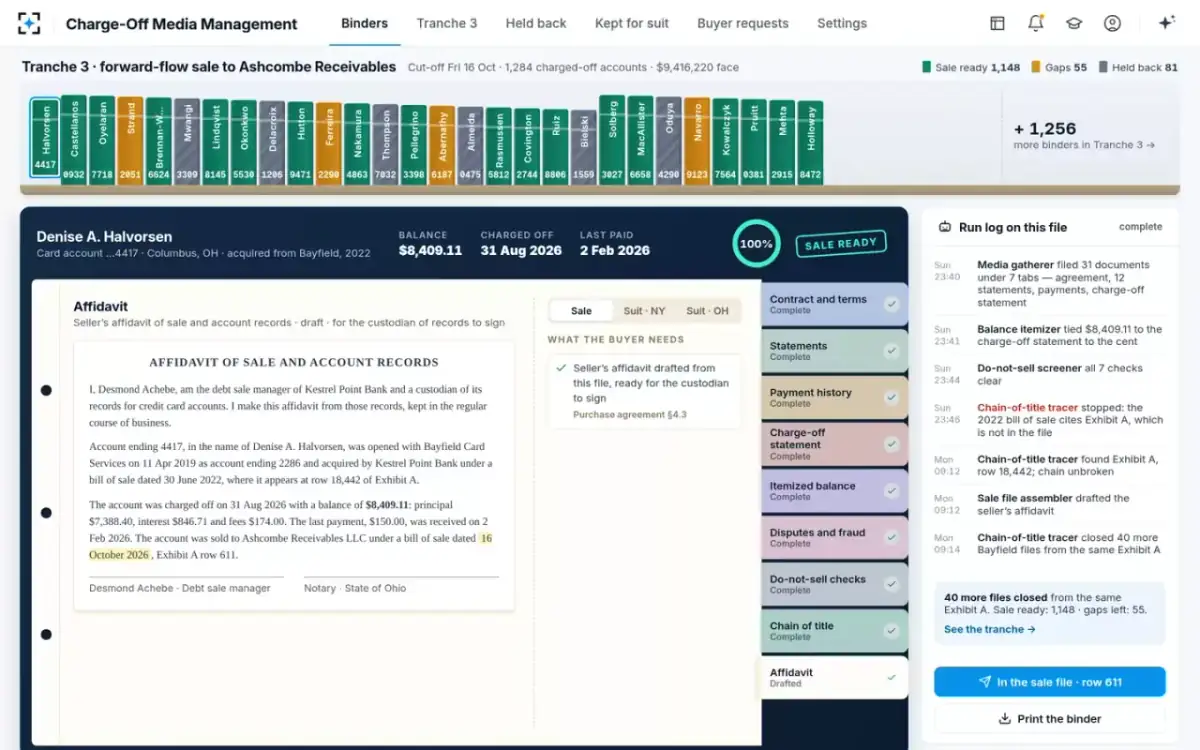
The signature sits inside a wider order. Three people sign a tranche, in sequence, each with a name and a date: the recovery analyst prepares the sale file, collections compliance confirms the holds, and the debt sale manager releases the tranche and signs the seller’s affidavit. The release cannot happen before compliance has confirmed, which means the affidavit is never signed over a schedule whose exclusions nobody has checked.
The order that keeps a signature safe
Agent
Media gatherer and balance builderFile every tab with its source and document identifier, and tie the balance to the charge-off statement to the cent.
Never: alters a document, or adds interest or fees after charge-off
Agent
Chain-of-title tracerFind the account’s own row on every bill of sale, through the conversion map where it was renumbered.
Never: asserts ownership without the row, and an affidavit never stands in for a missing schedule
Agent
Sale file assemblerBuild the schedule and the media package from complete binders, then draft the affidavit from the finished file.
Never: includes a held-back account, and never signs
A person decides
Collections complianceConfirm every hold before the schedule is final. A hold is lifted only with a reason and a second person.
A person decides
Debt sale managerRead the draft against the file, then sign as custodian of records and release the tranche under their own name.
Writing the affidavit from the file, not the file from the affidavit
There are only two possible orders of work, and they produce different documents. Writing the file from the affidavit means starting with a template, deciding what the account needs to say, and then looking for support — which is how a sentence survives into a document after the support for it has failed to turn up. Writing the affidavit from the file means grading the account first, chasing what is short, and drafting only from what arrived.
The second order has an obvious cost: some accounts never produce an affidavit, because their files never complete. That is the point. An account short on statements is an account whose custodian cannot truthfully swear to a payment history, and the right output for it is a request to the system that holds them, not a looser sentence.
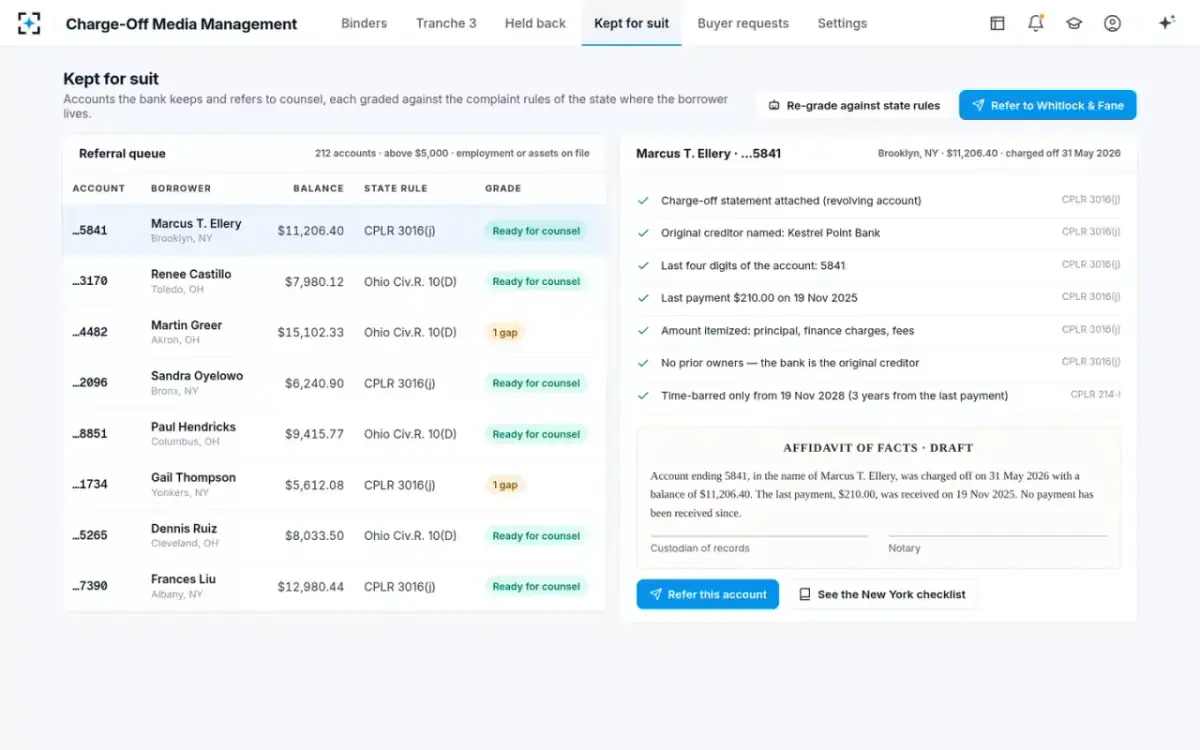
The same logic governs accounts kept for suit rather than sold. In the sample tranche those are graded item by item against the complaint rules of the borrower’s state — the solution’s own checklists name New York, Ohio, Pennsylvania and Texas as configured states, and each item is reported with the rule it comes from — and an affidavit of facts is drafted for the custodian of records only where the grading passes. The checker never refers an account to counsel; the litigation referral coordinator does. Grading a file before counsel follows that decision through.
Kept for suit in Charge-Off Media Management: graded item by item before any affidavit is drafted
The sentences an affidavit must never contain
Some sentences are warnings on their own, because of what they quietly assert. “Based on my review of the business records of the plaintiff and its predecessors” — when the predecessors’ records were never received — claims a review that could not have happened. “The account was duly assigned to the plaintiff”, with no bill of sale and no schedule attached, states a conclusion of law in place of the document. “The balance is correct and due” says nothing about where the figure came from, and leaves the signer defending arithmetic they cannot source.
Two more are worth naming. Any sentence that says the records are true, rather than that they were made and kept in a particular way, has misunderstood the exception it is relying on. And any sentence drafted before the exhibit it refers to was attached is, at best, a prediction.
The useful test before signing is short. Can you point to the document behind each sentence? Did you look at the exhibits that are attached, rather than at a list of them? Is anything in the draft a conclusion that the file does not support? If an account cannot pass that test, the file is not finished — Charge-Off Media Management is built to make that a visible fact about the account rather than a problem discovered at the notary.
Questions people ask
Who signs an affidavit of debt?
Someone who can speak to how the creditor’s records are made and kept — commonly described as a custodian of records, and in practice an operations head, a debt sale manager or a litigation referral coordinator. The title matters less than whether the person can answer the record-keeping questions and has actually reviewed the exhibits attached.
What is a custodian of records affidavit?
An affidavit whose purpose is to lay the foundation for documents rather than to recite facts about the account: it establishes that the records were made at or near the time by someone with knowledge, kept in the regular course of business, and that making them was a regular practice. Many courts accept a written certification in place of live testimony for the same purpose.
Can an affidavit prove a debt by itself?
It can establish facts for a court in an unopposed application, which is why default-judgment rules pay it so much attention. It cannot create a document that does not exist. Where ownership turns on a transfer, the affidavit’s job is to introduce the bill of sale and the schedule showing the account; it is not a substitute for them.
What is a seller’s affidavit in a debt sale?
A certification from the selling bank to the buyer, signed as part of the closing, about what is being sold and what is being handed over with it. It is the seller’s own statement rather than anything a court has asked for, and it should be drafted last, from the completed schedule and media package, so that what it certifies and what is delivered are the same thing.
What does it mean to swear to something on information and belief?
It signals that the statement is not made from the signer’s own knowledge but from what they have been told or have inferred. Some courts accept it for some facts and not for others, and a rule that demands personal knowledge is not satisfied by relabelling the sentence. Using the phrase to cover a gap in the file postpones the problem rather than solving it.
How long should it take to produce an affidavit for one account?
If the file is complete, drafting is quick, because every sentence has a document behind it and the exhibits are already listed. If the file is not complete, the honest answer is that it should take as long as the missing documents take to arrive. Speed in this work is a property of the file, not of the drafting.