The itemization date is the reference date a charged-off balance is built on: the date whose amount a validation notice states, and the date every interest charge, fee, payment and credit since has to be shown against. Regulation F lets a debt collector choose any one of five such dates, which reads like flexibility and is really a constraint — the only date you can choose is one the file behind the account can support to the cent. That is hard on charged-off credit card paper, because the figure usually travels as a single number in a data file while the statements, fee reversals and post-charge-off credits that would prove it sit in three other systems, some of them retired. Botminds’ Charge-Off Media Management rebuilds each balance into principal, interest and fees from the bank’s own card system and ties it to the charge-off statement, so the number on the notice and the number on the schedule come from the same arithmetic.
The worked balance on this page is a fictional sample account in a fictional sample tranche of 1,284 charged-off card accounts. Every borrower, bank and buyer named is invented, and the figures tagged as seen in the solution come from that one sample tranche. The regulation and the supervisory material are linked where they appear.
“An itemization of the current amount of the debt reflecting interest, fees, payments, and credits since the itemization date.”
Regulation F, 12 CFR § 1006.34(c)(2)(viii)
What is an itemization date?
An itemization date is one of five reference dates a debt collector may use as the starting point for showing a consumer what the debt is made of. It is defined, and the five options are listed, in the Bureau’s debt collection rule: “Itemization date means any one of the following five reference dates for which a debt collector can ascertain the amount of the debt: (i) The last statement date … (ii) The charge-off date, which is the date the debt was charged off; (iii) The last payment date … (iv) The transaction date … or (v) The judgment date” (12 CFR § 1006.34(b)(3)).
The phrase in the middle of that definition does the real work: “for which a debt collector can ascertain the amount of the debt”. A date qualifies only if the amount on it can be established. That turns a drafting choice into an evidence test, and it is the reason this page is about files rather than about forms.
Three things then hang off the chosen date. The amount of the debt on that date is disclosed. The creditor the debt was owed to on that date is named. The account number associated with the debt on that date — or a truncated version of it — is given. A collector that picks a date its file cannot describe has not made a formatting error; it has disclosed a figure it cannot stand behind.
The five dates Regulation F allows
All five are lawful. They are not equally available, and on charged-off card paper they fail in different ways. The table below sets out what each one asks the file to hold, and where each one tends to break when the account has already been through charge-off and an acquisition.
The five reference dates § 1006.34(b)(3) allows, and what each asks of the file
| Reference date | What the file has to hold | How it fails on charged-off card paper |
|---|---|---|
| Last statement date | The final periodic statement, and the balance it closed at. | Statements before a system migration often sit in a retired archive. The last statement may also post-date the last activity by a cycle, which invites argument about what accrued in it. |
| Charge-off date | The charge-off entry and the statement that carries it, with the balance split into principal, interest and fees. | Needs the split, not just the total. Where the account was acquired, the charge-off figure may have been loaded as one number with no components behind it. |
| Last payment date | The date, source and amount of the last payment, and the balance immediately after it. | The remittance detail usually lives with the payment processor, not with the account. A reversed or returned payment makes the date itself contestable. |
| Transaction date | The last extension of credit, and the balance at that moment. | Rarely meaningful on a revolving account that has been dormant since default; it predates most of the balance in dispute. |
| Judgment date | The judgment, and the amount it was entered for. | Only exists where the account has already been to court, which on a portfolio being sold is a small minority. |
Notice what the list does not contain: an instruction. Nothing in the rule prefers one date, and nothing in it makes the charge-off date special. What makes the charge-off date common in practice is that it is the one moment when a card issuer is obliged to do arithmetic on the account anyway. Charge-off is itself a timed event — the OCC’s guidance notes that for closed-end credit loans should be charged off “when a loss is identified but generally not later than 120 days past due”, and that “such open-end loans as credit card accounts must be charged off at 180 days past due” (OCC Bulletin 2014-37, footnote 1). A date the bank had to compute is a date the bank can evidence.
Which itemization date should a charged-off file use?
The one the file can prove. That is the whole answer, and it is more demanding than it sounds, because it means the decision belongs to whoever assembled the file rather than to whoever drafts the notice.
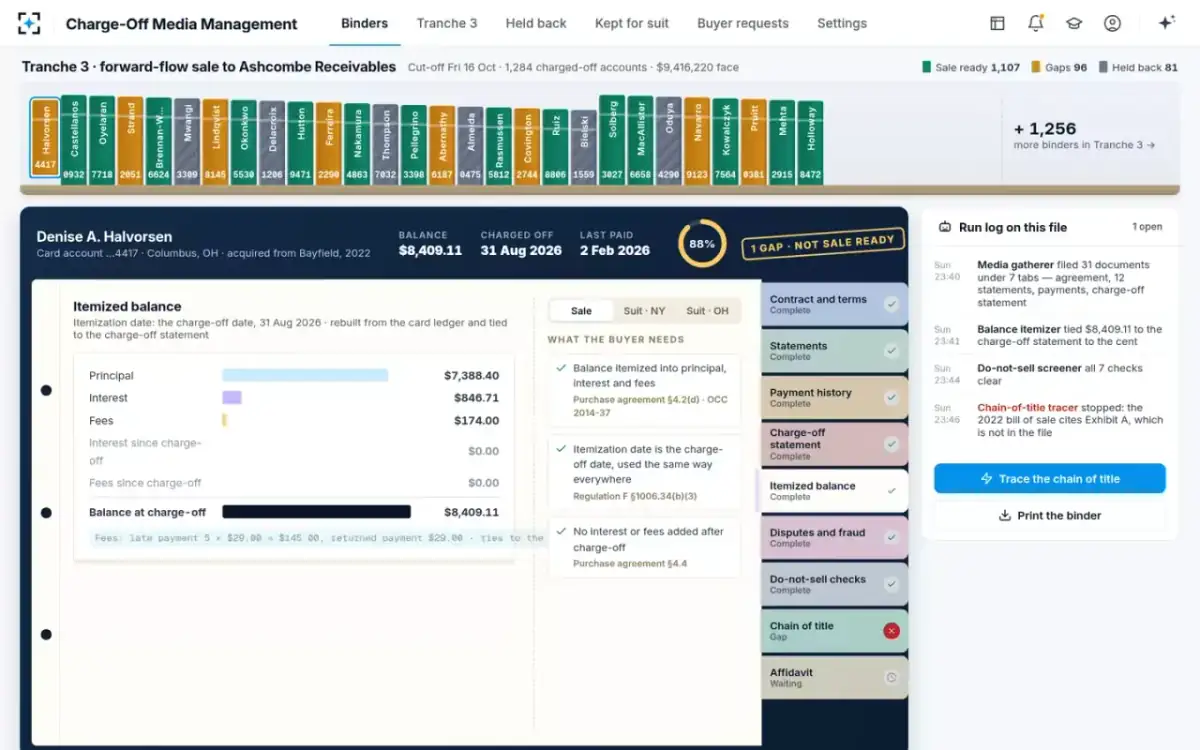
In the sample tranche the setting is the charge-off date, used the same way on every account and in every artefact: on the schedule that goes to the buyer, in the sale file, and in the figure the buyer will put on its own validation notice. One date, one number, one arithmetic. The alternative — a portfolio where the date is chosen per account according to what happens to be available — is how two documents about the same account end up disagreeing by the interest of one cycle.
Picking a date the file cannot support has a specific failure mode, and it is not a fine. It is a dispute: the consumer asks for verification, the collector asks the seller, and the seller discovers the statement behind the figure is in a decommissioned archive. Meanwhile the collection has to stop. That is the sequence a seller is buying its way out of when it fixes the date before the schedule is built.
What the itemization has to show after that date
Once the date is fixed, the rule asks for movement: “an itemization of the current amount of the debt reflecting interest, fees, payments, and credits since the itemization date” (§ 1006.34(c)(2)(viii)). Four categories, each stated, including the ones that are zero. A line that is simply absent is not the same as a line that reads nothing happened.
That requirement sits inside a longer list. Section 1006.34(c)(2) sets out nine pieces of information about the debt, and four of the nine are defined in terms of the itemization date rather than merely alongside it.
The nine pieces of debt information § 1006.34(c)(2) requires, and the four the itemization date decides
- The debt collector’s name and the mailing address for disputes and original-creditor requests
- The consumer’s name and mailing address
- The name of the creditor to whom the debt was owed on the itemization date
Decided by the date: on an acquired account, a different bank from the one that issued the card.
- The account number associated with the debt on the itemization date, or a truncated version of it
Decided by the date: the number the account carried then, which a conversion may since have changed.
- The name of the creditor to whom the debt currently is owed
- The itemization date itself
- The amount of the debt on the itemization date
Decided by the date: the figure the whole notice is anchored on.
- An itemization of the current amount reflecting interest, fees, payments and credits since the itemization date
Decided by the date: every line in it is measured from the date, not from charge-off by default.
- The current amount of the debt
Read down that list from a seller’s chair and it becomes a specification for the sale file. Three of the four date-dependent items — the creditor at the time, the account number at the time, the amount at the time — are historical facts about the account that only the seller holds. A buyer cannot derive any of them from a balance and a name.
Interest and fees after charge-off: the line that should read zero
On the sample account, the line reading “interest and fees since charge-off” is $0.00, and that is worth stating carefully. It is this bank’s policy and this portfolio’s fact, not a rule. Nothing prohibits post-charge-off interest where the contract and applicable law allow it; plenty of charged-off paper carries it. What matters for the file is that the figure is a fact somebody can evidence rather than an assumption nobody has tested.
When a bank does stop the clock at charge-off, two useful things follow. The balance stops being a moving target, so the figure on the schedule in October is the figure on the buyer’s notice in January. And the itemization’s four categories collapse to a statement that nothing has moved — which is still a statement, and still has to be true. The agent that rebuilds these balances is barred from adding interest or fees after charge-off at all, which is a narrower rule than the bank’s policy: it cannot quietly accrue even if someone changes a setting.
What the sample account’s $8,409.11 at charge-off is made of
Balance at charge-off, 31 Aug 2026
- Principal $7,388.40 · 87.9%
- Interest $846.71 · 10.1%
- Fees $174.00 · 2.1%
Added since charge-off
- Interest and fees since: $0.00 · 100%
How do you tie a balance to the charge-off statement?
You rebuild it from components and prove the components against the document. Three sums, in order, and all three have to hold.
One balance rebuilt and tied, to the cent
Principal
$7,388.40
The extensions of credit and purchases still outstanding at charge-off.
From the bank’s card system
Interest
$846.71
Accrued to the charge-off date under the terms in force.
From the bank’s card system
Fees
$174.00
Five late fees of $29.00 and one returned-payment fee of $29.00.
Each fee posting identified
Added since charge-off
$0.00
No interest, no fees, no credits, no payments since 31 Aug 2026.
Stated, not assumed
The first sum is arithmetic: the components add to the total. The second is documentary: the total equals the figure printed on the charge-off statement. The third is continuity: each statement in the run carries forward into the next, so the balance has an unbroken history behind it rather than one printed page. On the sample account the last 12 statements are filed and all 12 carry forward, which is why the tie-out is a check rather than an argument.
That third sum is the one most often skipped, and the one that catches a certain kind of error. A single statement proves a balance on a day. A run of statements that each close where the next one opens proves that nothing was inserted in between. It is the difference between a figure and an account.
The itemized balance in Charge-Off Media Management, component by component
Why this is the seller’s problem, not the buyer’s
A buyer sends the validation notice, so the itemization looks like the buyer’s obligation. The facts it states are the seller’s. The amount at the itemization date, the creditor at that date, the account number at that date, the fee reversals and the credits — all of them are events in the seller’s records, and none of them can be reconstructed from a sale file that carries only a current balance.
The supervisory material says this from both ends. The OCC expects a selling bank to provide, for each account, “an itemized account of all amounts claimed to be owed in connection with the debt to be sold, including loan principal, interest, and all fees” (OCC Bulletin 2014-37) — an itemization, not a balance. The 2015 consent order against a card issuer required the same split going forward, listing among the information to be made available to a debt buyer “the unpaid balance due on the Account, with a breakdown of the post-Charge-Off balance, interest, and fees” (CFPB consent order, 2015-CFPB-0013).
And examiners are told to look at the seller’s own doubts. The CFPB’s debt collection examination procedures direct an examiner to ask whether the seller had reason to doubt the account-level information it gave the buyer — patterns of disputes, unusual gaps, known account-maintenance problems (CFPB, Examination Procedures: Debt Collection). A seller that knows nine balances in a tranche are out and ships them anyway has given itself the answer to that question.
A balance that ties to the cent, against one that is out by $58
Ties to the charge-off statement: The amount on the itemization date, and that nothing has moved since.
Out by $58 after a fee reversal: A figure it cannot source. The itemization is a guess with a decimal point.
Ties to the charge-off statement: The statement is produced and the dispute closes on the document.
Out by $58 after a fee reversal: Collection stops while verification is sought from a seller that has to go and look.
Ties to the charge-off statement: The account is on the schedule at its face value.
Out by $58 after a fee reversal: A candidate for a put-back, and a reason for the next bid to be lower.
Ties to the charge-off statement: Nowhere — it was right before cut-off.
Out by $58 after a fee reversal: Back with finance operations, with the transactions behind it, before the account can be sold.
Ties to the charge-off statement: Nothing.
Out by $58 after a fee reversal: A media request, a retired archive, and someone’s week.
When the bank’s own figures and the statement disagree
They will, on some accounts, and the honest answer is that the statement wins the argument about what the account was told, while the underlying postings win the argument about what happened. A fee reversed after the cycle closed, a credit applied against a later charge-off entry, a returned-payment fee posted twice — each leaves the printed statement and the current figure a few dollars apart.
What matters is the rule for what happens next. In the solution the balance builder reports the difference with the transactions that caused it and changes nothing: the figure goes back to finance operations with its evidence, and the account waits. It is a deliberately unhelpful behaviour, and it is the right one. An agent that could close a $58 gap by adjusting the figure would be producing a balance that ties to nothing.
Differences sent back with the transactions behind them
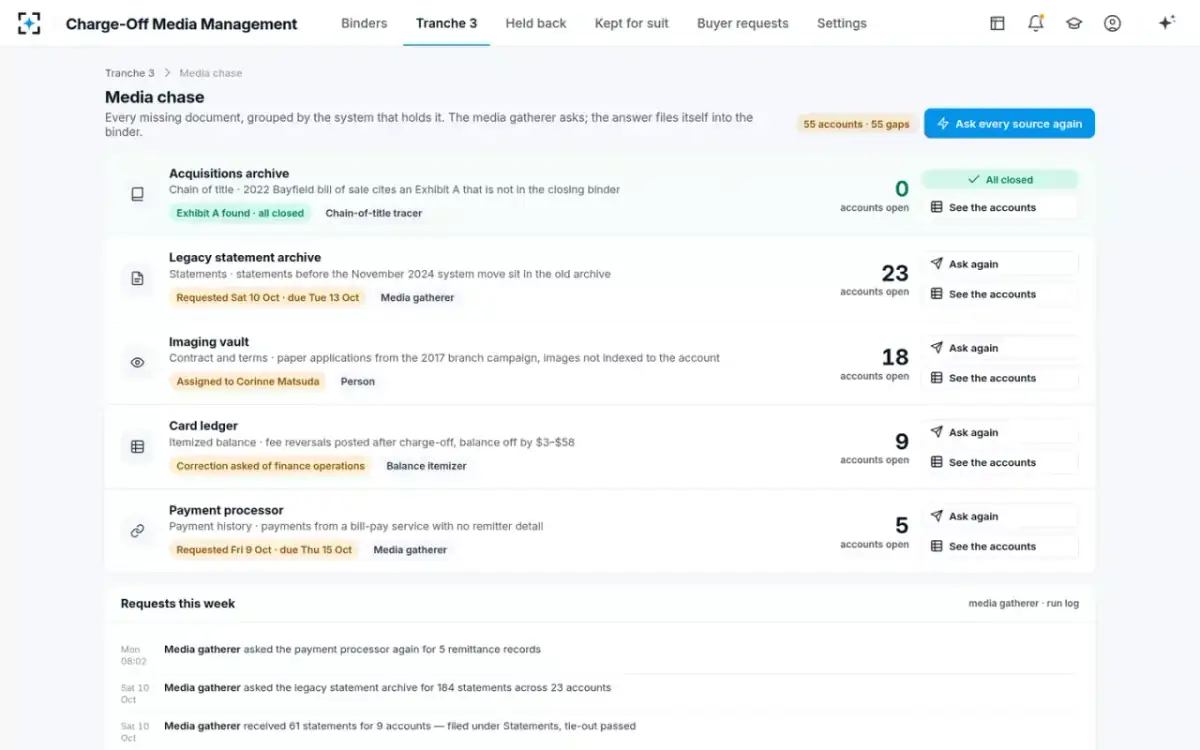
Nine out of 1,284 is the right order of magnitude to expect, and it is also small enough to fix inside cut-off week — which is the point. A difference found on the Tuesday is a request to finance operations. The same difference found after the sale is a media request from the buyer, answered against a service level, on an account that has already left the bank.
The same date in the sale file and on the notice
The last thing to get right is consistency, and it is the easiest to lose. The itemization date appears in several places that are usually produced by different people: the schedule, the media package, the seller’s affidavit, and later the buyer’s validation notice. If the schedule says one thing and the affidavit another, both are wrong.
New York’s rule for default judgments shows how exacting a court can be about the same facts. The affidavits there have to be supported by exhibits including the original creditor’s business records setting out “the date and amount of the charge-off balance; the date and amount of the last payment, if any; the amounts of any post-charge-off interest and post-charge-off fees and charges, less any post-charge-off credits or payments made by or on behalf the defendant; and the balance due at the time of sale” (22 NYCRR § 202.27-a(g)). Read it as a checklist and it is the same arithmetic as the itemization, carried through to the day of sale.
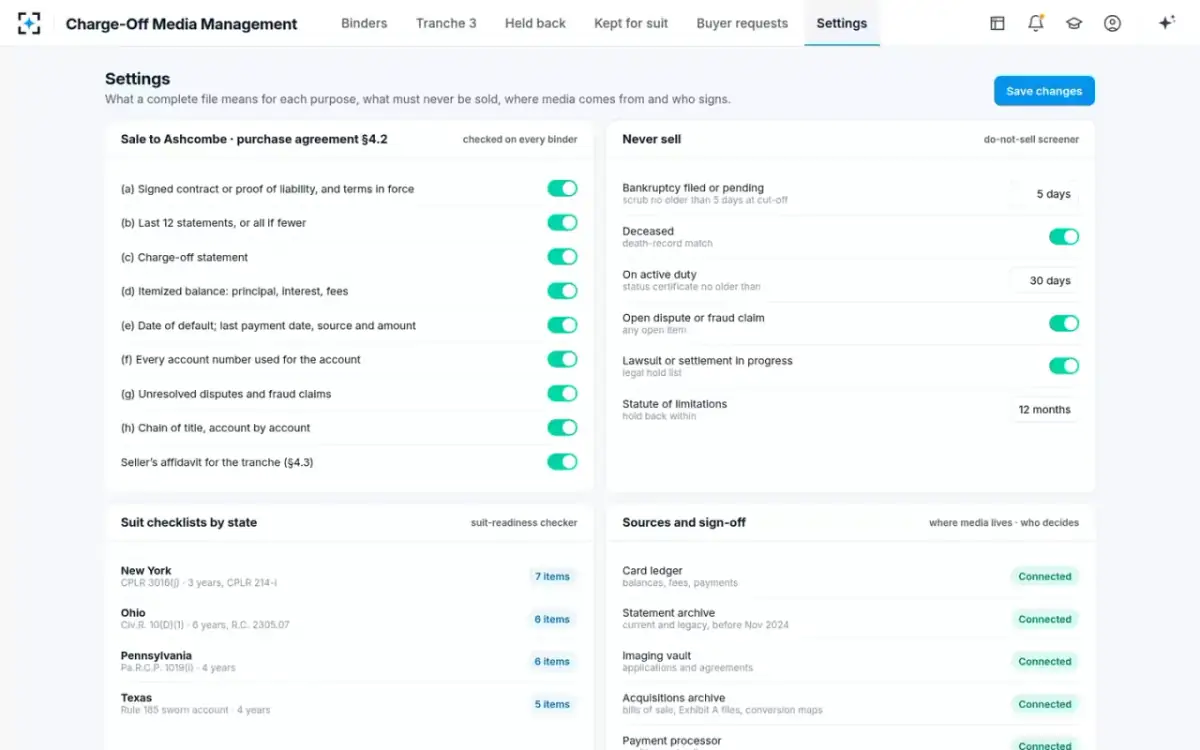
Three settings keep that consistent in the solution, and all three are the bank’s to set: which reference date the portfolio uses, what the sale checklist requires per account, and who signs. They sit beside the never-sell rules and the state checklists rather than in a separate configuration, because they are decisions of the same kind. Finding time-barred accounts before a tranche is sold covers the screening that runs on the same settings, and what a custodian of records can actually swear covers the signature that puts a name to the figures.
Charge-Off Media Management settings: one reference date, set once, used everywhere
To see a balance rebuilt, tied and carried through to a schedule on your own charged-off accounts, start from Charge-Off Media Management.
Questions people ask
What is an itemization of the current amount of the debt?
It is the breakdown a validation notice carries showing interest, fees, payments and credits since the itemization date, so a consumer can see how the amount now demanded differs from the amount on that date. Regulation F allows the itemization to be given on a separate page delivered in the same communication, provided the notice says where it is.
Does interest keep running after charge-off?
Sometimes. Charge-off is an accounting event — the balance is removed from the bank’s books as an asset — not an instruction to stop accruing. Whether interest and fees continue depends on the contract, the bank’s policy and applicable law. Some issuers stop; the sample portfolio on this page does, which is why its post-charge-off line reads $0.00. The figure has to be stated either way.
What goes on a model validation notice?
The validation information the rule requires: who the collector is and where disputes go, the consumer’s details, the creditor at the itemization date and the creditor now, the itemization date, the amount then, the itemization of movement since, and the amount now, together with the consumer-protection information about disputing and requesting original-creditor details. Using the Bureau’s model form in the prescribed way gives a collector a safe harbour on the form itself, not on the accuracy of the figures in it.
What if the itemization does not match the statement?
Treat it as an account to be fixed, not a notice to be re-typed. Find the postings that explain the difference — reversals, late credits, duplicated fees — and correct the figure at source, with the transactions attached. A collector that discovers the mismatch after sending a notice is in verification territory and has to stop collecting on the disputed amount until it can answer.
Can the itemization date be different for different accounts in one portfolio?
Nothing in the rule forbids it; each account’s notice stands on its own. It is still a poor idea on a portfolio being sold, because the schedule, the affidavit and the buyer’s notices then describe the same portfolio from several starting points, and any reconciliation across them has to be done account by account. Picking one date the whole file can support is cheaper than defending five.
Who decides the itemization date, the seller or the buyer?
Formally the collector sending the notice, which is usually the buyer. In practice the seller, because the buyer can only pick a date whose amount it can ascertain, and it can only ascertain the amounts the seller handed over. Fixing the date before the sale file is built is how the formal and the practical answers end up being the same date.