Selling bad debt to a collection agency usually means one of two different things, and the difference matters more than the vocabulary suggests. Selling transfers ownership: the buyer pays a fraction of the balances, becomes the creditor, keeps whatever it collects, and the seller is out. Placing keeps ownership with the lender and pays an agency a commission on what it recovers. The third option is to keep collecting internally. Whichever is chosen, the same thing decides whether it works — whether each account's file can answer the questions the buyer, the agency, the examiner or the court will ask. Charge-Off Media Management is Botminds' software for that file: it builds each charged-off account's binder from the lender's own systems, screens out the accounts that must never leave, and assembles the sale package for a named person to release.
The sample counts and screens below come from a fictional bank's tranche inside the solution. The supervisory expectations quoted are from OCC Bulletin 2014-37, which applies to national banks and federal savings associations; other lenders read it as the clearest published statement of what a supervisor expects rather than as a rule that binds them. The market figures come from the CFPB and the FTC, linked under each figure.
Selling bad debt, placing it, or keeping it
Fewer lenders sell than most people assume. The CFPB reports that "fewer than half of issuers surveyed sold debt in 2023 and 2024, unchanged from the 2021 and 2023 Reports", and that those who did not sell "indicated that they have no plans to do so in 2025" (CFPB, 2025). That is a settled split rather than a trend: selling is a structural choice about what kind of recovery operation a lender wants to run, not a quarter-by-quarter optimisation.
One charged-off account down three channels
Sold outright: The buyer. It becomes the creditor and keeps everything it recovers.
Placed, or kept and worked: The lender. An agency works it for a commission, or the internal team does.
Sold outright: A fraction of the balance, once, at the sale.
Placed, or kept and worked: A share of whatever is recovered, over years, net of commission or internal cost.
Sold outright: Everything, up front: proof of liability, statements, an itemized balance, the last payment, every account number, disputes, and a provable ownership trail.
Placed, or kept and worked: The same items, but on demand — when the borrower disputes, when the agency escalates, or when counsel asks what the claim rests on.
Sold outright: Per-item media fees, accounts returned, and a weaker price at the next negotiation.
Placed, or kept and worked: An agency that cannot substantiate, a dispute that cannot be answered inside the timescale, and a referral that cannot be filed.
Sold outright: The buyer, and whoever it sells to next if the contract permits resale.
Placed, or kept and worked: The lender, in its own name, for as long as it holds the account.
Sold outright: The reputational consequence of how former customers are treated, and the record of what was sold.
Placed, or kept and worked: All of it, plus the servicing cost.
The comparison has an uncomfortable implication for anyone building a business case. The channel that is cheapest to administer is the one that demands the most complete file at a single moment, and the channels that let a lender defer the file work are the ones where it never ends. Deferring is the expensive choice in every direction.
What the three channels have in common
Each channel breaks at the same point: an account about which the lender cannot now prove something it once knew. A buyer asks for the statements behind a disputed balance. An agency is told by a borrower that the debt was settled two years ago. A court asks what the claim is based on. In every case the answer exists somewhere — in a statement archive, an imaging vault, a processor's remittance detail, an acquisition's schedule — and the question is only whether it can be produced inside the time available.
The FTC's finding on what actually travels with sold accounts remains the clearest picture of how often it cannot: "for most portfolios, buyers did not receive any documents at the time of purchase. Only a small percentage of portfolios included documents, such as account statements or the terms and conditions of credit" (FTC, 2013). A market in which documents are the exception is a market in which the lender that prepares them is doing something structurally different from its peers, not merely doing it better.
How much of a charged-off book sits in the warehouse, by whether the issuer sells
Read that figure carefully, because it is easy to misread as an argument against selling. The warehouse is where accounts go when nobody is working them, and a seller's warehouse is larger in part because selling concentrates attention on the pools that meet the criteria and leaves the rest parked. That is a reason to know exactly what is in the warehouse and why — not a reason to collect or to sell. An account parked because its file is incomplete is an account waiting for its limitation period to run out.
What do you need before you can sell bad debt?
Three things in order: a written policy that says when selling is appropriate and what may never be sold; an analysis showing that selling is better than the alternatives for this population; and a file per account that will satisfy the contract you are about to sign. Most lenders get the third in place last, which is why most first tranches go out short.
The order of work the guidance implies
A person decides
PolicyName who in the organisation may sell debt at all, what types of account must never be sold, and the quality standards that apply to what is — with an emphasis on the accuracy of balances.
A person decides
Financial analysisDocument why selling this population is more beneficial than collecting it internally or employing collectors, and how a sale fits the business strategy and risk appetite.
A person decides
Buyer diligenceAssess the buyer’s background, experience and past performance, the complaints made about it, how it resolved them, and whether it is financially sound, licensed and insured.
A person decides
ContractSettle eligibility, put-backs, media obligations, service levels, resale and the treatment of customers before price.
Agent
The fileGather each account’s documents from the source systems, tie the balance to the charge-off statement, trace ownership account by account, and chase what is missing at the system that should hold it.
Never: Never alters a document or a balance
Agent
The screenRe-check bankruptcy, death, active duty, disputes, fraud, litigation and the limitation period close to the deadline, holding back every hit with its evidence.
Never: Never clears a hit by itself
A person decides
Release and oversightCompliance confirms the holds, a named person releases the tranche, and the bank monitors what comes back — repurchases, complaints, losses — and feeds it into the next sale.
Questions a management committee should be able to answer before the first tranche
- Who, by name or office, is responsible for debt sales across the whole organisation?
The OCC asks policies to identify the persons or offices responsible for all debt sales, and says an oversight committee should also be considered.
- Where is the written analysis that selling beats the alternatives?
Policies should require a financial analysis detailing why selling is more beneficial than managing collection internally or employing debt collectors.
- How does this sale fit our strategy and our risk appetite?
The guidance asks banks to assess how debt sales align with the business strategy and risk profile — a question that should be answered before the first buyer is approached.
- Which types of account will we never sell, and who enforces that?
Policies should identify types of accounts that should not be sold and specify quality control standards for what is, with an emphasis on the accuracy of account balance information.
- Who signs off, and were compliance, legal, credit, audit and information security all in the room?
The guidance asks for the involvement of appropriate bank personnel in the approval process so that all risks are fully considered.
- What will the borrower be told, and when?
Customers should receive timely notification from the bank that the debt has been sold, the amount transferred, and the name and address of the buyer.
- Is our credit reporting going to be right the day after?
The guidance asks banks to ensure credit bureau reporting is up to date and accurately reflects the sale or transfer.
- Can our systems report sales, prices, repurchases, losses and complaints together?
Management information should detail debt sales across lines of business, sales prices, repurchase volumes, losses incurred and customer complaints — the repurchase line is the one most organisations cannot produce.
- Who reviews that we followed our own policy?
The guidance asks for internal review standards to ensure debt sales comply with the bank’s own policies and procedures.
The accounts that should never leave the bank
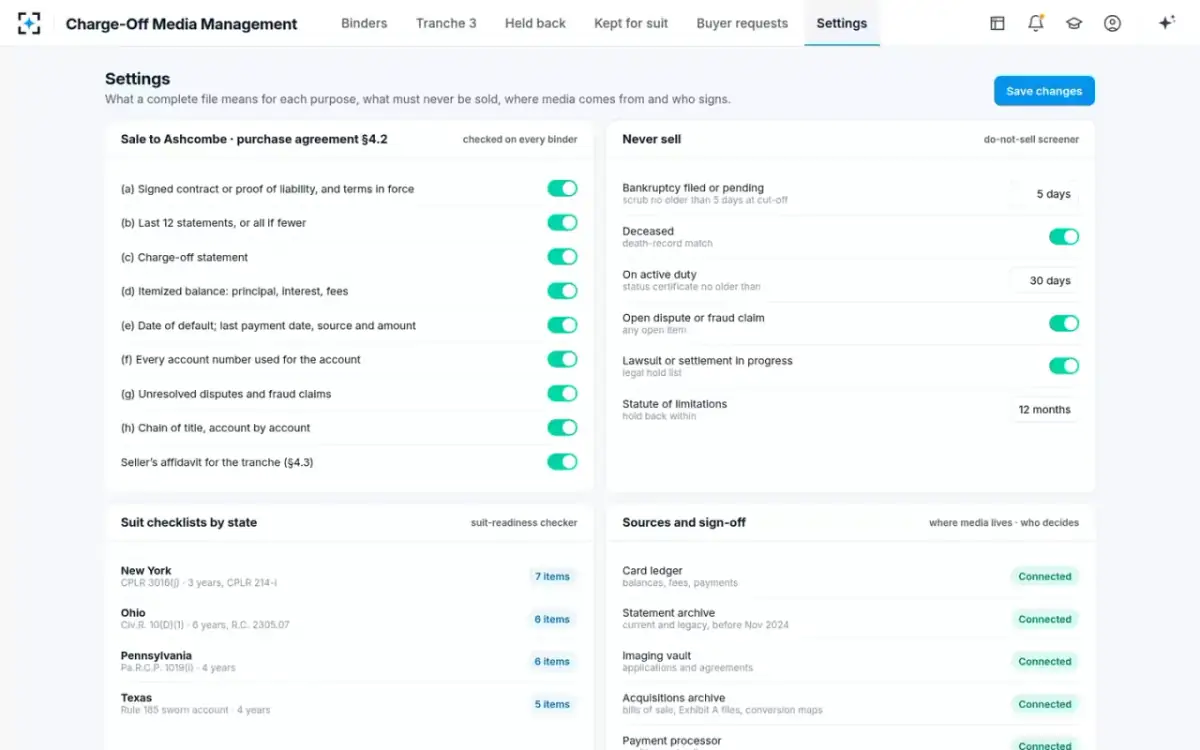
Every policy needs a never-sell list, and the list is only as good as the freshness of the checks behind it. A borrower who files for bankruptcy, dies or is called to active duty after the scrub but before the cut-off is indistinguishable, in the data file, from one who did not. That is why the useful question about a never-sell rule is not whether it exists but how old the evidence behind it is allowed to be on the day the schedule is signed.
A never-sell list with the freshness each check has to have
| Hold | What it is checked against | How fresh it must be in the sample configuration |
|---|---|---|
| Bankruptcy filed or pending | The national bankruptcy scrub, with the court, case number and filing date recorded. | No older than 5 days at cut-off |
| Deceased | A death-record match, with the date behind it. | On, and re-run with every screen |
| On active duty | A servicemember status check, with the status certificate kept. | Certificate no older than 30 days |
| Open dispute or fraud claim | The dispute log and the fraud case system. | On, and re-run with every screen |
| Lawsuit or settlement in progress | The legal hold list. | On, and re-run with every screen |
| Near the statute of limitations | The date of default and the borrower’s state, against the period the bank configures. | Held back within 12 months of the bar |
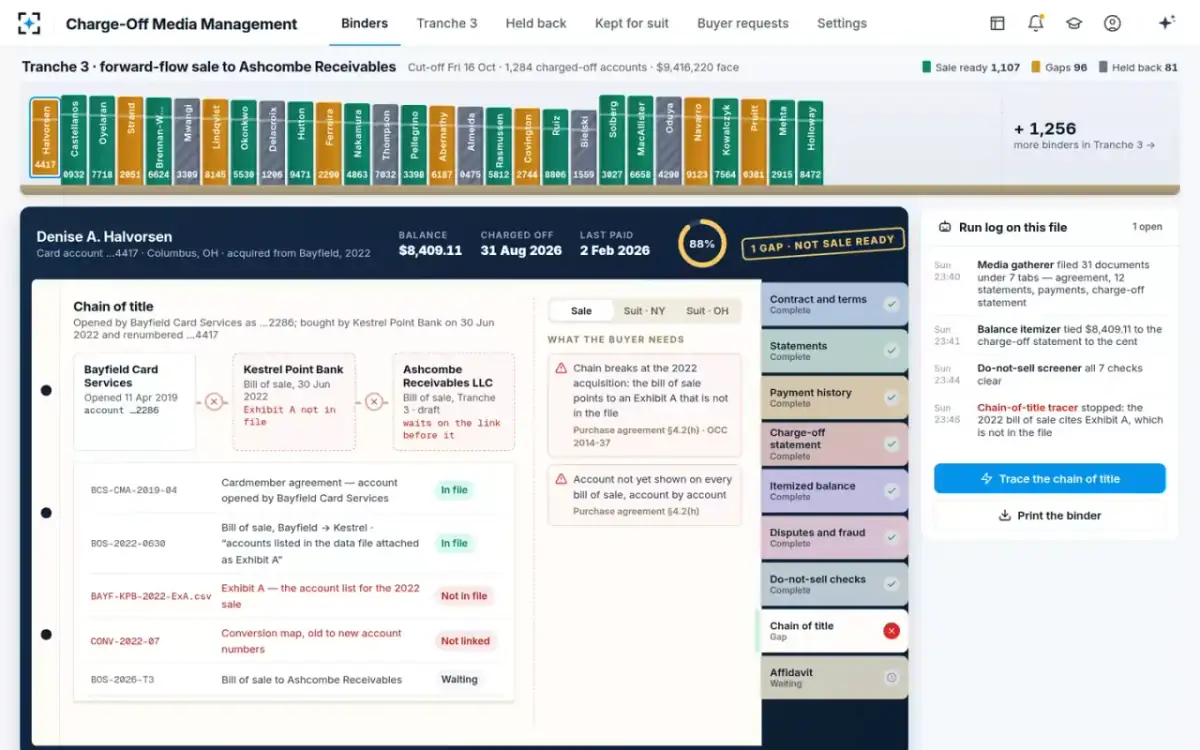
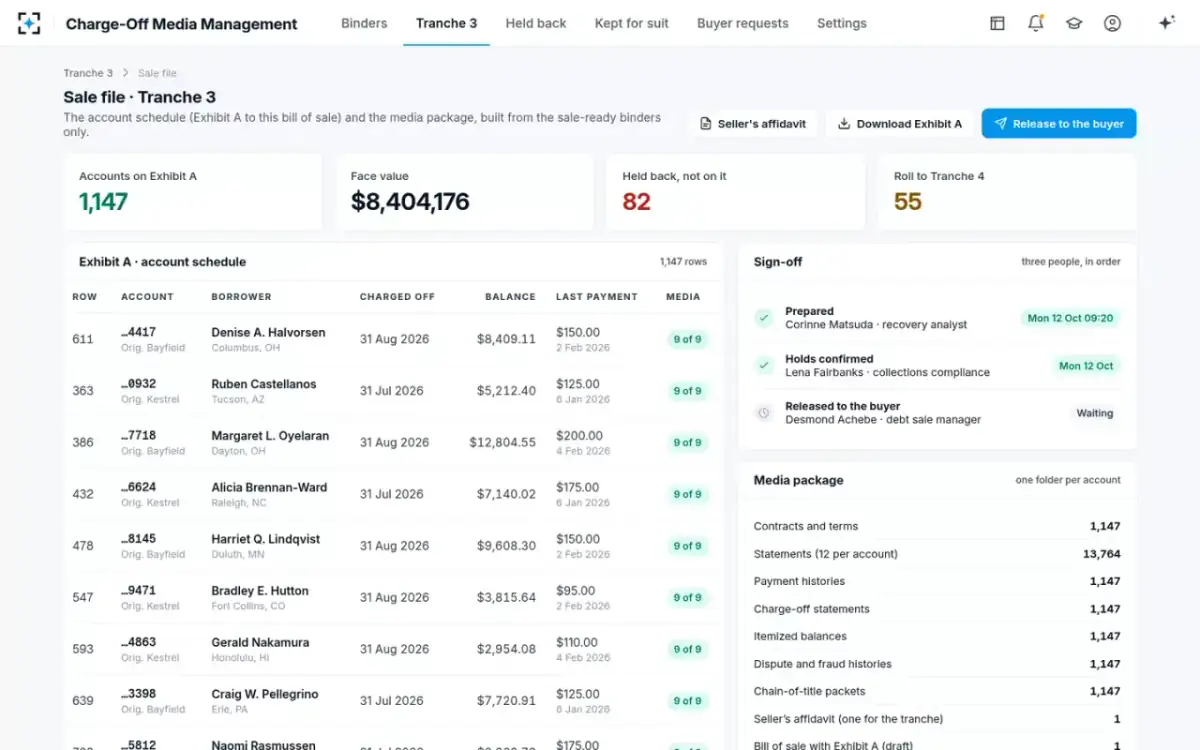
In the sample tranche the re-screen before cut-off found one new bankruptcy — a Chapter 13 filed on the Saturday — and removed the account from the schedule with its evidence, taking the hold count from 81 to 82. The whole value of the rule is in that one account: a list that is re-tested close to the deadline catches the case that a list tested three weeks earlier cannot. What may and may not be done with a deceased borrower's account is set out in the guide to collection after death, and the limitation question in the guide to time-barred debt.
The policy, written down as settings a named person owns
The accounts that stay with the bank, each with its evidence
How do you choose a debt buyer or collection agency?
On how it will treat your former customers, first, and on what it can pay, second. That ordering is not sentiment; it is what the supervisory guidance actually says, and it is the point on which the OCC reported finding real failures.
Through its supervisory process, the OCC has identified instances in which banks agreed to sell debt to debt buyers without full understanding of the debt buyers' collection practices.
OCC Bulletin 2014-37, Consumer Debt Sales: Risk Management Guidance
The diligence the bulletin describes is specific. Banks "should assess the potential debt buyers' background, experience, and past performance, including consumer complaints about the debt buyers, and assess steps taken by debt buyers to investigate and resolve the complaints" (OCC Bulletin 2014-37). Note the second half: a complaint count on its own is close to meaningless without what the buyer did about it, and a buyer that can describe its complaint resolution process in detail is telling you more than one with a lower count and no account of itself.
Four more tests sit alongside it. Financial soundness, licensing and insurance, confirmed from pertinent information including audited financial statements. Control over the buyer's own network of collectors and agents, demonstrated rather than asserted. Staff training, so that the people who will contact your former customers know the consumer protection rules. And a record of compliance with those rules that the bank assesses before the relationship starts — and, where a standing arrangement is in place, periodically afterwards, with the right to terminate reserved.
The due diligence a supervisor expects
Two further expectations are easy to miss and expensive to discover late. The first is reserves: before entering into debt-sale arrangements, a bank should determine what repurchase and litigation reserves to establish, given the size and type of sales contemplated. A seller with no repurchase reserve is a seller who has assumed its put-back rate will be zero.
The second is that diligence is not a one-off. Where a standing arrangement is in place, the bulletin asks for diligence before the relationship starts and periodically while it runs. A forward-flow seller that diligenced its buyer in year one and has sold to it monthly ever since has a three-year-old assessment attached to a current relationship — which is exactly the gap the supervisory finding above describes.
Examiners come at the same material from the other side. The CFPB's procedures tell an examiner, where an entity sells debt, to look at what the entity hands its debt buyers about each debt, and to determine, where a debt has been disputed, whether the entity tries to verify it before selling and passes the dispute on. A lender that cannot say, per account, what it provided and what it knew is not in a position to answer either question.
What the contract has to say, before price
The clauses that decide the economics of a sale are eligibility, put-backs, the media obligation, the service level and resale, and they are worth more attention than the price per dollar — they are read clause by clause in the guide to the forward flow agreement, and the price itself in what debt buyers pay for debt. For a lender choosing a channel rather than negotiating a deal, three of them matter most.
Eligibility, because it defines the population the lender has to be able to prove things about, and therefore the size of the file work. The media obligation, because it determines whether the lender is answering requests for six months or three years, and at whose cost. And resale, because a contract silent on resale is a contract in which the lender has no idea who will be contacting its former customers in three years' time. An agency placement agreement has a parallel set: what the agency may say, what it must escalate, how disputes are handled and returned, and what happens to the account's documents at the end of the placement.
What happens to the account after it is sold?
Three things, and a lender should be able to describe all three before the first tranche leaves. The borrower is told: the OCC expects customers to receive timely notification from the bank that the debt has been sold, the dollar amount transferred, and the name and address of the buyer. The credit file is corrected: the guidance asks banks to ensure credit bureau reporting is up to date and accurately reflects the sale or transfer, and the CFPB's market report found that among surveyed card issuers "all sellers are deleting the tradeline in its entirety" (CFPB, 2025). And the lender's own obligations continue: media requests arrive for years, put-back claims arrive, and complaints about the buyer's conduct find their way back.
That last point is the one most often underestimated in a business case. A sale ends the asset but not the relationship. The practical consequence is that the file has to outlive the account: in the sample data a buyer may ask for any sold account's media for three years, and the requests are answered from the binder the sale was built from, against a thirty-day service level in the agreement in this example.
What goes to the buyer, and what stays
Where a file-first system fits, and where it does not
It is worth being exact about the boundary, because this category is frequently oversold. Charge-Off Media Management prepares and screens the file and builds the sale package. It does not broker a sale, price a portfolio, run an auction, choose a buyer or an agency, manage an agency placement, dial, send collection letters or take payments. It is not a system of record for balances: it reads the lender's own records, never changes them, and where a balance does not tie it reports the difference with the transactions behind it. It does not sign anything, and it does not refer an account to counsel.
What it does is narrow and measurable. Each account becomes a binder of items with their sources; gaps are addressed to the system that should hold them, with an owner and a date; balances are rebuilt into principal, interest and fees and tied to the charge-off statement; ownership is traced through each transfer by the account's own row on the schedule; the never-sell screens re-run close to the cut-off; and the schedule, the media package and the seller's affidavit are assembled from complete, unheld binders for a named person to release. In the sample data the design targets are two days to build a tranche's sale file and every account re-screened within five days of cut-off.
Which channel a lender should choose is not a question this or any software answers. It is a question of cost to collect, appetite for litigation, the segment and the strategy — decided by people, written down, and reviewed. What software can do is remove the reason all three channels most often disappoint: the account whose story the lender can no longer tell. To see the binders, the holds and the release on sample data, start from Charge-Off Media Management.
Questions people ask
What is the difference between selling debt and placing it with an agency?
Selling transfers ownership: the buyer pays a fraction of the balances up front, becomes the creditor and keeps what it recovers. Placing leaves ownership with the lender, which pays the agency a commission on what it collects and can recall the account. Selling converts an uncertain stream into certain cash and ends the lender's servicing cost; placing keeps the upside, the control and the obligation to answer for the account.
Is it better to sell debt or use a collection agency?
It depends on the lender's cost to collect, its appetite for litigation, and the age and segment of the population. Fewer than half of the card issuers the CFPB surveyed sold debt at all in 2023 and 2024, and those that did not reported no plans to start — which suggests this is a structural choice rather than a close call rerun each quarter. The supervisory expectation is that the comparison is written down as a financial analysis, not assumed.
What accounts should never be sold to a collection agency?
At minimum: accounts of deceased borrowers, accounts in or seeking bankruptcy, accounts already settled or in the process of settlement, accounts in litigation with the institution, debts arising from fraud, and accounts lacking clear evidence of ownership. Supervisory guidance also asks banks to refrain from selling further categories, including accounts eligible for servicemember protections, accounts of minors, accounts in disaster areas and accounts close to the statute of limitations.
What due diligence does a lender owe on a debt buyer?
Background, experience and past performance; the complaints made about the buyer and what it did to investigate and resolve them; financial soundness, licensing and insurance, confirmed from pertinent information including audited financial statements; control over its own network of collectors; staff training on consumer protection law; and a record of compliance assessed before the relationship starts and periodically while it continues, with the right to terminate reserved.
What happens to the account after it is sold?
The borrower should be told promptly by the lender that the debt has been sold, for how much and to whom; the credit file should be updated to reflect the transfer, and among surveyed card issuers the practice found was deletion of the tradeline in its entirety; and the lender continues to answer media requests and put-back claims for as long as the contract requires — commonly up to three years.
Who buys charged-off debt?
Specialist debt buyers, usually pre-selected under a standing contract rather than found deal by deal, and often segmented by what they are equipped to work — some specialise in accounts in bankruptcy, where a proof of claim is a defined route to recovery, and others in fresh charge-off. A lender choosing among them should weigh how each one will treat its former customers at least as heavily as what each one will pay.