Debt recovery software is the system a lender uses to work accounts after they have gone bad: it queues them, contacts the borrower, records promises and payments, sends the letters and, in most products, stops there. That definition is complete enough for a pre-charge-off collections floor and badly incomplete afterwards, because once an account has charged off the decisions stop being about the conversation and start being about the file — whether the bank can prove the amount, prove it owns the account, prove nothing bars collection, and produce the paper on request three years later. This guide is written for a selection that wants to test that half, and it uses Botminds' Charge-Off Media Management, which does only that half, as the worked example of what a file-first system has to do.
The sample screens and counts below come from a fictional bank and a fictional tranche inside the solution. The research figures come from the OCC, the CFPB and the FTC, linked under each figure.
What debt recovery software usually means
Open any shortlist and the feature matrix is predictable: account segmentation and queueing, a dialler or a contact strategy engine, letter and email templates, a borrower self-service portal, payment processing, payment-plan and settlement handling, agency placement, commission tracking, dashboards. All of it is real, useful, and about the contact. The documents attached to an account appear in one row of the matrix, usually as "document storage" or "attachments".
That shape made sense when recovery meant collecting. It stops making sense the moment a lender does any of three things: sells charged-off paper to a debt buyer, refers accounts to counsel for suit, or has to answer a buyer's or an examiner's question about an account it sold two years ago. Each of those is answered out of a file, not out of a call history — and the system that holds the call history usually holds, at best, a folder of scanned attachments with no idea what is missing from it.
The half of recovery that is not a conversation
The second half is dull to specify and expensive to get wrong. For each charged-off account somebody has to gather the signed agreement and the terms in force, the statements, the charge-off statement, an itemization of the balance into principal, interest and fees, the date and amount of the last payment, every account number the account has ever had, the dispute and fraud history, and the ownership trail from the originator to today. Then somebody has to check that what was gathered is actually complete, chase what is not, and re-check the never-sell screens close enough to the deadline that nothing has changed since.
The FTC measured what arrives when nobody does that work systematically. Looking at documentation that changed hands with the accounts themselves, it found that "the debt buyers reported receiving only three types of documents: account statements, received for 6% of accounts, 'terms and conditions' documents, also received for 6% of accounts, and account applications documents, received for less than 1% of accounts", that buyers "typically received just one type of document per account", and that only 13% of the portfolios contained any account documents at all (FTC, 2013).
What actually travelled with the accounts
6%
of accounts came with an account statement at the time of purchase
6%
came with a terms and conditions document
<1%
came with the account application
Those are the conditions a document-side product has to improve on, and they explain why the gap matters to the seller as much as the buyer. Every account that moves without its paper comes back later as a request, a fee, a returned account or a dismissed case.
An account modelled as a file rather than as a contact history
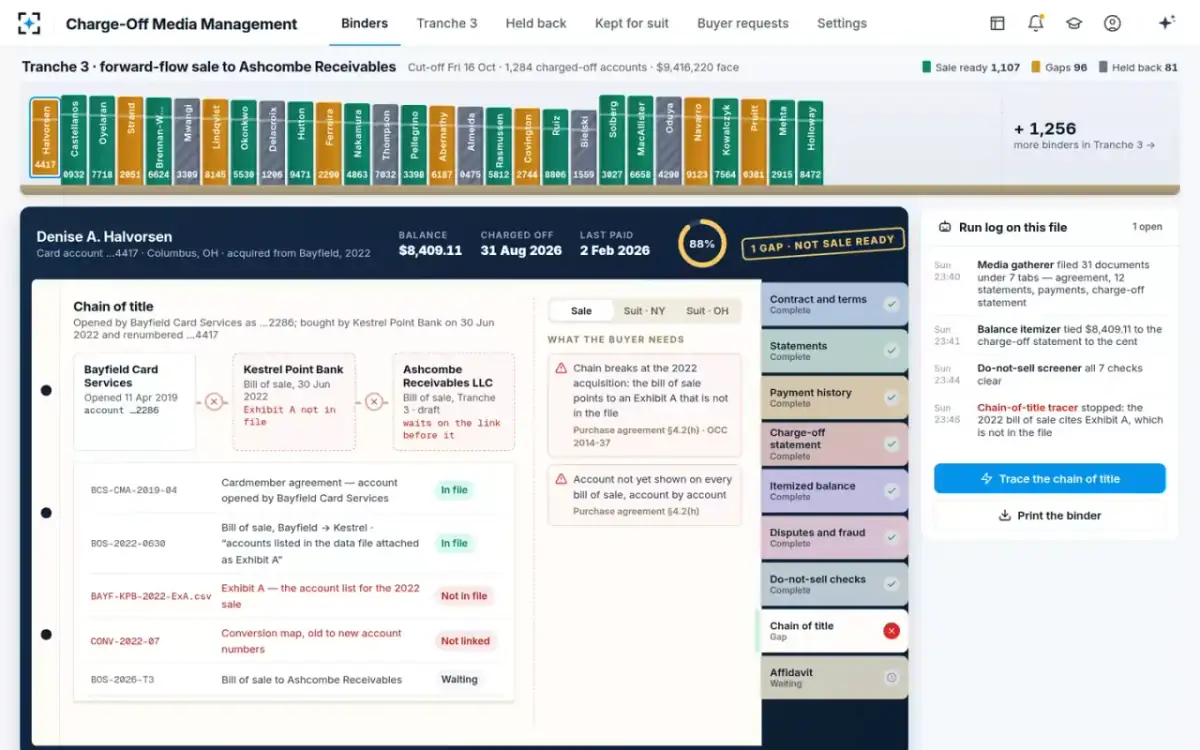
What should debt recovery software do with a charged-off file?
It should be able to answer four questions per account, on demand, without a person opening a folder: which items the file is missing, which system should hold each missing item, who owes it and by when, and whether the account may be sold or referred at all today. Everything else — storage, search, viewers — is plumbing. A product that can store a document but cannot tell you what is absent has automated the filing cabinet, not the work.
Two regulators have published lists that can be read directly as a specification. They are not the same list, which is itself instructive: one is supervisory guidance about what a seller should hand over, the other is an enforcement requirement about what must exist before a buyer may collect at all.
Two regulators' lists, read as a specification for the file
| What the file must carry | OCC guidance: provide to the buyer for each account | CFPB consent order: required before the buyer may begin collecting |
|---|---|---|
| Proof of the debt itself | A copy of the signed contract or other documents evidencing the consumer’s liability. | The effective credit agreement, available on request for at least three years. |
| Statements | All, or the last 12 (whichever is fewer), account statements. | The last 18 monthly statements, available on request; all of them if the account was open for less. |
| Account numbers | All account numbers used by the bank and, where appropriate, its predecessors. | The last four digits of the number used at the time of the last statement. |
| The amount, itemized | An itemized account of all amounts owed, including principal, interest and all fees. | The unpaid balance with a breakdown of post-charge-off balance, interest and fees. |
| Who the creditor is | The name of the issuing bank and, where appropriate, the store or brand name. | The name of the last creditor to extend credit to the consumer. |
| Dates and the last payment | The date, source and amount of the last payment, and the dates of default and amount owed. | The first date of delinquency for consumer reporting, the date and amount of the last payment, and the charge-off date. |
| Disputes and fraud | Information about all unresolved disputes and fraud claims. | Any dispute raised in the 18 months before sale, and the result of the investigation. |
| Collection history | Information about collection efforts, internal and third-party, through the date of sale. | Whether the consumer has demanded in writing that contact cease. |
| The borrower | The debtor’s name, address and Social Security number. | The consumer’s name and last known address. |
Eight questions to ask about documents
Take these to a demonstration and insist on seeing the answers on screen, on the vendor's own sample data, rather than hearing them described. Each has an answer that should end the conversation one way or the other.
Eight questions to put to a vendor about the document side
- Show me one account and tell me what is missing from it
Not "here are its attachments" — the list of items the file should contain, with the absent ones named. If the product cannot state an absence, it has no checklist, only storage.
- Whose checklist is that, and who can change it?
A sale checklist differs from a litigation checklist, and both differ by state and by counterparty. It must be configuration a compliance officer can edit and version, not code.
- For each missing item, which system should hold it?
A gap is only actionable when it is addressed to the statement archive, the imaging vault or the acquisitions archive. "Missing" with no destination is a to-do list.
- Who owes it, and by when?
Every outstanding request should carry an owner — a system or a named person — and a due date, and the overdue ones should be visible without running a report.
- Does it check the documents against each other?
Twelve statements that do not carry forward are twelve documents and no proof. Ask to see a tie-out: each statement’s closing balance against the next opening balance, and the final balance against the charge-off statement.
- What does it refuse to do to a document?
The right answer is that it never alters, re-renders or regenerates one, and never produces a document the bank does not hold. Ask what happens when a source system returns nothing.
- Can it tell me, today, which accounts must not leave the bank?
Bankruptcy, death, active duty, open dispute or fraud, litigation and the limitation period — each with the date its check ran and the evidence behind the hit.
- How does it answer a request about an account sold two years ago?
From the file that was built for the sale, or by starting the search again. The difference shows up as a service level you either meet or explain.
The systems it has to reach
A documents evaluation is also an integration evaluation, and the integration list is longer than it looks because the archives are plural. In the sample configuration the solution reads from six places: the card system for balances, fees and payments; the statement archive, both the current one and the legacy one from before a system move; the imaging vault for applications and agreements; the acquisitions archive for bills of sale, account schedules and conversion maps; the payment processor for remittance detail behind the last payment; and the never-sell screens — the bankruptcy scrub, the death-record match, the servicemember status check, the dispute log and the legal hold list.
The pipeline a file-first system has to run, per account
Agent
GatherPull the agreement, the statements and the payment history from the source systems, and file each document under its item with the system it came from and its identifier.
Never: Never alters or re-renders a document
Agent
CheckTest the file against the checklist for its purpose, and test the documents against each other — each statement’s closing balance carrying to the next, and the balance tying to the charge-off statement.
Never: Never changes a balance to make it tie
Agent
ChaseAsk the system that should hold each missing document, record the request with its due date, and file what comes back under the right item.
Never: Never invents a document the bank does not hold
Agent
ScreenRe-run bankruptcy, death, active duty, dispute, fraud and limitation checks over the whole population close to the deadline, and hold back any hit with its evidence.
Never: Never clears a hit by itself
A person decides
Confirm and releaseCompliance confirms the holds; the debt sale manager releases the tranche and signs. A hold is lifted only with a reason and a second person.
The archive that catches people out is the acquisitions archive. A bank that has bought portfolios holds bills of sale that refer to account schedules filed elsewhere, under numbers that changed at conversion. Resolving that is not a document-retrieval problem but a matching problem, and it pays back in bulk: in the sample tranche one schedule found in the archive closed 41 accounts at once. How the ownership trail is actually proved goes through it link by link.
Gaps grouped by the system that should hold them
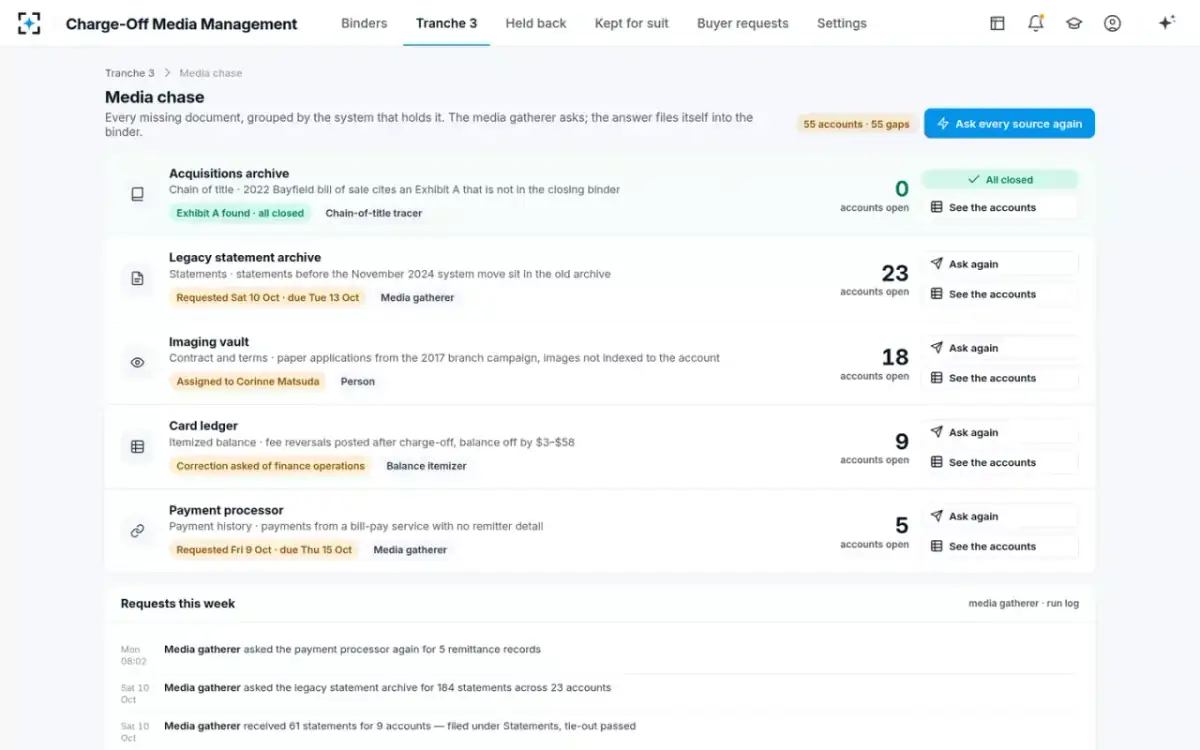
How do you test recovery software before buying it?
On your own worst tranche, not on the vendor's demonstration data. Pick a population that includes acquired accounts, accounts from before your last system migration, and a handful you already know are messy. Then measure four things, each of which has a number you can write down before the pilot starts.
Where a tranche's working days go by hand, line by line
The four measurements worth agreeing in advance: how many accounts reach complete without a person touching them; how many distinct requests the gaps collapse into, because a hundred missing statements addressed to one archive is one piece of work; how long it takes to answer a media request from the resulting file; and how many never-sell hits the system finds that your current process would have found only after the cut-off. The last is the one that pays for the pilot, because each of those accounts is a put-back or worse.
The same tranche through a contact-first system and a file-first one
Contact-first: A borrower to be reached: numbers, attempts, promises, payments.
File-first: A file to be made complete: items, sources, gaps, holds — with the contact history as one of the items.
Contact-first: Answerable only by opening the folder for each account.
File-first: Answerable by item across the whole population, before anyone starts chasing.
Contact-first: A note on the account, found when someone looks.
File-first: A request addressed to the archive that should hold it, with an owner and a due date.
Contact-first: A scrub run against a file extract, usually once, early.
File-first: A standing check re-run over the whole population inside the deadline, each hit carrying its evidence.
Contact-first: A search across source systems, some of which have since moved.
File-first: An answer from the file the sale was built from.
Contact-first: Reaching people, taking money, running plans and placements at scale.
File-first: Proving an account — and nothing else. It does not dial and does not take payments.
What an examiner will ask the software to show
Supervisors have published what they look for, which makes this part of the specification unusually easy to write. The CFPB's examination procedures tell an examiner, where an entity sells debt, to "review the information that the entity provides regarding the debt to the debt buyers", considering "whether the entity provides information sufficient to determine the consumer's identity, the amount due, whether all amounts due were permitted by contract or applicable law, and the original creditor" (CFPB examination procedures). Three of those four are documentary facts, and a system that can produce them per account produces most of the examination.
The same procedures ask, of disputed accounts, whether the entity "attempts to verify the debt prior to selling it" and "provides information about the dispute to the debt buyer" — which means a dispute flag has to travel with the account, not sit in a contact note. The OCC adds the management view: a bank's systems should "generate timely, accurate, and comprehensive reports for bank management that detail debt sales across lines of business, sales prices, repurchase volumes, losses incurred, and customer complaints" (OCC Bulletin 2014-37). Repurchase volumes is the line most recovery systems cannot produce, because nothing joins a returned account back to the tranche it left in.
A reasonable test: ask the vendor to produce, for one past tranche, the list of accounts sold, what each one carried at the time, which ones came back and why. If that report exists, the data model is right.
What it must not do, and where a person takes over
A buying guide that does not say where the product stops is marketing. Charge-Off Media Management does not dial, does not send collection letters, does not take payments, does not run a payment-plan or settlement book, and does not place accounts with agencies. It is not a system of record for balances — it reads the bank's records and never changes them, and when a balance does not tie it reports the difference with the transactions behind it rather than correcting it. A lender that needs a collections platform still needs a collections platform.
Nor does it decide. Agents gather, check, chase, screen and draft; the recovery analyst prepares, collections compliance confirms every hold, and the debt sale manager releases the tranche and signs the seller's affidavit. A hold is never cleared by the system, and an account is never referred to counsel by the system — the grading that precedes that referral is the subject of the guide to legal collection software. Those are limits, not modesty: an automated system that could clear its own compliance hold would be the single most dangerous feature in the product.
Whose rules: the checklist, the never-sell settings and who signs
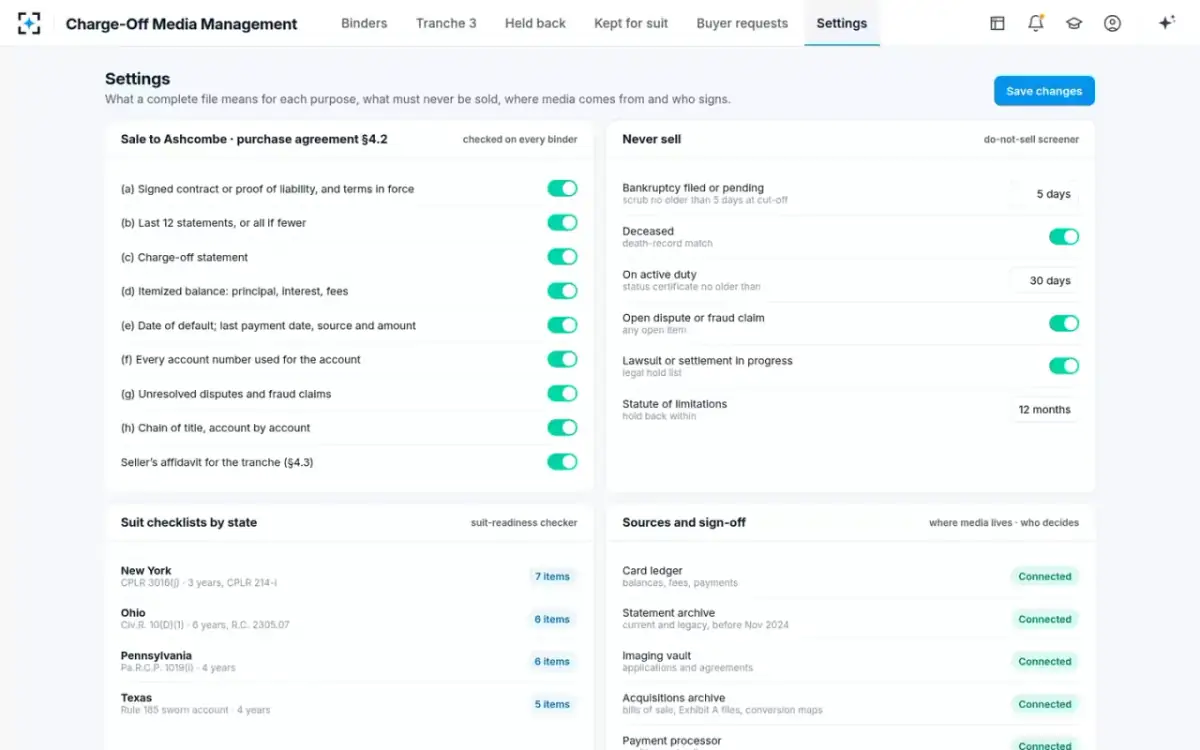
A pilot you can run on one tranche
Keep it to one month and one population. Take a tranche you have already prepared by hand, so you have a baseline, and include the acquired accounts you usually set aside. Load the checklist from the counterparty agreement that actually governs it, not a generic one. Give the system read access to the archives rather than an extract, because the extract is the thing you are trying to stop building. Then compare, account by account, what the system says is missing with what the manual preparation found — in both directions, because the interesting failures are the items it did not know to look for and the items your analysts quietly let pass.
Three traps are worth naming in advance. Running the pilot on a clean, recent population proves nothing; the value is entirely in the messy tail. Judging it on documents retrieved rather than files completed flatters any product, because a file with eight of nine items is worth the same as a file with none. And accepting a vendor's measurement of its own accuracy without a sample you have graded yourself is how a documents evaluation becomes a demonstration. What the finished file is worth commercially is set out in what debt buyers pay for debt; to see the gaps, the chase and the release on sample data, start from Charge-Off Media Management.
Questions people ask
What is debt recovery software?
A system for working accounts after they have gone bad: queueing and segmentation, contact strategy and dialling, letters, payment plans and settlements, payment processing, agency placement and reporting. Most products are built around the contact. The separate document work a charged-off account needs — assembling and proving its file — is usually left to a shared drive, and is what a documents evaluation tests.
How do you evaluate debt collection software?
Score the contact side on the things you can count — reach rates, plan performance, compliance controls on contact frequency — and score the document side separately, on whether the system can name what each account is missing, address the gap to the system that should hold it, give it an owner and a date, and re-check the never-sell screens close to a deadline. Run both on your own data, including the acquired and pre-migration accounts.
Can recovery software prepare accounts for sale?
Some can; most do not. The test is whether the product models an account as a file with required items rather than as a borrower with attachments. Preparing for sale means grading each account against the counterparty's checklist, chasing what is short, re-screening what must never be sold, and assembling the schedule and the media package — then answering the buyer's requests afterwards from the same file.
What systems does recovery software need to connect to?
More than the core. For charged-off work: the card or loan system for balances, fees and payments; the statement archive, current and legacy; the imaging vault for applications and agreements; the archive of bills of sale, account schedules and conversion maps from past acquisitions; the payment processor for the last payment's detail; and the never-sell screens — bankruptcy, death records, servicemember status, the dispute log and the legal hold list.
What reports should recovery software produce?
For the document side, three: completeness by item across a population, outstanding requests by the system that owes them, and holds with their evidence and dates. For the sale side, the one the OCC asks a bank's management information to produce — debt sales across business lines with sales prices, repurchase volumes, losses incurred and customer complaints. The repurchase line is the one that is usually missing.
What does debt recovery software cost, and how long does it take to put in?
Neither question has an honest published answer, and a guide that gave one would be guessing: both depend on the number of source systems, the state of the archives and how much of the checklist is already written down. The useful version of the question is what the current process costs. In the sample data, preparing a tranche of about 1,300 accounts by hand is estimated at around twenty working days of analyst effort, against a design target of two.