Legal debt collection software is the category that covers everything a creditor or a debt buyer uses to move an account from collection into court: referral queues to law firms, matter tracking, pleading and affidavit generation, judgment and post-judgment management, and the fee accounting behind all of it. Judged on those features, the products look similar. Judged on the decision that actually determines whether a case is worth filing — whether this account's file can carry the pleading and proof rules of this borrower's state, item by item — most of them do nothing at all, because the grading happens upstream of the matter they are built to manage. This guide is written for that decision, and it uses Botminds' Charge-Off Media Management, which grades the file and then stops, as the worked example.
The sample grading, screens and counts below come from a fictional bank's sample data inside the solution. Nothing here is legal advice: the rules cited are quoted from the regulation or rule's own text, and what any of them requires of a particular case is a question for the lender's own counsel.
What legal debt collection software is for
In most organisations it is for administration after the decision: a file goes to a firm, the firm takes an action, the system records it, and the money or the judgment comes back. That is a real need and the products meet it. The harder question is the one asked before the referral — is this account one we should be suing on at all, and will the file stand up when the court asks what it is based on?
Two classes of answer sit behind that. One is legal eligibility: whether any action may be brought. Regulation F is categorical on the clearest case — a collector may neither sue nor threaten to sue on a time-barred debt (12 CFR § 1006.26(b)) — and the CFPB's examiners are told to "determine whether the entity sues or threatens to sue on time-barred debt" (CFPB examination procedures). Where the limitation period runs from, and why an account close to it deserves a buffer rather than a bet, is worked through in the guide to time-barred debt.
The other is documentary sufficiency, and it is the one no queue-and-matter system touches. It is not a single question but a list, and the list is written by the borrower's state.
The referral decision is a file decision
A referral that goes out short does not fail quietly. It fails after counsel has been paid to read it, usually at the moment the complaint has to attach something the bank promised but never produced. In the sample data that is exactly the before-and-after of the litigation referral coordinator: previously he sent files to counsel and found out later that the court wanted the charge-off statement attached, not described; now he refers accounts that have already been graded item by item against the rules of the borrower's state.
What a referral file is graded against, in the sample configuration
4states
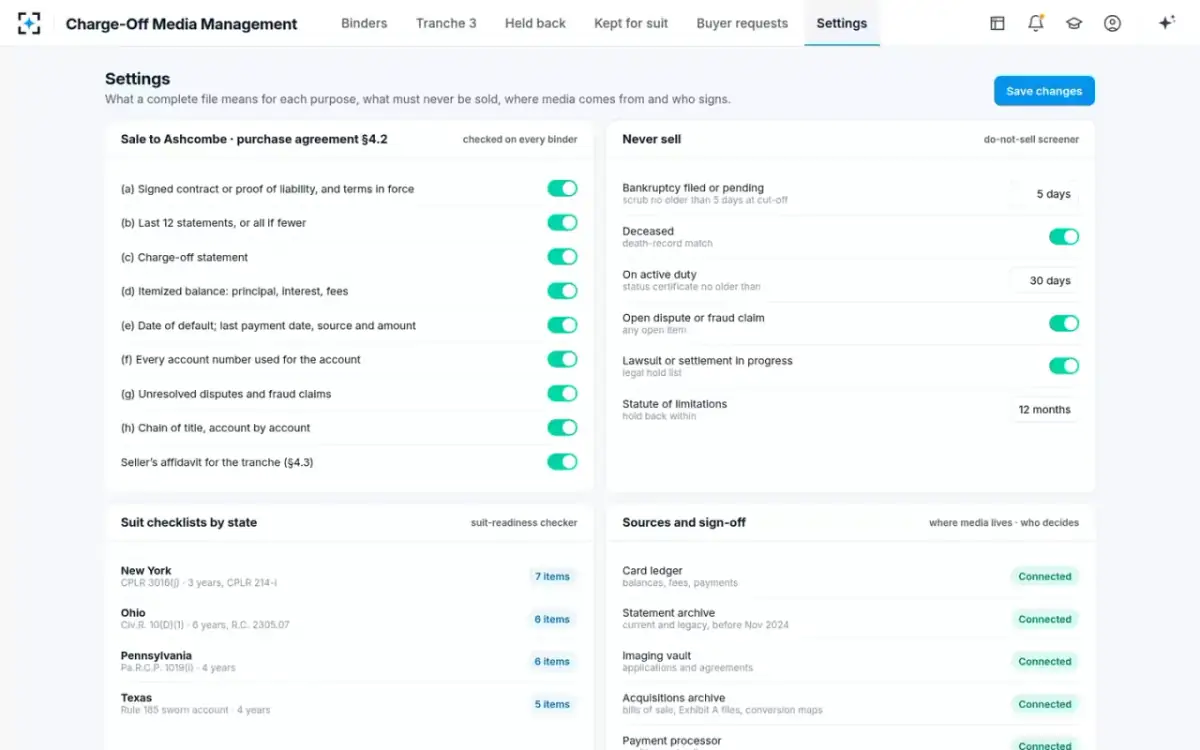
suit checklists configured — New York, Ohio, Pennsylvania and Texas — each with its own complaint rules and limitation period
5–8items
graded per account, depending on the state: the lists differ in length as well as in content
9tabs
in the underlying file every graded item is drawn from, each document carrying its source system and identifier
The number that matters in that figure is not four or nine but the middle one. A single global checklist cannot be right for four states at once, so a product that offers one is wrong somewhere by construction — and wrong in the direction that produces referrals that cannot be filed.
What documents do you need to sue on a credit card debt?
It depends on the state, on whether the plaintiff is the original creditor or a debt buyer, and on whether judgment is sought by default or after an answer. The general shape is consistent, though: something that evidences the borrower's agreement to the account, something that establishes the amount, something that establishes the plaintiff's right to bring the claim, and a witness who can put the records in front of the court.
That last requirement is federal in form and mirrored in most state rules. The business-records exception admits a record only where, among other conditions, "making the record was a regular practice of that activity" and "all these conditions are shown by the testimony of the custodian or another qualified witness, or by a certification that complies with Rule 902(11) or (12) or with a statute permitting certification" (Federal Rule of Evidence 803(6)). In other words: documents alone are not evidence; documents plus a person who can properly speak to how they were made are. What that person can honestly swear to is the subject of the guide to the affidavit of debt.
New York's answer, item by item
New York is the useful worked example because its rule is unusually explicit about the paper. For a default judgment arising from a consumer credit transaction, the affidavits the rule requires "shall be supported by exhibits", and it then names them.
The exhibits New York requires behind the affidavits, and where each one comes from in a charged-off file
| What the rule requires as an exhibit | What it means in practice | The item of the file it comes from |
|---|---|---|
| A copy of the credit agreement as defined in the rule | The rule defines a credit agreement as a contract or other document governing the account, provided to the defendant, evidencing the agreement to the debt, the amount due, the original creditor’s name, the account number and the defendant’s name and address — and says the charge-off statement, or the monthly statement recording the most recent purchase, payment or balance transfer, "shall be deemed sufficient evidence of a credit agreement". | Contract and terms, or the charge-off statement |
| The bill of sale or written assignment, where applicable | For a debt buyer, the instrument by which the account was transferred — and where it was bought more than once, for each seller in turn. | Chain of title |
| The defendant’s name | From the original creditor’s own business records, not from the data file alone. | The account record itself |
| The last four digits of the account number | Truncated, as the rule states it. | Account numbers used |
| The date and amount of the charge-off balance | The balance as struck on the charge-off date. | Charge-off statement |
| The date and amount of the last payment, if any | A date that also drives the limitation analysis in most states. | Payment history |
| Post-charge-off interest and fees, less post-charge-off credits or payments | The movement since charge-off, itemized rather than netted into one figure. | Itemized balance |
| The balance due at the time of sale | What the account was worth when it changed hands, which is not always what is claimed now. | Itemized balance and the sale record |
Two details in that list repay attention. The rule's own definition of a credit agreement is generous in a way that solves a problem every recovery team has: where the original signed application cannot be found — and the FTC's industry study found applications travelled with well under one percent of sold accounts — the rule deems the charge-off statement or the most recent transacting statement sufficient. A grading system that marks such an account as unfileable because the application is missing is applying a stricter rule than the state does, and quietly killing referrals that would have been fine.
The second is the bill of sale. For a debt buyer the ownership instrument is an exhibit in its own right, and where the account passed through more than one hand, each transfer needs its own. That is the point at which an ownership trail stops being a diligence nicety and becomes an attachment to a court filing — the subject of the chain of title guide.
One account graded item by item before it goes to counsel
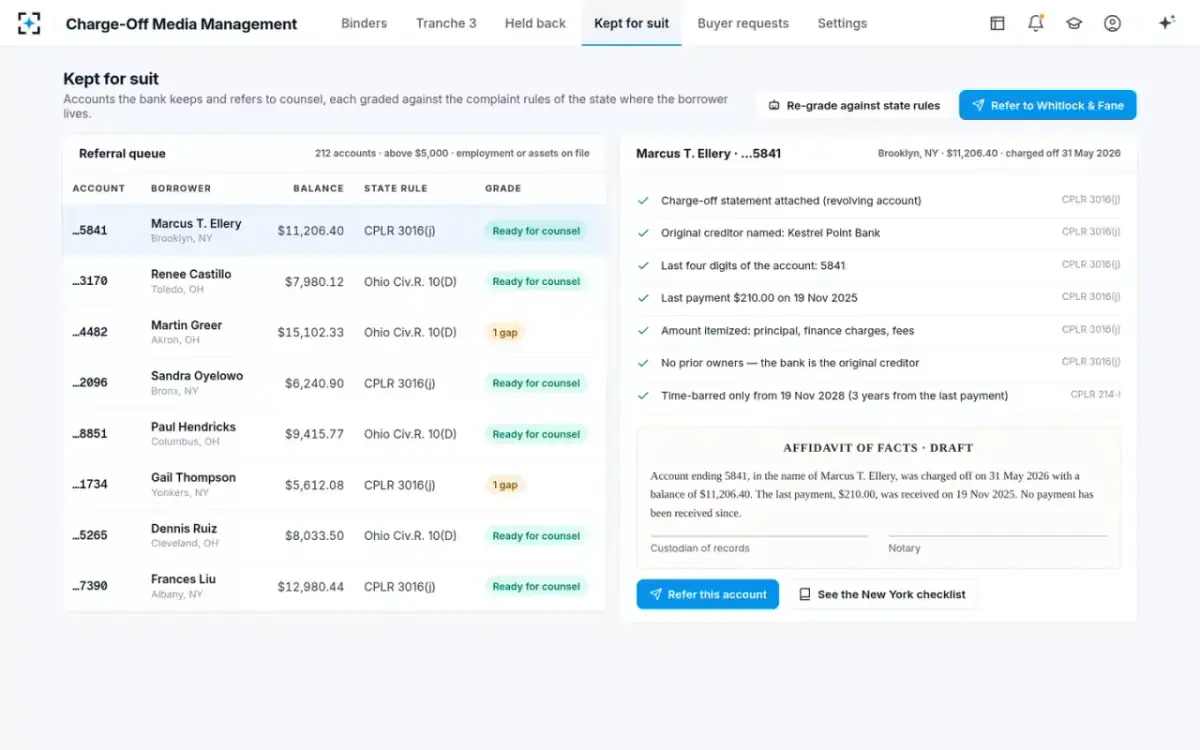
The affirmation counsel has to sign
New York adds a requirement that no software can satisfy and every system should be built around: "in all applications for a default judgment arising from a consumer credit transaction, the plaintiff must submit the AFFIRMATION OF NON-EXPIRATION OF STATUTE OF LIMITATIONS executed by counsel" (22 NYCRR § 202.27-a). It is executed by counsel, not by the creditor and not by a system, and it is an affirmation about a legal conclusion drawn from facts the creditor supplies.
That division of labour is the right model for the whole category. The system's job is to make the underlying facts unambiguous and dated — when the account defaulted, when the last payment was made and for how much, where the borrower lived — and to show its working. Counsel's job is to decide what those facts mean under the law of the forum and to sign. A product that presents a limitation verdict as an answer rather than as an input to that judgement is inviting someone to rely on it.
In the sample data the solution computes the limitation position from the date of default and the borrower's state, and reports it as the rule the bank configured together with the date it falls — for one New York account, that no action is barred until a date some years out under the limitation period in the bank's own New York checklist. It presents that as a fact to be checked by counsel, not as permission.
Grading by state: why one checklist is not enough
States differ on what must be pleaded, what must be attached to the pleading, how long the limitation period runs and what restarts it, and what a court will accept to prove the chain of ownership. They also differ in length: in the sample configuration the four state checklists carry between five and eight graded items each. A single list long enough to satisfy all of them refers almost nothing; a single list short enough to refer comfortably satisfies none of them.
What a per-state grading has to produce for each account
- The item, named as the state names it
Not "documents complete" but the specific exhibit or allegation the state’s own rule calls for, in its own words.
- The rule beside it
A coordinator reading a fail should be able to see which rule produced it without asking counsel what the system meant.
- The evidence that satisfies it
The document in the file that answers the item, with the system it came from and its identifier — so counsel receives the proof, not a claim that proof exists.
- The limitation position, with its inputs
The date of default, the last payment date and amount, the state applied and the period the bank’s own checklist uses — shown, so counsel can test the conclusion rather than accept it.
- Standing, where the bank is not the original creditor
Each transfer in the chain, evidenced by the account’s own row on the schedule to each bill of sale rather than by an assertion.
- The single thing that would fix a fail
A grading that says "incomplete" is a report. A grading that says "the charge-off statement is missing; the statement archive holds it" is a piece of work.
- A date the grading was run
Eligibility decays. A grade from three weeks ago is a statement about a different account.
There is one more reason the checklist has to be the lender's own rather than the vendor's. Court rules change, and they change per state. A product that ships state rules as content takes on a maintenance promise it will eventually break, silently, in the direction of referring accounts under a rule that has moved. A product whose checklists are settings, versioned and owned by a named person, fails visibly instead.
The state checklists as configuration, not as product content
What to ask a vendor about the grading itself
Five questions, each with an answer you can see on screen rather than hear described. First: show me an account that fails, and tell me which single item fails and which rule it fails under. Second: show me the same account under a second state's checklist, and show me the two gradings disagreeing. Third: where did the evidence for each passing item come from, and can I open it? Fourth: what does the system do when it cannot tell — is there a third state between pass and fail, and who does it route to? Fifth: who can change the checklist, and is the change recorded with a name and a date?
The fourth question is the one that separates serious products. A grading that only ever says pass or fail will say pass when it should have said "a person needs to look at this", and the cases that land in that gap are the ones with unusual facts — a borrower who moved between states, an account with a post-charge-off payment nobody can trace to a source, a name that matches a deceased record imperfectly.
The referral path, from graded to filed
Agent
GradedEach account kept for suit is tested against the checklist for the borrower’s state — what must be attached, what the complaint must state, the limitation period and standing — and every item is reported with its rule.
Never: Never refers an account to counsel
Agent
Short items chasedWhere an item fails for a missing document, the request goes to the system that should hold it, with an owner and a due date, and the file is graded again when it arrives.
Never: Never substitutes an affidavit for a missing document
Agent
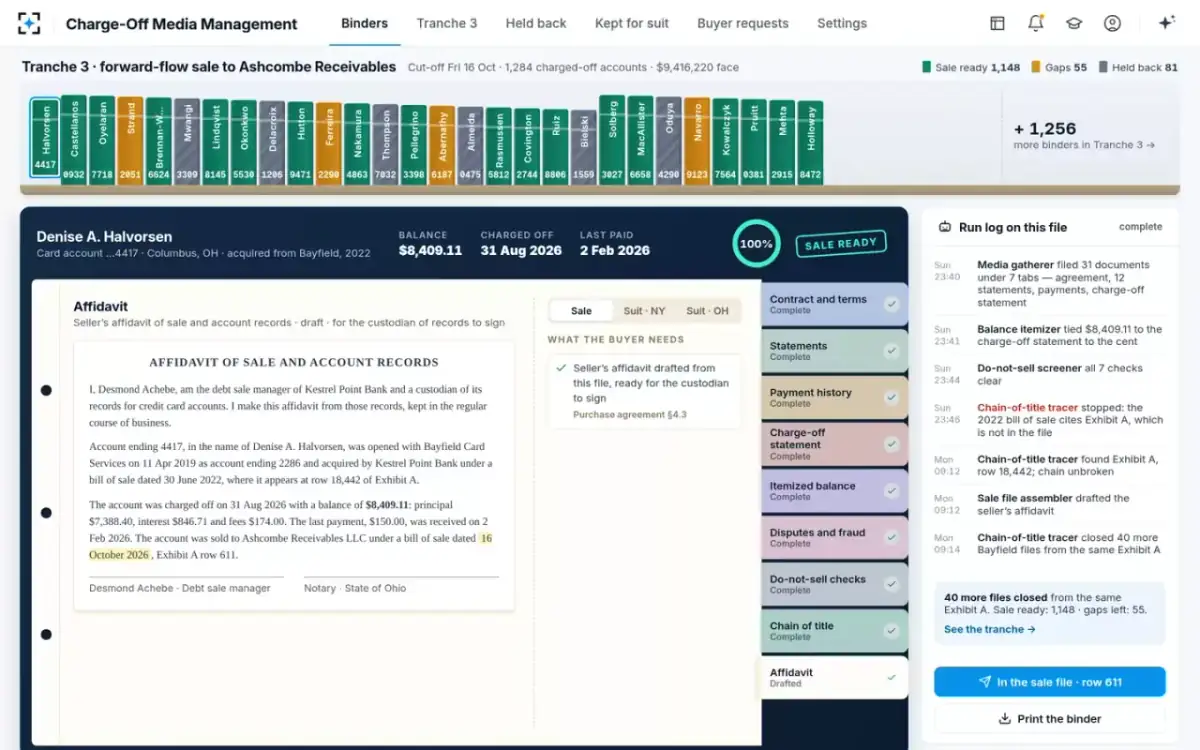
Affidavit draftedWhere the file is complete, an affidavit of facts is drafted from it for the custodian of records — drawn from the documents in the file, not from a template filled with field values.
Never: Never signs
A person decides
Custodian signsThe custodian of records reads the file and signs what they can properly swear to, or does not.
A person decides
Coordinator refersThe litigation referral coordinator decides which graded accounts go to which firm, and sends the evidence with them.
Where the system must stop and a person must decide
Three boundaries are worth writing into a selection's requirements. A grading system must not refer: it may rank, queue and recommend, but the act of sending an account to counsel belongs to a named person who can be asked why. It must not sign: an affidavit drafted from a file is a draft until a custodian of records has read the file and sworn to it, which is the whole point of the business-records rule's insistence on a custodian or other qualified witness. And it must not clear its own exceptions: an account held back because of a bankruptcy hit, a death record or an open dispute should need a reason and a second person to release, not a permission setting.
Those limits also protect the measurement. A system that refers automatically cannot be evaluated on the quality of its grading, because nobody ever sees the cases it got wrong — they go out, and what comes back is a mixture of outcomes with too many causes. A system that grades and hands over produces a clean, countable disagreement: the accounts a coordinator referred despite a fail, and the accounts a coordinator held despite a pass.
The affidavit drafted from the file, for a person to sign
What happens when a debt case is dismissed for lack of documents?
In the clearest published example, it never becomes a case at all. New York's rule ends with an instruction to the court's own staff: "the County Clerk or clerk of the court shall refuse to accept for filing a default judgment application that does not comply with the requirements of this section" (22 NYCRR § 202.27-a).
The County Clerk or clerk of the court shall refuse to accept for filing a default judgment application that does not comply with the requirements of this section.
22 NYCRR § 202.27-a, on applications for a default judgment in consumer credit matters
Read that as a design constraint rather than as a risk. The rule is enforced at the counter, by someone who has the list in front of them and no interest in the account's merits, which means the cost of a short file is incurred in full and produces nothing: the fees are spent, the affirmation has been executed, and the application comes back. Whether a case that has been filed and then challenged can be brought again, on better papers, is a question of the forum's own law and of what the court said when it dismissed — a question for counsel, and a reason the grading should happen before the referral rather than after the answer.
The same account referred complete, and referred short
Referred short: A file with items promised rather than attached, and an assurance that the rest can be obtained.
Referred complete: Every item on the state’s checklist answered by a document, each carrying the system it came from and its identifier.
Referred short: Counsel, after reading the file — or the clerk, at the counter.
Referred complete: The grading, before the referral, naming the single item that was short.
Referred short: Counsel’s reading time and the court fee, spent on an application that produced nothing.
Referred complete: One request to the archive that should hold the document, with an owner and a due date.
Referred short: Running while the file is reconstructed, on an account that is already old.
Referred complete: Computed from the default date and the state before the referral, and shown with its inputs.
Referred short: That this account failed, some time later, mixed with every other reason a matter can fail.
Referred complete: Which item fails most often across the population — a measurement of the file, not of the accounts.
Referred short: An action brought on a claim the creditor could not substantiate when it was filed.
Referred complete: An action brought only where the creditor can show what it rests on, or no action at all.
The costs that are certain are worth listing plainly: counsel's time reading a file that could not support a filing, the court fee, the coordinator's time assembling the referral, and the opportunity cost of an account that sat in a litigation queue for months while its limitation period ran. Against those, grading the file first is cheap. And a lender that grades consistently gets something a lender that refers optimistically never gets — a count of how many of its accounts are actually fileable, which is a materially different number from how many are collectable.
Where the same file work makes an account saleable instead, and what a buyer pays for it, is set out in what debt buyers pay for debt. To see the grading, the drafted affidavit and the state checklists on sample data, start from Charge-Off Media Management.
Questions people ask
What must a debt collection complaint include?
That is set by the forum's own pleading rules, and they differ. New York's default-judgment rule gives the clearest published illustration of the kind of thing required: affidavits supported by exhibits including the credit agreement as the rule defines it, the bill of sale or written assignment where the plaintiff is a debt buyer, the defendant's name, the last four digits of the account number, the charge-off balance and its date, the last payment's date and amount, post-charge-off interest and fees net of credits, and the balance due at the time of sale. A lender should hold its own state-by-state list, written by its counsel.
What does New York require before a default judgment on a consumer debt?
Specific affidavits, which may not be combined, supported by named exhibits — and, in every such application, an affirmation of non-expiration of the statute of limitations executed by counsel. Where the plaintiff is a debt buyer, the rule requires an affidavit of facts and purchase of account by the debt buyer plaintiff, an affidavit of facts and sale of account by the original creditor, and, where applicable, an affidavit of purchase and sale for each earlier debt seller.
What is an affirmation of non-expiration of the statute of limitations?
A statement signed by the plaintiff's attorney, required in New York for every default-judgment application arising from a consumer credit transaction, affirming that the limitation period has not expired. It is executed by counsel rather than by the creditor, which is why a software product can supply the facts behind it — the default date, the last payment, the state — but can never supply the affirmation itself.
How do law firms decide which accounts to sue on?
By balance, by the borrower's apparent ability to pay, by the forum, and — the part that is frequently discovered too late — by whether the file supports the filing. The order is worth reversing: grading the file first removes accounts that would have failed at the counter regardless of how attractive their balance looked, and leaves the commercial judgement to be made over a population that can actually be filed.
How do you measure the quality of a referral file?
Not by documents held but by items answered: the share of referred accounts where every item on the state's checklist is satisfied by a document in the file, measured before referral and again at filing. Two other counts are worth keeping — how often a coordinator overrides a fail, and how often a graded pass is later queried by counsel. Both are measurements of the checklist rather than of the accounts.
Can legal collection software decide whether to sue?
It should not. It can establish and date the facts a decision needs, show the evidence behind each one, and refuse to present an account as ready when an item is short. The decision to refer belongs to a named person, the affidavit belongs to a custodian of records who has read the file, and in New York the affirmation about the limitation period is required to be executed by counsel.