Chain of title in debt collection is the documented line of ownership from the bank that first extended the credit to whoever holds the account today, and it is proved one account at a time. A complete chain is not a stack of contracts. For every sale in the line it needs three things: the bill of sale, the account schedule that bill of sale refers to, and this account’s own row on that schedule. It is hard because the cover page of a bill of sale names a portfolio and never a person; because the schedule it points at is a separate file that may sit in an acquisitions archive nobody has opened in four years; and because an account renumbered when it was converted onto the buying bank’s systems no longer matches the number printed on the older schedule. Botminds’ Charge-Off Media Management traces every charged-off account from its originator through each acquisition to the sale in front of it, and will not call a chain complete until it has found that account’s row on every schedule in the line.
The worked figures on this page come from a fictional sample tranche as it runs through the solution: Tranche 3 of a forward-flow sale by Kestrel Point Bank, 1,284 charged-off credit card accounts, $9,416,220 of face value, cut-off Friday 16 October. Every bank, buyer and borrower named is invented. The research figures come from regulators and the courts, linked where they appear.
What buyers actually received with the accounts
12%
of accounts came with any document at all at the time of purchase
13%
of portfolios contained any account documents; the rest arrived as data only
1type
of document per account was what a buyer typically got, where anything came
That is the scale of the problem a seller is solving. The accounts move as rows in a data file; the paper that proves where the rows came from mostly stays behind. Everything below is about closing that distance for one account, then for every account on one schedule at once.
What is chain of title in debt collection?
Chain of title in debt collection is the unbroken sequence of transfers that connects the account in a collector’s hands to the credit the borrower actually agreed to. Each transfer is a link, and each link has to be evidenced by a document that names this account. The phrase is borrowed from land records, where a county registry holds every deed in order and a searcher can read the chain off one index. Consumer debt has no registry. The chain exists only in the private files of the parties that sold the account, which is why it so often exists in only one of them.
Two words in the chain mean less than people assume. “Original creditor” does not mean the bank that opened the account: New York’s default-judgment rule for consumer credit defines it as “the financial institution that owned the consumer credit account at the time the account was charged off, even if that financial institution did not originate the account” (22 NYCRR § 202.27-a(a)(2)). A bank that bought a card portfolio in 2022 and charged the account off in 2026 is the original creditor for that rule, and the bank that issued the card in 2014 is further back up the chain. And “portfolio” is a unit of sale, never a unit of proof. A buyer suing one borrower cannot put a portfolio in front of a judge.
So the only question that matters is the narrow one: for this account, on this date, which document shows it changing hands? Everything else — the master agreement, the closing certificate, the wire — is context.
The three documents every link needs
Every link in the chain, including the one the seller is creating right now, stands on three documents. Miss any one of them and the link does not hold, however impressive the other two look.
One link of the chain, and the three things that have to exist
1
The bill of sale
The instrument that transfers a portfolio from one owner to the next, signed and dated.
Proves That a sale happened on a date, between two named parties.
Fails as Names a portfolio, not a person. On its own it proves nothing about any one account.
2
The schedule it names
The account-level file the bill of sale refers to — usually an exhibit, usually a spreadsheet.
Proves Which accounts were in the sale that day.
Fails as Referred to, not attached. It travels separately, and a later owner often never received it.
3
This account’s row on it
One line in that file, found by the account number the account carried at the time.
Proves That this account — this borrower, this balance — was in that sale.
Fails as Renumbered at conversion. The number on the schedule is not the number on the file today.
The middle document is the one that goes missing most. A bill of sale almost never lists accounts in its own body; it says the accounts sold are those listed in a file attached or delivered as an exhibit. That file is a spreadsheet of tens of thousands of rows, it is delivered once, and it is not what anyone files with the closing papers. Four years and one system migration later, the bill of sale is in the acquisitions archive and the exhibit is not.
The third is the one that fails silently. A seller can hold both the bill of sale and the exhibit, search the exhibit for the account number on today’s file, find nothing, and conclude the account was not in that sale — when in fact it was there under the number it carried before conversion. The chain is intact; the search was wrong.
How do you prove chain of title on a single account?
You prove it by walking the account backwards from today to its origination, and producing a document with its row on it for each sale you cross. The account below has been through one acquisition and is about to go through a sale, so its chain has two links and three owners.
One account’s chain, end to end — the document and the row that prove each link
- Signed application and terms in the imaging vaultorigination
- 2022 bill of salenames the exhibit
- BAYF-KPB-2022-ExA.csv, 61,288 rowsthe schedule
- Row 18,442, account ending 2286the row
- The map that links the old number to the new onenot a sale — but the join that finds the row
- Draft bill of sale to the buyernames the schedule
- Exhibit A for Tranche 3the schedule
- Schedule row 611, account ending 4417the row
Read in that order, the proof is mechanical. For each sale, name the instrument, name the file it refers to, and quote the row — file name, row number and the account number as it appears there. A reader can check every step without trusting the person who wrote it, which is the whole point of a chain.
The conversion map in the third lane is worth dwelling on, because it is not a link and gets treated as one. It transfers nothing. It is a join between two numbering systems, and its only job is to let the searcher find the right row on an older schedule. A chain that relies on a conversion map to carry ownership, rather than to locate evidence, is a chain with a hole in it.
Where chains break: the account number that changed at conversion
Chains break at acquisitions, and nearly always at the same place inside them. When a bank buys a card portfolio, the accounts are loaded onto its own systems and renumbered, the seller’s imaging stays with the seller or arrives in bulk, and the exhibit that lists the accounts is handled as a closing deliverable rather than as evidence that will be needed in 2030. The regulator described the result plainly in its 2015 action against a card issuer: when the bank “obtained portfolios of credit card Accounts from acquired banks, they did not always receive important documentation needed to support claims that Consumers owed the Debts and owed the amount stated,” and on certain accounts the bank was “unable to conform their databases” with the original account documents (CFPB consent order, 2015-CFPB-0013).
“Unable to conform their databases” is the renumbering problem in supervisory language. The account exists in two systems under two identities and nothing in the file joins them. Everything downstream inherits the break: the itemized balance cannot be tied to statements held under the old number, the date of first default sits in a system that no longer has the account, and the schedule that would prove the 2022 sale is unsearchable because the search key is wrong.
“Which number was this account carried under, in which system, on the day of each sale?”
What the seller’s file has to answer, for every account it sells
The supervisory consequence is not subtle. The OCC puts “Accounts lacking clear evidence of ownership” on its list of debt that should plainly not be sold, because it probably fails the basic test of being an ongoing legal debt at all (OCC Bulletin 2014-37). A broken chain is not a documentation gap to be cleared up after the sale. In the bulletin’s framing, it is a reason the account should not have been on the schedule.
What the OCC expects a seller to hand over, account by account
The OCC’s debt-sale guidance sets out, for each account, the documents and account information a bank should give a debt buyer, as applicable and consistent with its retention requirements. There are nine items. None of them is headed “chain of title” — a point worth making precisely, because the list is often quoted as though it were. Two of the nine are where ownership lives, and they do a lot of work.
The nine things the OCC says a bank should provide for each account sold
- The signed contract, or other evidence of the consumer’s liability for the debt
The document the borrower actually agreed to.
- All, or the last 12, account statements — whichever is fewer
- Every account number used by the bank and, if appropriate, its predecessors
Bears on ownership: this is the item that makes an older schedule searchable at all.
- An itemized account of all amounts claimed to be owed, including principal, interest and all fees
- The name of the issuing bank and, if appropriate, the store or brand name
Bears on ownership: it names where the chain starts, which is not always the charge-off owner.
- The date, source and amount of the last payment, and the dates of default and amount owed
- Information about all unresolved disputes and fraud claims made by the debtor
- Information about collection efforts to the date of sale, internal and third-party
- The debtor’s name, address and Social Security number
The practical reading is that the bulletin does not ask for a chain, it asks for the materials from which a chain can be built, and leaves the construction to the contract. That is what happens in practice: in the sample tranche the obligation to show ownership account by account comes from § 4.2 of the purchase agreement, and every account is graded against it, while the OCC’s guidance is what makes the bank’s own control over the sale an examinable matter. Keeping the two apart matters when someone asks which rule a line item comes from.
What the bulletin is unambiguous about is the resale. Where a debt-sale arrangement permits the buyer to resell, it “should obligate the initial debt buyer to conduct thorough due diligence on the proposed purchaser and to pass on all account information and documentation in its possession to a subsequent buyer” — and the reason is stated at the top of the same guidance: “Each time account information changes hands, risk increases that key information will be lost or corrupted, calling into question the legal validity and ownership of the underlying debt.”
Does an affidavit prove ownership of a debt?
No. An affidavit is a statement by a person about records; it is not the record. A custodian who swears that the bank’s files show this account was acquired in 2022 is offering evidence of what the files say, and that evidence is only as good as the files and as the custodian’s actual review of them. Where the schedule exists and has been found, the affidavit introduces it. Where the schedule does not exist, the affidavit is all there is, and a court is being asked to accept a conclusion in place of the document that would support it.
Ownership proved by the account’s row, against ownership asserted by affidavit
The account’s row on each schedule: A document made at the time of the sale, by the parties to it, listing this account.
A custodian’s affidavit, with no schedule behind it: A statement made later, by one party, about what its files contain.
The account’s row on each schedule: The file name, the row and the account number on it — independently, line by line.
A custodian’s affidavit, with no schedule behind it: Nothing, without the files. The reader is checking the signer’s care, not the fact.
The account’s row on each schedule: The seller produces the row; the dispute is about the number, not the owner.
A custodian’s affidavit, with no schedule behind it: The buyer produces another affidavit, and the argument moves to who may swear to what.
The account’s row on each schedule: The conversion map joins the numbers and the row is still found.
A custodian’s affidavit, with no schedule behind it: The affidavit either overstates what the files show, or admits it cannot say.
The account’s row on each schedule: Proving the link.
A custodian’s affidavit, with no schedule behind it: Introducing the document that proves the link, and swearing to the balance.
This is why the chain-of-title tracer in the solution has two standing limits: it never asserts ownership without the account’s own row, and an affidavit never stands in for a missing schedule. The second limit is the one that costs work, and it is the one worth keeping. What a custodian of records can actually swear goes through the signature itself — who may give it, what personal knowledge means, and the exhibits that have to travel with it.
New York’s answer: one affidavit for every owner in the chain
One state has written the chain into procedure, and it is the clearest short statement of what a complete chain looks like from the bench. Under New York’s rule for default judgments in consumer credit matters, a debt buyer applying to the clerk must file “the AFFIDAVIT OF FACTS AND PURCHASE OF ACCOUNT BY DEBT BUYER PLAINTIFF, the AFFIDAVIT OF FACTS AND SALE OF ACCOUNT BY ORIGINAL CREDITOR and, if applicable, the AFFIDAVIT OF PURCHASE AND SALE OF ACCOUNT BY DEBT SELLER for each debt seller who owned the debt prior to the plaintiff” (22 NYCRR § 202.27-a(d)).
Who has to swear to each link, before a New York clerk will enter a default judgment
| The link | Who swears to it | What it is called |
|---|---|---|
| The account, and the buyer’s purchase of it | The debt buyer bringing the action | Affidavit of facts and purchase of account by debt buyer plaintiff |
| The sale out of the charge-off owner’s books | The original creditor — the institution that owned the account at charge-off | Affidavit of facts and sale of account by original creditor |
| Every sale in between | Each debt seller that owned the debt before the plaintiff, one affidavit each | Affidavit of purchase and sale of account by debt seller |
| The exhibits behind all of them | Supported by the credit agreement, the bill of sale or written assignment where applicable, and the original creditor’s business records | Required by subdivision (g) |
Note what the structure implies. Each affidavit covers the transfer its signer was party to, and nobody is asked to swear to a sale they were not in. That is the right shape for a chain, and it is also an uncomfortable test for a seller: a buyer that cannot obtain an affidavit from a seller three owners back has a chain that may be complete in the files and unprovable in that court. The documents are what survive a party going out of business; a willing signatory is not.
One schedule found, forty-one files closed
The reason to trace a chain properly rather than paper over it is that the work is shared. A schedule is not evidence about one account. It is evidence about every account on it.
In the sample tranche, one account stood at 88% ready on the Monday of cut-off week: eight tabs complete, one gap. The gap was chain of title. The run log at 23:46 the night before read “Chain-of-title tracer stopped: the 2022 bill of sale cites Exhibit A, which is not in the file.” The tracer had read the instrument, understood what it pointed at, and stopped rather than assert the link.
Charge-Off Media Management after the trace: the chain, link by link
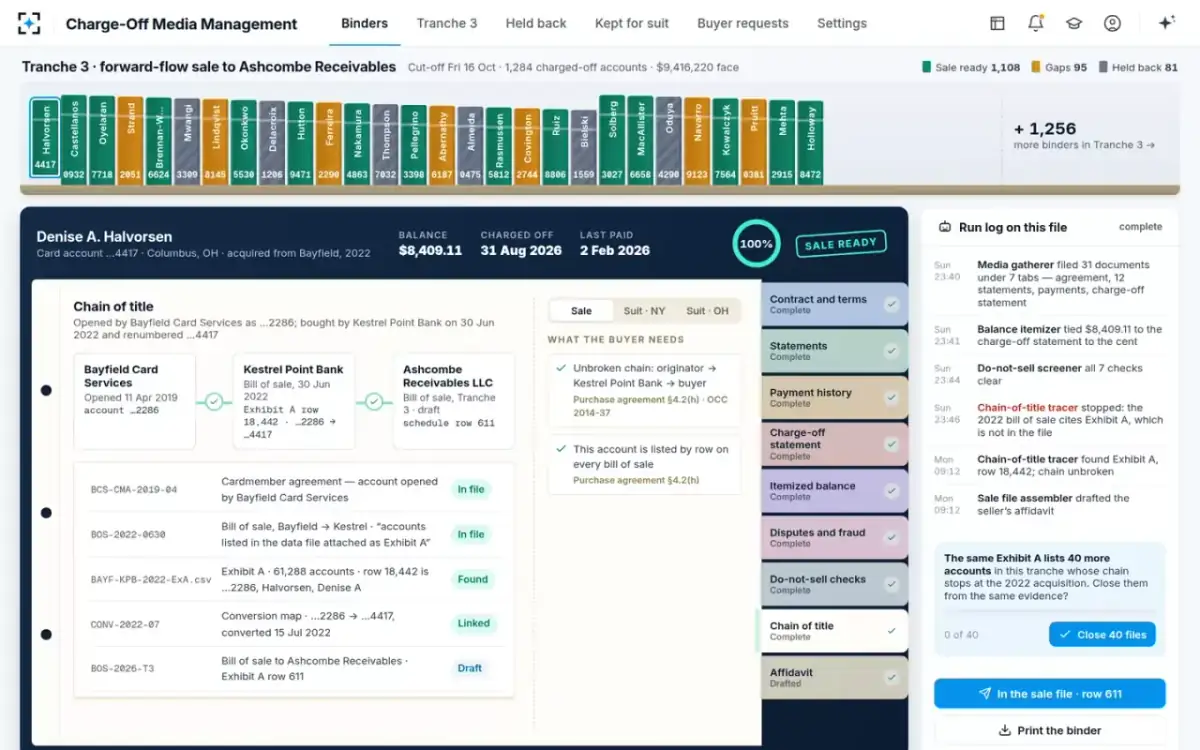
On one instruction the tracer read the 2022 bill of sale, found BAYF-KPB-2022-ExA.csv in the acquisitions archive — 61,288 rows — and found the old account number ending 2286 at row 18,442. The 2022 conversion map joined that number to the account ending 4417. The draft bill of sale to the buyer added schedule row 611. The readiness ring went from 88% to 100% and the stamp turned to sale ready.
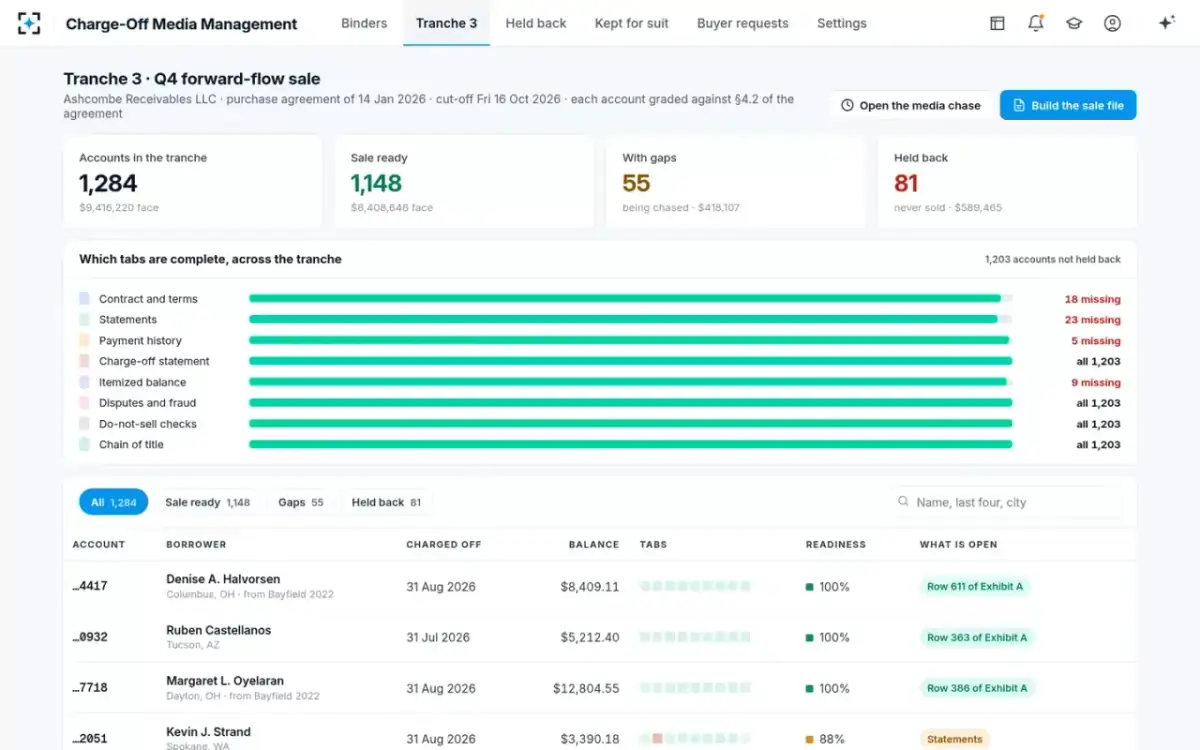
Then the same file closed the rest. Forty more accounts in the tranche had stopped at the same 2022 acquisition, and one more instruction closed them from the same evidence: 41 files in all, from one schedule found once. Across the 1,203 accounts not held back from the sale, chain of title was complete for all of them, and what remained short was ordinary media — 23 accounts missing statements, 18 missing contract and terms, 9 short on the itemized balance, 5 on payment history.
The tranche, tab by tab, with chain of title closed
What a broken chain costs: put-backs, dismissals and price
A chain that cannot be shown costs in four places, and only one of them is the lawsuit everyone pictures.
The first is the put-back. Purchase agreements let a buyer return accounts that fail the seller’s representations, and an account whose ownership cannot be evidenced is the easiest return there is. The second is the media bill: where the contract allows the buyer to request documents after the sale, somebody has to answer, and the request that arrives two years later for a 2022 exhibit is the most expensive kind. The third is the account that should never have been sold at all — the regulator’s 2015 action found accounts sold that “were no longer owned by Respondents when they were sold,” alongside accounts already settled or paid in full.
The fourth is price, and it is the one sellers feel every cut-off. A buyer prices the file it expects to receive, not the portfolio it is shown; a seller with a reputation for complete chains and a seller without one do not get the same bid on the same paper. What the contract then says about documents and warranties is where that difference is written down — what a seller commits to at every cut-off sets out those clauses.
Examiners look at this from the buyer’s end too. The CFPB’s debt collection examination procedures tell examiners to “review the account information that the entity received regarding the debt when it purchased the debt,” and to “consider in particular whether the entity received information sufficient to make required disclosures and to determine the consumer’s identity, the amount due, whether all amounts due were permitted by contract or applicable law, and the original creditor” (CFPB, Examination Procedures: Debt Collection). A buyer that cannot show the original creditor is a buyer whose seller did not hand over the chain.
Holding the chain together for the next sale
The chain a seller hands over is also the chain it will be asked about in three years, and every link it fails to record now is a link somebody reconstructs later at ten times the cost. Three habits keep it together.
Record the schedule, not just the instrument. When an acquisition closes, the exhibit belongs in the same place as the bill of sale, under the same reference, with its row count — a bill of sale filed without the file it names is half a document. Keep the conversion maps as permanent records rather than migration artefacts; they are worthless on the day of the migration and essential a decade later. And prove each sale as it is made: the seller building a schedule today is creating a link, and the cheapest moment to evidence it is while the data is still in front of someone.
Where the chain sits in the file Charge-Off Media Management builds
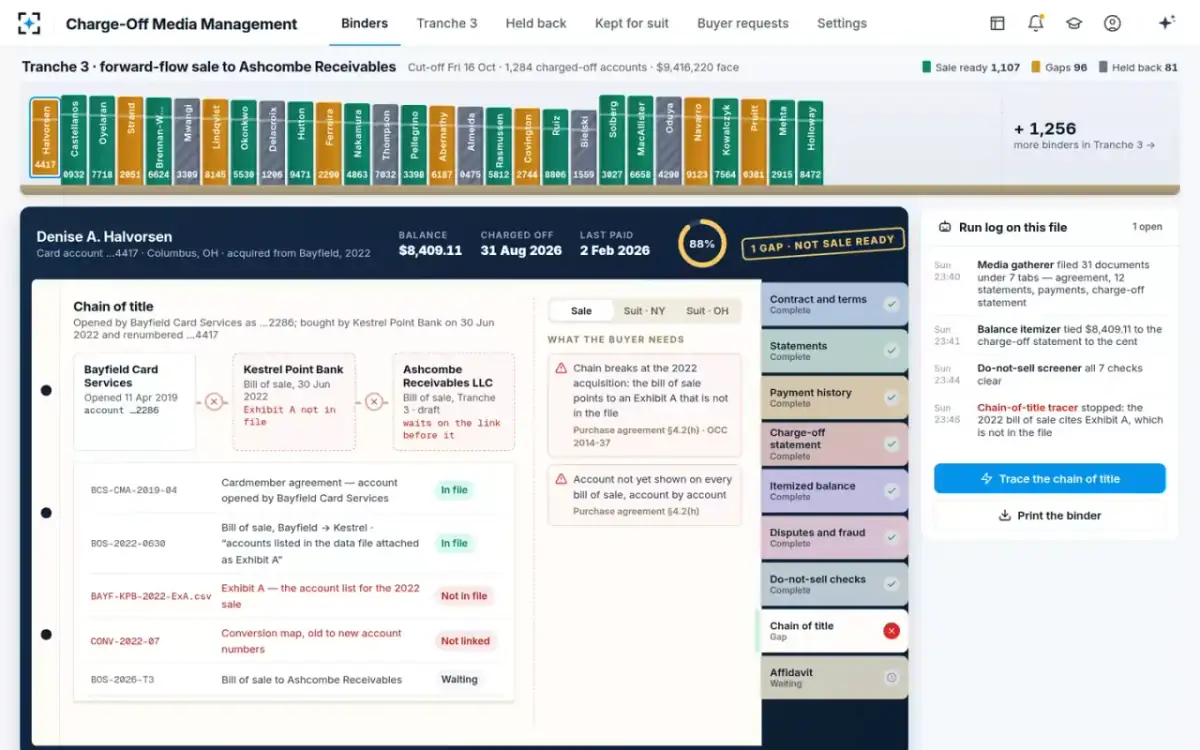
None of this is exotic. It is filing, done once, in the knowledge that someone will ask. The reason it so rarely happens is that nobody owns the question between sales, and the week it matters is the week before cut-off, when there is no time. That is the work Charge-Off Media Management does overnight, and the reason the sample tranche’s chain-of-title work was a Monday morning rather than a fortnight: the gap was found, named and closed from evidence, and the evidence was reused across every account it covered.
Questions people ask
What is a bill of sale in debt collection?
It is the instrument that transfers a portfolio of accounts from one owner to the next, signed by both parties and dated. It establishes that a sale happened, between whom, and on what date, and it almost always identifies the accounts sold by reference to a separate schedule rather than by listing them. On its own it proves a transaction, not the transfer of any particular account.
What is Exhibit A on a bill of sale?
Exhibit A is the usual name for the account-level schedule a bill of sale refers to: a data file, one row per account, carrying the account number, the balance and whatever other fields the agreement requires. It is where an individual account is actually sold. Because it is delivered as a file rather than filed as a page of the contract, it is also the document most often absent when the chain is examined years later.
Can a debt collector prove it owns my debt?
Sometimes, and the way to find out is to ask for the specific documents rather than for proof in general: each bill of sale in the line, the schedule each one refers to, and the row on that schedule showing your account — by the number it carried at the time, which may not be the number you recognise. In the FTC’s study of the industry, documents of any kind reached the buyer for only 12% of accounts at purchase, so a collector may hold the data and not the paper.
What is a broken chain of title on a debt?
A chain is broken when one transfer in the line cannot be evidenced for that account — most often because the schedule a bill of sale refers to was never passed on, or because the account was renumbered at a conversion and no map joins the old number to the new. The balance can be right and the borrower’s liability undisputed while the chain is still broken; they are separate questions.
Who has to prove the chain of title, the seller or the buyer?
Whoever is asked. In court it is the party bringing the action, which is usually the buyer. In the sale it is the seller, because only the seller holds the files for the links before its own, and the purchase agreement will say so. The OCC’s guidance also expects a first buyer that resells to pass on all account information and documentation in its possession to the next buyer, so the duty travels down the line with the accounts.
Does a new account number mean a new debt?
No. Renumbering at a conversion changes the identifier, not the obligation; the credit the borrower agreed to is the same credit. What it does change is the search: anybody looking for the account on a schedule written before the conversion has to look under the old number, which is why the list of every account number ever used — including predecessors’ numbers — is part of what a seller is expected to hand over.