A capital call default makes an investor a defaulting limited partner under the fund's partnership agreement, and what happens next is whatever that agreement says. No regulator sets the remedies. Delaware's limited partnership act lets an agreement attach consequences to a missed contribution that range from losing part of its interest, to having it subordinated, sold or forfeited, to a lawsuit for the unpaid amount. The trap most LPs walk into is not the call they cannot pay; it is the call they think is wrong and short-pay, because paying less than the notice asks is usually a default too. Botminds' Capital Call Processing rebuilds every capital call from the commitment and the fee terms, and when an amount is off it recommends paying in full and querying, so a disagreement never becomes a missed call.
The worked example comes from fictional sample data: Quillfield Capital, an LP with 412 commitments to 168 GPs, as a disputed call runs through the solution. Statutes and research are linked where they appear; agreements differ, and none of this is legal advice.
A partnership agreement may provide that the interest of any partner who fails to make any contribution that he or she is obligated to make shall be subject to specified penalties for, or specified consequences of, such failure.
Delaware Revised Uniform Limited Partnership Act, 6 Del. C. §17-502(c)
What happens if an LP misses a capital call? The agreement decides
Missing a capital call puts the investor in breach of its obligation to contribute, and the remedies are contractual: the fund's partnership agreement lists them, and the statute under which the fund is formed sets the limits. For a Delaware limited partnership, section 17-502 makes a partner's promise to contribute enforceable and then hands the details to the agreement.
An LP's operations team should read each agreement for three things before it ever needs them. First, whether a written default notice and a cure period come before any remedy, and how long the cure period is. Second, what interest or charge runs on a late amount, and from when. Third, which remedies the GP may choose, and whether it must choose the same one for every defaulting investor.
The statute also protects the fund's own counterparties. Unless the agreement says otherwise, an obligation to contribute "may be compromised only by consent of all the partners", and a creditor that extended credit in reliance on the obligation can still enforce the original promise to the extent it relied on it (6 Del. C. §17-502(b)(1)). A fund's bank is such a creditor, which is why a missed call matters beyond the fund itself.
What are the penalties for defaulting on a capital call?
The penalties for defaulting on a capital call are the ones the agreement chooses from a menu Delaware expressly allows. Section 17-502(c) names them: reducing or eliminating the defaulting partner's interest, "subordinating the partnership interest to that of nondefaulting partners, a forced sale of his or her partnership interest", forfeiture, "the lending by other partners of the amount necessary to meet his or her commitment", "a fixing of the value of that partnership interest by appraisal or by formula and redemption or sale of the partnership interest at such value", or other penalty or consequence (6 Del. C. §17-502(c)).
The capital call default remedies Delaware lets an agreement use, and what each costs the investor
| Remedy | What happens | What it costs the defaulting LP |
|---|---|---|
| Reduction or elimination of the interest | The investor's share of the fund is cut, sometimes to nothing. | Capital already contributed can be lost, not just the missed amount. |
| Subordination | The defaulter is paid only after the other investors. | Distributions arrive late or not at all if the fund underperforms. |
| Forced sale | The interest is sold, often to other investors. | A price set by the agreement's mechanism, which may be well below what the investor thinks it is worth. |
| Forfeiture | The interest is lost entirely. | Everything contributed to date. |
| Lending by other partners | Other investors fund the shortfall as a loan to the defaulter. | Interest on the loan, and a creditor claim against the interest. |
| Valuation and redemption | The interest is valued by appraisal or formula and redeemed or sold at that value. | Exit on terms the agreement fixed in advance. |
| Suit for the amount | The fund sues to make the investor pay. | The contribution plus costs; the obligation survives. |
The suit is not a remote option. Section 17-502(a)(2) keeps the fund's other rights, "including the right to specific performance", alongside the option to take cash for an unperformed contribution. A defaulting investor can therefore lose the remedy on its interest and still owe the money.
Other consequences follow from the agreement and the market rather than the statute: being reported to the fund's lenders, losing a seat on an advisory committee, or being excluded from the next fund. None of them is in the statute; they come from the agreement, the fund's credit facility or the GP's own choices.
What is a defaulting limited partner, and who else is affected?
A defaulting limited partner is an investor that has failed to pay a capital call by the date and in the amount the agreement requires, after any notice and cure period. The label matters because agreements attach remedies to it, and because others in the fund feel the shortfall.
The other investors may be asked to fund more, either as a loan to the defaulter or through a larger call. The GP may miss an investment it has signed. And the fund's lender may see its collateral shrink: a subscription facility lends against investors' uncalled commitments, and under the facility's exclusion terms a defaulting investor's commitment can stop counting. How investor exclusion events work in a borrowing base explains that side from the lender's desk.
European law treats the uncalled commitment as part of what a fund is. The 2024 amendments to the Alternative Investment Fund Managers Directive count both paid contributions and uncalled commitments as the fund's capital (Directive (EU) 2024/927). A missed call is a hole in the fund's capital as the law counts it, not a late invoice.
Can an LP refuse a capital call?
An LP can dispute a capital call, but it can rarely refuse one. A call that meets the agreement's conditions must be paid; Delaware treats a contribution payable on a discretionary call as a conditional obligation until the call is made, and once the conditions are met it is enforceable (6 Del. C. §17-502(b)(2)).
Three situations differ. If the call is fake, it is not a call at all, and the right answer is not to pay it. If the agreement gives an excuse right, for example where a particular investment would breach the investor's own legal or policy restrictions, the investor can use it, but only through the agreement's procedure and before its deadline. And if the call is for a purpose the agreement does not permit, the investor can dispute it, ideally after paying under protest, so that the dispute is argued on its merits while the agreement's default remedies, which turn only on the missed payment, never start.
Why paying less to be safe is worse
Short-paying a call because a fee looks too high turns a fee dispute into a default. The default remedies apply to a shortfall of any size unless the agreement says otherwise, while an overcharged fee is usually recoverable once the GP agrees the error. The asymmetry decides it: pay in full, by the due date, and query in writing.
A fee $18,750 above the side letter: pay in full and query
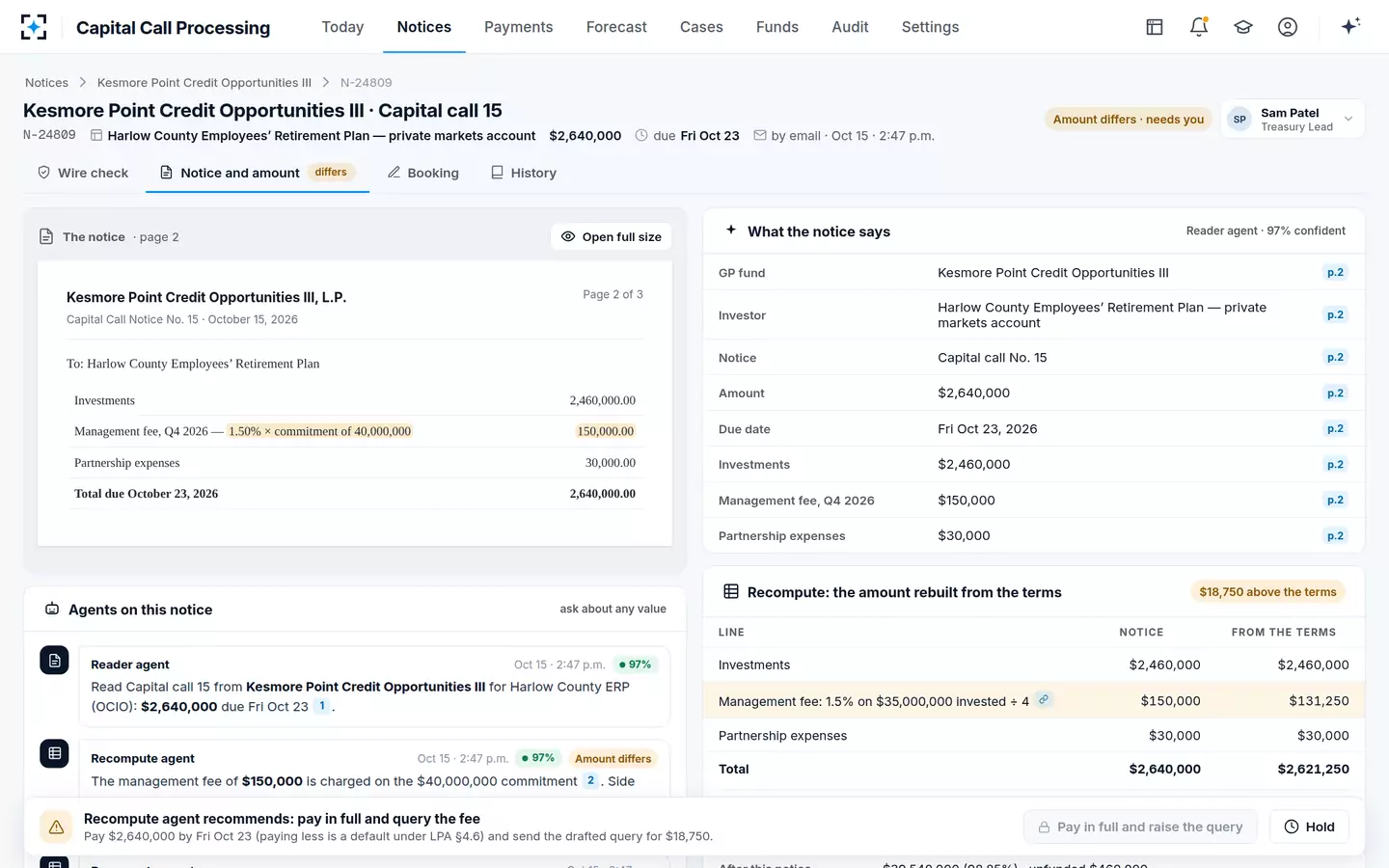
The arithmetic in the sample is simple and the decision is not close. The fee should have been 1.5% of $35,000,000 for a quarter, $131,250, not $150,000. Short-paying $18,750 would have exposed a $40,000,000 commitment to the agreement's default remedies; paying $2,640,000 and querying the difference exposed nothing but a few weeks of $18,750. Whether a fee should move from commitments to invested capital, and when, is a question of the fund's terms, and fees on committed capital versus invested capital explains the switch.
A decision path for a capital call that looks wrong
Before the due date, every doubtful call goes through four questions in the same order. The order matters: a fake notice should never reach the fee question, and a fee question should never delay the payment.
Four questions before a doubtful capital call is paid
- 1
Is the notice genuine?
Bank and sender details match those verified for the fund; any change confirmed by a call-back to a number on file.
If not
Do not pay this notice. Hold it, open a fraud case, and pay the genuine call on time.
- 2
Does the amount rebuild from the LP’s records?
Commitment, contributions to date, call percentage, fee basis and rate, side letters.
If not
Pay in full by the due date and query the difference in writing, citing the clause.
- 3
Is the LP obliged to fund this investment?
Yes, unless the agreement gives it an excuse right for it, used by its procedure and deadline.
If not
Use the excuse procedure before the due date; do not simply withhold.
- 4
Is the cash in the right entity in time?
Release one business day before the due date, before the bank's wire cut-off.
If not
Call the GP before the due date, fund from a credit line, and get any extension in writing.
- ✓
All four answered yes
Book it, have someone else check it, and release it to the verified account before the cut-off.
The first question is the one most likely to be skipped under pressure, and the one where the cost is highest. In the reports Luxembourg's financial intelligence unit reviewed for 2025, 60% of email-fraud suspicions in the investment sector involved fraudulent capital call notices (CRF Trend alert #2). A capital call notice template, set against a fake, shows the fields to compare.
If a capital call looks wrong: what to do before the due date
- Confirm the notice is genuine before anything else
Compare the bank and sender details with those on file; call back on a number from the subscription documents if anything changed.
- Rebuild the amount from the LP’s own figures
Commitment, contributions to date, call percentage, fee basis and rate, and every side letter.
- Cite the clause for any difference
The agreement or side letter section and the arithmetic, not a feeling that the number is high.
- Pay the full amount by the due date
Unless the GP agrees a revised notice in writing before the due date.
- Send the query the same day
In writing, through the GP's investor channel, asking for a credit or a revised notice.
- Track the query to its credit
A query without an owner and a follow-up date is how an overcharge becomes permanent.
Can an LP pay a capital call late?
Only if the GP agrees in writing before the due date, or the agreement itself gives a grace period. Otherwise a late payment is a default from the first day, even if interest is the only consequence the GP chooses to impose. Ask early: before the due date, a request for time is a negotiation; after it, it is a default the GP has to decide whether to pursue.
Late payments are as often operational as financial: a notice opened after the weekend, a wire released after the bank's cut-off, a due date on a holiday in the paying entity's country but not the fund's. The sample LP's settings release every payment one business day before the due date, by 3:00 p.m. Eastern, with holiday calendars for the US, the euro area's TARGET2, the UK, Singapore and Japan.
When the cash is genuinely short
When an investing entity cannot meet a call from cash, the options are to draw on a credit line, sell other assets, ask the GP for time, or sell the fund interest, and each is better used weeks before the due date than days. Private fund commitments are long and illiquid: the Federal Reserve notes that private debt funds have historically locked investors' money up for seven to ten years, with no option to redeem (Federal Reserve, Financial Stability Report, May 2026).
Calls also tend to arrive when other cash is scarce. Robinson and Sensoy found that distributions react to public equity values more strongly than calls do, so that private equity funds are net users of investors' cash when valuations are low (Journal of Financial Economics, 2016). An investor that funds calls from distributions finds the distributions slow first. Planning cash for unfunded commitments works through how much to hold.
In the sample, the solution's 13-week forecast flagged one entity, the Wealth PE Access Fund, as about $1.2 million short within 13 weeks: $9.4 million of cash against $2.5 million of confirmed and $8.1 million of projected calls. The suggestion was a draw on its $15 million credit line in the week of December 7, for treasury to plan, weeks before any due date.
How Capital Call Processing keeps a dispute from becoming a default
Capital Call Processing is built so that a disagreement about an amount and a decision to pay are separate steps. The Recompute agent rebuilds every call from the commitment, contributions to date, the call percentage, the agreement's fee terms and the side letters, and cites the clause for any difference; one of its fixed limits is that it never recommends short-paying a call. The query to the GP is drafted for the operations manager to approve, and the payment goes ahead on time.
The other defaults it guards against are operational. Due dates on weekends and holidays move to the business day before; payments are grouped by release date against the wire cut-off; an entity short of cash shows up in the forecast weeks ahead; and a fake notice is held before anyone can confuse it with the genuine call. People still decide: an analyst books, the manager checks, and treasury releases. To see a fee query beside the payment queue, start from Capital Call Processing.
Questions people ask
Can a GP sue an investor for an unpaid capital call?
Yes, if the agreement and governing law allow it, and Delaware's act expressly preserves the fund's rights against a partner "including the right to specific performance". The agreement's remedies on the investor's interest do not replace that obligation to pay.
Do other investors have to cover a defaulting LP?
Only if the agreement says so. Delaware lists "the lending by other partners of the amount necessary to meet his or her commitment" among the remedies an agreement may use, and some agreements also allow the GP to call more from the others, within their own commitments.
Can a GP waive a capital call default?
Under Delaware's default rule, an obligation to contribute may be compromised only by consent of all the partners, unless the agreement provides otherwise, and a creditor that relied on the obligation can still enforce it. Read whether the agreement obliges the GP to apply its remedies or lets it choose.
What is a cure period?
It is the time an agreement gives a defaulting investor, after written notice, to pay before remedies apply; interest may run on the late amount meanwhile. Its length, and whether it exists at all, is set by each agreement.
Does a capital call default affect the fund's credit line?
It can. A subscription facility's borrowing base counts investors' uncalled commitments, and its terms can exclude a defaulting investor's commitment after a set period, which cuts what the fund may borrow. That is the lender's side of the same event.
Is it a default if the capital call notice was fake?
No: a fake notice is not a call under the agreement. The genuine call still has to be paid by its due date, which is why the fake should be held and the GP called back on a number on file at once, so the real notice is identified in time.