A capital call tracker is the LP's running list of every capital call and distribution: each notice's amount, due date, status and owner, and each fund's commitment, contributions and unfunded balance. The useful kind is not another system of record. It reads notices from the places they already arrive, GP portals, the operations mailbox and administrators' files, checks them against the fund documents and the bank details on file, and writes only checked entries to the portfolio accounting and treasury systems the LP already runs. Botminds' Capital Call Processing works that way: agents read, recompute, verify and propose; people book, check and release; the systems of record stay where they are.
The examples come from fictional sample data: Quillfield Capital, an LP with 412 commitments to 168 GPs through 23 investing entities and about 3,100 notices a year, as they run through the solution.
Capital Call Processing: read from six places, write to the systems you keep
Reads from
GP investor portals
notices as posted, with the portal's timestamp
The LP operations mailbox
notices, revised notices and every message on the thread
Fund administrators
notice files over SFTP
Document repository
partnership agreements, side letters, subscription agreements
Portfolio accounting
commitments and contributions to date
Custodian banks
cash statements in camt.053 and MT940, to match distributions
Does, with people
Read and cite
every value tied to its page, in the notice's language
Recompute
the amount from the commitment, fee terms and side letters
Verify
bank and sender details against those verified; call back on numbers on file
Propose
entries by capital activity type and the payment instruction
Forecast
13 weeks of calls and distributions by entity and currency
Writes to, after a person approves
Portfolio accounting
capital activity, after the analyst books and the manager checks
Treasury payment system
payment instructions after release; confirmations come back
Case system and mail gateway
fraud cases and domain blocks, once the financial crime officer approves
GPs
queries and letters, drafted by agents, sent by people
What is a capital call tracker?
A capital call tracker is a list, by fund and investing entity, of every capital call and distribution notice, with what each asks for, when it is due, whether it has been checked, booked and paid, and what remains of each commitment. It answers the treasury question, what do we owe and when, and the operations question, what still needs a person.
What it must not become is a third copy of the truth. The GP's register says what each investor has contributed; the LP's portfolio accounting says what it has booked. A tracker kept by hand beside both, in a spreadsheet updated from the same PDFs, adds a place for the three to disagree and no way to tell which is right.
How do LPs track capital calls, and why a spreadsheet struggles
Where the tracker is a spreadsheet, an analyst keys each notice into it, keys it again into portfolio accounting, and re-types the payment into the treasury system, while the bank details live in a fourth place. Each copy is a chance for the figure or the account to drift, and the spreadsheet cannot tell whether the bank details in a new notice match the ones verified for that fund.
Volume makes it worse. The sample LP's 412 commitments produce about 3,100 notices a year, and the flow is lumpy: funds call most of their commitments in their first few years, with the average fund in one large investor's records 56.8% called by the end of year 3 (Ljungqvist and Richardson, NBER Working Paper 9454). A spreadsheet that was manageable in a quiet year breaks in the year after a heavy commitment programme.
Can a capital call tracker connect to GP portals?
Yes, with each portal's credentials, and it should also read the mailbox and administrators' files, because no single channel carries every notice. Some GPs post only to their portal, some email, some send through an administrator, and the same notice can arrive by two routes.
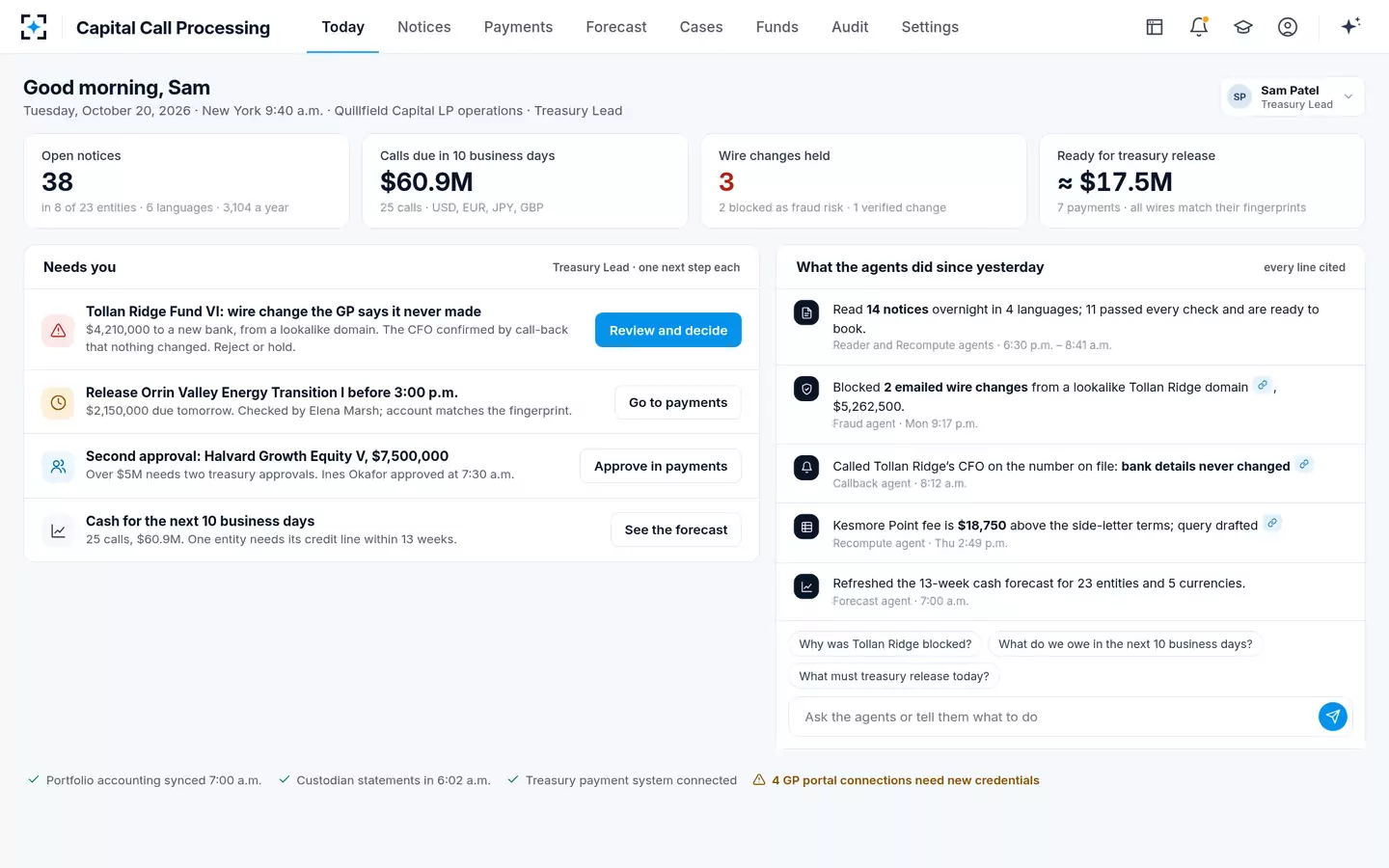
Portal connections need looking after. GP portals change their log-in rules and expire credentials, and a connection that silently stops is worse than none, because the tracker then looks complete when it is not. In the sample, the home screen's status line said it plainly on a Tuesday morning: portfolio accounting synced at 7:00 a.m., custodian statements in at 6:02 a.m., the treasury payment system connected, and four GP portal connections needing new credentials. A tracker should show that line every day.
The status line every tracker should show: what is connected, and what is not
When the tracker, the GP and portfolio accounting disagree
When the figures disagree, the notice is the place to settle it, before anything is booked. Every well-made notice prints the investor's commitment summary: commitment, called before, this call, called after. If the GP's figure for capital called before this notice differs from the LP's contributions to date, one side has missed or mis-booked something, and the next call will be calculated on the GP's number, not the LP's.
The sample's German notice shows the check working. Rheinau Infrastruktur Fonds III's Call 7 printed €21,500,000 called before, 43.00% of a €50,000,000 commitment, and €23,342,500 after this call, 46.69%; the solution's rebuild from portfolio accounting matched it to the cent, so the booking went ahead. Had it not matched, the difference would have become a query to the GP, with both figures and the notices behind them, instead of a reconciling item found at year-end.
What is a capital call journal entry, and where does it post?
A capital call journal entry records the call as contributions to the fund, split by purpose, against a payable that the payment later clears. In the sample, the Tollan Ridge Partners Fund VI Call 12 for $4,210,000 was proposed as three debits to the investment in the fund, $3,900,000 for investments, $262,500 for the management fee and $47,500 for partnership expenses, and one credit of $4,210,000 to capital calls payable; when treasury pays, the payable is cleared against cash.
One booking, two destinations, and a checker who is not the maker
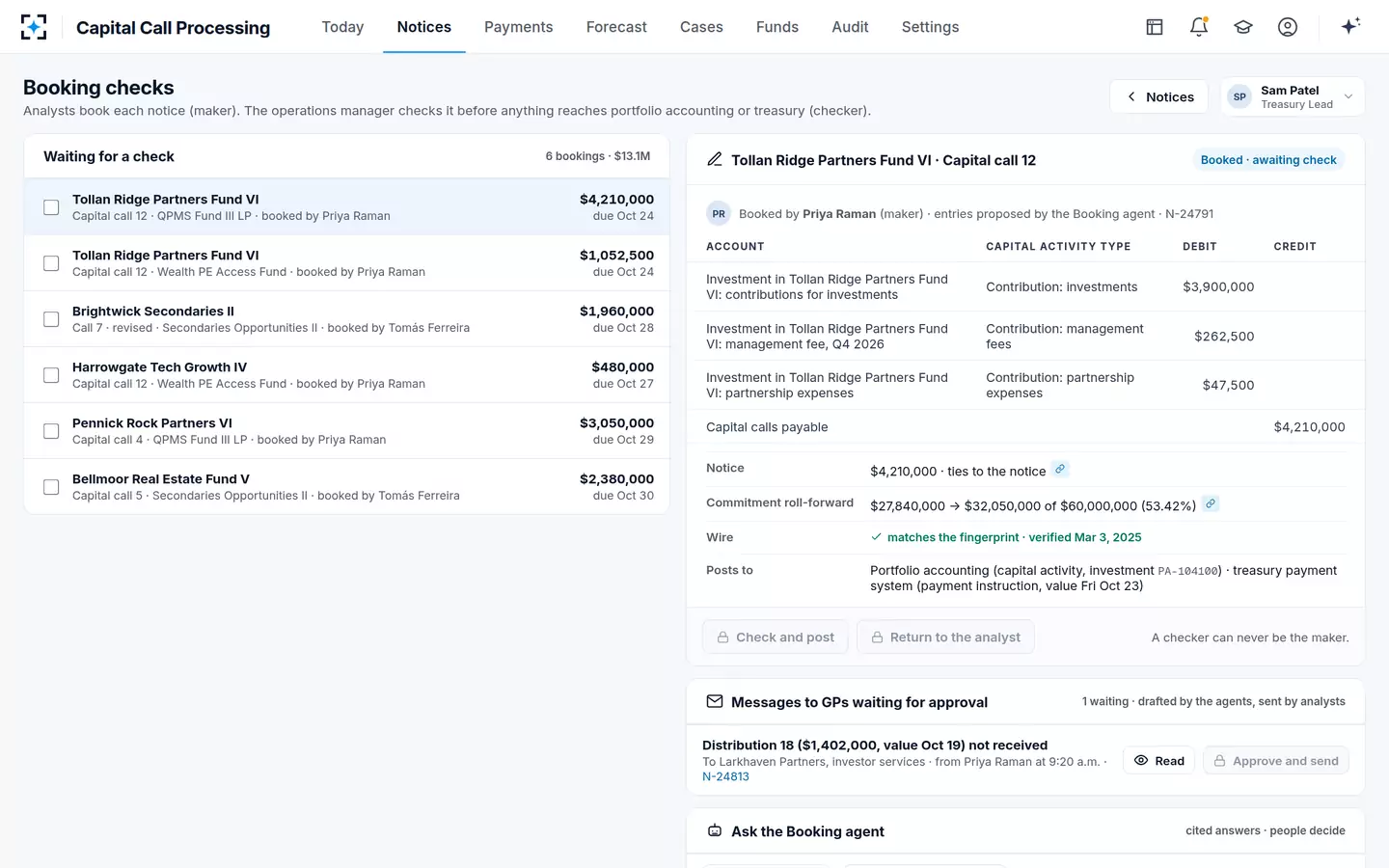
The split by purpose is not optional. Contributions for investments raise the cost of the fund interest; fees and expenses are contributions too, but they buy nothing, and an LP's performance and its checks of the GP's fee all depend on keeping them apart. A tracker that records only the total cannot answer either question.
Read everywhere, write in two places: who approves each write
The integration rule is simple: the tracker may read anything it needs, and may write to a system of record only what a named person has approved. That keeps the LP's controls where its auditors expect them, in portfolio accounting and the treasury system, and makes the tracker a place where work is prepared rather than a place where money moves.
What the tracker writes, where, and who has to approve it first
| Write | Goes to | Approved by | Never |
|---|---|---|---|
| Capital activity entries | Portfolio accounting | Analyst books, operations manager checks | Posted by the person who booked it |
| Payment instruction | Treasury payment system | Treasury release; two approvers over $5,000,000 in the sample | To bank details that differ from those verified |
| Change to a fund's verified bank details | The verified details used for every later check | Two call-backs, then the operations manager and the financial crime officer | Approved by the person who requested it |
| Query or letter to a GP | The GP's investor channel | Operations manager approves; an analyst sends | Sent by an agent |
| Fraud case, domain block, law enforcement complaint | Case system, mail gateway, IC3 | Financial crime officer | Filed by an agent |
The bank-details row is the one to insist on, whatever tracker you choose. FinCEN suggests organisations examine how they "communicate information and changes about transactions" (FIN-2019-A005), and a tracker that lets an analyst overwrite a fund's bank account from a notice turns a fraud attempt into a routine edit.
Treasury: payment instructions out, confirmations back
The treasury link carries two things: approved payment instructions out, and confirmations back. Payments are grouped by release date against the bank's wire cut-off, 3:00 p.m. Eastern in the sample, and released one business day before each due date, with holiday calendars for the US, the euro area's TARGET2, the UK, Singapore and Japan.
The custodian link closes the loop for distributions. Cash statements arrive as ISO 20022 camt.053 or SWIFT MT940 files, and each distribution is matched to its credit on the value date; one that does not arrive becomes a query to the GP, not a booking. A distribution notice, annotated shows what is matched and why.
What is a capital call schedule?
A capital call schedule is a forward view of the calls an LP expects: the confirmed calls from notices already received, by due date, and projected calls for funds that have not yet sent them. The confirmed part comes straight from the tracker; the projected part needs a model of how fast each fund calls.
Fund age is the best single input. Robinson and Sensoy found that cash flows vary mostly for reasons particular to each fund, and that the part you can predict is mostly explained by how old the fund is (Journal of Financial Economics, 2016). In the sample, the forecast showed $70.6 million of confirmed calls from open notices and $79.3 million projected over 13 weeks, paced from fund age, unfunded commitment and each GP's history; unfunded commitments and the cost of cash that waits goes deeper.
Go-live: what you bring, and the one step you cannot skip
A tracker that checks notices needs the documents and details it checks them against. The work at go-live is mostly gathering what the LP already has, and one step that cannot be shortcut: verifying each fund's bank and contact details independently of any notice.
Going live with a capital call tracker: what the LP brings
- Partnership agreements, side letters and subscription agreements
The terms each call is recomputed against, including fee bases and the dates they change.
- Verified bank and contact details for every fund
Built from the signed subscription documents and confirmed by call-back; the step that cannot be skipped.
- A sample of past notices
Calls and distributions from your own GPs, in their layouts and languages, to test reading and recomputing before go-live.
- Portal credentials, mailbox access and administrator file feeds
Every channel notices arrive through, with an owner for each.
- Commitments and contributions from portfolio accounting
The starting balances, reconciled with the GPs' registers.
- Your thresholds and roles
Approval limits, call-back triggers, holiday calendars, who books, who checks, who releases.
The verification step is where most of the protection comes from, and also where an LP is most tempted to cut corners, by importing bank details from last quarter's notices. That simply copies whatever was in them, including any change a fraudster slipped in. Luxembourg's financial intelligence unit makes the same point: verified contacts and authorised signers are the control, not whatever last quarter's file happens to hold (CRF Trend alert #2).
Go-live in four steps, before the first live notice
A person decides
GatherDocuments, balances, channels and settings from the systems and files the LP already has.
Agent
Read and proposeAgents read the documents and past notices and propose each fund's terms and the details found in them.
Never: treats details found in a notice as verified
A person decides
VerifyCall-backs on numbers from the signed subscription documents confirm each fund's bank and contacts.
A person decides
Replay and approvePast notices and planted fakes are run through; the operations manager approves the rules before live use.
What to ask before you buy a capital call tracker
Ask how it gets notices in, how it writes out, and what it refuses to do. On the way in: which channels it reads, how it tells a revised notice from a new one, and what it does with a value it cannot read. On the way out: which systems it writes to, in what format, and who approves each write. And on refusal: whether it can pay to bank details that differ from those verified, and who can override that.
Then ask to see it on your own notices, including a few planted fakes; testing capital call wire checks with planted fakes describes how. A tracker that only lists notices will pass an integration test and fail a fraud test.
What Capital Call Processing replaces, and what it leaves in place
Capital Call Processing sits between the channels notices arrive through and the LP's systems of record. It replaces the re-keying, the spreadsheet tracker and the hand comparison of bank details; it does not replace portfolio accounting, the treasury payment system, the custodian, the GP's portal or the fund administrator. It reads from all of them and writes to two, only after people approve.
It also keeps evidence those systems do not: every read, check, call, decision and payment, with the person or the agent's version, the reason code and a hash chaining it to the last, exportable for auditors, regulators and fund boards. Data stays in each entity's region, account numbers are masked, and records are kept for seven years. To see the tracker beside the systems it feeds, start from Capital Call Processing.
Questions people ask
How do LPs track capital calls?
With a list of every notice by fund and entity, its amount, due date, status and owner, and each commitment's contributions and unfunded balance, reconciled with the GP's figures. The list can be a spreadsheet or software; what matters is that it is fed from the notices and agrees with portfolio accounting.
Is a capital call tracker the same as fund accounting software?
No. Fund accounting software is the GP's or administrator's book of the fund. An LP's capital call tracker works on the investor's side, checking incoming notices and feeding the LP's own portfolio accounting and treasury.
Can a capital call tracker work with our fund administrator?
On the LP side, the tracker reads the notices administrators send, by email or as files over SFTP, alongside the GP portals. It does not connect into the administrator's own systems, and it does not need to.
Does it handle several currencies and countries?
It should. In the sample, calls were due in US dollars, euros, sterling and yen across 23 entities, with release dates set by the US, TARGET2, UK, Singapore and Japan holiday calendars.
What is capital call management software?
It is software that collects, checks, books and tracks capital calls and distributions for investors. The difference between products is less in the list they show than in the checks they run before a payment, and in what they refuse to do without a person.
Can a capital call tracker be built in Excel?
A list can. What a spreadsheet cannot do on its own is read hundreds of layouts, rebuild each amount from the fund terms, or stop a payment to bank details that changed, which is where the risk sits.