Capital call processing is the limited partner's work of taking each capital call notice from the moment it lands to a booked, checked and paid transaction: read it, rebuild the amount, verify the bank details, book it, have someone else check the booking, and release the payment before the due date. It can be automated in part: software can read, recompute, compare and even make the call-back, while people book, approve and pay. The trace below follows a fake notice that reached an LP's mailbox at 9:14 on a Monday night, and the genuine call it imitated, through Botminds' Capital Call Processing, with every timestamp taken from the sample, so you can see where each agent stops and which decisions stay with people.
Everything in the trace is fictional sample data: Quillfield Capital, an LP with 412 commitments to 168 GPs through 23 investing entities, and Tollan Ridge Partners Fund VI's Call 12 for $4,210,000, as they run through the solution.
Nothing is paid to these details until a call-back on the number on file confirms them and two people approve.
Capital Call Processing, the wire check on the sample notice
How is a capital call processed? Six steps, two kinds of owner
A capital call is processed in six steps: reading, recomputing, wire verification, call-back, booking with a second check, and release. In Capital Call Processing the first four are done by agents and checked by people; the last two are done by people, and no agent can do them.
Capital Call Processing, step by step: who does each, and what each never does
| Step | Done by | What it does | What it never does |
|---|---|---|---|
| Read | Reader agent | Every notice from GP portals, the mailbox and administrators' files: GP, fund, investor, amount, due date, purpose breakdown and wire block, each value cited to its page; finds duplicates and revised notices. | Never fills a missing value; marks it unreadable for an analyst. |
| Recompute | Recompute agent | Rebuilds the amount from the commitment, contributions, call percentage, fee terms and side letters; moves weekend due dates. | Never recommends short-paying a call. |
| Verify the wire | Fraud agent | Holds twelve fields of the wire and its sender against those verified for the fund; blocks any change. | Never unblocks a payment; never uses contacts from a notice. |
| Call back | Callback agent | Calls a contact from the subscription documents or the GP contact record, records and transcribes the answer. | Never approves a change; a person reviews every call. |
| Book and check | Analyst, then operations manager | The analyst books the entries the Booking agent proposed; the manager checks and posts. | A checker is never the maker. |
| Release | Treasury | Releases to verified details before the cut-off, with two approvers above a threshold. | Treasury never edits a booking or a wire. |
The right-hand column is the one to read when you evaluate any capital call software. A tool that can release a payment, accept a bank change or fill in a value it could not read has moved a decision from a person to a model, and the decision it moved is usually the one an auditor will ask about.
9:14 p.m.: the email arrives, and is blocked three minutes later
The fake arrived at 9:14 p.m. on Monday, October 19, in the LP operations mailbox: "updated wire instructions" for Tollan Ridge Partners Fund VI, Call 12, for the Quillfield Private Markets Solutions Fund III entity. At 9:17 p.m. the Fraud agent blocked it, having compared twelve fields of the wire and its sender with the details verified on March 3, 2025 by call-back and used for eleven payments since.
Eight of the twelve differed: five of eight payment details, including a new bank, Harborline National Bank in Wilmington, and an account the bank directory showed was opened on September 28, 2026; and three of four sender details, including a domain with one added hyphen, registered on October 10 through a privacy service, with no DMARC policy, and a channel the GP had never used for this fund. The amount, on the other hand, was right: the Recompute agent rebuilt $4,210,000 from the $60,000,000 commitment and the 1.75% fee in the agreement's section 8.1.
That combination, right amount and wrong bank, is the signature the CRF describes. Fraudsters' documents "often contain accurate and credible information about the targeted investments" (CRF Trend alert #2), so an amount check alone passes them.
From email to signed rejection: three minutes of agents, a night of waiting, two minutes of decision
- Read, rebuilt and compared: blocked 9:17 p.m.3 min
- Held overnight: nothing payable10 h 55 min
- Call-back to the CFO on file, 8:12 a.m.2 min 41 s
- Look-across and case drafted, waiting for treasury1 h 25 min
- Treasury reviews and rejects, 9:42 a.m.2 min
Overnight and at 8:15 a.m.: what the agents did, and what they did not
The agents widened the search but decided nothing. The same email had reached a second Quillfield entity, the Wealth PE Access Fund, for $1,052,500, and the Fraud agent held that copy at 9:17 p.m. as well: two blocked wire changes, $5,262,500 together. At 8:15 the next morning the Case agent reported its look-across of every entity and the mailbox, including a find in an analyst's inbox: on October 15 the same domain had asked her who approves payments.
No payment could be selected for release while the notices were held, and no agent could change that. The genuine Call 12, posted on the GP's portal on the previous Friday as notice N-24791, stayed booked and on course to be paid; the fake was held as a separate notice, N-24817, beside it, because telling new notices from duplicates and revisions is part of the Reader agent's job.
8:12 a.m.: the call-back on the number on file
At 8:12 a.m. on Tuesday the Callback agent called the GP's CFO on the number in Schedule B of the subscription agreement, re-confirmed in March 2025, never the different number printed in the email. It said the call was recorded, asked three open questions without reading out the emailed details, and recorded a 2 minute 41 second call in which the CFO said the fund had not changed banks and that the GP never sends wire changes by email.
The agent's conclusion was clear, and it still did not act on it. A call-back is evidence for a person: the recording and transcript sit on the notice's call-back tab, a second contact is available if the rules require one, and the decision waits for treasury. The CRF's advice for the sector is to confirm the client's named contact and the people authorised to validate and sign payments (CRF Trend alert #2), as the LP desk's day sets out; the agent does the calling, and people do the confirming.
9:42 a.m.: the decision belongs to treasury
The treasury lead signed in at 9:38 a.m., found the item first under what needed him, asked the agents in plain words why the domain was suspicious, read the answer with its sources at 9:41, and at 9:42 rejected both payments with reason code RJ-02, "Call-back says the notice is not genuine". In the same step he opened fraud case FC-2026-031 for the financial crime officer and put the domain on the watch list.
Reject the payment and open the case: one signed step
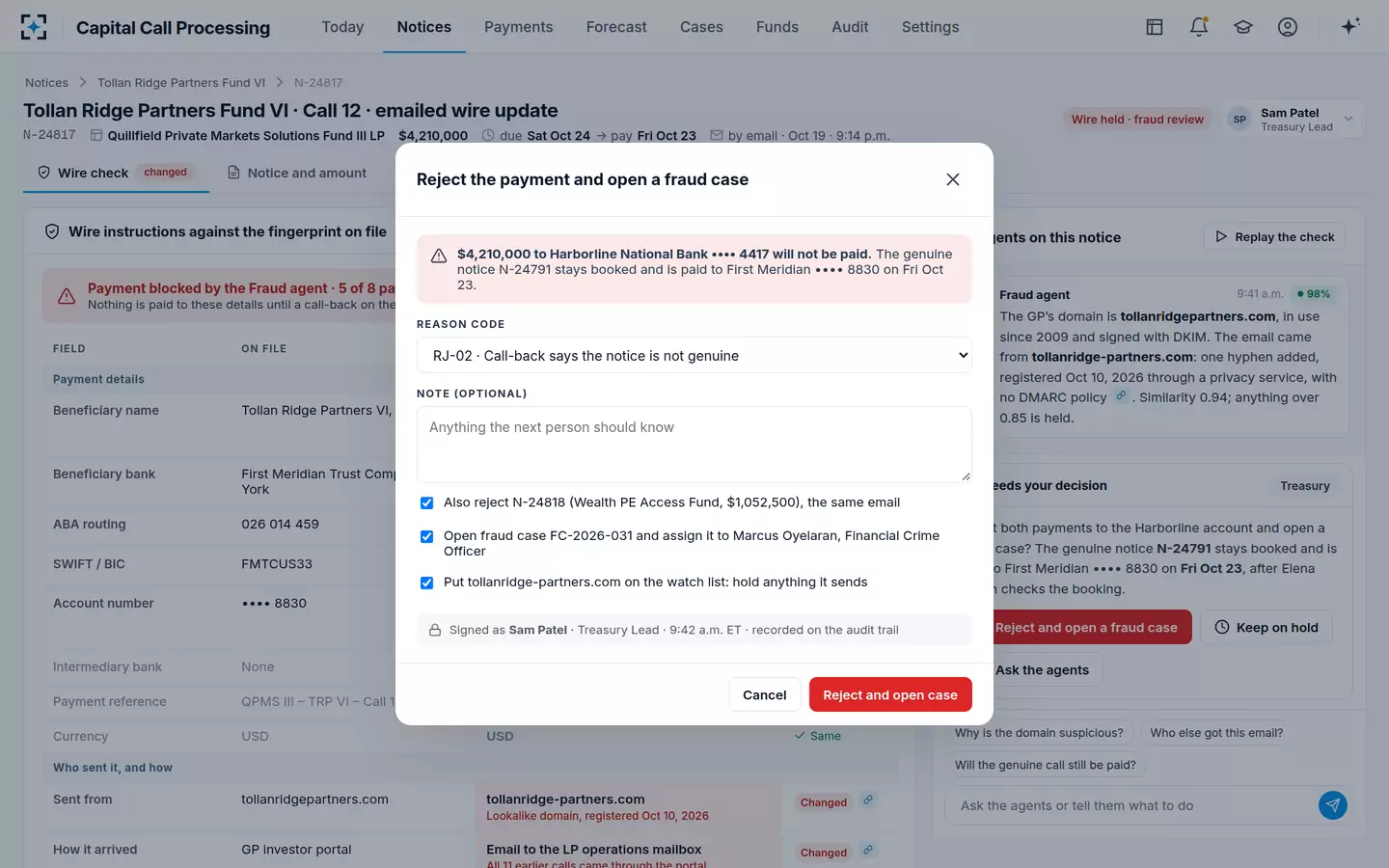
What happened next was drafting, not acting. The Case agent drafted a letter to the GP, a request to block the domain at the mail gateway, a complaint to the FBI's IC3 and a notice to the receiving bank's fraud desk; the financial crime officer opens and approves each, and decides on any regulatory reporting himself. Closing the case needs his sign-off and the operations manager's.
The genuine call: booked by one person, checked by another
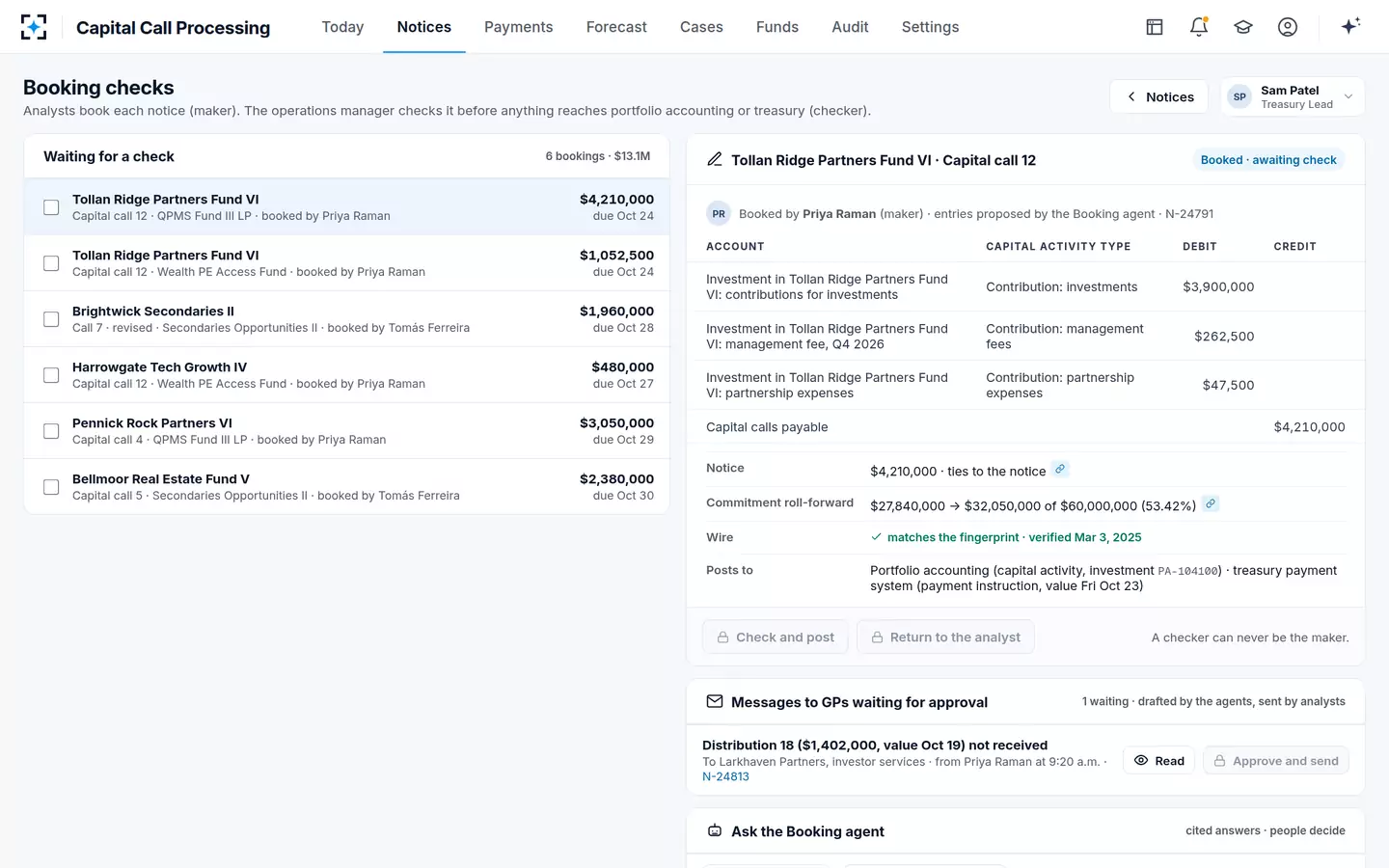
The genuine Call 12 had passed every check after it was posted on Friday. An analyst booked it on Monday, October 19, from the entries the Booking agent proposed, and it then waited for the operations manager, because nothing reaches portfolio accounting or treasury until someone who did not book it checks it.
The genuine call as entries, with the commitment roll-forward and the bank-detail match
Paid before the cut-off, to verified details only
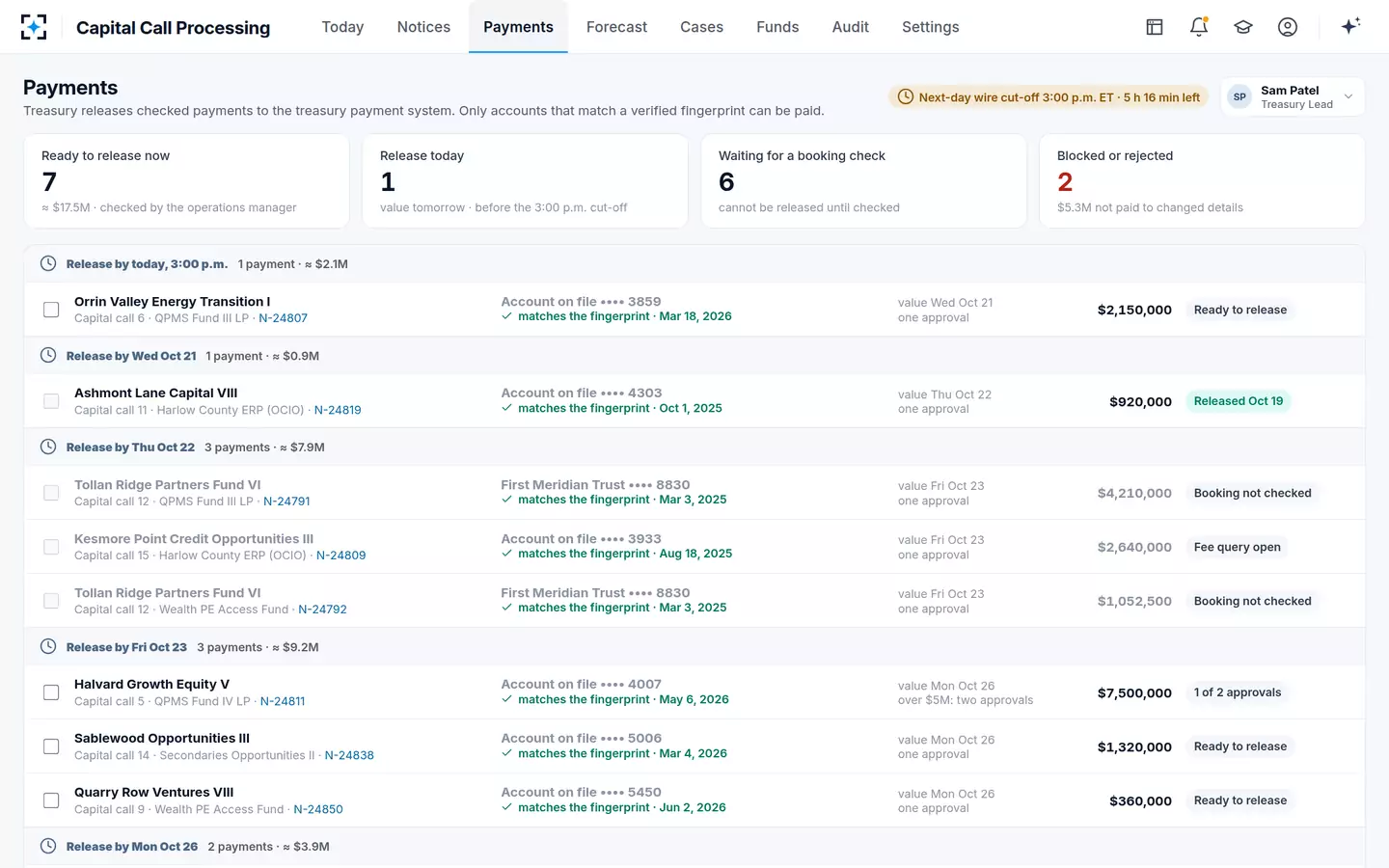
Treasury sees payments grouped by release date against the wire cut-off, and can select only those whose bank details match the verified ones. In the sample, the genuine Tollan Ridge call sat in Thursday's group as "Booking not checked" until the manager signed, for value Friday, October 23, a day before its Saturday due date.
The payment queue: verified bank details only, released by date against the cut-off
Every step above, from the Reader agent's first read to the treasury lead's signature, is on the audit trail with who did it, the evidence, the reason code and the agent's version, chained so that entries cannot be altered afterwards. Internal audit can export the evidence for a case, an entity or a quarter.
The other trace: a bank change that was genuine
A genuine bank change goes through the same steps and comes out the other side, more slowly and with more signatures. In the same week, Meridale Ventures IX sent Capital Call 4 for $1,050,000 with new bank details: the GP had moved its fund's bank after changing administrators. The Fraud agent blocked it exactly as it blocked the fake, because a changed detail blocks payment whatever the reason.
The difference came from the call-backs. The Callback agent called on Monday afternoon, at 2:10 and again at 3:02 p.m., and the GP's COO, reached on the number on file, confirmed the change, and the notice moved to "Wire change · needs approval" rather than to a fraud case. Under the sample rules, which are locked, a genuine change of a fund's verified details needs two call-backs to contacts on file and two approvers, the operations manager and the financial crime officer, neither of them the person who requested it. Only then do the new details become the ones future notices are compared with.
That symmetry is the design. The tool does not try to tell a fraudulent change from a genuine one by how the email reads; it treats every change the same way until people, using evidence from calls they did not dial from the notice, decide which it is.
Can capital call processing be automated?
The reading, arithmetic, comparison and call-back can be automated; the decisions should not be. The parts that are mechanical, collecting notices, keying values, rebuilding amounts from the terms, comparing bank details with verified ones and placing a scripted call to a number on file, are where the hours go and where software is consistent. The parts that carry liability, booking, approving a bank change, releasing a payment and deciding that a notice is fraud, are where an organisation needs a named person.
FinCEN's advice on email compromise separates the same three jobs: confirming who you are dealing with, authorising the payment, and handling changes to payment details (FIN-2019-A005). Agents can do most of the confirming legwork; authorising stays with people. And automation has to assume the fakes are well written, since the FBI now reports AI-written business email compromise among its complaints (IC3 2025 report), so the checks compare with verified details rather than judging prose.
What to look for when you evaluate capital call processing software
Ask for a trace like this one on your own notices, with timestamps, before you buy. A vendor demonstration on its own data shows the screens; a trace on yours shows whether the tool reads your GPs' layouts and languages, rebuilds your fee terms and side letters, and stops the fakes you plant.
Look for five properties. Every value cited to its page, and unreadable values marked rather than guessed. Every difference in the amount tied to a clause. Bank changes that block payment, not just flag it, with unblocking that needs people who did not request the change. Call-backs only to numbers on file, recorded. And an audit trail that shows, for any payment, what was compared and who decided. Testing capital call wire checks with planted fakes describes the test to run, and a capital call tracker that works with your systems covers the integration questions.
Be equally clear on what such software does not do. Capital Call Processing does not replace portfolio accounting or the treasury payment system; it reads from them and writes checked entries to them. It does not fix GP portal access: in the sample, four portal connections needed new credentials that morning. And its quality rests on the verified details it starts with, built at go-live from signed subscription documents and confirmed by call-back. Before a new prompt or model is used, it is run against a set of 640 notices and 214 fraud tests and approved by the operations manager; that is a design target, and your own trace is the evidence that counts. To start one, go to Capital Call Processing.
Questions people ask
How fast can a capital call be processed?
The mechanical part takes minutes: in the sample, the fake notice was read, rebuilt, compared and blocked three minutes after it arrived. The elapsed time is set by the people steps and the calendar; Botminds estimates about one and a quarter business days per notice with the solution against five and a half by hand, an estimate rather than a measured result.
Who books a capital call?
An LP operations analyst books it, usually from proposed entries, and a second person, typically the private markets operations manager, checks and posts it. Treasury then releases the payment; it never edits the booking or the bank details.
What does capital call software do?
It collects notices from portals, mailboxes and administrators, reads their values, rebuilds the amount from the fund terms, compares the bank and sender details with those verified, and proposes entries and payment instructions. Some also make call-backs, keep a cash forecast and build fraud cases; the decisions should stay with people.
Can it read notices in other languages?
Capital Call Processing reads notices in their original language and shows the original beside the English values, each tied to its page. In the sample, notices arrive in English, German, French, Japanese, Swedish and Spanish.
What happens when the software cannot read a value?
It should say so rather than guess. In the sample, a faint scan's due date could not be read with confidence, so the agents marked it unreadable and handed the notice to an analyst instead of filling in a plausible date.
Does the GP have to change anything?
No. The solution reads each GP's notices in the layout and channel the GP already uses. What it needs from the GP side is a verified set of bank and contact details for each fund, built from the subscription documents and confirmed by call-back at go-live.