A capital call is the GP asking a limited partner for part of its commitment; a distribution is the fund paying money back. The difference that matters to an LP's books is what each does to the unfunded commitment: a call reduces it, an ordinary distribution leaves it unchanged, and a recallable distribution increases it, because the GP may call that money again under the partnership agreement. An LP that books recallable money as final understates what the GP can still call and overstates its own spare cash. Botminds' Capital Call Processing splits each distribution into return of capital, gain and recallable amounts, and keeps every commitment's recallable balance and unfunded figure current from the notices themselves.
The worked loop below uses an illustrative fund with round numbers of our own; the screen comes from fictional sample data, Quillfield Capital, an LP with 412 commitments to 168 GPs, as its notices run through the solution.
Capital call vs distribution: two directions of cash, and what each changes
Capital call: From the LP to the fund, by wire to the fund's account.
Distribution: From the fund to the LP, to the account the GP holds for it.
Capital call: The GP needs cash for an investment, fees or expenses.
Distribution: A sale, income, or capital called and not used.
Capital call: Falls by the amount called.
Distribution: Unchanged, unless part is recallable; then it rises by that part.
Capital call: Mostly early: 56.8% of commitments called by year 3 in one large study.
Distribution: Mostly later: only 12.9% of commitments distributed by year 3 in the same study.
Capital call: Rises with public equity valuations.
Distribution: Rises with valuations too, and more sharply than calls.
Capital call: A contribution to the partnership.
Distribution: Reduces the partner's basis by the money distributed (§733).
Capital call: A fake notice asking the LP to pay a new account.
Distribution: A forged request asking the GP to pay the LP's money somewhere new.
What is the difference between a capital call and a distribution?
A capital call moves money into the fund and a distribution moves money out; one draws down the investor's commitment, the other returns capital and profit. Both arrive as notices from the GP, both are booked as capital activity in the LP's portfolio accounting, and both change the investor's running totals: contributed, distributed and unfunded.
They arrive at different points in a fund's life. In Ljungqvist and Richardson's data, the average fund had called 56.8% of commitments by the end of year 3, while less than a fifth of invested capital had come back by then (NBER Working Paper 9454; the figures are set out in the annotated distribution notice). Early on, an LP's desk sees mostly calls; later, mostly distributions; in the middle, both, sometimes in one notice.
They also respond differently to markets. Robinson and Sensoy found that both flows rise with public equity values, but distributions swing harder than calls (Journal of Financial Economics, 2016). In a weak market, calls continue while distributions dry up, which is why the recallable part of past distributions, money the investor may have to send back, matters for cash planning.
What each one does to the unfunded commitment
A call reduces the unfunded commitment by the amount called; a final distribution does not touch it; a recallable distribution adds its recallable amount back. The commitment itself never changes because of either: it is the ceiling, and calls and recalls draw against it.
The rule sounds simple and is easy to break, because the recallable part is a line inside a distribution notice, not a separate event. A distribution of $1,500,000 with $1,000,000 marked recallable is one wire and one notice. Booked as one amount, it looks like $1,500,000 of money that is gone from the fund's reach, when $1,000,000 of it is still callable.
What is a recallable distribution?
A recallable distribution is money paid to investors that the partnership agreement allows the GP to call again, typically within a set period and up to a set limit. It usually arises when the fund returns capital soon after calling it, or when it sells an investment early in its investment period and the agreement lets it reinvest the proceeds.
Whether a particular distribution can be recalled, and for how long, is a question of the fund's terms: the recycling or reinvestment clause, its cap and its deadline. Which distributions can be recycled under an LPA takes that question from the GP's and the agreement's side; this page takes the LP's bookkeeping side.
The recallable loop, worked through
Follow one commitment through two calls, a recallable distribution and a recall, and the effect on the unfunded figure is plain. The figures are illustrative, our numbers, on a $10,000,000 commitment.
One $10,000,000 commitment through two calls, a recallable distribution and a recall
Commitment signed
Contributed$0
Recallable distributed$0
Unfunded$10,000,000
Call 1: an investment and fees
Call $3,000,000
Contributed$3,000,000
Recallable distributed$0
Unfunded$7,000,000
Call 2: a second investment
Call $2,000,000
Contributed$5,000,000
Recallable distributed$0
Unfunded$5,000,000
Distribution: part of Call 2's company sold
$1,500,000, of which $1,000,000 recallable
Contributed$5,000,000
Recallable distributed$1,000,000
Unfunded$6,000,000
Call 3: the recalled money reinvested
Call $1,000,000 against the recallable amount
Contributed$6,000,000
Recallable distributed$1,000,000
Unfunded$5,000,000
Two things in the loop surprise people. The distribution raised the unfunded figure, from $5,000,000 to $6,000,000, although the investor received cash. And the recall, Call 3, is a contribution like any other: it counts toward the investor's total contributed, which by the end is $6,000,000, even though $1,000,000 of it came back and went out again.
The later the cash outflows, and the sooner the cash inflows, the better is a fund's performance.
Ljungqvist and Richardson, NBER Working Paper 9454
That sentence explains why GPs like recallable distributions and why LPs should track them. Returning capital early and calling it later improves the fund's timing, and with it measures such as its internal rate of return. For the investor, it means the cash returned is not entirely spare: part of it is a loan of the investor's own money back to itself, repayable on call.
What happens when recallable money is booked as final
Booked as final, a recallable distribution makes the investor's unfunded commitment too low by the recallable amount, and everything built on that figure inherits the error: the cash forecast, the commitment pacing plan and the next call's check.
The same commitment's unfunded figure, booked right and booked as final
The worst moment is the recall itself. To an LP whose books say $5,000,000 remains and whose forecast never expected a call for money already returned, a call against the recallable balance can look like an error or even a fake. Querying it is fine; withholding it is a default under the agreement, with remedies that can reach the whole interest. What happens if you miss a capital call sets those out. The fix is upstream: book the recallable part when the distribution arrives.
Recallable distribution vs return of capital: not the same thing
Return of capital describes what a distribution is; recallable describes what the GP may do with it later. A recallable amount is normally returned capital, since recycling clauses are written around money the fund called and gives back; but returned capital is recallable only if, and only while, the clause allows it. Once the window has closed, capital returned is final.
The distinction matters in the books. A final return of capital lowers the cost of the investment and leaves the unfunded commitment alone; a recallable one lowers the cost and also adds to the recallable balance. A distribution notice that says only "return of capital" without saying whether any of it is recallable is incomplete, and the right response is a query, not an assumption. A distribution notice, annotated shows where that line sits.
How do you track recallable capital?
Track recallable capital as its own balance on each commitment: every recallable amount distributed, with the clause it was made under, its cap and its expiry, less every amount since recalled. Reconcile that balance with the figure the GP prints on each notice, because the GP's figure is the one the next call is calculated from.
Three events change the balance: a distribution marked recallable adds to it, a call made against it reduces it, and the end of the recall period removes whatever is left. The third is the one that is easily missed, because nothing arrives to mark it; the date sits in the agreement. A tracker that holds the expiry date will drop the balance on time; one that does not will overstate the unfunded figure for years.
What is a net capital call?
A net capital call is a notice that sets a distribution against a call due at the same time, so that the investor pays or receives only the difference. It saves two wires and creates one bookkeeping trap: booked net, both the contributions and the distributions to date are understated, and so is any recallable amount inside the distribution.
Booking a net notice: both legs gross, the cash net
| Line | Amount | Booked as |
|---|---|---|
| Capital call for an investment and fees | $2,000,000 | Contribution, by purpose; unfunded falls by $2,000,000 |
| Distribution from a sale | $1,500,000 | Return of capital $1,000,000 recallable and $500,000 gain; unfunded rises by $1,000,000 |
| Net amount the investor wires | $500,000 | Cash movement only; matches the treasury payment |
| Effect on unfunded | −$1,000,000 | Down $2,000,000 for the call, up $1,000,000 for the recallable part |
The fraud angle applies to net notices too. A netted notice still carries bank details for the net payment, and fraudsters copy genuine notices: Luxembourg's financial intelligence unit describes scams using "fake capital call or drawdown notices" whose documents contain accurate information about the investments (CRF Trend alert #2). The bank details are checked against those verified, whatever the notice nets.
What is a drawdown notice?
A drawdown notice is another name for a capital call notice: the GP draws down part of the investor's commitment. The two terms are used interchangeably; Luxembourg's financial intelligence unit, for one, writes of "fake capital call or drawdown notices". The content, the checks and the bookkeeping are the same. Robinson and Sensoy's phrase "capital calls" and Ljungqvist and Richardson's "draw downs" describe the same cash flow.
The tax treatment of the two directions also differs. Under section 733, cash from a distribution that does not liquidate the interest lowers the partner's adjusted basis, though never below zero (26 U.S.C. §733), while a later recall is a new contribution. An LP's tax team works from the K-1, but it needs the operations team to have booked both legs, with their characters, so the two views can be reconciled.
How Capital Call Processing keeps calls, distributions and recalls straight
Capital Call Processing reads calls and distributions with the same agents and books them with the same people. For a distribution, the Reader agent splits the notice into return of capital, gain and recallable amounts and cites each to its page; the Booking agent proposes entries by capital activity type and matches the cash to the custodian statement on the value date; the analyst books and the operations manager checks. Each commitment's contributed, distributed and recallable totals roll forward on every booking.
Calls and distributions by week, with the recallable balance inside the projection
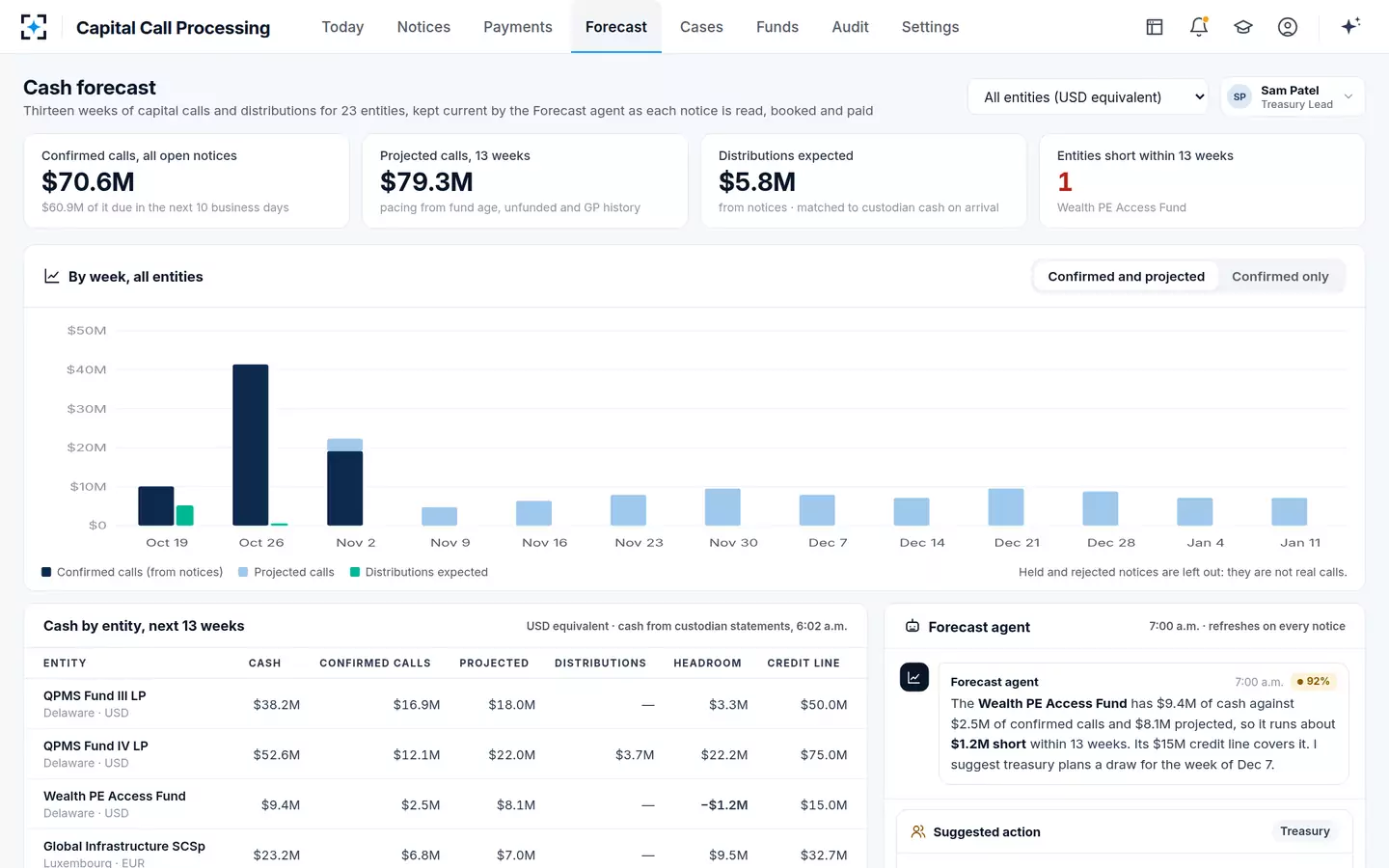
Recall clauses, caps and expiries come from the fund documents the solution reads, and a call made against a recallable balance is recomputed against it like any other. What it does not do is decide whether a distribution should be recallable; that is the GP's call under the agreement, and a question for the investor's counsel if it looks wrong. To see a distribution split and matched, start from Capital Call Processing.
Questions people ask
Does a distribution reduce my capital commitment?
No. The commitment is fixed; a distribution changes what has been returned. Only a recallable distribution changes what can still be called, and it increases it.
Is a recalled distribution counted as a contribution?
Yes. When the GP calls a recallable amount back, the investor contributes it like any other call, so it adds to contributions to date and reduces the recallable balance and the unfunded commitment.
What is the difference between a capital call and a capital contribution?
The call is the GP's demand; the contribution is the investor's payment in response. Once paid and booked, a call becomes a contribution, and the two words are often used for the same amount.
What is the difference between a capital call and a margin call?
A capital call is a contractual instalment of a commitment, made when the fund needs cash. A margin call is a demand for more collateral on a borrowed position because its value has fallen. One is planned in the agreement; the other is triggered by prices.
Can a GP recall a distribution after the investment period?
Only if the agreement allows it. An agreement that permits recycling or recalls sets their limits, typically a period and a cap, and once that window closes, capital returned is final; check the clause and its expiry date for each fund.
Why does my unfunded commitment go up after a distribution?
Because part of the distribution was recallable. The GP returned that money but may call it again, so it is added back to what remains callable until it is recalled or the recall period ends.