A distribution notice is the GP's statement of cash a fund is paying to an investor: how much, on which value date, from which investment, and how the amount divides between return of capital, gain and any part the GP may recall under the partnership agreement. For the limited partner it is not good news to file but an entry to split, because each part changes something different: the cost of the investment, the reported profit, the tax basis and, for a recallable amount, how much the GP can still call. Botminds' Capital Call Processing reads every distribution notice, splits it into return of capital, gain and recallable amounts and matches the cash to the custodian statement on the value date, and an analyst books it.
The annotated notice below is illustrative, with round numbers of our own. The screens come from fictional sample data: Quillfield Capital, an LP with 412 commitments to 168 GPs, as its notices run through the solution.
One $1,000,000 distribution, three different things
What the wire says
- One payment, $1,000,000 · 100%
What the notice says
- Return of capital $400,000 · 40%
- Recallable $150,000 · 15%
- Gain $450,000 · 45%
What is a distribution notice? The GP's account of money going out
A distribution notice tells each limited partner what it is being paid and why: the gross amount, its character, any amount withheld, the value date and the investor's running totals. The cash comes from a realisation, such as the sale of a portfolio company, from income such as interest or dividends, or from capital the fund called and did not use.
Delaware's statute leaves the timing to the deal. Under 6 Del. C. §17-601 a partner receives interim distributions at the times or on the events the partnership agreement specifies, and the agreement's waterfall decides how a realisation is shared between the investors and the GP (6 Del. C. chapter 17, subchapter VI). The notice is where that calculation reaches the LP, usually as one page per investing entity with the fund totals beside it.
Distributions come late in a fund's life. In one large US investor's records, by the end of year 3 "only 16.6 percent and 12.9 percent of total invested capital and total committed capital have been distributed", and "it takes a little under seven years for total invested capital to be returned in the average fund" (Ljungqvist and Richardson, NBER Working Paper 9454). They also move with markets: Robinson and Sensoy found that distributions are more sensitive to public equity valuations than calls are (Journal of Financial Economics, 2016), so the flow an LP plans on can thin out in exactly the year it needs it.
A distribution notice, annotated line by line
Every distribution notice answers the same nine questions, whatever its layout. The annotation says what each line is for and what the LP does with it.
Nine lines of a distribution notice, and what each one asks of the LP
Notice
Distribution Notice No. 9 · dated 6 November · Fund IV, L.P.
The number ties a revised notice to the one it replaces. Book against the number, not the email.
Value date
12 November
The day the cash should be in your account. The custodian statement for that day is the proof.
Source
Sale of the fund's interest in a portfolio company
Tells you which investment is being returned, and so whose cost basis in your own records falls.
Return of capital
$400,000
Your cost coming back. Final: it does not restore anything you can be called for.
Return of capital, recallable
$150,000 · LPA clause on reinvestment
Also cost, but the GP may call it again. Your unfunded commitment rises by this amount.
Realised gain, net of carried interest
$450,000
Profit after the GP's share. The split came from the waterfall; the notice only reports it.
Total distributed
$1,000,000
Must equal 4 + 5 + 6 and the cash that arrives. Any difference is a query before booking.
Your commitment after this notice
Contributed, distributed to date, recallable balance, unfunded
The GP's register. Reconcile it to yours every time, not at year end.
Paid to
Your account on file, by reference
A distribution goes to an account the GP already holds for you. A notice that asks you to confirm or change it is a red flag.
Lines 4 to 7 are the ones to check arithmetically. The parts must add to the total, the total must equal the cash, and the cash must arrive on line 2's date. Line 8 is the one to check against your own records: if the GP's figure for your recallable balance differs from yours, one of you has booked an earlier notice wrongly, and the next capital call will be calculated on the GP's figure.
Line 6 is a report, not a calculation you can redo from the notice. The gain is what is left for the investors after the fund's waterfall has given the GP its carried interest, and checking that split needs the agreement and the fund's history; a worked private equity waterfall calculation shows how it is built.
What is return of capital in private equity?
Return of capital is the part of a distribution that gives back money the investor contributed, as opposed to profit on it. When a fund sells a company, the proceeds first repay the cost of that investment, and depending on the waterfall, fees and expenses; the rest is gain. The notice states the split as the GP's accounts see it.
For the LP, a return of capital lowers its cost in the fund and moves its distributed-to-paid-in multiple, but it does not reduce the commitment. Unless the agreement makes it recallable, capital returned is gone from the unfunded side for good: the investor's remaining obligation is still the commitment less what it has contributed, whatever has come back.
The search phrase "return of capital vs distribution" mixes two different levels. A distribution is the payment; return of capital is one character a distribution can have. A single notice often carries several characters at once, which is why it has to be split before it is booked.
What is a recallable distribution on a distribution notice?
A recallable distribution is cash paid to investors that the GP is allowed, under the agreement, to call again. It usually covers capital returned soon after it was called, or proceeds the fund may reinvest during its investment period, and the agreement limits how much and for how long.
Recallable money changes the LP's planning number. The unfunded commitment rises by the recallable amount, so an LP that books the whole distribution as final understates what it can still be asked to pay. Capital call versus distribution, and the recallable loop between them works through the arithmetic and the tracking; whether a given distribution may be recycled is a question of the fund's terms.
Is a private equity distribution taxable? Not the way the notice suggests
For a US investor in a partnership, the cash in a distribution is generally not what is taxed. The partner is taxed on its share of the partnership's income as allocated to it, and the distribution reduces its basis. Section 731 says that on a distribution "gain shall not be recognized to such partner, except to the extent that any money distributed exceeds the adjusted basis of such partner’s interest in the partnership immediately before the distribution" (26 U.S.C. §731).
Section 733 adds the other half: on a distribution that does not liquidate the interest, the partner's adjusted basis "shall be reduced (but not below zero) by— (1) the amount of any money distributed to such partner" (26 U.S.C. §733). So the line marked "gain" on the notice is the fund's accounting description of where the cash came from. The investor's taxable income arrives later, on its Schedule K-1, and that is the document to reconcile it with; the K-1 footnotes an LP tax team captures show where a distribution's timing and a gain's character are explained, and Botminds' K-1 Aggregation handles that side.
The practical point for operations is keeping both views. The capital activity booked from the notice drives the LP's performance and commitment figures; the tax basis is tracked from the K-1s. An LP that books a distribution only as "income" loses the return-of-capital line that both views need.
Distributions in kind: when the notice delivers shares, not cash
Some distributions arrive as securities, typically shares of a portfolio company after its listing, and the notice then states a number of shares and a value. Delaware's default protects the investor from being handed an unfair slice: a partner "has no right to demand and receive any distribution from a limited partnership in any form other than cash", and, unless the agreement says otherwise, may not be compelled to take more than its proportionate share of an asset in kind (6 Del. C. §17-605).
In-kind notices need two extra checks. The value used must be the one the agreement prescribes, often a price over a stated period rather than one day's close, because that value is what the waterfall and the investor's distributed totals use. And the shares must arrive at the custodian in the right account and quantity. For US tax purposes, section 731(c) generally counts marketable securities as money for the gain test, but with exceptions, including one, to the extent regulations provide, for property that was not a marketable security when the partnership acquired it, which describes most private equity holdings (26 U.S.C. §731(c)). The notice cannot settle which applies; the investor's tax adviser can.
How do you book a distribution notice?
Book a distribution notice by character, against the notice number, only after the cash or securities are matched on the value date. Each part goes to its own capital activity type, and the recallable balance and unfunded commitment are updated in the same entry, so that the next capital call is checked against the right figure.
Each part of a distribution is booked differently and moves a different number
| Part of the distribution | Booked as | Unfunded commitment | Partner's tax basis (US) |
|---|---|---|---|
| Return of capital, final | Reduction of the investment's cost | No change | Reduced by the cash (§733) |
| Return of capital, recallable | Reduction of cost, plus a recallable balance | Rises by the amount | Reduced by the cash; a later recall is a new contribution |
| Realised gain, net of carry | Realised gain on the investment | No change | Reduced by the cash; income comes through the K-1 allocation |
| Income (interest, dividends) | Investment income | No change | Reduced by the cash; income comes through the K-1 |
| Securities in kind | Securities received at the agreement's value | No change unless recallable | Marketable securities generally count as money for the gain test, with exceptions (§731(c)) |
A distribution-notice booking checklist
- Match the cash before you book
The custodian statement for the value date (camt.053 or MT940 files) shows the credit; no credit, no booking, a query instead.
- Check the parts add up
Return of capital, recallable, gain and income must equal the total and the cash, to the cent.
- Reconcile the commitment summary
The GP's contributed, distributed and recallable figures against yours, at every notice.
- Record the recallable amount and its clause
With the expiry the agreement sets, so the unfunded figure and the cash forecast both include it.
- Handle revised notices by number
A revised notice replaces one entry; it is not a second distribution.
- Never act on bank details in a distribution email
Your account is already on file with the GP. A request to change it goes to a call-back on a number you already hold.
Matching the cash: the distribution that is not on the custodian statement
A distribution notice is a promise; the custodian statement is the payment. Matching the two on the value date is the step that finds a payment the GP never sent, sent to the wrong entity, or sent net of something the notice did not mention.
A distribution overdue by a day, with the query already drafted
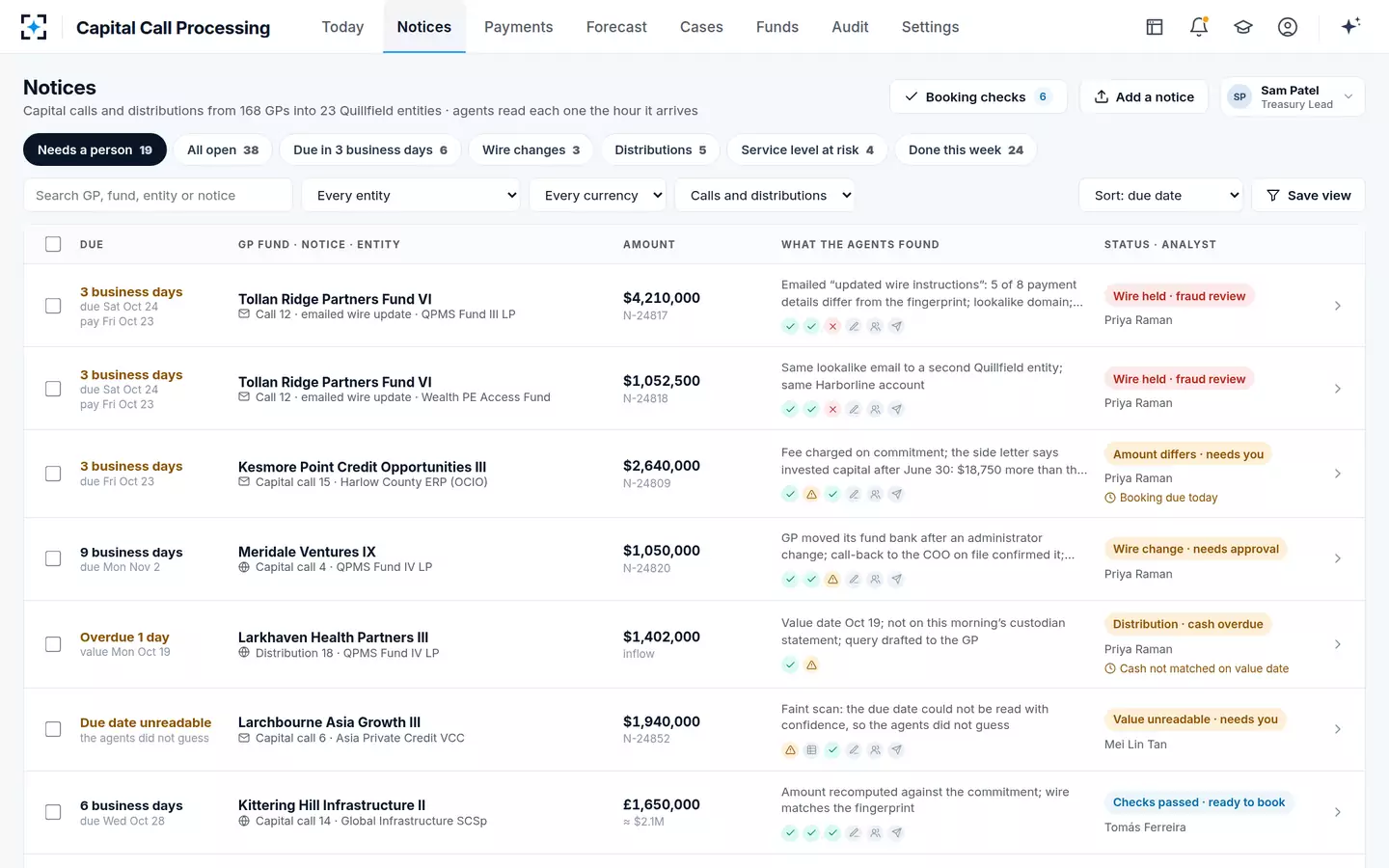
The sample shows the discipline. The Larkhaven distribution was due with value October 19; the custodian statement read at 6:02 the next morning did not show it; the row turned to "overdue" and the agents drafted a message to the GP's investor services team, which waits for the operations manager's approval before it is sent. Nothing was booked, because a booked distribution that never arrived would overstate cash and understate the unfunded commitment at the same time.
Why a distribution thread is a fraud target too
Fraud on the distribution side runs the other way: instead of asking the LP to pay a fake account, it asks the GP to pay the LP's money somewhere new. The red flag is one FinCEN lists for any payment: emailed instructions that send money to a known beneficiary but to account details different from those used before (FIN-2016-A003).
Three cases in 2026, none of them paid
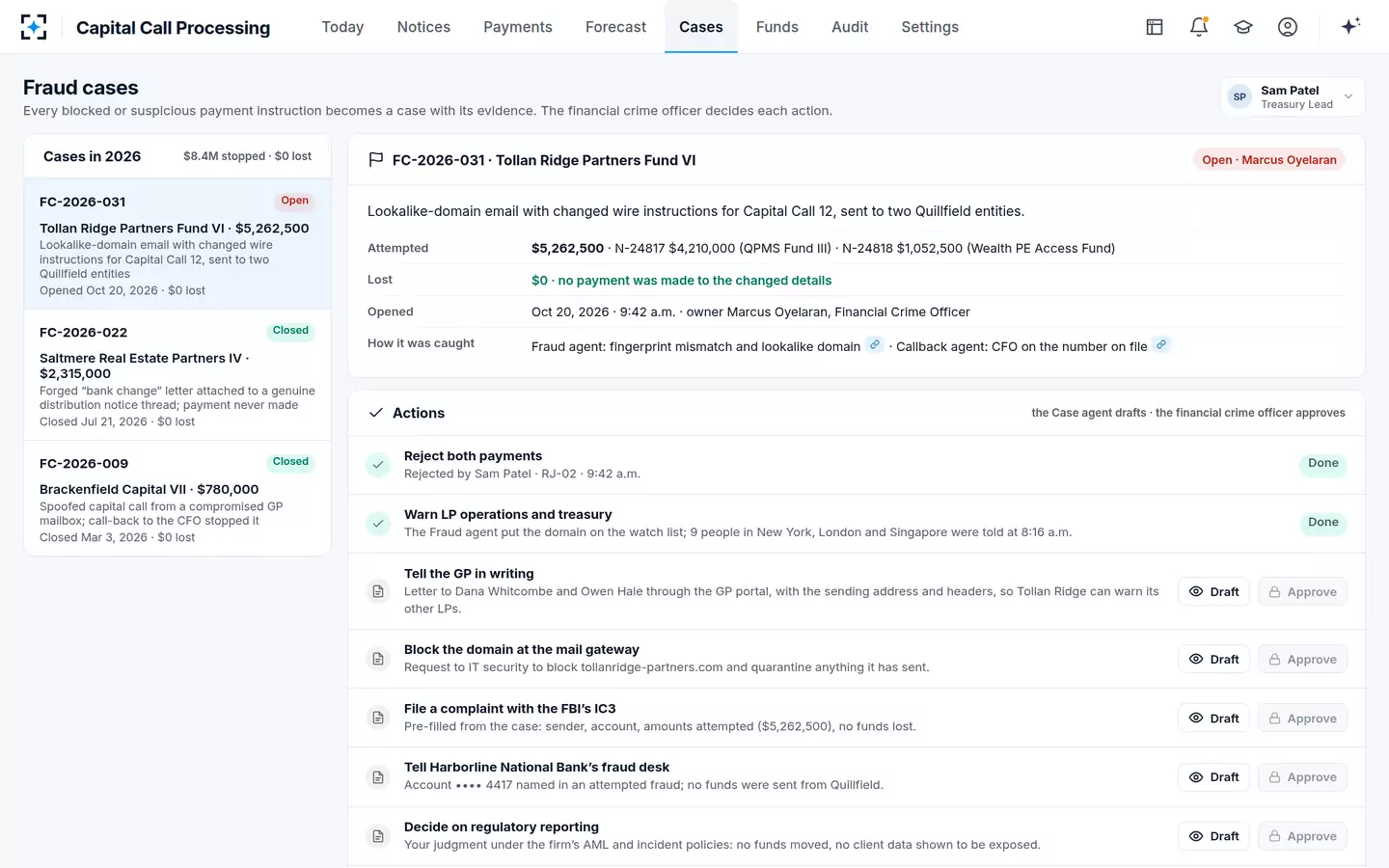
An LP's controls therefore have to cover its own outgoing messages as well as incoming notices. Bank details for distributions should change only through the GP's verified channel, confirmed by a call-back the LP itself initiates to a number it already holds, and a GP that receives a change by email should call the LP the same way. The case also explains why the solution reads every message on a notice's thread, not just the first PDF.
Where Capital Call Processing fits on the distribution side
Capital Call Processing treats a distribution as a notice like any other: the Reader agent reads it in its own language and cites each value to its page, the Booking agent proposes the entries by capital activity type and matches the cash to custodian statements on the value date, and the Forecast agent adds expected distributions to the 13-week cash view. An analyst books, the operations manager checks, and any message to a GP is drafted for a person to approve and send.
It does not calculate the GP's waterfall or the LP's taxes. It reports the character the GP gives each amount, flags where the parts do not add up or the cash has not arrived, and keeps the recallable balance current, which is the figure the next capital call will be checked against. To see the notices, matching and cases together, start from Capital Call Processing.
Questions people ask
What is a distribution notice in private equity?
It is the GP's notice to each investor of a payment from the fund: the gross amount, how it divides between return of capital, gain, income and any recallable part, the value date and the investor's updated totals. It is usually issued by the fund administrator on the GP's behalf, one per investing entity.
Does a distribution reduce my commitment?
No. The commitment stays the same; what changes is what has been contributed and returned. A distribution only increases what can be called if the agreement makes it recallable, and then by the recallable amount alone.
What is a tax distribution?
Some partnership agreements provide for distributions sized to help partners pay tax on income allocated to them before the fund has distributed that income. Whether they exist, how they are calculated and whether they are advanced against later distributions is set by each agreement, so the notice should name the clause.
Why does the cash differ from the notice?
The usual reasons are tax withheld, a netting against a capital call due on the same day, bank charges, or a currency conversion. Each should be stated on the notice; an unexplained difference is a query to the GP before the distribution is booked.
What is a net capital call?
It is a notice that offsets a distribution against a call, so the investor pays or receives only the difference. Book both legs gross, the full call and the full distribution, or the contributions and distributions to date will each be understated.
When do private equity funds start distributing?
Mostly from the middle years. In one large investor's records, only 12.9% of committed capital had been distributed by the end of year 3, and the average fund took a little under seven years to return its invested capital.